Tag Archives: Cabernet Sauvignon

DEMYSTIFYING YOUR WINE ENJOYMENT

The wine world is filled with possibilities. There are dozens of nations, hundreds of regions, thousands of appellations, tens of thousands of vignerons and wine makers, and probably hundreds of thousands of wine outlets if you count restaurants. You can add to that all of the wine knowledge, science, literature, publications, websites, bloggers, and well, it’s a lot. Can you imagine walking into a restaurant, asking for a wine from a specific label which you happen to like, and them actually having it?

How is one to make choices about what to drink and when?
wine-france-2013-lafayette-d-chateau-yquem-rack
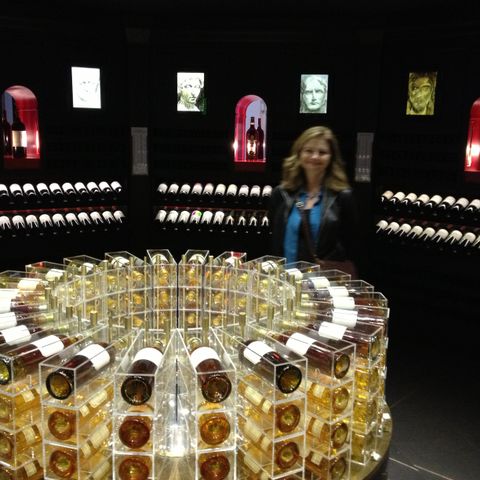
Dorianne at Gallerie Lafayette’s Chateau d’Yquem Display – Paris

And there are price points to consider, wine rating points (should I order a 91 or an 88?), sometimes snooty sommeliers and wine shop employees, various vintages of differing quality, and labels, labels, labels. And those labels are on bottles with corks, bottles with screwcaps, boxes, cans, casks, and more. And by the way, how should you store that wine?
Wine Angst
Too many options can be frustrating.

Oh, and what wines to serve with which foods? Which wines to sip alone? What kind of wine opener should I use? What other wine accessories should I buy? What temperature at which to serve the wine? In what kind of glass (or slipper)? Bubbly, sweet, dry, demi-sec? Port or late harvest? And ice wine!
wine-redness
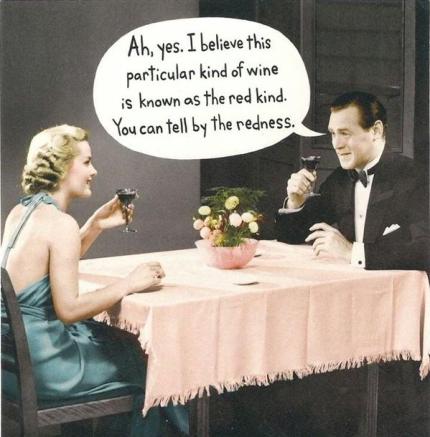
Many “experts” are just guessing.

All of this can be seen as a huge obstacle to wine enjoyment, or it can be seen as a vast array of opportunities to enjoy wine. Like much of life, it all depends on your attitude.

Entry into the world of wine is really quite easy. Wine is practically ubiquitous – it’s pretty much everywhere. I was just in eastern Ukraine and had local wine, some of which was delicious (LINK).

One way to view the many options in the wine world and all of the different types of knowledge and skill that goes into the whole process of bringing wine to your table, is to see an opportunity for almost endless exploration. You can have a different wine every day and never repeat yourself (assuming varied wine retail options in your area and online).

Another way to approach the wine world is to find a few wines that you like and stop there. I have a friend who rarely drinks anything beyond Kendall-Jackson Chardonnay; another who will only drink oaky chardonnays. Some may only drink Port wines; others Napa Cabernets.
wine-pouring-gig

You can study broadly or do a deep dive into a narrow range of wine knowledge and experience. Most will be somewhere in between the extremes, but there is a niche for everyone. The key is not to pay too much attention to what the “experts” or the marketing forces tell you as they try to steer you toward their own preferences. Find your own way – if it isn’t interesting or fun for you, you’re not doing it right.

Me, I have some favorite wines, some favorite producers, some favorite growing areas, and some favorite countries. I also like to experiment with wines I have not tried yet, but I tend to favor a known quantity with a good meal. For example, we were in Kraków, Poland recently (LINK), dining at Padre, a local Polish restaurant. I was having lamb and noted that there was a very nice French Malbec from Cahors on the list. Knowing how a rich, inky Cahors Malbec would go with lamb made my decision easy – so I passed on some Polish wines. I picked a favorite over the chance to explore – that time. At other times, I will make a different decision. But that is me. You may well do something different.
2015-12-29 14.10.57
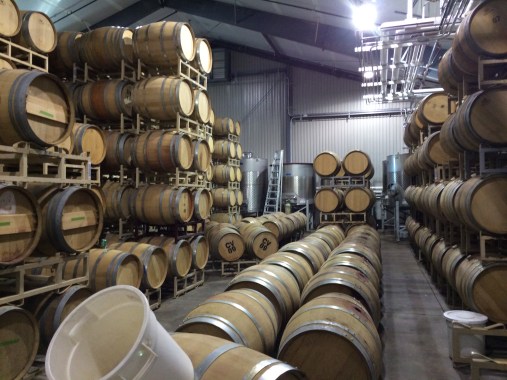
Visiting Wineries can be both Fun and Educational.

My point is that the bulk of the effort in learning about wine should go into learning what YOU like about it. Then go from there. You may become an expert in Cabernet Sauvignons from the east side of Paso Robles; or you may be the go-to person for advice on Hungarian reds. Or, you may be that person who always drinks Kendall-Jackson Chardonnay.

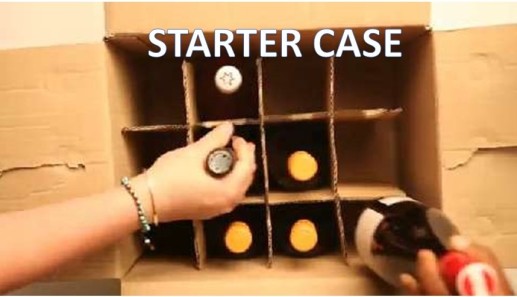
So, if you are new to wine, consider building yourself a starter case (LINK) to see what you like. Let your local wine retailer know your preferences, including if you like to try new things or stick close to what you already know. If you travel, check out the local wine scene, either in town – wine bars, urban wineries and restaurants; or head out into the local wine country to taste and explore. In an airport? Stop at Vino Volo and try a wine that you’ve never had before. Sign up for an online service like WTSO.com (LINK) and opt for something new to you.
Starter Case Slide
A Starter Case is a great way to find out what wines you like.

Maybe you are a long-time wine consumer who is ready to spread your wings a bit. You might begin with your local wine shop – tell them what you like and ask them how you can explore some new wines that have a similar profile. Go to a Greek restaurant with good Greek wines on the wine list, and try some if that is new to you. See if there are some small producers of wines in your local area and give them a try. There are lots of possibilities. Try not to be intimidated by the experts or by too many choices. Take your time and stick to what you like – and maybe explore around the edges.

The world of wine is literally at your feet. Enjoy!

wine-young-lover

Text Copyright 2016 – Jim Lockard


THE KIEV WINE SCENE

We spent 12 days in Ukraine earlier in the month, mostly to attend a conference. But the first long weekend was in Kiev, the capital city of 4.5 million along the Dniepper RiverKiev is in a deep economic funk, although, as usual, there are some who are doing quite well. Most restaurants that have a wine list have a few Ukrainian wines along with a couple of selections from Italy, France, and/or Spain. Our hosts had laid in a few cases of inexpensive Spanish wine for our stay.

The highlight of our time in Kiev, food and wine-wise, was a visit to the Kanapa Restaurant, on Andreevskiy Spusk, 19. Billed as featuring “molecular” Ukrainian cuisine, it is more about very good food served beautifully – most does not fit the description of molecular. That said, the place was very good. There is both a wine steward and a cheese steward on the premises.


There were five in our party, so we had three bottles of wine, plus digestifs. Two of the bottles were Ukrainian and the middle bottle a Barbera from Italy. Also, when he learned that I was a wine blogger, the steward brought three Ukrainian wines to taste – including a nice rosè – and the great Ukrainian Pinot Noir mentioned below.

The Ukrainian Cabernet was very light and very young. The Barbera D’Alba from Pelissero, was average – nothing special (I have a theory about western European wines shipped to eastern Europe – they rarely are very good). But the Ukrainian Pinot Noir was something special. Smooth, with red fruit, a hint of minerality, and medium tannins, the wine could have been from Burgundy (in the middle of the pack there, but still . . . ). Had we tried this one first, we would have stayed with it.

There are some higher end restaurants in Kiev with good wine lists, but overall it is not a wine destination. Perhaps as their wine making skills improve and the climate warms a bit, that will change.

THE EPICENTER OF WINE CULTURE IN MÀLAGA, SPAIN

I went to Los Patios de Beatas on Calle Beatas the other evening to check out the wine scene there. It was recommended by Kelly Kannisto of Tannin Trail Tours (LINK) (LINK TO PREVIOUS POST), when I contacted him about recommendations for wine experiences in Màlaga.

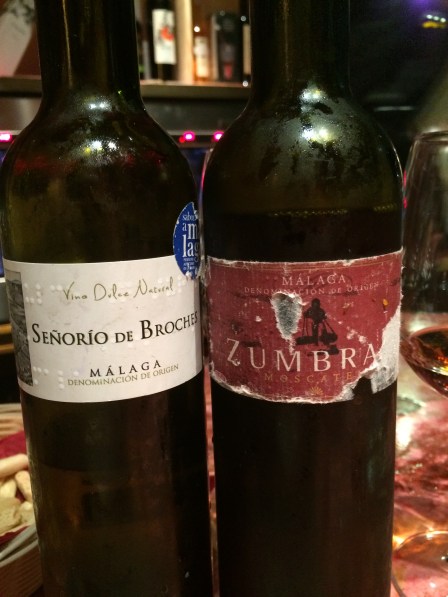
Although Màlaga is a wine region, the wines made here are generally sweet. The great dry wines of Spain are made elsewhere.

Los Patios de Beatas is a combination restaurant, tapas bar, wine tasting room, wine retailer, and event location. It is beautifully appointed, has indoor and outdoor seating, and a good selection of wines, almost all from Spain, on sale. Since being in Màlaga, we have had some difficulty finding a good wine shop.

I looked around the space a bit, and asked if I could do a tasting. Àngel, the head waiter told me to sit anywhere in the tasting room/tapas bar area. He and Christina made sure that I was well attended to, even though there were other customers – the exterior seating was full. The main restaurant is staffed separately.

2016-07-20 21.00.34

There is a Enoteca Machine that dispenses wines and keeps them at temperature. The wine list had over 15 tintos (reds) and half a dozen blancos (whites) available by the glass. Eight of the reds were in the Enoteca. I started with a 2005 Tilenos Pagos de Posada, 100% Mencia from D.O. Bierzo (LINK) in northwestern Spain. This wine has a great minerality with hints of dark fruit, chocolate, and leather. Very nice. It retails for 33€ or about $36. Another great value from Spain.

Next, I tried a 2009 Alma de Luzon, Monastrell blend of 70% Monastrell, 20% Cabernet Sauvignon, and 10% Syrah. This wine is from D.O. Jumilla (LINK), in southern Spain not far from Valencia, where the Monastrell Grape is very popular. This wine was rich and chewy, with medium tannins and a smooth finish. It retails for 36€ or about $39.

Next, Àngel brought four bottles to the table – all chilled. Three were Sherry, and one was a local Màlaga sweet wine. There were two sweet Sherries and one dry Sherry from D.O. Jerez (LINK) (LINK TO PREVIOUS POST), where Dorianne and I visited last year. I tasted these side by side while waiting for my tapas to arrive.

The Màlaga sweet wine, a Trajinero (LINK), made from 100% Pedro Ximénez grapes and fortified, was semi-sweet, with a nutty flavor and a nice smooth finish. The stand-out was the Fernando de Castilla Antique Oloroso Jerez Sherry (LINK), probably the best dry Sherry I have ever tasted. Over 20 years in the barrel (they rotate Sherries through a series of barrels so that each vintage is similar – taking some out, leaving some in, and adding the more recent vintage), this wine was smooth, with traces of coconut, vanilla and pear. Really special. This wine retails for 22€, or about $24 per 500ml bottle.

Then, my two tapa arrived. The first, a cod in a sauce that include coconut milk, was an amazing sensation of flavor. The second, pork belly, slow cooked and then the fat removed and a slice of pork chorizo inserted, accompanied by fennel and an apple puree. Amazing! The kitchen here is wonderfully creative and executes that creativity beautifully.

To accompany those, Àngel suggested a 2008 Mauro “Sin D.O.” from Castilla y Leon, made from 88% Tempranillo and 12% Syrah. The wine was a decent pairing with the cod (the coconut made it tricky), but perfect for the pork belly.

Then, to round of a great experience, Àngel brought out two local digestifs. They retail for about 7€ for a ½ bottle. Both were nice, if not exceptional.

2016-07-20 22.03.57

My tab for the whole thing was 50€. I know that a couple of things were comped. One of the more expensive evenings I’ve had in Màlaga, but a bargain anywhere outside of Spain.

So if you find yourself in Màlaga, find Los Patios de Beatas and have a great wine experience. I was solo on this trip, as Dorianne is out of town – so I will be taking her there when she returns.

As always, your comments on all things Spanish and/or wine are welcome.


Copyright 2016 – Jim Lockard

SPANISH WINE IN ANDALUCIA’S RONDA

Dorianne and I are staying in Málaga and Granada for six weeks. The other day, we took a tour of the beautiful white town, Ronda. We were going to go there anyway, but found a local tour company that combines your tour of the town with stops at two local wineries. All in all, a very nice day.

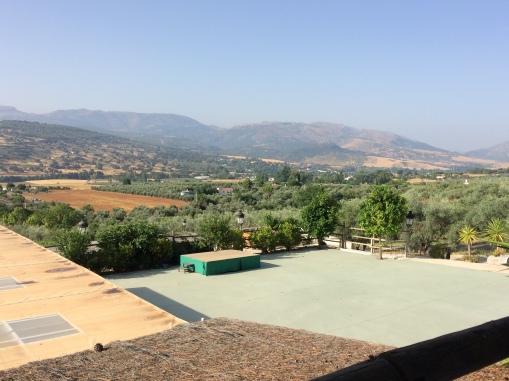
Southern Spain’s Andalucía region is an expansive area the borders the Mediterranean Sea on the south and east, Portugal on the west, and central Spain on the north. It includes cities like Seville, Granada, Málaga, Cordoba, Cadiz, and a host of other smaller towns and villages. The topography and climate are very much like southern California – warm and dry inland, slightly cooler and more humid near the sea. It is the home of millions of olive trees – and, where you can grow olives, you can usually grow grapes.

2016-07-08 09.42.24
Andalucian Valley

The wines of Andalucia are often sweet and/or fortified, such as the famous Sherry wines of the area around Jerez (LINK). Málaga is also known for sweet red wines (vino tinto dulce). But elsewhere, small producers are making dry wines out of unexpected varietals in the midst of olive country.

Our first stop was at Bodega Joaquín Fernández (LINK), just 3km north of Ronda. The bodega is located on a sloped property, and there are five hectares under cultivation, with an additional hectare about a mile away. They produce about 5,000 cases per year. Also, there is a rental unit where you can stay right at the vineyard.

2016-07-08 09.58.01
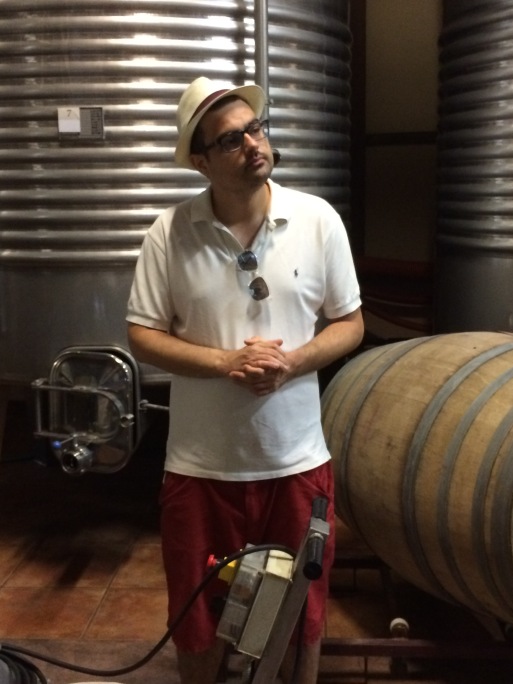
Moises Fernandez

Our tour was led by Moises Fernández, the son of the owner. He gave a very thorough tour of the vineyard and winemaking operation, with great detail on their organic processes. Only red varietals are grown at the bodega – Cabernet Sauvignon, Merlot (pronounced Mer-LOT here), Syrah (pronounced SEE-rak), and Garnacha.  A white wine and a rosé (Rosado) made from Merlot are signature wines here along with some red blends.

All wines are fermented in large stainless steel tanks – a fermentation for alcohol, and then a malolactic fermentation. The wines are then stored in oak barrelsFrench and American, for periods from 3 months to two years. This is regulated by the local D.O. Malaga Hills/Mountain. Another regulation is that Tempranillo, the most popular red wine grape of Spain, cannot be grown here. That is why local wine makers rely on Bordeaux and Rhône varietals. In keeping with their organic philosophy, then do not use foils on their wine bottles. Instead, they seal them with a thin coating of beeswax.

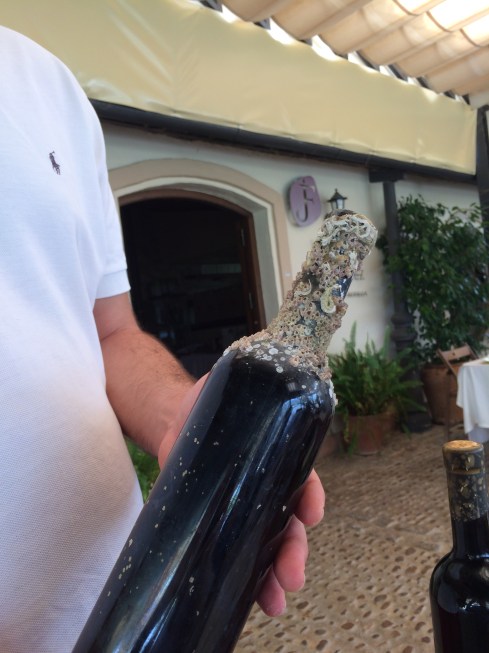
Of interest, they have been experimenting with storing bottled wine under water. Here is a sample.

2016-07-08 11.00.56

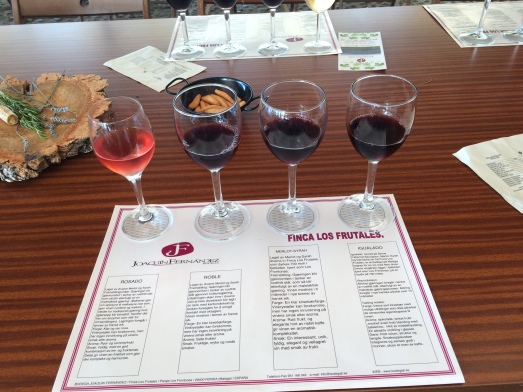
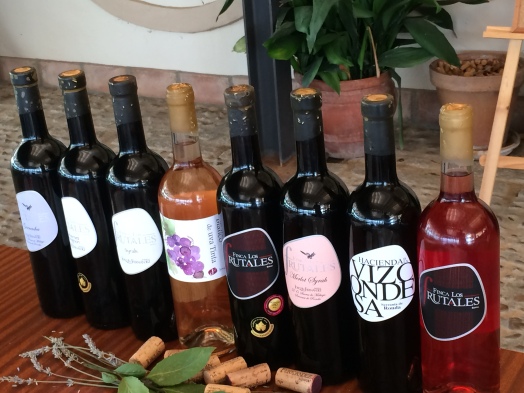
After the tour, we had a tasting and tapas in the bodega’s outdoor tasting room that overlooks the vines. We tasted all of the wines produced – six in total. Dorianne and I were both impressed with the craftsmanship here – the wines were uniformly well-balanced, and all were very enjoyable. Two favorites were the 2015 Blanco de Uva Tinta – a white Merlot, and the 2014 Garnacha, a blend of 90% Garnacha & 10% Cabernet Sauvignon. Their wines sell in the 11€ to 15€ range – great values.

2016-07-08 10.22.43

2016-07-08 10.22.50
The line up – note the beeswax seals.

Next, we had a couple of hours to tour Ronda – a beautiful city bisected by a river canyon that runs about 300 feet deep or more. If you visit Andalucía, Ronda should be on your list of places to visit. But back to the wine.

Our second stop would include lunch. We were driven a few kilometers out of town to a small bodega called Bodega Garcia Hildago, a small producer – about 1,000 cases annually. Here, we received a tour by Miguel Hildago, the owner and then a four-course lunch with some of his wines. His wife is an amazing cook, but she was away for the day, so he served the food that she had prepared earlier at a table on the patio of their beautiful home.

Miguel grows the same varietals as Bodega Joaquín Fernández, on about 2 hectares on his property. A few of his wines are in local restaurants, but otherwise, you have to visit the bodega to enjoy them. He makes four wines using organic techniques in his vineyard.

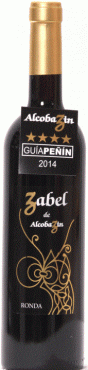
We particularly enjoyed his 2014 Zabel de Alcobazin, a blend of Cabernet Sauvignon, Merlot, and Syrah. It was rich, full bodied, and had a nice hint of minerality to it. There was a good tannin structure, so it should age well. It sells for 14€.

ZABEL OK_600x900

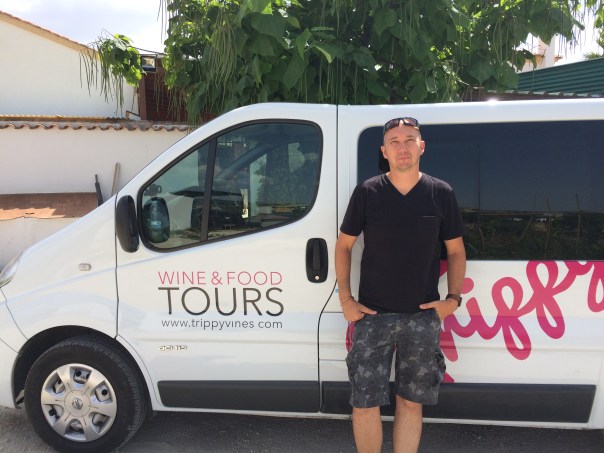
Our tour company, Tannin Trail (LINK), offered a great experience. The van was comfortable (only two couples on the tour, which may have been a factor), the guide, Kelly, who originates from South Africa and has lived in Spain for eight years, was very knowledgeable about the local viniculture and the wines of the region, and the two bodega stops were interesting and fun. The tour company is in the process of expanding their operations to the Rioja Region as well, and have been re-branding from Trippy Vines to Tannin Trail during that time. Their Tripadvisor.com ratings are also excellent (LINK).

2016-07-08 16.44.47

It was good to get out and visit some of the wine makers who are making dry wines in this area of mostly sweet wine production. To be sure, Andalucía has a lot to offer.


Copyright 2016 – Jim Lockard

WINE HISTORY IN DOWNTOWN LA?

On a trip to Olvera Street (LINK) (LINK) in downtown Los Angeles, across from the iconic Union Station, one finds not only links to the earliest settlements in the area and its Hispanic heritage, but vestiges of some of the earliest California wine production as well.

Wine was introduced into California by the Franciscans in the late 18th Century. By the early 1800s, there were a number of vineyards around the Los Angeles pueblo, where Olvera Street sits. Olvera Street was originally called Calle de las Vignas or Vine Street, because of the many wineries there.

2016-06-07 11.35.19

Later, French immigrants began to make wine using cuttings of Cabernet Sauvignon and Sauvignon Blanc from France in the Los Angeles area and shipping it to northern California. Later, Italian immigrants joined the party on what is now Olvera Street.

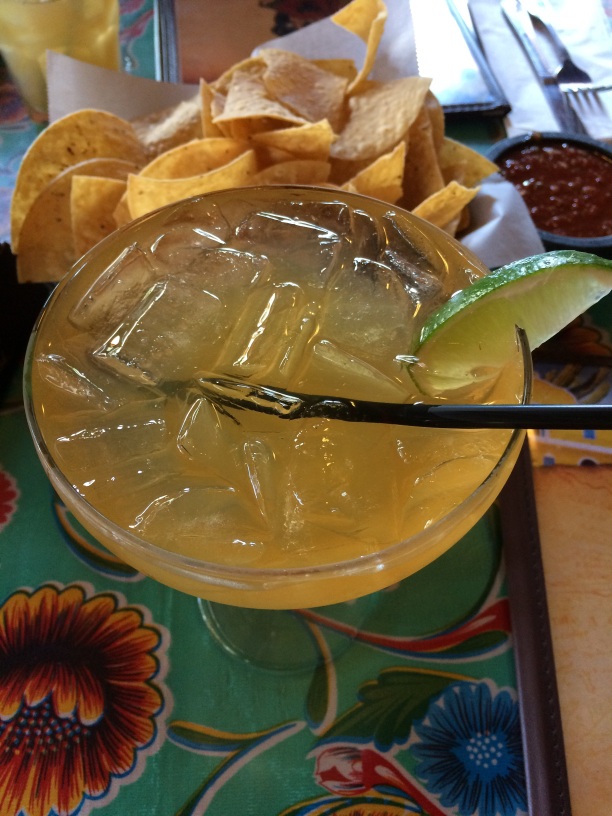
Several of the restaurants on the street are housed in former wineries, including El Paseo Inn (LINK), where Dorianne and I had lunch. See the photo of the sign over the door. But, alas, there was no wine in sight, so we settled for an appropriate local beverage – a Cadillac Margarita.

2016-06-07 11.53.57.jpg

2016-06-07 11.59.13

Nearby is the Avila Adobe (LINK), where two large grapevines grow. Over 150 years old, these vines were recently determined to be a hybrid of a native California grape and a European grape. They are related to the Vina Madre, or the mother grape, at the San Gabriel Mission (LINK).


So, winemaking in California pre-dates the Napa-Sonoma area by quite a bit. It was fun to explore the historic area of downtown LA, and then to go home and have a glass or two of California wine.

Copyright 2016 – Jim Lockard

A DAY IN NORTHERN SANTA BARBARA COUNTY – THREE WINERIES

I love the Santa Barbara County AVAs. Not only do they produce great wines, have lovely scenery, and a host of great winemakers and tasting rooms; they are easily accessible from the Los Angeles area.

On Tuesday, Dorianne and I were joined by Mary Stec and Richard Clark for a day trip to Santa Barbara County (LINK). We visited three wineries and had lunch at Industrial Eats in Buellton. Mary is a home chef and runs a cooking school & is a weight-loss coach (LINK) (LINK); Richard is the winemaker for the Conejo Valley Wine Co-op (LINK to previous post).

Our plan was to visit two wineries in the Santa Rita Hills AVA (LINK), have lunch, then visit two wineries in the northern section Stana Ynez Valley AVA (LINK), north of Los Olivos. The Santa Rita Hills are known for Burgundian varietalsChardonnay and Pinot Noir; the northern Santa Ynez Valley is Rhône varietals – especially Syrah, but also Mouvedre, Roussanne, Marsanne, Viognier, and Cinsault.

A late start and a few other things shifted out plans a bit, but we made the most of a magnificent sunny day in the 80’s.

Our first stop was Babcock Winery (LINK) along Rt. 246 near Lompoc. Babcock has been around for a while and they make some excellent wines, with Pinot Noir leading the way. Our tasting room host Jamie showed the four of us through two different tastings, one featuring their estate fruit, the other wines sourced from elsewhere in the Santa Rita Hills AVA. Babcock’s new and updated tasting room is filled with their wines mixed with places to sit, antiques and other items, some of which are for sale.

Babcock’s strongest suit is their Pinot Noir. They produce several estate wines and a blend of several vineyards. All of them drink well and show excellent craftsmanship, balance, and quality. We purchased a bottle of their 2013 Radical Pinot Noir, which showed the most character (to us) and will age well. We will be laying this one down for a while. Their Cabernet Sauvignon is notable as well, as is their Backroads Red BlendBabcock offers tours and you can have events there. It is a great winery to visit.

The next stop was lunch at the wonderful Industrial Eats (LINK) in the warehouse area of Buellton (of “Sideways” fame). This artisanal eatery also features a number of local wines on tap for $9 a glass, beer, cider, and more. You eat at common tables and can watch the pizza maker use the brick ovens.

2016-04-19 13.03.39
Menu Wall at Industrial Eats

As we were leaving the restaurant, we noted that the tasting room next door, Alma Rosa, showed the proprietors to be Thekla and Richard Sanford, well-known pioneers of the Santa Rita Hills. Richard is in the Vintner’s Hall of Fame. It turns out that I did not know that Alma Rosa was the Sanfords’ (relatively) new wine operation. So, our plans changed and in we went.

Alma Rosa Winery & Vineyards (LINK) has been around since 2005. Like most in the Santa Rita Hills AVA, they specialize in Pinot Noir and Chardonnay, also producing Pinot Gris, Pinot Blanc, and a Pinot Noir-Vin Gris Rosé. They have two levels of tastings, so each couple had one of them. The wines here are uniformly well-crafted and each has unique characteristics. There are five Pinot Noirs (three are single vineyard/clone) and two each of the Chardonnays, Pinot Gris, and Pinot Blancs. We purchased some of the La Encantada Vineyard Pinot Gris and the Clone 667 La Encantada Vineyard Pinot Noir. We would have purchased more, but our wine locker is nearly full (really).

2016-04-19 14.01.41
The Tasting Crew at Alma Rosa
2016-04-19 14.20.14
Rena of Alma Rosa Wine

The tasting room staff included Rena, who is both knowledgeable about the wines and the process and very outgoing. This small wine tasting room is really lovely (and you can have food sent over from Industrial Eats to boot!).

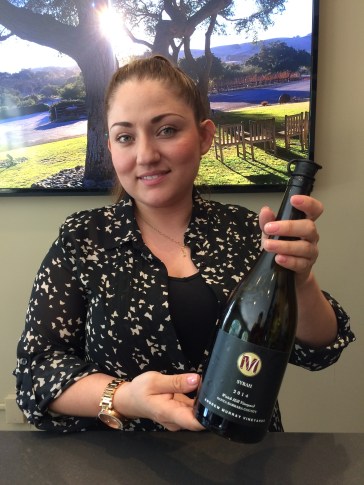
Next, it was on up the 101 Freeway to Zaca Mesa Road near Los Olivos. Our destination was Andrew Murray Wines (LINK) and their new facility at the former Curtis Winery which was purchased and added to the Andrew Murray operation a few years ago. Long known as the producer of the best Syrahs along the Central Coast, Andrew Murray has expanded into some additional Rhône varietals plus a few others since taking over Curtis. Our tasting was a reminder that these are truly exceptional wines. Highlights of the tasting were, of course, the Syrahs, especially the 2013 Thompson Vineyard Syrah, and the 2014 Watch Hill Vineyard Syrah. Both had nicely balanced fruit and minerality, a beautiful bouquet, and a smooth finish.

Also notable were the 2014 Estate Grown Cinsault, and the 2013 Curtis Vineyard Mourvèdre. Both were very well crafted and balanced with minerality and fruit that alternately competed for your attention. We bought some of the Cinsault. And finally, the 2015 Espérance Rosè, a light and crisp rosé made of nearly 100% Cinsault. It results in a surprising rich and flavorful rosé reminiscent of the wines of the Tavel A.O.P. (LINK to previous post) in the Rhône Valley. This is one of the best rosés I have had in some time. Richard and I took a case of this beauty home. Well – it was on sale and I will find the space!

2016-04-19 15.01.14

That was our day – we headed home with wine in the trunk and some great memories that will be rekindled each time we open a bottle.

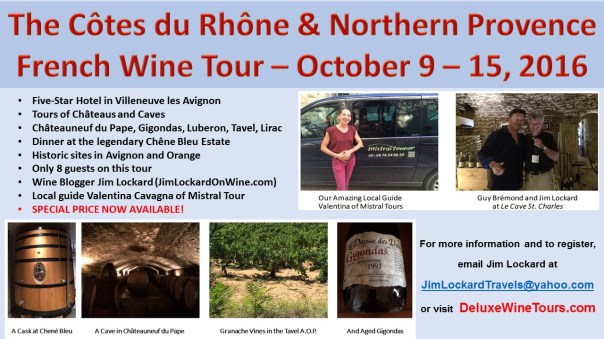
And a reminder – our amazing Wine Tour of the southern Rhône Valley and Provence (including Tavel) still has some space left. Visit (LINK – Deluxe Wine Tours) to get all the information and to register.

Wine Tour Online Image 1

Copyright 2016 – Jim Lockard

BRAND TASTING – LOS VASCOS WINES

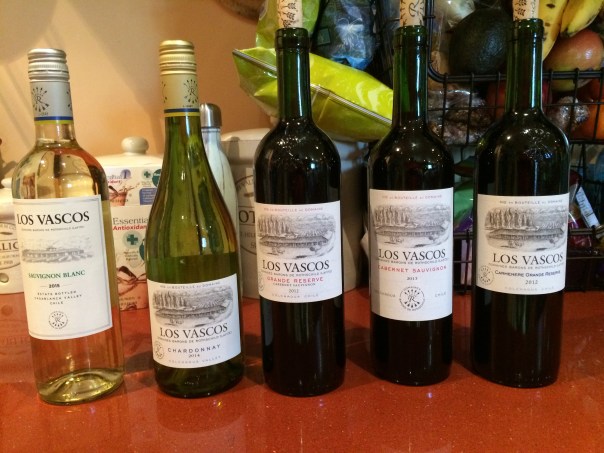
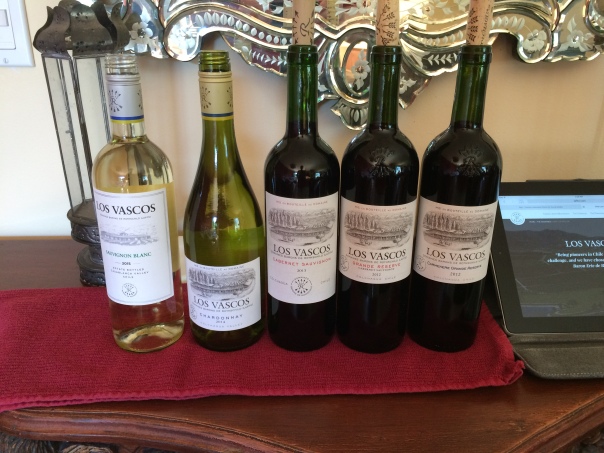
A while back, I purchased five current offerings of Los Vascos wines (LINK) from Wine.com (LINK) to do a tasting. Los Vascos is the Domaines Barons de Rothschild (Lafite) holdings (since 1988) in the Peralillo area of the Colchagua province of Northern Chile. I have blogged about Los Vascos Cabernet Sauvignon before (LINK).

The wines were:

2015 Sauvigon Blanc, retail $14.00

2014 Chardonnay, retail $8.99

2014 Cabernet Sauvignon, retail $8.99

2012 Cabernet Sauvignon Grand Reserve, retail $20.00

2012 Carmenere Grand Reserve, retail $20.00

I did not get the rosé (90% Cabernet Sauvignon, 10% Syrah, retail $11.99), or the LE DIX (retail $65.00), which is their highest-end Cabernet which were both available at the site, but are generally not available locally.

2016-04-17 14.59.08

2016-04-17 15.13.11
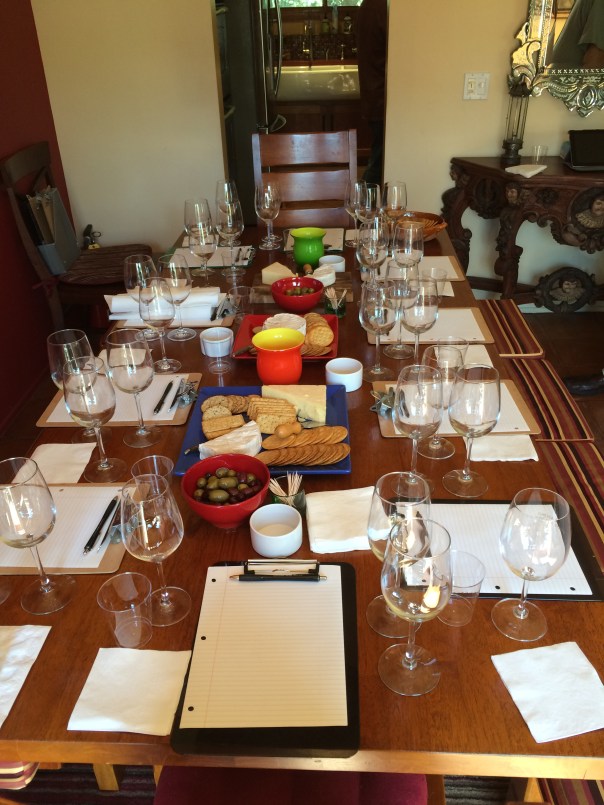
The table is set for the tasting. And note those fancy spit-buckets!

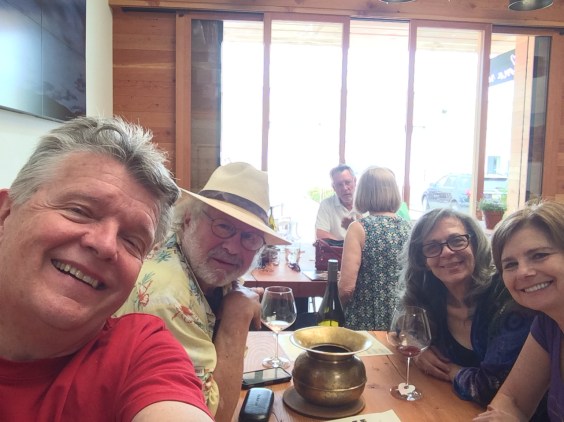
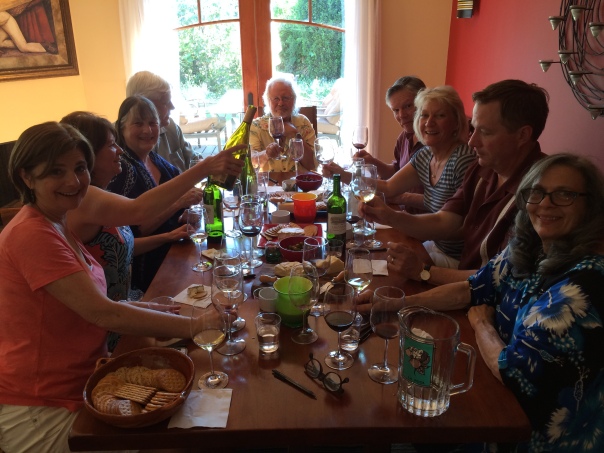
For the tasting, ten of us gathered at the home of Mary Stec and Richard Clark. Richard is the winemaker for the Conejo Valley Wine Co-op (LINK). Those joining Dorianne, Richard, Mary and me were Steven and Diane Brabant, Brad Kieffer and Karen Oxrider, and Doug and Corrine Draper. All of these folks know wine very well.

2016-04-17 16.21.42
The Tasting Team hard at work at mid-tasting.

The tasting of these wines, which fall into the Everyday Wine category, was to get a sense of the product line of a South American Producer who has a couple of big sellers in the U.S. market, but also has some other wines that are a bit harder to find, but are around. I judged the two wines not included as too difficult to find in retail stores.

The red wines were opened about an hour before the tasting. All of the wines were kept at about 50 degrees Fahrenheit in Richard Clark’s wine cold room, where they have been for about 6 weeks. We served a variety of cheeses, crackers and olives with the tasting, which did affect how the wines tasted. Everyone tasted each wine and made personal notes before we all discussed the wine. The wines were tasted individually, although the Cabernets were poured at the same time to allow for comparison.

2016-04-17 15.17.26
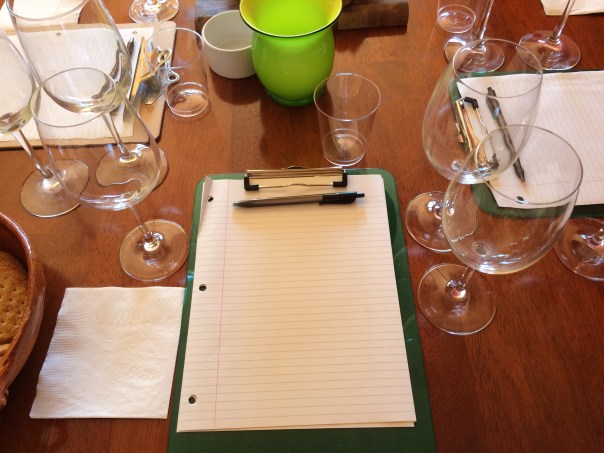
My seat at the table.

The tasting notes and the conversations revealed what you might expect – there was some agreement and some disagreement about each of the wines. There was a rage of opinions as to the presence of tannins in the Reserve Cabernet Sauvignon, for example. Almost everyone noted the presence of grapefruit-citrus in the Sauvignon Blanc, but not everyone. Some found the Grand Reserve Carmenere very smooth and a couple of people found it to be harsh.

Some comments about each wine, with an attempt to capture the essence of the notes and comments from the group for each:

2015 Sauvignon Blanc: light, citrus/grapefruit with a hint of tangerine, lemon grass, high acid, crisp, New Zealand style, mineral finish; better with food than alone.

2014 Chardonnay: Minimal nose, hints of butter, crisp, light, hints of nuts, minerality, more like a Pinot Gris, pear, apricot, neutral oak, not much of a finish; improved with the cheese.

2014 Cabernet Sauvignon: Nose red fruit, alcohol, ashes, acid; thin, minerals, hint of cherry (minimal fruit), slightly astringent finish; also improved with food.

2012 Grand Reserve Cabernet Sauvignon: Inky red color; plum, ripe fruit, cassis on the nose; balanced tannin, acid, and fruit (one comment too much tannin, needs longer decanting); nice finish; needs some time – 2 to 3 years; more substantive than the 2014 Cab, but still a bit thin for a Cabernet Sauvignon. Clearly a superior wine to the 2014 (with one dissenting opinion on that).

2012 Grand Reserve Carmenere: Dark, inky color; rich bouquet of black fruit, green pepper, cloves and spice, tobacco, earthy soil on the nose; nicely balanced with light tannins, hints of currant, prune and figs; smooth finish; approachable wine; described as “smooth” and “harsh”; “pick of the litter”; would be great with lamb.

2016-04-17 15.16.54.jpg
The line-up of wines.

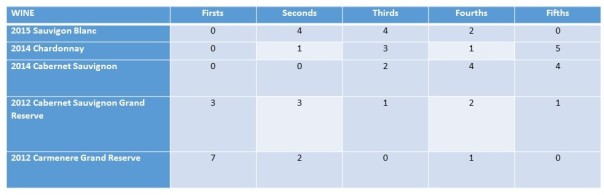
I asked each person to rate the five wines from 1 through 5 in terms of their impressions of the realizing this has an apples to oranges quality, but aiming at which of these would you be most likely to purchase yourself?):

1 Table

The upshot – all of these wines are drinkable and have both positive qualities and drawbacks that are largely subjective. Los Vascos wines are reliable go-tos for everyday drinking. If your budget calls for the inexpensive Chardonnay or Cabernet Sauvignon, go for those – even though the Chardonnay was not well reviewed by the group, several people liked it very much – at $9.00 or so, you can find out for yourself; if you can upscale a bit to the Grand Reserves, you will find a good increase in value at the higher price-point. The Sauvignon Blanc is at a good price-point if you enjoy a citrusy New Zealand-style, and grab that Grand Reserve Carmenere if you can find it.

Two of us (Steven and I) who had first encountered the Los Vascos Cabernet Sauvignon in the 1980’s and early 1990’s noted that it seems to be a very different wine than in those days. A reading of the website (LINK) bears this out, as extensive replanting has occurred since that time. And, both of us are drinking wines at higher price-points today, which may also be a significant factor in our impressions. Perhaps we have changed along with the wine.

Comments about your experience with these wines is, of course, most welcome.


Copyright 2016 – Jim Lockard


APPLEGATE VALLY AVA – TWO WINERIES

Yesterday, several of us went to the Applegate Valley AVA area in southern Oregon to taste some wines. This area, just to the west of Ashland, is in the foothills of the Coastal Range near the Rogue River Siskiyou National Forest. Beautiful country, a growing number of  wineries in the area , but you travel a bit of a distance to get from winery to winery.

The AVA does not have a signature varietal. There are a number of micro-climates present, soil variations, and annual rainfall amounts vary from around 20 to 40 inches in different parts of the AVA. So you have Italian varietals like Sangiovese, Spanish Tempranillo, Rhône Syrah, Rousanne and Marsanne, plus Pinot Noir, Cabernet Franc, Cabernet Sauvignon and others.

We wanted to taste some of the best of the area, so our local friends took us to Cowhorn Vineyard and Garden (LINK) and to Red Lily Winery both off of Route 238 southwest of the quaint town of Jacksonville.

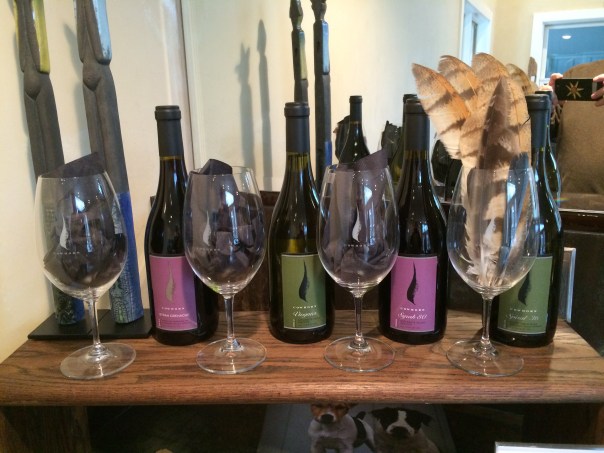
Cowhorn represents a number of good things about growing and making wine. First of all, the quality of the wines is simply superb. Producing a total of 2300 cases of Rhône varietals – Grenanche, Mouvedre, Syrah, ViognierRousanne and Marsanne, the owners and winemakersBill and Barbara Steele, use state-of-the-art biodynamic techniques. The wines that we tasted (and we didn’t even get to taste the reserve wines, which are spoken for by the wine club – hint) were beautifully crafted, balanced, and tasted much like wines we have had in the Rhône Valley. Their wines consistently score in the low to mid 90’s from such reviewers as Wine Spectator, Wine Enthusiast and Robert Parker.

The 2012 Syrah was beautifully crafted and needs a couple more years in the bottle to reach it’s peak. The whites – a Spiral 36 Blend of ViognierRousanne and Marsanne  is delicious and a bargain. The 100% Viognier was a revelation – a beautiful mouth feel with apple, pear, and other green fruit, some minerality, and a very smooth finish. The Marsanne/Rousanne 50/50 was also quite good – all of the whites could have been from top Rhône Valley producers. We did take some of these home with us.

2016-03-11 13.37.55
Some of Cowhorn’s Wines
2016-03-11 14.09.03
Jim & Bill Steele

Second, they are operating a highly eco-sensitive and sustainable operation. Under construction is a new tasting room that is being built to the exacting standards of  the International Living Future Institute (ILFI) (LINK), meaning that the building will add as much as it takes from the environment at every step of the building and operating process. While we were there, a beautiful table made from recovered wood and custom-designed for wine tasting by Barbara Steele, was delivered and set up. Here are a few photos.

If you can get your hands on some Cowhorn wines, do it.

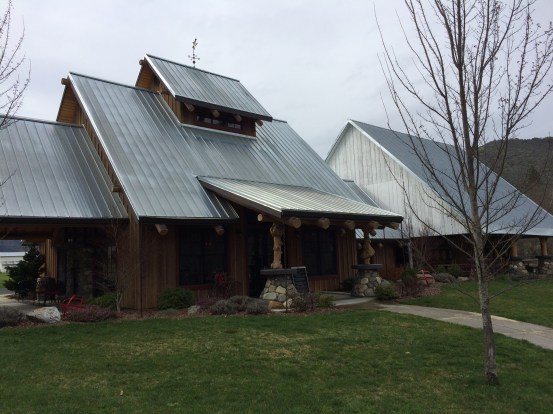
Our next stop, after getting a bit lost on the scenic back roads of the area, was Red Lily Vineyards (LINK), a beautiful property along the roaring Applegate River. Here, Tempranillo is king. Les and Rachel Martin own and operate the vineyard and winery. The tasting room building is beautifully designed and contains facilities for special events. They also have a kitchen that produces some very good food. We had lunch here, accompanied by some of the Red Lily Wines.

2016-03-11 15.01.28
Red Lilly Tasting Room

The wines that we tasted were primarily Tempranillo, some mixed with Cabernet Sauvignon. The 100% 2012 Tempranillo in the tasting was the best of that group. I had a glass of a 2006 100% Tempranillo that showed how well these wines age. Great tannin structure, well balanced between dark red fruit and minerality. A beautiful wine (and, at $51, the most expensive). They also sell some wines made in Spain to compliment the Spanish varietals grown here.

The wine tastings are available poured into test tubes and put in a rack that you can pour yourself when you are ready. There are tasting notes for each wine. You can also have the friendly and knowledgeable tasting room staff pour each taste for you. The Red Lily wines are very well crafted, not up to the level of the Cowhorn, which would be exceptional in any AVA or appellation, but very drinkable and reasonably priced.

Both of these wineries were a joy to visit, with the usual great people that one tends to meet in the wine industry. If you are visiting southern Oregon soon, make it a point to check these two out.

We will be doing some more exploration on this visit – so watch this space.

applegate_map11

Copyright 2016 – Jim Lockard


PREVIEW – LOS VASCOS WINE TASTING

In a few days (OK – in a month or so – we didn’t get this done before leaving for Oregon for five weeks), I will assemble a panel to taste the range of Los Vascos wines from Chile. We do not have every wine that they produce, but five will do for this purpose.


I have always listed the Los Vascos Cabernet Sauvignon as one of my go-to everyday red wines. Now we will extend out a bit an add the 2012 Grand Reserve Cabernet, the 2012 Carmenere Grand Reserve, the 2014 Chardonnay, and the 2015 Sauvignon Blanc.

Watch this space for the tasting report.

PASO ROBLES TRIP, PART 2.TABLAS CREEK VINEYARD AND CALCAREOUS WINERY

As I noted in my last post (LINK), Dorianne and I went to Paso Robles  along California’s Central Coast region for three nights and two days of wine tasting with her sister and brother-in-law, Debby and Mike. Our daughter, Grace, joined us on the first day of wine tasting, but the four of us were on our own as we set out on Tuesday morning. We decided to keep it to two wineries to allow time for a nature walk later in the day.

Our first stop on the west side was Tablas Creek Vineyards (LINK) in the Adelaida AVA of west Paso Robles. Long known for their expertise in Rhône varietalsTablas Creek has a Rhône River partner, Chateau Beaucastel (LINK) in France. You could spend months studying the Tablas Creek history, viticulture, wine making techniques, and tasting their wines (maybe a lifetime on that), but we only had a couple of hours.

2015-12-29 11.38.53

From the website (LINK) with embedded links:

Tablas Creek Vineyard is the result of a decades-long friendship between the Perrin family of Château de Beaucastel and Robert Haas, longtime importer and founder of Vineyard Brands. The families created a partnership in 1985 and in 1989 purchased a 120-acre property in the hilly Las Tablas district of west Paso Robles for its similarities to Châteauneuf du Pape: limestone soils, a favorable climate, and rugged terrain.

The partners imported the traditional varietals grown on the Perrins’ celebrated estate, including Mourvèdre, Grenache Noir, Syrah, and Counoise for reds, and Roussanne, Viognier, Marsanne, and Grenache Blanc for whites. These imported vines passed a rigorous 3-year USDA testing program, were propagated and grafted in our on-site nursery, and used to plant our organic estate vineyard.

Dorianne and I were members of the Tablas Creek wine club for a couple of years before we moved from Southern California. Their wines are beautifully crafted and many of their varietals are unique on the Central Coast, or even in all of California. They produce a few dozen wines, only three of which, called their core blends, are distributed widely. Here is the link to their wines page (LINK) for a more thorough description of each one.

Tablas Creek Vineyards and Tasting Room is located at the far west end of the Paso Robles area, which means that they are closer to the Pacific Ocean and its cooling influence. The tasting room is modern and state-of-the-art, with views into the winery. Several tasting stations surround a central core with displays of wines and other things for sale. As you approach the entryway, a display of grape vines for sale and a tub of stainless steel water bottles for guests to use during their visit.

The tasting room was crowded when we arrived. We found some space at a station being staffed by Suphada Rom, a very knowledgeable and well-traveled young woman from Vermont. Like many of the winery and tasting room workers in California, she arrived after some experience in Old World wine regions and developed a love for wineSuphada writes a wine blog (LINK).

The tasting experience at Tablas Creek involves the core blends and one or two varietals. To keep it short, I will just say that the core blends are always of a very high caliber. What I seek out at Tablas Creek are the single varietals. Our tasting included the 2013 Viognier and the 2013 Cabernet Sauvignon. Both were very good – the Cabernet being smoother and lighter, more elegant  than the typical Paso Robles-style Cabernet, which are big powerful wines.

Before departing Tablas Creek, we purchased a four-pack of varietals that included the 2013 Cabernet, 2012 Tannat2012 Picpoul Blanc (a varietal we enjoyed in France), and the 2013 Vermentino – a set that should provide many pleasures in the coming months.

Our next stop was farther east, up on a very high hill closer to Paso Robles on the border between the Adelaida and Willow Creek AVAsCalcereous (pronounced with two hard “C’s”) is another wonderful Paso Robles wine experience. The name comes from the limestone soils of the area.

From their website (LINK): “Father and daughter Lloyd Messer and Dana Brown realized their dream of finding a place to express their passion for wine in 2000, when they established Calcareous Vineyards on one of the highest limestone plateaus on Paso Robles’ westside. Both Lloyd and Dana, experienced wine distributors in their native Iowa, recognized the westside of Paso Robles had potential to produce world class wines. Their acquisition of 342 acres atop solid calcareous rock reaching 1,800 feet above sea level confirmed their dedication to producing the highest quality, terroir driven wines possible.  It is a labor of love to cultivate fruit on this challenging land, but the reward is immediately apparent when tasting the wines.”
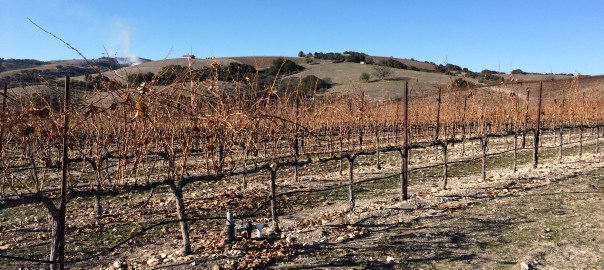
 

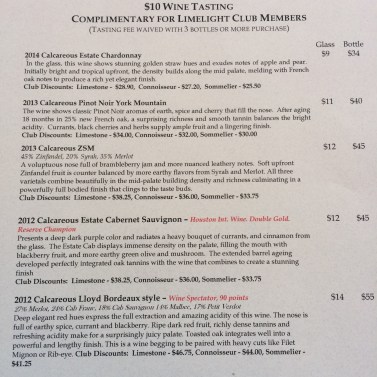
Everything about Calcereous is beautiful – the wines, the land, the tasting room, and the experience. Our tasting room host, Karl Jepsen, is from Denmark. He gave an animated and informative “wine seminar” as we tasted six wines (five from the list and one additional).
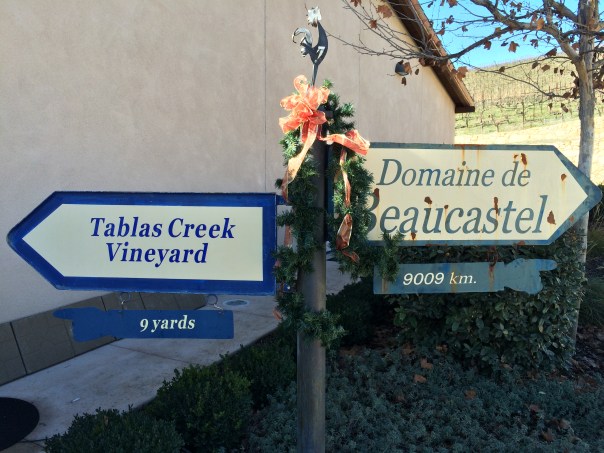
2015-12-29 13.20.04

Karl led us through the tasting, going over the provenance of each wine and adding some additional bits of information, such as how to determine which aspects of the bouquet of the wine come from the fruit and which come from the barrel.

Calcereous wines are premium wines – every wine we tasted was in the 90’s in my own mental ratings chart. We were given an impromptu tour of the  vineyard & winery as well. I think we spent nearly 3 hours there. Wine highlights were the 2014 Estate Chardonnay, the 2013 ZSM (a fantastic blend of Zinfandel, Syrah & Merlot), and the 2012 Lloyd Bordeaux-style Blend, a truly exceptional wine Our 1/2 case purchase contained all three of those.

A note about the restaurant where we ate lunch after these great winery experiences – Fish Gaucho (LINK) in downtown Paso Robles did not disappoint. Very good Mexican dishes, large portions, and a nice atmosphere with good service. It’s worth a look when you are in Paso Robles.

There are over 200 wineries in Paso Robles, California. We visited just five of the more established producers on this short trip. I look forward to returning soon and exploring some of the smaller and newer producers.

As always, your comments are welcome.

And it was chilly – here are Dorianne and Debby clearing the ice from the car in the morning.

2015-12-30 08.46.55


Copyright 2016 – Jim Lockard