I am very pleased of officially announce the launch of DELUXEWINETOURS.COM (LINK), my new venture with Journey Different, Inc. to provide unique wine tours in France. Our focus is on bringing wine lovers into contact with wine makers and others in the industry in the great wine regions of France.
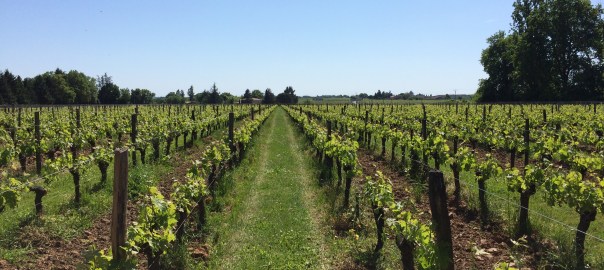
Chateau Guibeau and its Organic Vineyards in St. Emilion are on our Itinerary!
Why France? Because France is the modern-day cradle of all things wine. Wine may not have originated there, but modern wine culture is centered there. And, it is a truly beautiful country, offering great cities such as Paris and Lyon that can be added to itineraries and provide a much richer experience.
You are invited to join us for this unique and exciting inaugural tour!
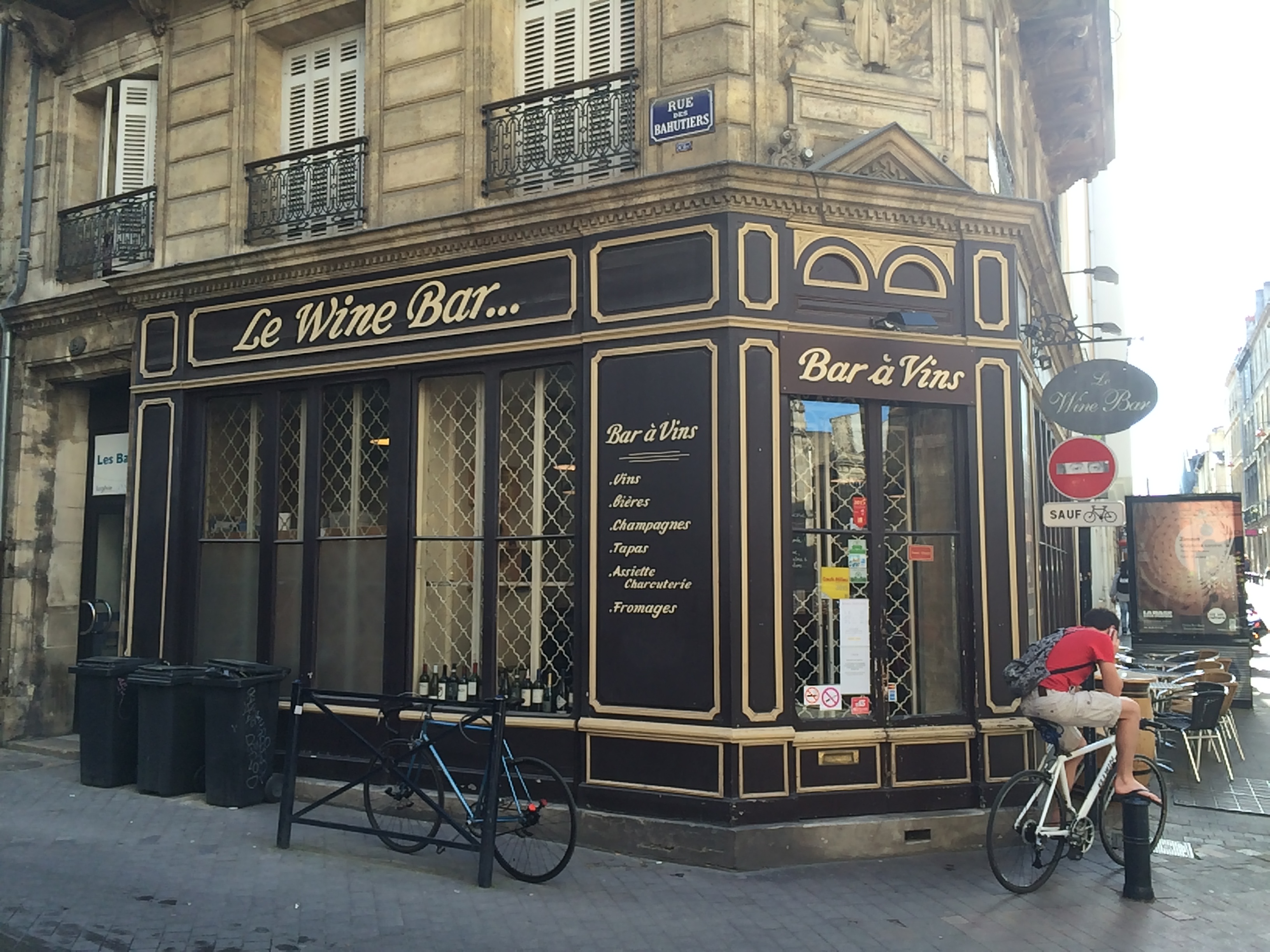
Le Wine Bar, the top-rated wine bar in Bordeaux is on our itinerary!
Our first small group tour, scheduled for March 15-22, 2016, is to include Bordeaux, Paris, and Champagne.
We will combine visits to châteaus with great meals (some of them IN the châteaus) and fine wine tastings, wine seminars, luxury accommodations, local guides and experts, time in the vineyards, opportunities to purchase fine wines to ship home, a literary walking tour, TGV train travel, and more!
Did I mention that there would be great food?
Visit our website (LINK) for all of the information and to register at a limited time discounted price.
Tell your wine-loving friends about this great opportunity to experience the best of French wine culture with me!
Last Saturday, we took a mini tour of the Cotswolds region, a beautiful rural area of southwestern England dotted with picturesque towns. We spent a week in one of those towns, Fairford, which is very friendly and beautiful.
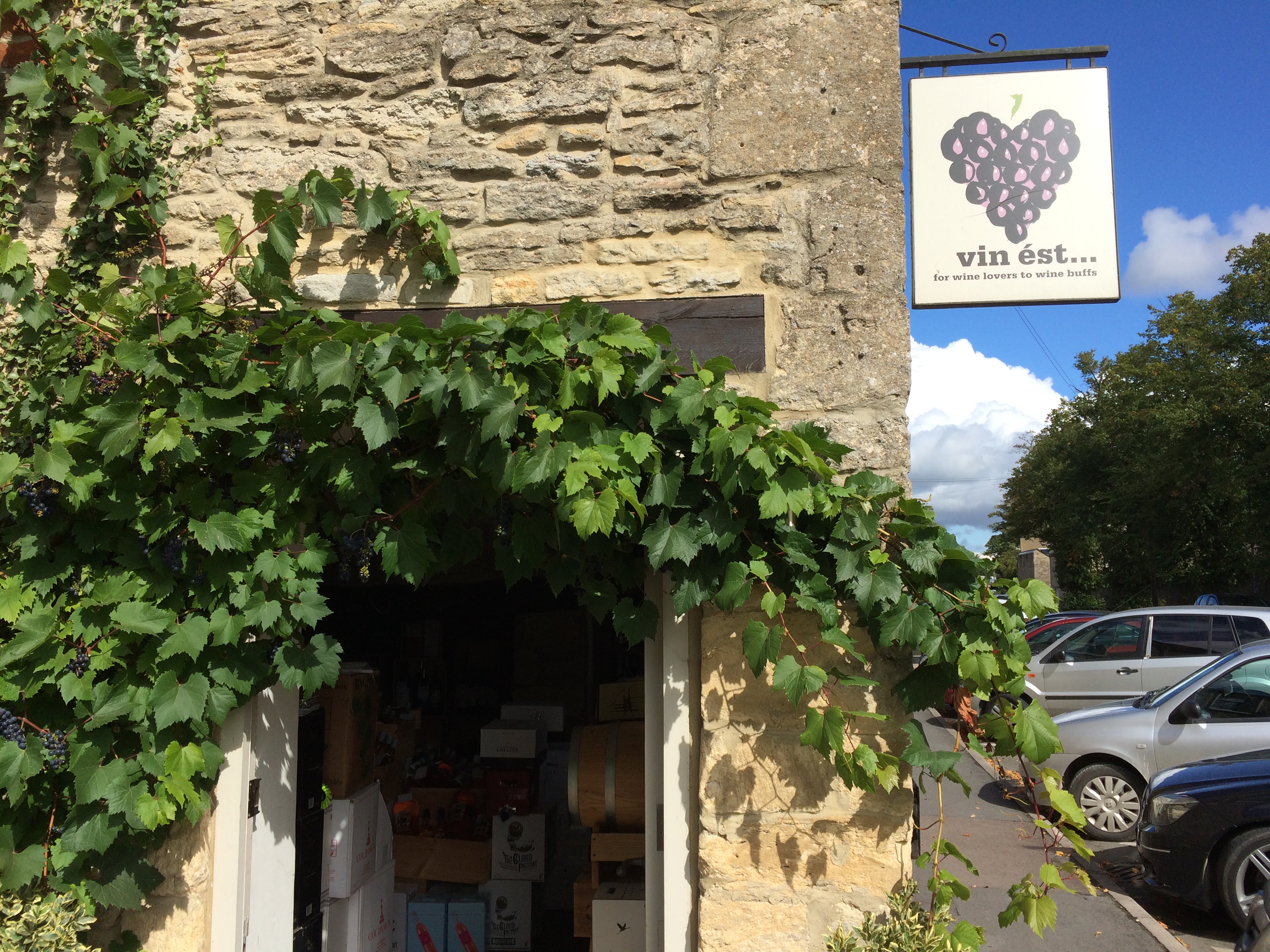
On Saturday, our friends, Charlie and Avril, who live in Broughton Poggs, picked us up and took us out for the day. The first stop was in Lechlade, a town between Fairford and Broughton Poggs. While Dorianne and Charlie went to the store, I spied a little wine shop called Vin Est . . .; I told them to stop on their way back and pick me up.
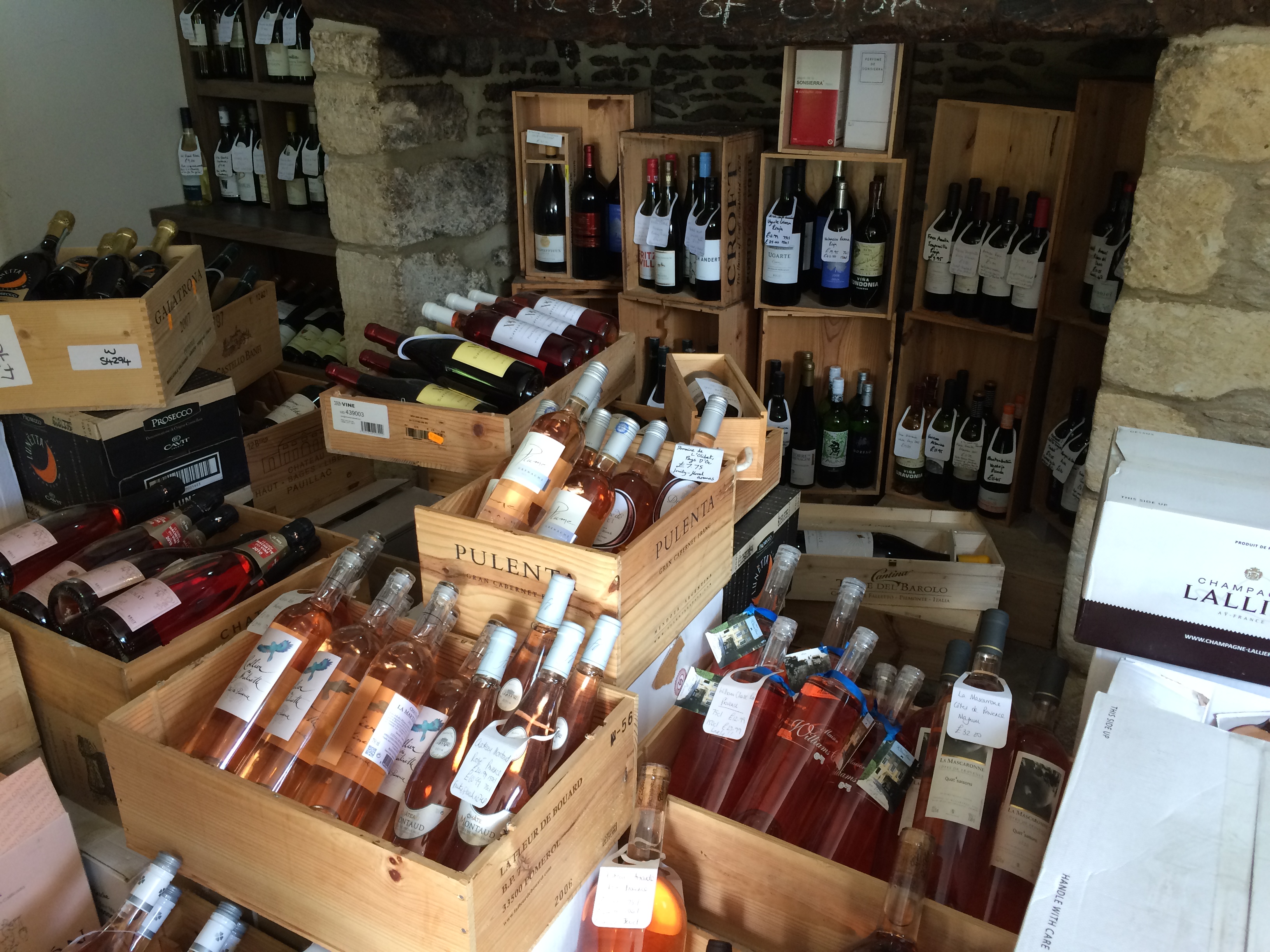
The Vin Est . . . shop (LINK) is very small, a front room stocked with wines on shelves, in bins, on tables, and three casks for those who want to bring their own container. In the back are a couple of more rooms, one empty on this visit – about to become a beer room and to be used for tastings, and a smaller room where the premium wines are kept. They also distribute wines to a number of restaurants and pubs in the area.
Some of the Good Stuff.Fill Your Own Bottle.Nice Wine Shop in Lechlade.The Main Shop Floor
I spoke with Rachel Jenkins, who owns the place with her husband Mike. They moved out from London to this idyllic spot and noticed a hole where a premium wine shop should be. The shop is inviting and intimate, and the Jenkins’ know their wine. If you are in the area sometime, this is the go-to wine shop once you get away from Oxford. I bought a nice bottle of Pouilly Gris that is sitting comfortably in the fridge now.
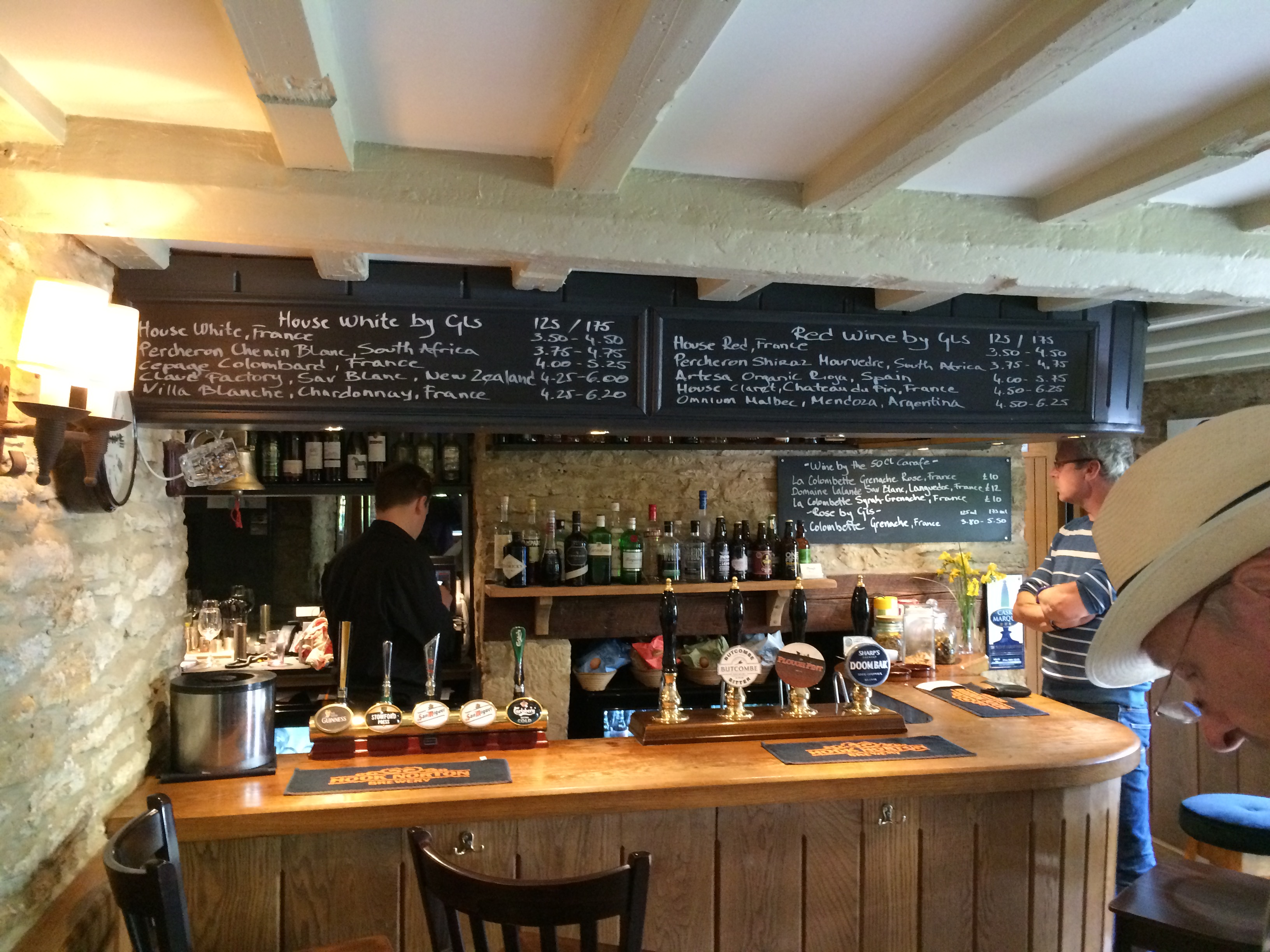
Back in the car to Charlie and Avril’s beautiful home in Broughton Poggs. A cup of tea or coffee and some conversation, then we are off to The Plough Inn(LINK) in Kelmscott for a hearty lunch. Sauvignon Blanc for Dorianne, grapefruit soda for Avril, and the local Buttcombe Bitters for Charlie and me. Great food in a really nice spot – and you can book a room if you like.
The Plough Inn Barroom.Some Wine Choices at the Plough Inn
Then a walk down the lane to Kelmscott Manor (LINK), the former home of the great arts and crafts movement’s William Morris and his family.
After a tour of the stately home and grounds, we headed back to Broughton Poggs, where we examined a very old stone barn that Charlie and Avril are reconditioning into a home. A remarkable transformation is done with these old buildings, keeping the historic charm while remaking them with all the current conveniences.
Then to their home, which is in a converted 15th Century mill, with about an acre plus of gardens on the property – truly a remarkable place. We toured the gardens with a nice glass of Crémant(my fault in not noting the maker) from near Macon in France.
Glasses of Crémant for our Garden tour.Jim, Avril, Dorianne and Charlie. Well into a Very Good Day.
Then more tea and conversation before heading out to dinner at The Five Alls (LINK), a pub about 50 meters from Charlie and Avril’s home. The same management as The Plough Inn, it is a nicely appointed pub with a barroom and several dining rooms. We were seated in short order and I perused the menu and the wine list. The list is interesting, mostly French, of course, but with a number of New World wines from South Africa, New Zealand, Chile, and Argentina. And, the wines are sourced thought our friends at Vin Est . . ., mentioned earlier. The only U.S. wine is a (cringe) White Zinfandel. But, we’re in England after all.
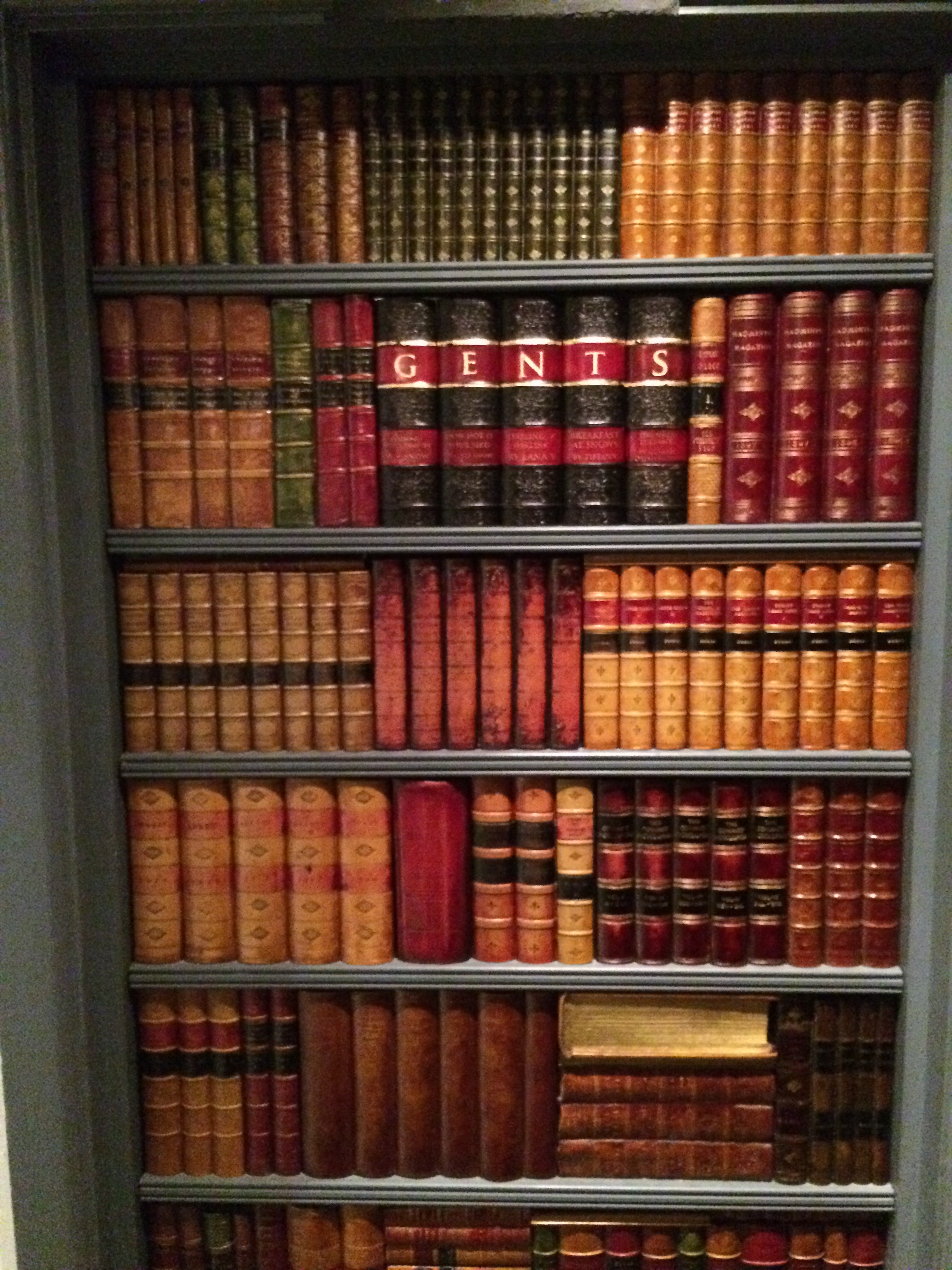
Door to the Gents Room at The Five Alls.
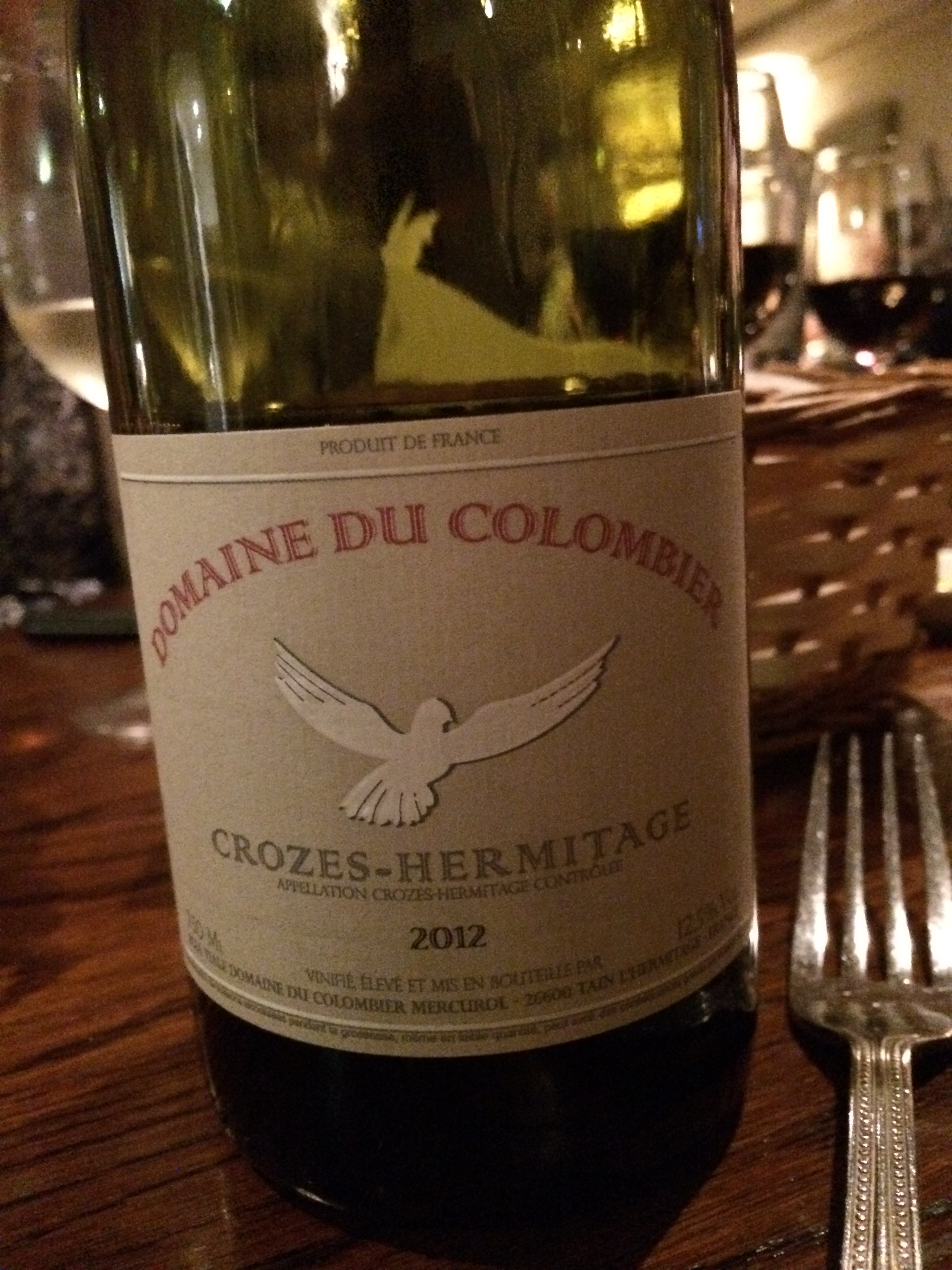
Charlie asked me to select the wines, so I chose a 2014 Picpoul de Pinet from Racine (LINK)in the Languedoc, France. Charlie cringed a bit at my choice, noting that the Picpouls had been pushed in England as an alternative to Pinot Grigio and that he found most of them lacking in any complexity. So we would see. At the same time, I also ordered a 2012 Crozes-Hermitage from Domaine du Colombier (LINK), to go with the venison that we had all chosen for our main course. This rich Syrah with a peppery, dark fruit, favor and good structure proved a success with the venison. I had asked that the second wine be decanted when I ordered it, however, this did not happen, so it took some time to open up nicely.
But back to the Picpoul de Pinet. When it arrived, I was wondering if Charlie would be right, and we would be getting a vin ordinaire with little to no character. Right off the bat, it had a strong minerality on the nose, with hints of pear, citrus and lemongrass – similar, except for the heavy minerality to a New Zealand Sauvingnon Blanc. The taste was strongly earthy with hints of floral notes, pear, and a saltiness around the edges. It opened up a bit more after about ten minutes in the glass – it smoothed out and the complexity showed through. Charlie approved.
This is a beautiful region, becoming more gentrified by the minute due to its proximity to London, but retaining much of its charm – and getting some very good restaurants in the bargain. We have thus far not had an English wine – we plan to do that next week in London, but we have stuck pretty much with the French, with a couple of forays into South America and New Zealand at the supermarket. I would love to hear comments about your wine experiences in the U.K., and any recommendations for London would be appreciated as well.
I can begin by saying that we only visited a portion of the region. We were based in the northern part of Provence, in the village of Villeneuve-les-Avignon on the Rhône River, where two major wine regions converge: Languedoc-Roussillon and Côte-du-Rhône. In our immediate area were over a dozen A.O.P.’s, or Appellation d’Origine Protégée, which replaced the A.O.C. or Appellation d’origine Contrôlée designation in France in 2009 (LINK). So there were plenty of wines to taste and vineyards to visit very close to us.
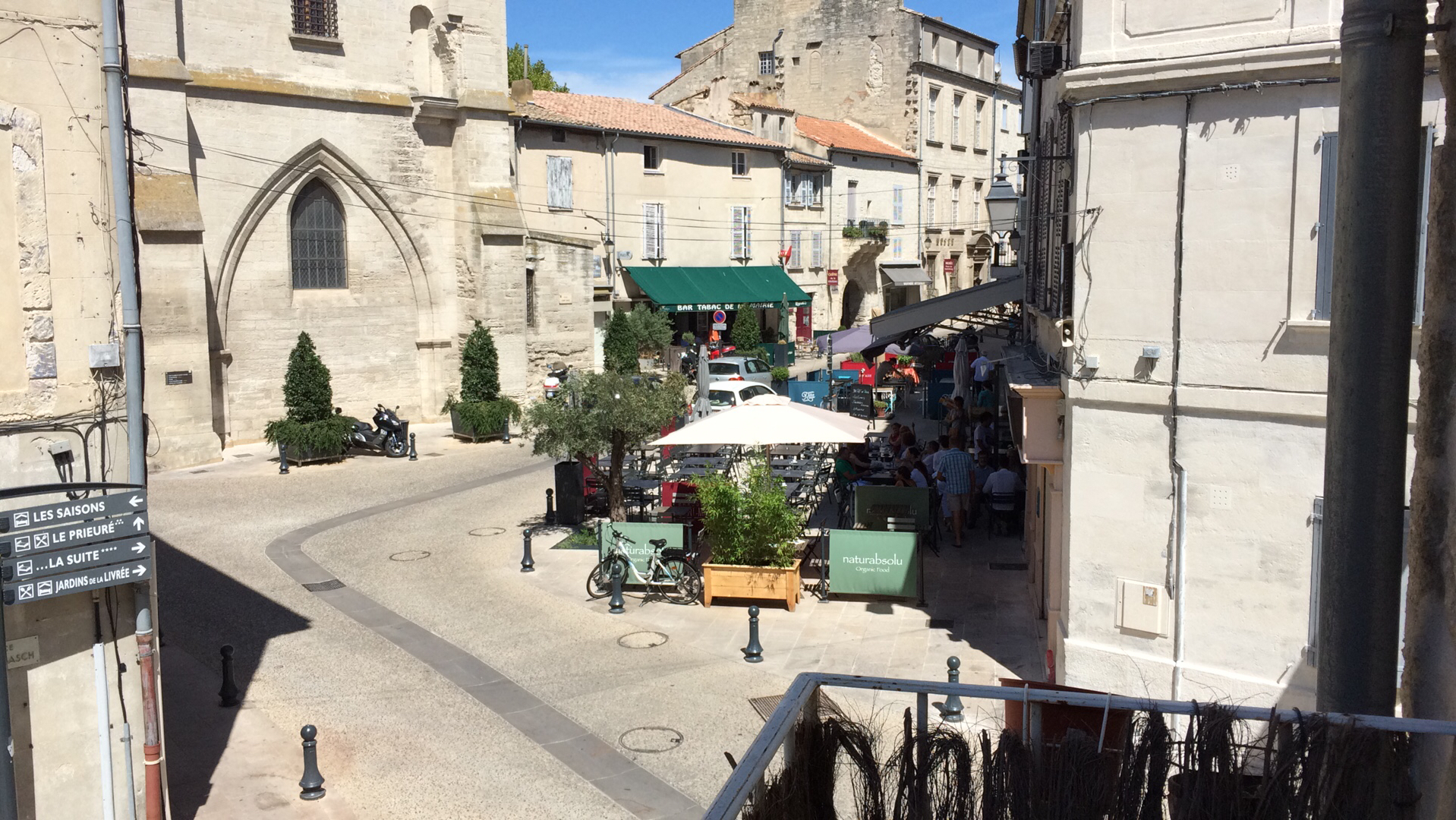
The View from our AirBnB Apartment in Villeneuve-les-Avignon.
And, this trip was not just about wine (!) it was also a time for Dorianne and I to write, to explore the history of the region and meet people, and to see if we might want to settle here someday soon. And, as it turned out, to see if I am going to extend my new winetour business to this area.
I have already blogged about several of our experiences during our stay (best key word to search is Provence), and Tweeted just about every wine we had on my Twitter account – @JimLockardWine.
But, some additional tidbits.
We first encountered Lauren, proprietor of the marvelous Arts, Design, and Wine Shop in Villeneuve-les-Avignon on the day we arrived. The shop is on the town square and has a nice selection of local wines plus design items from wristwatches to sunglasses to home décor items and wine glasses – all very nice stuff, by the way. Lauren spent some time living in Los Angeles, so his English is excellent. We asked him about the local wines and he gave us a lot of information and sold us our first two bottles of local wine, a 2014 Château d’Estoublon le Rosè and a 2014 Château La Verrerie Blanc, a Provençal Rosè and a white from the nearby Luberon Valley. We were off an running.
It was Lauren who told us to serve the area wines, including most of the reds, chilled – Châteauneuf-du-Pape being an exception. And, after asking if we had appropriate glassware in our apartment, Lauren loaned us two sets of very nice wine glasses for our stay, which was six weeks. He also pointed us to MistralTour.fr(LINK) and the amazing Valentina Cavagna, who took on a memorable tour of Châteauneuf-du-Pape, Gigondas, and to Domaine de la Verrière in Crestet that I blogged about previously (LINK). So Lauren is the kind of key person that you want to look for on journeys such as this – the one who knows the local scene and, ideally, loves to talk about it.
Dorianne and I had most of our meals in our two bedroom apartment [AirBnB.com listing – (LINK)], so we bought wines, mostly rosès, from Lauren and other local shops until we began visiting the wineries. Local wines start at around 3€ and go up, the top end being under 30€, except in Châteauneuf-du-Pape and one or two other places. Wine here is a great value. We found a nice sweet spot for rosès at around 10€ per bottle.
If I take away two main revelations from this trip, it will be these:
The rosès of Tavel, the only O.P. in France devoted exclusively to rosè wines. These wines were a revelation of complexity, some even being age worthy. Definitely a departure from the standard Provençal rosè, in the way that a great Napa Cabernet differs from an everyday supermarket Cabernet. The other rosès were fine to drink, but the Tavels raised the bar quite a bit. It’s the sort of thing that you don’t know you are missing until you have some.
Age Worthy Tavel Rosè Wine.
The white wines of Châteauneuf-du-Pape, Lirac, and Gigondas were also a pleasant discovery. I did not know that whites were a factor, r even necessarily present, in these regions, and the complexity, beauty and approachability of these wines converted me instantly. If you can find white Châteauneufs in your area, try one. Cold, but not too cold – maybe out of the fridge for 15-20 minutes before serving. These blends of Grenache Blanc and Rousanne with small amounts of other varietals are among the best white wines I have ever tasted. Lirac in particular was a revelation – Châteauneuf – style wines, same varietals, different side of the river, at much lower price points, often made by the Châteauneuf wine makers themselves.
Château Vieudieu in Châteauneuf-du-Pape.Château Vieudieu’s Châteauneuf-du-Pape Wines
I know that there is much more to the Provençal wine scene – we did not get to the south on this trip, although we have been there before. I do think that the north, with it’s proximity to the Rhône River Valley is where the bulk of the better wines are cultivated and made.
As far as places to visit in northern Provence, I strongly recommend Avignon for the history and the food and wine in some of its better restaurants; the hill towns in the Ventoux and in the Luberon Valley, where good wine is cheap and the history and the landscape are so captivating; Nimes for really spectacular Roman ruins and a great old town center; and Gigondas for great wine and a very vertical hill town overlooking the Rhône River Valley. It gets pretty cold in the winter in the region as the Mistrals, the cold north winds, blow through the valleys, but spring, summer, and fall are all beautiful in Provence. But you probably already knew that.
We will be leading tours here beginning in the second half of 2016, so stay tuned.
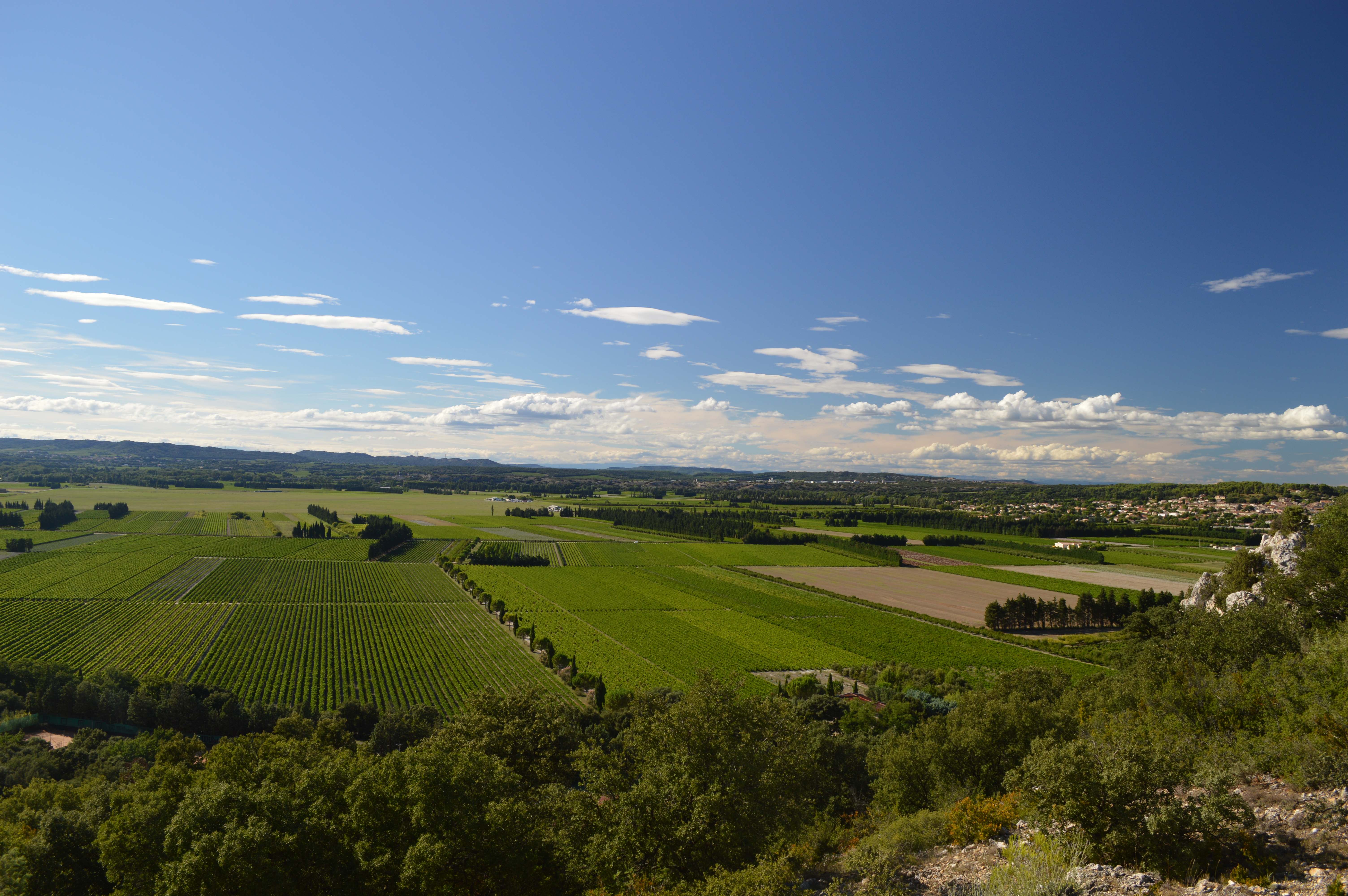
This past Saturday, Dorianne and I returned to Châteauneuf-du-Pape (LINK) for lunch and a tasting at a wine cave – a retail wine store. It was a beautiful day, and we drove through the lovely Provençal countryside, with its vineyards, orchards, scenic homes and farms, and lush vegetation. Our friendly GPS took us along about 5 kilometers of single-lane road through vineyard after vineyard before we entered the town of Châteauneuf-du-Pape, the most storied Appellation (LINK) of this part of France.
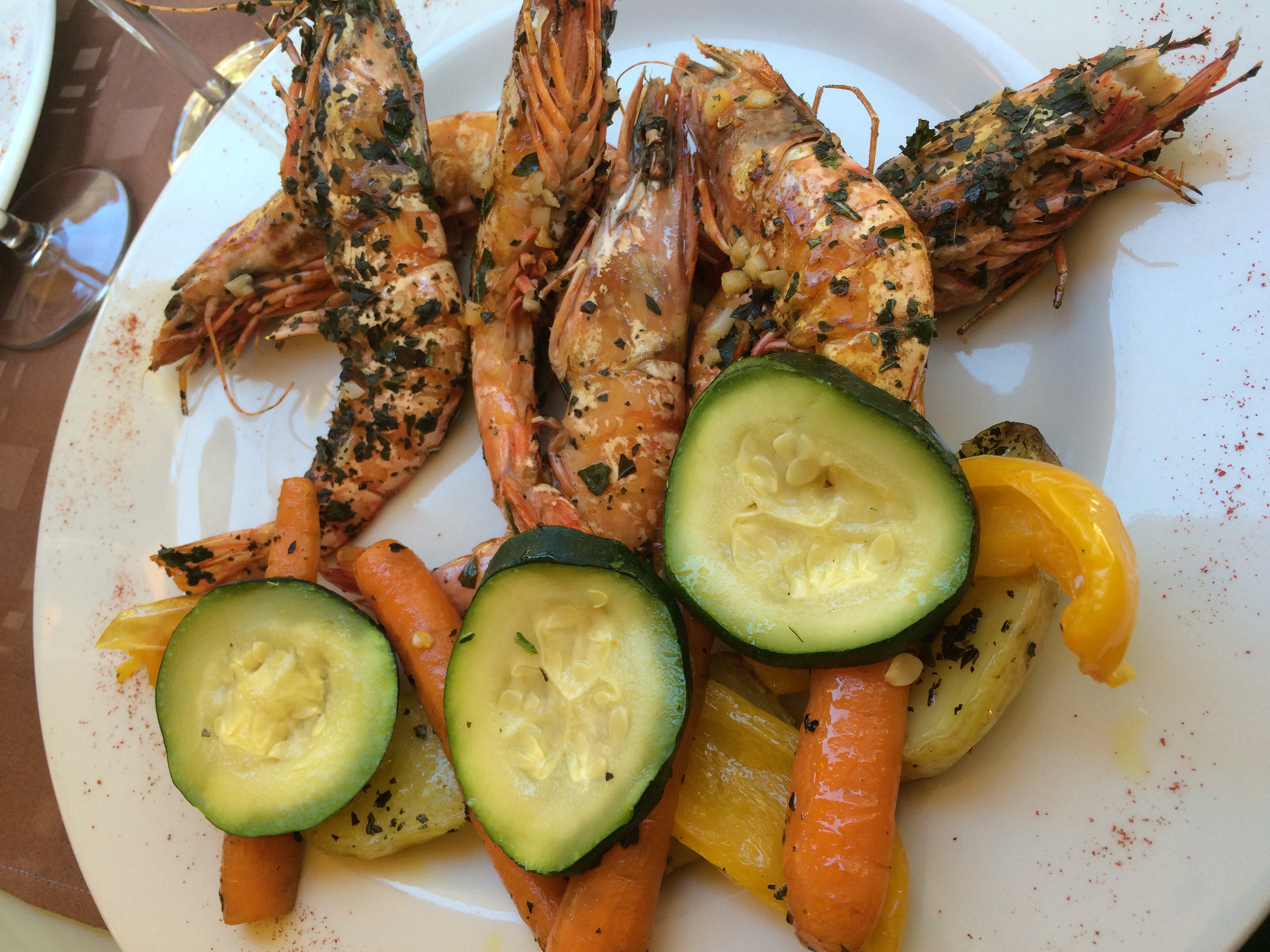
Lunch was at Restaurant Le Pistou (LINK) on a little side street off of the main town square. We sat outside and expected a light lunch, but the servings were very large – gambas salad for Dorianne, and grand gambas with salad and vegetables for me. As you can see, the plates were sizeable. We washed this down with the house white – a Châteauneuf-du-Pape. Before this trip, I did not know that whites were made here – but they are, compromising about 6% of the total production. The whites of Châteauneuf-du-Pape stand alongside the storied reds as excellent wines.
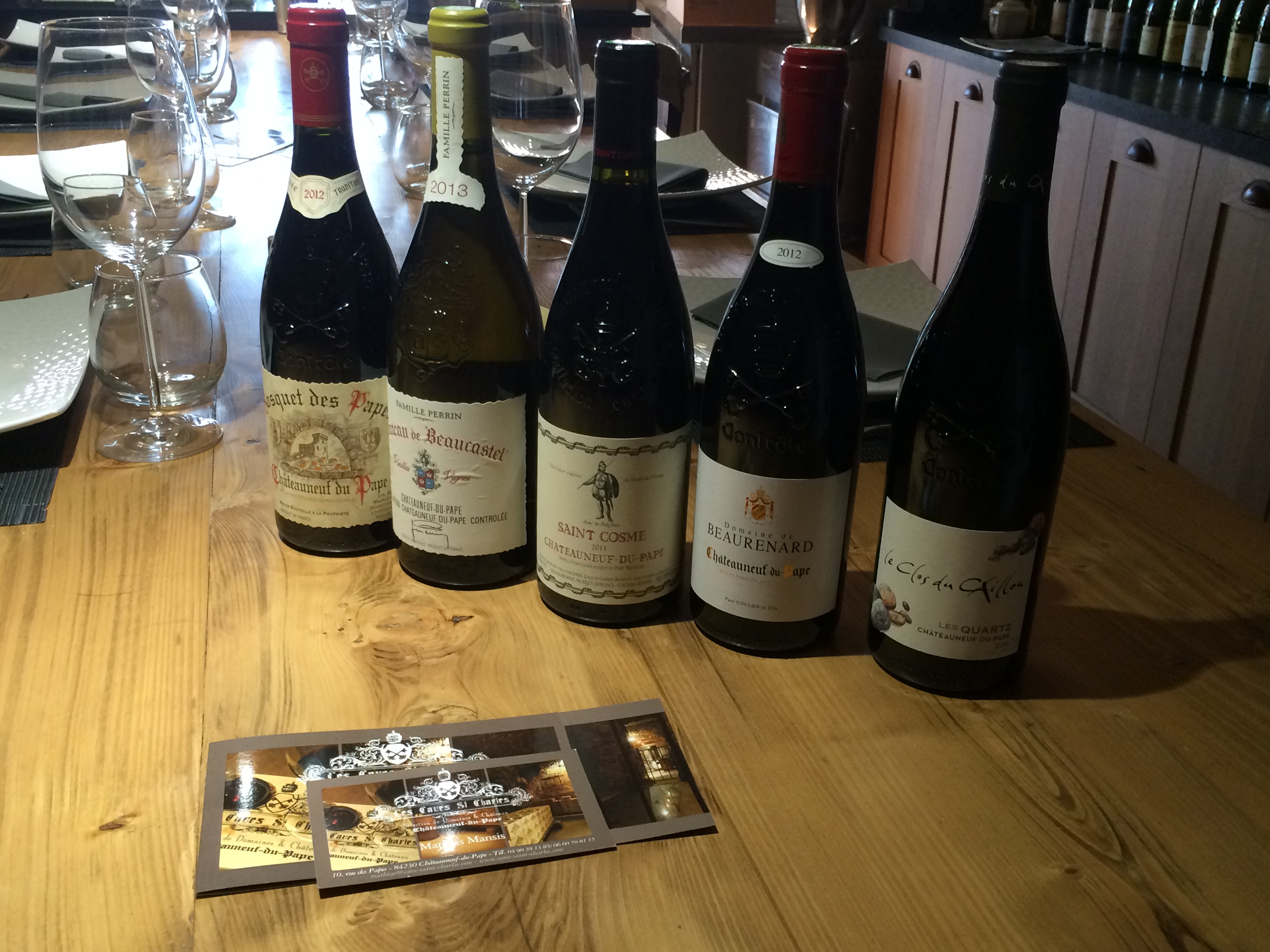
Le Caves Saint Charles (LINK) was highly recommended in Tripadvisor.com (LINK), which we used as a means of sorting through the dozens and dozens of caves du vin in the town of Châteauneuf-du-Pape. We wanted to ensure that we were tasting really good wines. After deciding, we made an appointment via email to meet the owner, Guy Brèmond, for 3:30 pm. We were a bit late, having had some trouble locating the cave – our GPS being little help – and in finding a place to park. When we arrived at the cave, which is at the top of the highest hill in town, only overlooked by the nearby ruins of the original Château of Châteauneuf-du-Pape, it was locked up. We knocked on the door to no avail. We called the number, and did connect. It turned out that Guy was later than we were, having been stuck in traffic in Marseilles earlier. After a few minutes, we were in the temperature controlled cave, which is under the home of the owner.
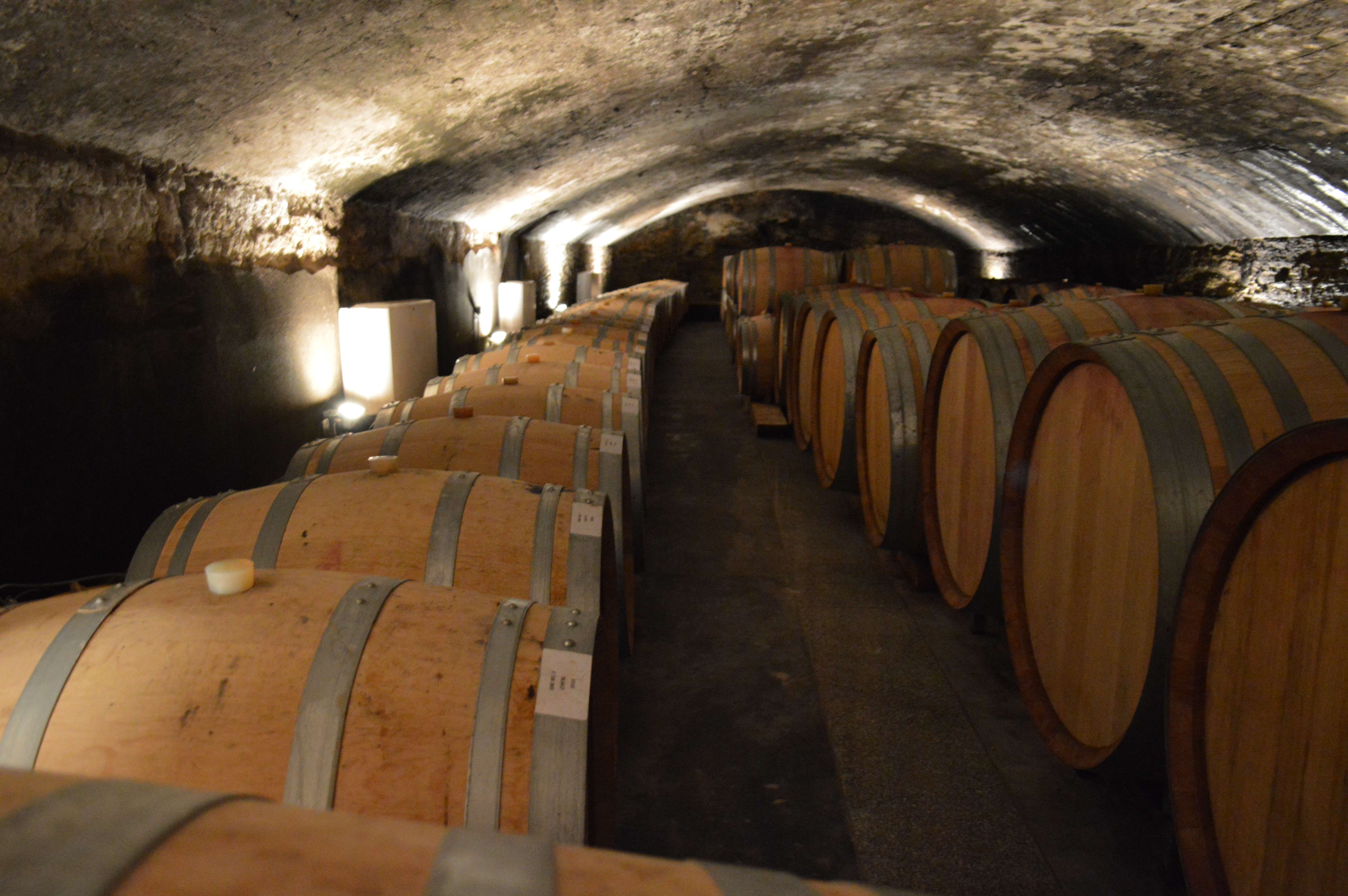
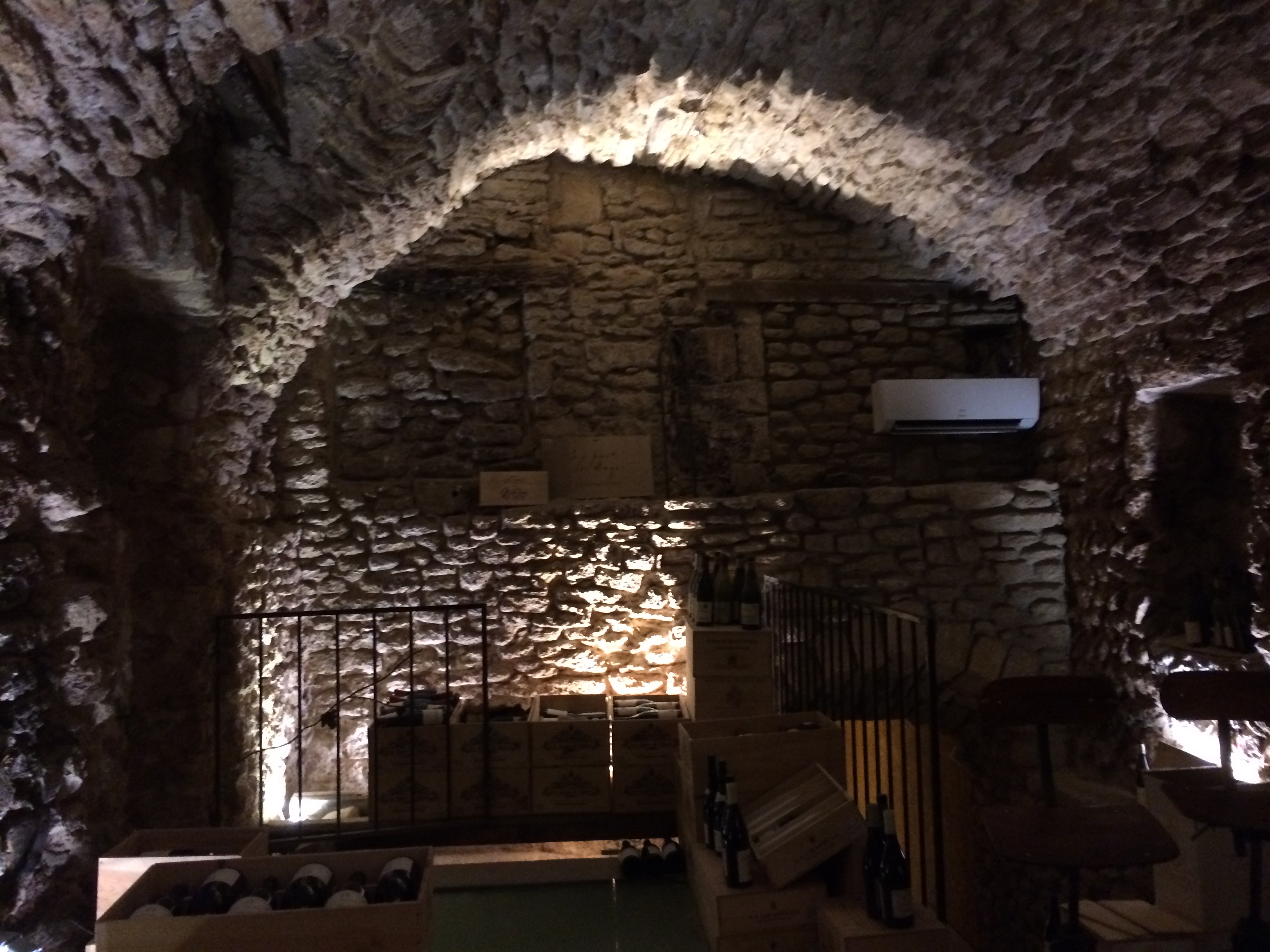
The actual cave structure of Le Caves Saint Charles dates from the 13th Century. There is another section underneath that dates from the 12th Century that is going to be renovated in the coming year. The cave in use has four rooms carved out of the rock with stone walls and vaulted ceilings – a lobby area, the tasting area, a small storage area and an area converted into a modern kitchen. There are bottles of wine in wooden boxes from the 45 producers that Guy represents throughout the cave rooms. We started in the tasting area.
Guy Brèmond is a Master Sommelier and a very personable and outgoing man. Once we established that Dorianne and I knew something about wine, although not that much about Châteauneuf-du-Pape, we were off and tasting. He spoke in depth about the philosophy and history of the appellation, and about the way the wines are made and the misconceptions that many have about Châteauneuf-du-Pape. We tasted 8 wines, two whites and six reds. The reds were made in three different styles, or methods.
The 90 minutes or so that we were at Le Caves Saint Charles with Guy Brèmond went by quickly. I kept having the feeling that this was a really special experience, and it was. The depth of his knowledge of wine in general and Châteauneuf-du-Pape wines specifically, combined with his enthusiasm, was a bit hypnotic. I will share now that we did purchase a mixed case of wine at the end of our visit to have shipped to California; but we were intending to do that when we arrived, if the wines were good. Guy is a very good businessman, but there was no pressure to purchase beyond what may naturally arise when you are in a fabulous environment, tasting exceptional wines, with an enthusiastic and knowledgeable host.
Now to the wines – to be tasted in huge stemmed glasses, by the way:
We began with two whites. As I said, I was surprised to find whites here, as I have never seen them in the U.S., nor read about them. We had tried a Mont-RedonChâteauneuf-du-Pape white shortly after arriving here in Provence and found it delicious.
The Châteauneuf-du-Pape Whites.
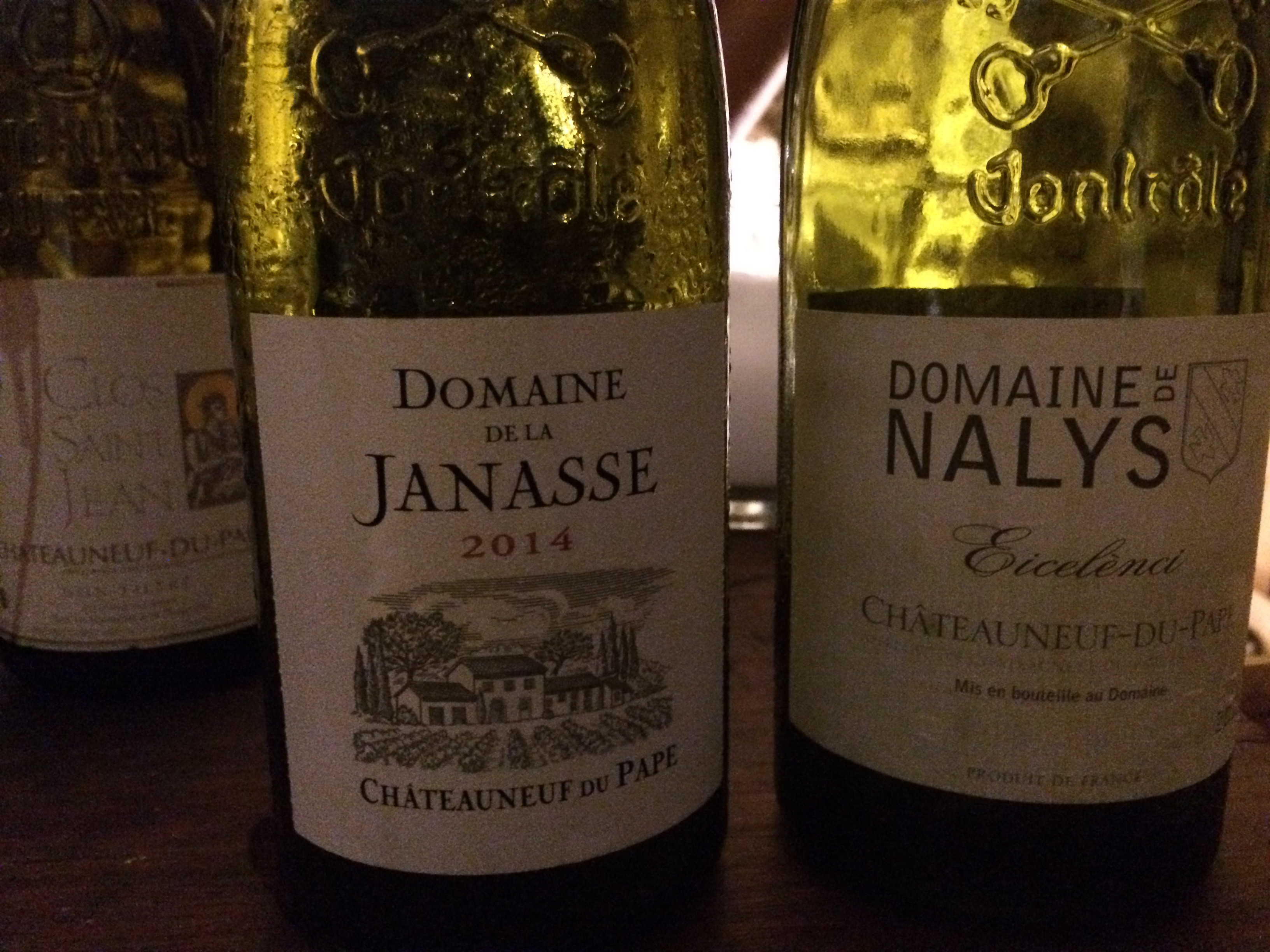
First, we tasted a 2012 Domaine de Nalys Blanc (LINK)(LINK), a blend of 40-56% Grenache blanc, 14-34% Clairette, 13-27% Bourboulenc, 3-10% Roussanne, 1-5% Picardan, 1-3% Picpoul. The white wines of Châteauneuf-du-Pape are, like the reds, complex. This wine gives you a lot to experience on the nose, in the mouth, and through the finish. There is green fruit, minerality (always), some floral notes on the nose; apple, pear, and hints of earth and anise on the tongue; with a smooth lingering finish that returns to the mineral notes from the bouquet. This wine would be exceptional with lighter cheeses and seafood – oysters and shellfish in particular. We bought 3 bottles at 31€ and change.
Next, we went to the 2013 Domaine de la Janasse Châteauneuf-du-Pape Blanc (LINK)(LINK), a blend of 40% Grenache Banc, 40% Clairette, and 20% Rousanne. This is a beautiful wine from one of the most highly regarded producers in Châteauneuf-du-Pape. A wine that is very drinkable now, but should age well. The nose is peach and floral, but with that ever-present minerality; mouthfeel is rich and viscous with hints of vanilla; long, smooth finish. We bought 3 of these, too, at 34€ and change. (That’s half a case so far.) I think that we will continue to explore the whites of Châteauneuf-du-Pape; in fact, I am certain of it.
As we move to the reds, I should point out of few things (this will be a rather long post). As we taste, there is a lot of conversation going on. Dorianne is full of questions. I ask a few myself. Guy Brèmond is expounding on each wine, each producer, their philosophy, their practices, the market, his business, and more. It is quite lively and very interesting.
There are a number of misconceptions that are very common when it comes to Châteauneuf-du-Pape wines:
Many people do not know about the white wines, as their small production limits their distribution.
Many believe that all Châteauneuf-du-Pape reds come from thirteen varietals. There are, depending upon who you speak to, anywhere from 14 to 18 varietals in the appellation. Some do not count the white varietals other than Granache Blanc. Others count only some of them. So there are, essentially 13 varietals of red, but some of the white varietals may be blended into the red wines. The appellation currently allows 18 varietals under a Châteauneuf-du-Pape label.
Many believe that all Chateauneuf-Du-Pape reds must be blends. This is not true. For example, you can have a 100% Granache, which we have tasted (not at the Cave). Most reds are a blend of three to five varietals. The basis for almost all Châteauneuf-du-Pape reds is the classic GSM Blend – Granache, Syrah, and Mourvedre.
Why so many varietals in a small appellation? Guy says that it was because when the appellation was developed and the rules created in 1923 (amended in 1936 and 2009), all of the varietals under cultivation at the time were included. This “democratic” move forestalled the inevitable infighting that might have jeopardized the pact.
Châteauneuf-du-Pape is part of the Côtes du Rhône, or the Rhône Valley Area. It has 3161 hectares, or 7811 acres under cultivation. Total production is 2,686,841 gallons, or about 21,000 cases per year. 94% is red and about 6% is white. (LINK)
So on to the reds. We tasted six, from three different philosophies of making Châteauneuf-du-Pape red wines, as described by The Wine Cellar Insider website (LINK):
The Traditional, Modern & Neoclassical styles – “Much of the difference between traditional and modern, is the ripeness of the grapes, effective yields, amount of stems used and most importantly, the percentage of new oak barrels used in aging the wine. Producers making wines in a more traditional style do not use oak, preferring to age the wine in older, neutral, massive barrels, cement lined vats or foudres that are widely used in the region. They do not destem the grapes. In other words, they follow the traditional practices of the region. There are numerous high quality traditional Châteauneuf-du-Pape wines made all over the appellation today” (LINK). So the use of smaller oak barrels designed to impart its characteristics onto the wine is a hallmark of the Modern Method. The Neoclassical Method is a hybrid of the other two, some oak barrels are used, but only for a portion of the harvest.
Our first two red wines are from the Modern Method:
The Châteauneuf-du-Pape Modern Method Reds.
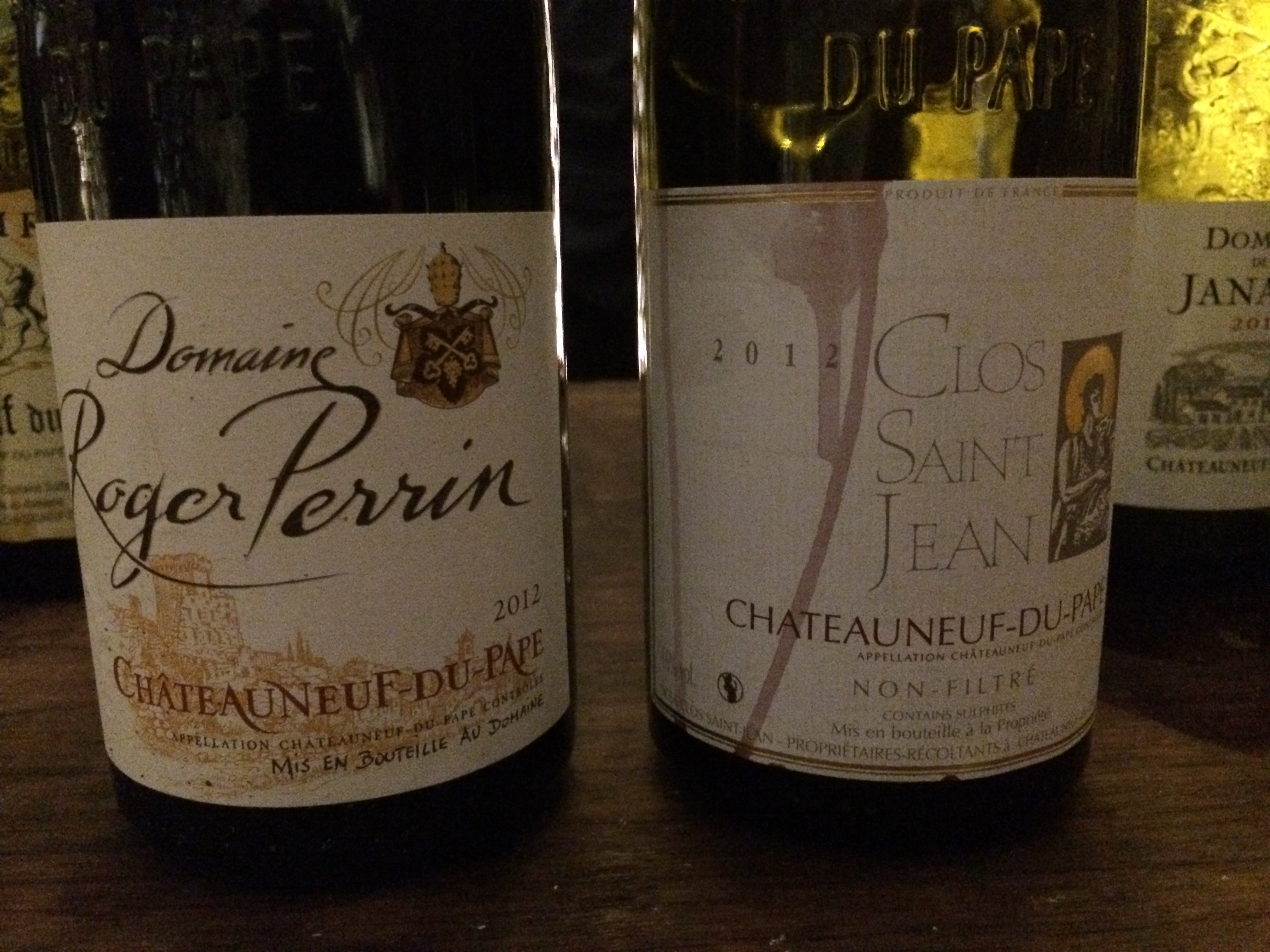
First, a 2012 Clos Saint Jean “Vieilles Vignes” Châteauneuf-du-Pape (LINK), a blend of 85% Grenache with the remainder a mix of Mourvedre and Syrah (Guy says that Syrah is used only for “cosmetic purposes” – to provide a richer color). This is a big wine, full-bodied, with deep red fruit and minerality on the nose and the palate. A wine that will age well, I think. If this is typical of the Modern Method, it is very much like a California or New World wine – bold, high alcohol, fruit forward. In my research, I noticed that Robert Parker generally gave higher marks to Modern Method wines.
The next Modern Method wine is a 2012 Domaine Roger Perrin Chateauneuf-du-Pape(LINK) the website lists an average blend of 70-75% Grenache, 15-20% Syrah, 10-15% Mourvedre, 2-5% Cinsault or Clairette and 1-2% Counoise or Vaccarese. Another big, fruit-forward wine. Dark red fruit, a bit of mushroom on the nose, minerality throughout. Very similar to the Clos Saint Jean, but with a bit more finesse.
The next three wines are from the Traditional Method:
The Châteauneuf-du-Pape Neoclassical Method wine (Left) and the three Traditional Method Reds.
First, a 2010 Domaine du Pegau Châteauneuf-du-Pape Cuvee Reservee (LINK), a blend of 80% Grenache, 6% Syrah, 4% Mourvedre and 10% other varietals. This is an amazing wine – you can immediately see the difference between this method and the Modern Method – something that would carry through with the rest of the wines tasted. It is more mineral than fruit, more elegant than bold, with a beautifully balanced structure of tannins. This is my style of wine. But we did not buy this one.
Next, a 2010 Château Fortia Châteauneuf-du-Pape Tradition (LINK), a blend of 65% Grenache, 20% Syrah and 15% Mourvedre. Aged in foudres (concrete tanks). This wine is pretty much everything that the Domaine du Pegau is, but it takes it to a higher level, but is very much its own wine. You get some barnyard on the nose, which begins to dissipate after a few minutes, but remains. I did not find it off-putting, but some may. There is ripe fruit in there, but it is subdued in a minerality – dirt, terroir – that permeates the wine. On the palate it is very nicely structured and balanced and the fruit began to come through. This is a wine that will age well and one that would benefit from decanting. We bought 3 of this one at 35€.
Next, a 2010 Beaurenard domain Cuvee Boisrenard Chateauneuf-du-Pape (LINK), a Grenache blend but the winery does not release specifics as far as I can tell – only that up to 13 varietals may be included in the wine. Parker 91, Wine Spectator 97 points. A long, smooth finish. The initial tasting bottle had been opened too long, Guy opened a new bottle and got us clean glasses. This one, too, could benefit from decanting a while. We probably would have bought some of this wine, too, but a case was our limit, and we couldn’t pass up the next wine.
Finally, a wine in the Neoclassical Method – meaning a mixture of traditional and modern. A Château Jas de Bressy Châteauneuf-du-Pape (LINK)(LINK), a blend of 80% Grenache; 15% Syrah and 5% Mourvèdre. This wine has lots of mushroom on the nose and a nice peppery sense as well. Fruit is secondary to the minerality on the palate, plus a sense of chocolate. The tannins were there to ensure a relatively long life for this wine. A very nice wine. We added three of these at 36€ and change to round out our case purchase.
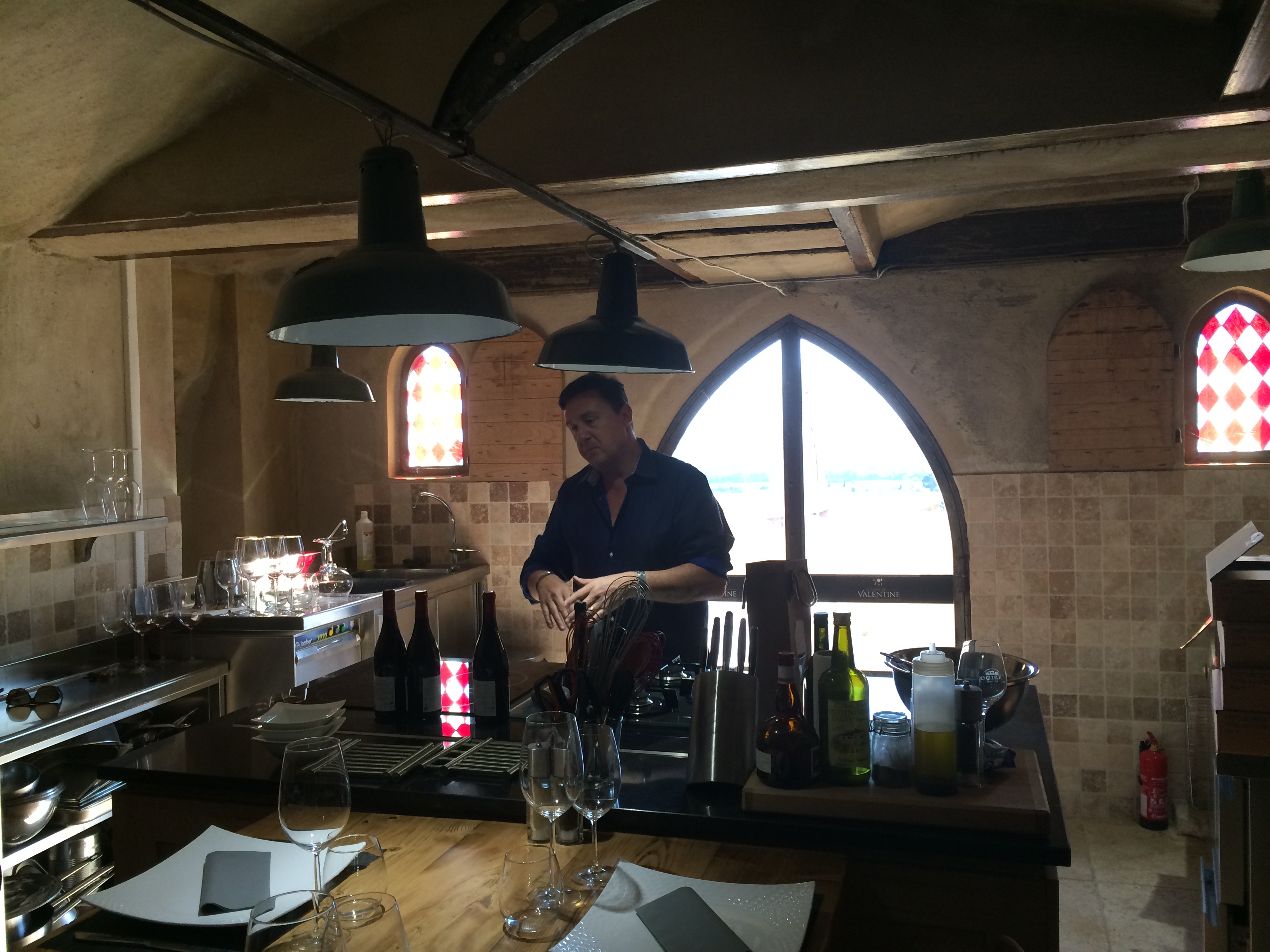
After our tasting, we had a quick tour of the rest of Les Caves Saint Charles with Guy Brèmond. There is another small storage room in the cave and a modern kitchen also where gourmet dinners are prepared to pair with these amazing wines. Guy also takes his act on the road, bringing dinners to private homes in the U.S. with a Michelin-Star chef. You can find out more about this at his website (LINK). This experience has been the wine highlight of our six weeks in France. I am very grateful to have discovered so much about the joys of Provence, and the wines of this amazing region.
Guy in the kitchen. Behind him is a terrace with an amazing view.Some of the Cave wines in the kitchen.A Cave Storage RoomEvery Chef needs some Wine for Cooking – and for the Cook!
I haven’t posted in a while, because Dorianne and I have been focusing on some writing projects and dining in our apartment for the most part. We are sill in Villeneuve-les-Avignon, the picturesque village across the Rhône River from Avignon in northern Provence.
This weekend, we were invited by our friend Richard Major, who lives in Mazan in the Ventoux region, to a party being hosted by an ex-pat American couple celebrating one year of living in France. There would be ex-pats from the United Kingdom, New Zealand, and other nations, plus a few French neighbors. So, of course, we were interested in attending. I won’t use any names here, because I did not get permission to do so. Here is the sunset from the home.
The home was located in the hills above Bédoin, a picturesque (they are ALL picturesque) village near the base of Mont Ventoux. The couple, from California, and their two children seemed very happy with their choice to move to Provence. We also spoke with a number of other ex-pats and a couple visiting from the U.S., also from California, who own a home nearby, but still live in the States.
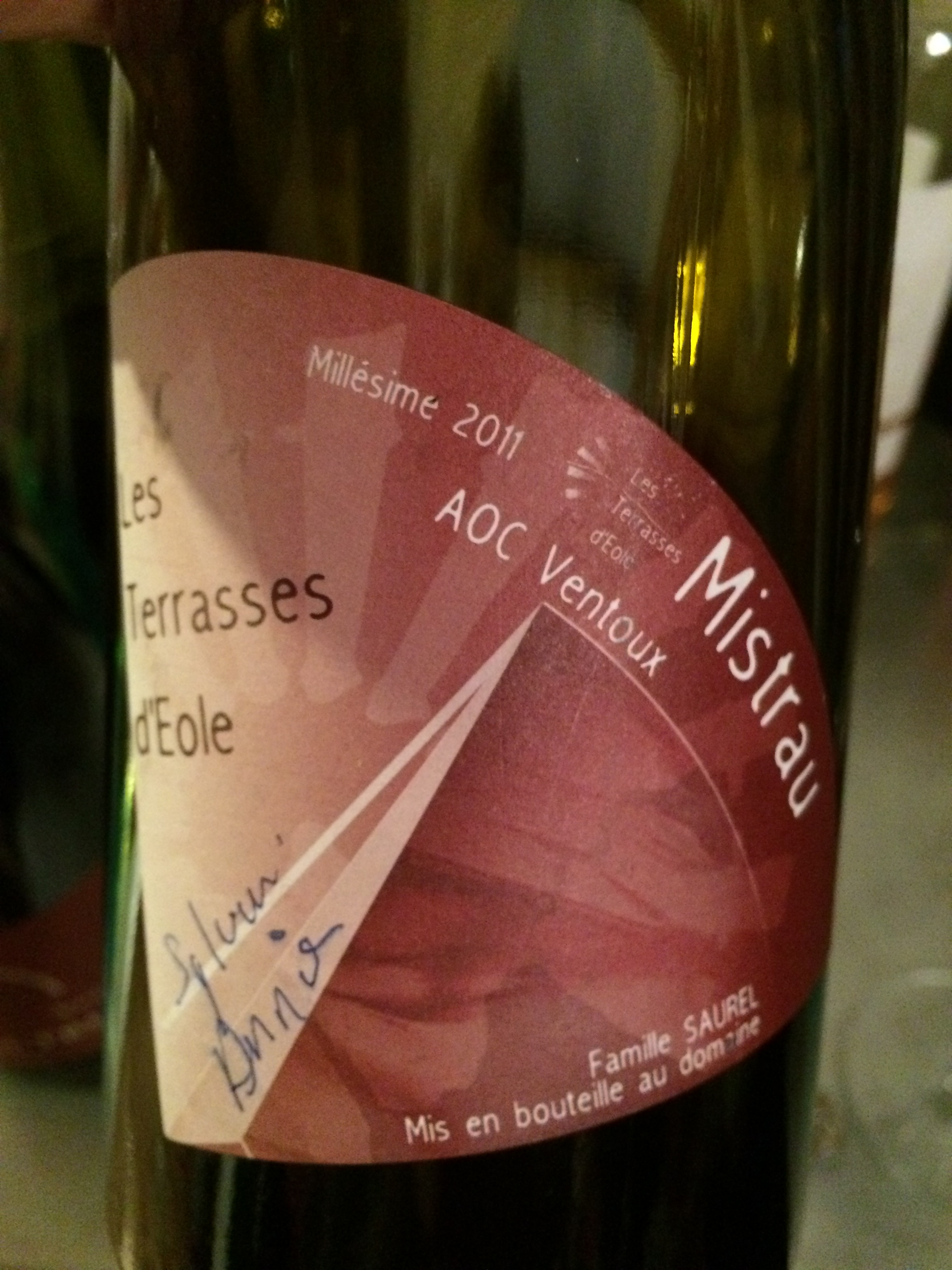
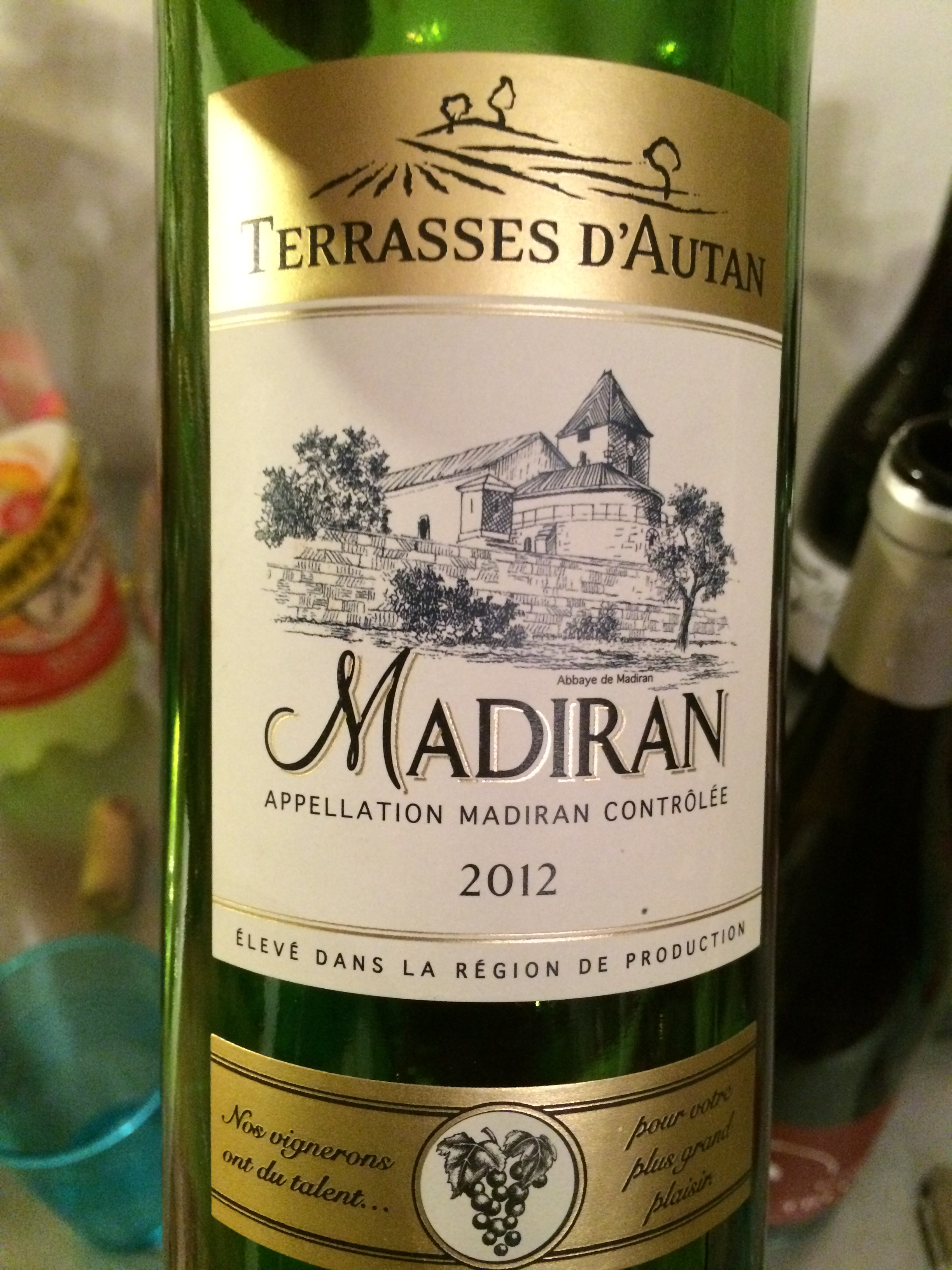
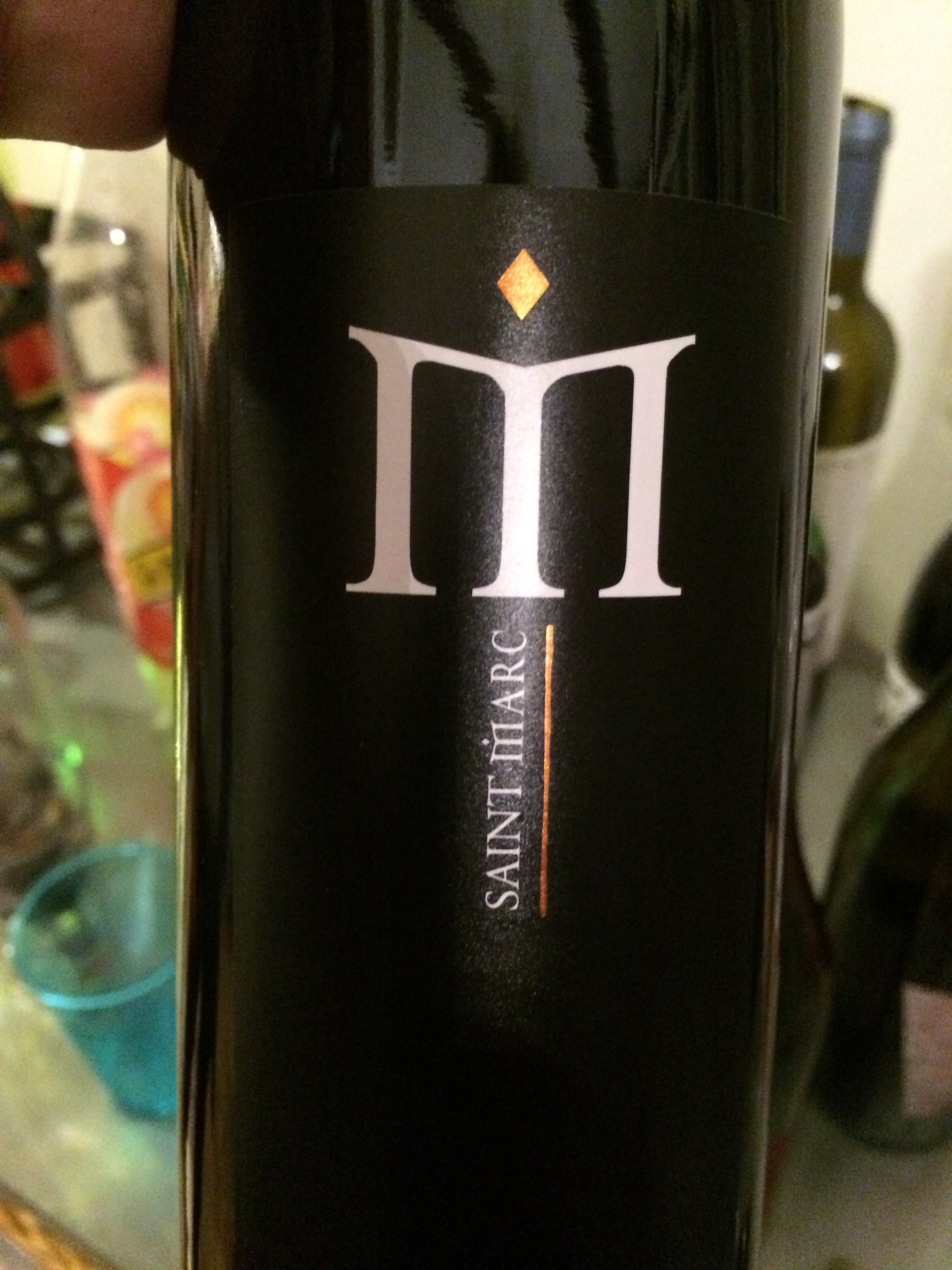
The dinner was pot-luck, and there was a good bit of local wine. The Ventoux Region (LINK) is known for Grenache, Syrah and Mouvèdre, with Cinsault and Carignan – the usual Rhône Valley suspects. In the Ventoux A.O.P., no varietal can be more than 30% of the blend. Here are some images of some of the wines served at the party.
Suffice to say, Dorianne and I were impressed by the lifestyle and the conviviality of the English-speaking ex-pats in this part of Provence. It gave us more food for thought about our future home base.
After an overnight at Richard’s in Mazan, we headed for a day in Tavel, the only A.O.P. in France where only rosè wines are allowed; and then over to Châteauneuf-du-Pape for lunch and a visit to Les Caves St Charles, which will be detailed in a separate post.
It was a very special day. If you stay off of the highways, this part of France is a treat for the senses – beautiful panoramas of low hills, valleys, fields of grapes and olive trees, rustic farmhouses – simply beautiful. We traveled down one-lane roads through vineyards and tiny villages, smelled the aromas in the air, and heard almost nothing – silence. It was a very peaceful way to travel.
Tavel (LINK) is located on the right bank of the Rhône River, bordering the Lirac A.O.P., and very close to Avignon. First, let’s look at A.O.C. and A.O.P.
The French government, not too long ago, officially announced that the long standing A.O.C. (Appellation d’origine contrôlée) system for wine is being replace by an new quality ladder with the top step being an A.O.P. (Appellation d’Origine Protégée) (LINK). So, since about 2009, the correct designation is A.O.P.– – That’s just F.Y.I.
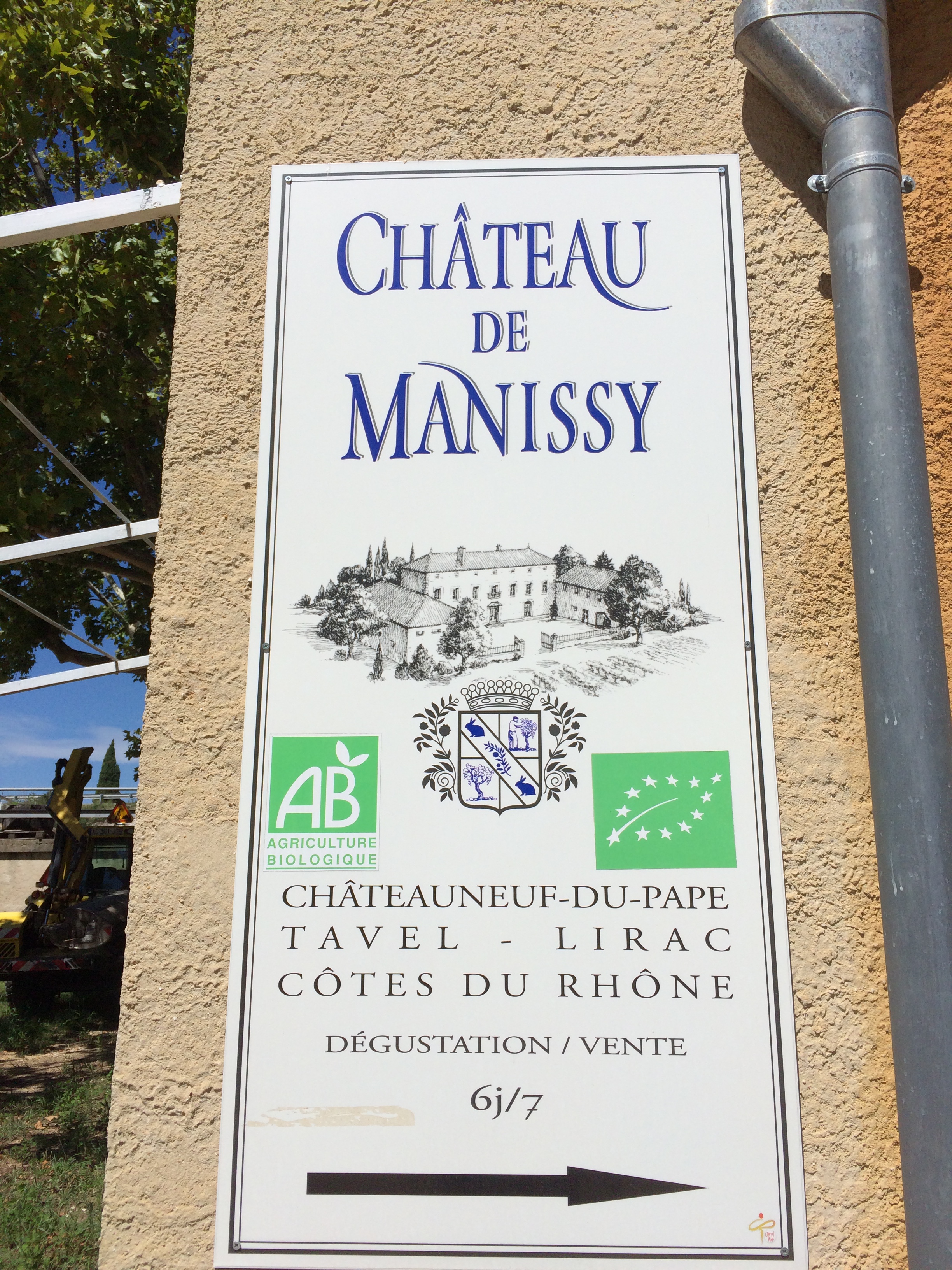
We chose Château de Manissy (LINK) in the Tavel A.O.P. from a list online. We are very glad that we did. Owned by the Holy Family’s Missionaries, it has produced rosè wines since the beginning of the 20th century and acquired a famous reputation with the “Tête de Cuvée” wine, a barrel-aged rosé. The monks turned over the viticulture and wine-making to a young many from Tavel, Florian André, who was in his early 20’s at the time. MonsieurAndré has continued some of the traditions of the monks, and oversaw the conversion to an organic winery in 2009. He has also modernized some of the techniques, while keeping that barrel-aged rosé in production. By the way, the monks still live in the Château.
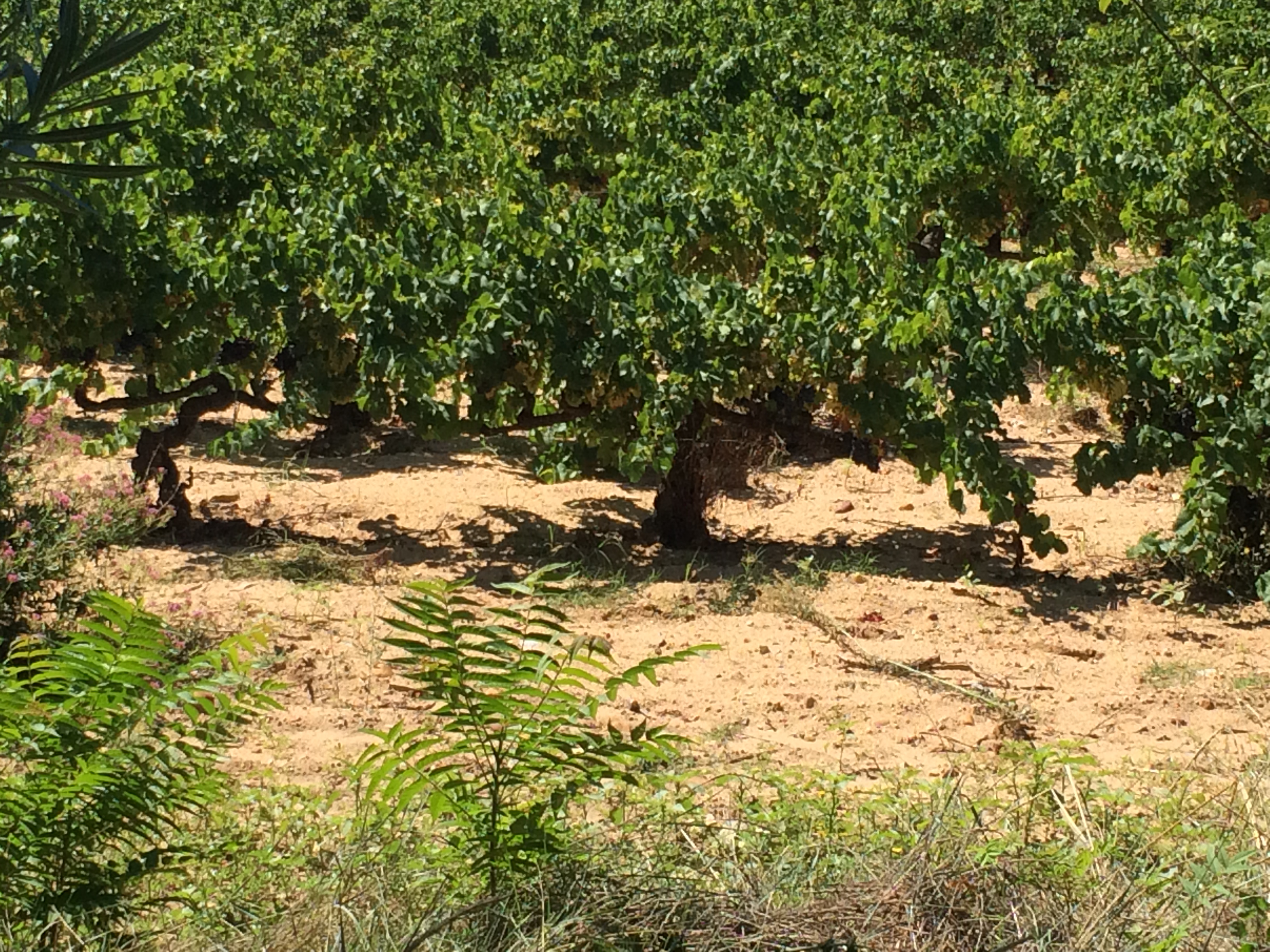
We arrived a bit early for our 2:00 pm appointment, so we wandered the grounds a bit before being met by Anaïs, the Tasting Room Manager. She took us out to the vineyards and we discussed the viticulture of the region. It turned out that her English was so good because she spent a year (2013) working at Tablas Creek Winery in Paso Robles, known for their Rhône varietals and techniques. As it happened, Dorianne and I were in the Tablas Creek wine club in 2013. Anaïs told us that her father is the winemaker at Famille Perrin/Perrin & Fils in Tavel, and they partner with Tablas Creek in a number of ventures. Small world.
Anaïs – Tasting Room Manager.Manissy’s Chateauneuf-du-Pape – from a Single Hectare Vineyard. 100% Grenache.
It also turned out that our guide on a previous tour (LINK) of Châteauneuf-du-Pape and Gigondas, Valentina of MistralTour.fr, used to work at Château de Manissy. Smaller world.
We did a tasting and then toured the wine-making operation.
First, we tasted a white from another area of vineyards and a Côtes du Rhône – Rosé of Grenache 40% – Carignan 40% – Cinsault 10% – Syrah 10%. This wine, not from 100% Tavel fruit, was closer to the rosé wines of the larger Provencal region. It was lighter and crisper than the wines to follow. They also make some other wines from vineyards outside of Tavel, all were good and very reasonably priced, but they are not why you want to visit Château de Manissy, or the wines you want to try.
The rosé wines of Château de Manissy, and of Tavel in general, are unlike other rosé wines from Provence. They tend to have a deeper pink to red color and be bolder. This is true of the 2013Tavel Rosé that we tasted, a blending of principally Grenache, Clairette, Cinsault and Bourboulenc, from about 40 years old vines. This is a bolder, more structured rosé with a sense of terroir, unusual in a rosé. There is also a nice balance of fruit – this wine manages to be refreshing and structured enough to pair with chicken or other fowl. This wine is a good representative of the moden Tavel A.O.P. rosés.
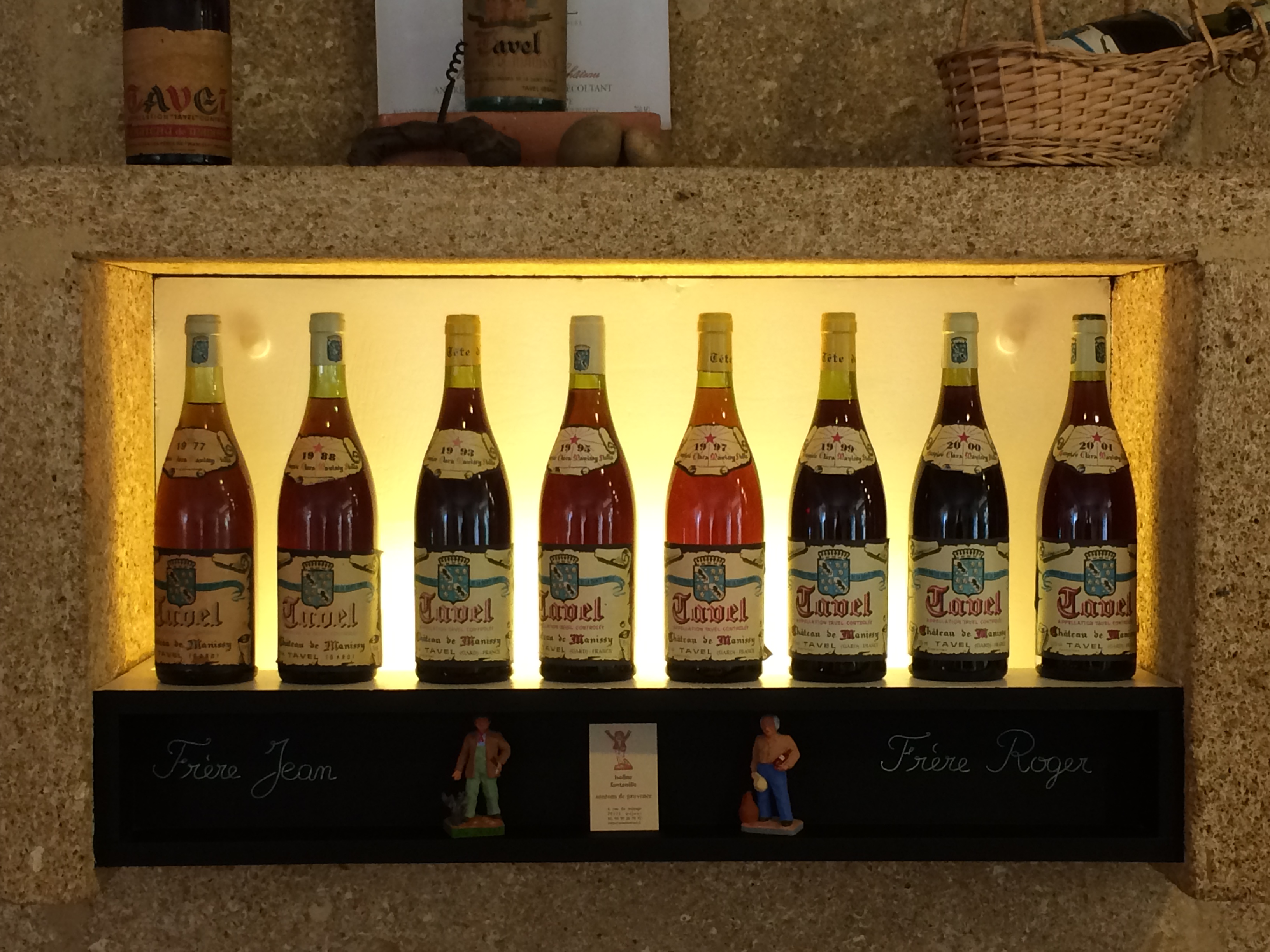
Then, we had the unique2013 Tête de Cuvée, the barrel-aged roséthat is the last vestige of the monks’ style of wine making. This is a unique roséin almost every respect. It is aged in small oak barrels, bottled in brown glass like a red wine, it pairs with beef and other meats, it is made to age for decades, and it is made to consume year-round. It is a blending of Grenache, Clairette, Cinsault, Bourboulenc and Carignan. It is mentioned but not listed for sale on their website, and there is very little information about this wine on the internet that I could find. This would be a wonderful wine for Thanksgiving Dinner, strong enough to stand up to turkey and gravy and such, but supple enough to match pretty well with all the other appetizers and side dishes that show up at that feast that is so hard to find good wine parings for. We have two bottles that will travel home with us for this purpose. Oh, and the 2013 Tête de Cuvéewas priced at 11€ or about $12.00 – one of their more expensive wines!
Tête de Cuvée Rosés Gone Back to 1977
It is also worth noting that Anaïs told us that we were the very first visitors in 2015 from the United States. I found this surprising, but then again, Tavel is not well known in the U.S. If you are looking for rosés for the remainder of the summer and into the cooler days of autumn – see if your wine retailer has wines from Tavel – you won’t be disappointed.
I will post about the other part of our day – a return to Châteauneuf-du-Pape, in the next post.
There are any number of aspects of wine enjoyment that can get confusing. The number of varietals, the thousands of producers in hundreds of regions, the right temperature and stemware to use, just to name a few. But one area that seems to stump just about everyone at one time or another is traveling with wine, especially internationally.
The article at the link is from the Lazenne.com blog site. Lazenne is a manufacturer of wine travel gear, everything from padded sleeves to keep your wine from breaking open in your suitcase to, well, wine suitcases. Here is the link to their retail site: (LINK).
“You’ll be pleasantly surprised that there are no TSA-regulated quantity limits for wine or alcohol in your checked (hold) baggage as long as it contains less than 24% alcohol. Those wanting to add a little spirits to the mix need to know that alcohol that contains over 24% alcohol is limited to 170 oz or 5 litres per person. Beverages that contain more than 70% alcohol are prohibited.
Individual airline baggage weight limits still apply, but you can use up your entire weight allotment for wine or alcohol if you choose as long as the above mentioned rules are respected. One bottle of wine weighs on average 3 lbs or 1.4 kg so you can do the math. Typical international baggage weight limits are 50 lbs or 23 kg.”
And when you get to U.S. Customs:
“In the United States there are no limits to how much alcohol you can bring as long as it is intended for personal consumption and not resale. Many mistake the duty-free limit of 34 oz or 1 liter as the total limit. If you are over the duty-free limit, you simply have to declare the alcohol you are transporting on your customs form and pay the appropriate duty to the customs officer, typically around $1 to $2 for wine and beer, while the amount for spirits is slightly higher and varies by type, as of publication. From our experience however, more typically than not, you will be waived through without paying any duty due to the amount being so negligible.”
There is more there, so check it out if you are thinking about traveling with wine soon.
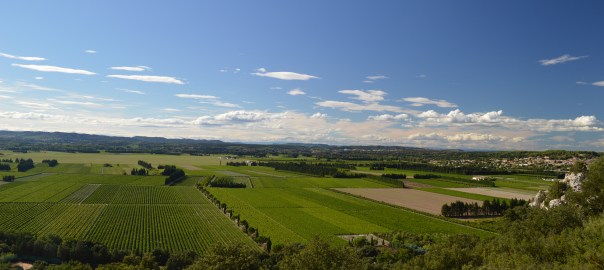
Last week, Dorianne, Grace and I joined our friend Richard Major, who was raised in the Luberon region for an afternoon drive thought the region. We started with a wonderful lunch at his home in Mazan, sharing a couple of bottles of local wines, then drove through a beautiful gorge into the Luberon Valley. As we approached the town of Bonnieux, one of the places where Richard grew up, he turned into a driveway marked Château La Canorgue (LINK). “Let’s see if they are still open,” he said – it was 6:45 pm. As we drove up the driveway through the scenic property, Richard said casually, “The winemaker, Jean-Pierre Margan and I went to high school together. I haven’t seen him for forty years.”
We digested that bit of information as we pulled into the parking area, and Richard spotted Jean-Pierre standing outside of the tasting room. They engaged in conversation while we went inside, where we met his daughter, Nathalie, who now represents the 5th generation of winegrowers at this storied property.
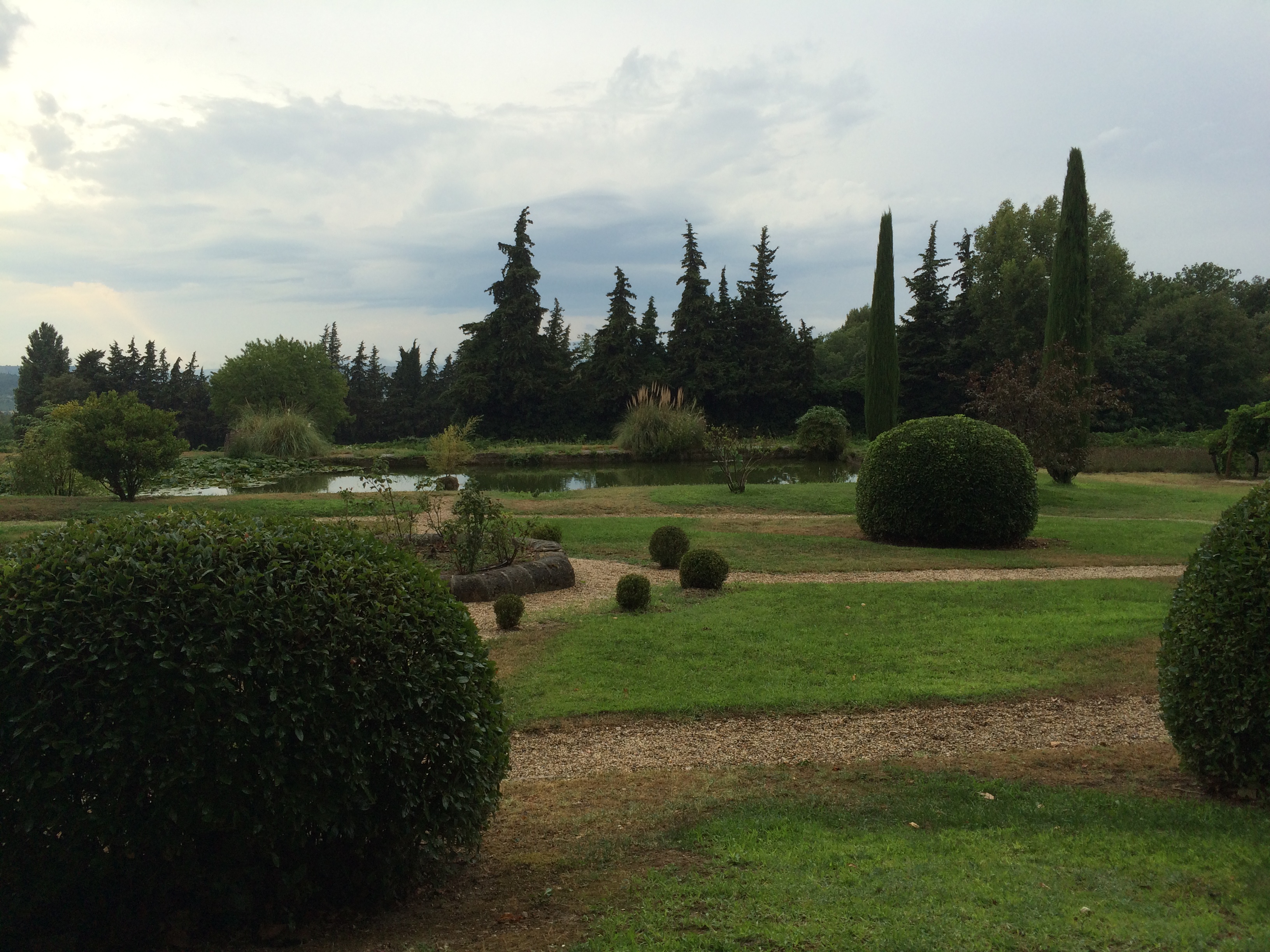
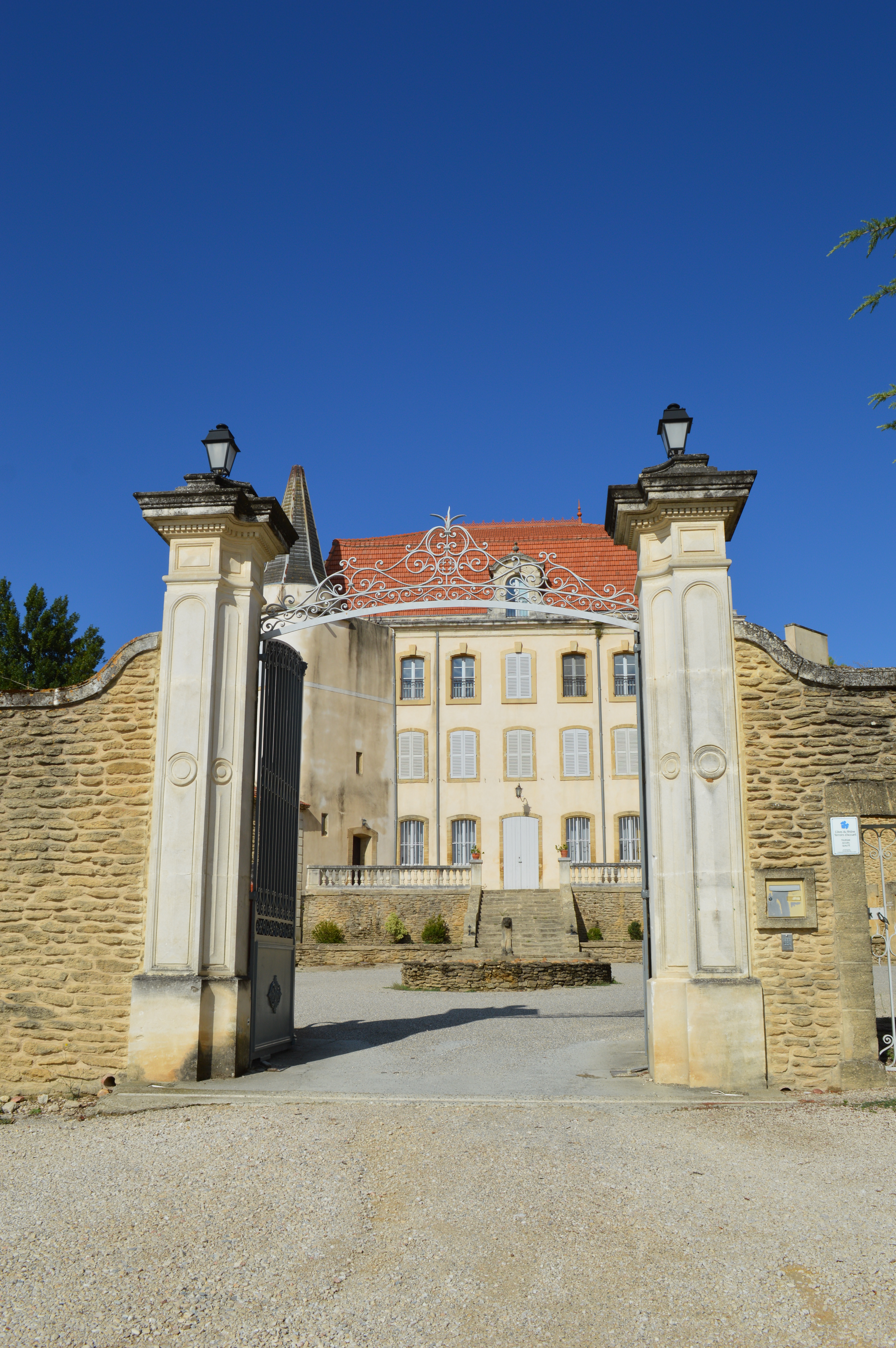
The Chateau grounds.
This beautiful property was featured in the movie “A Good Year” (A Big Year) with Russell Crowe and Marion Cotillard directed by Ridley Scott. They produce 100% organic wines(LINK) .
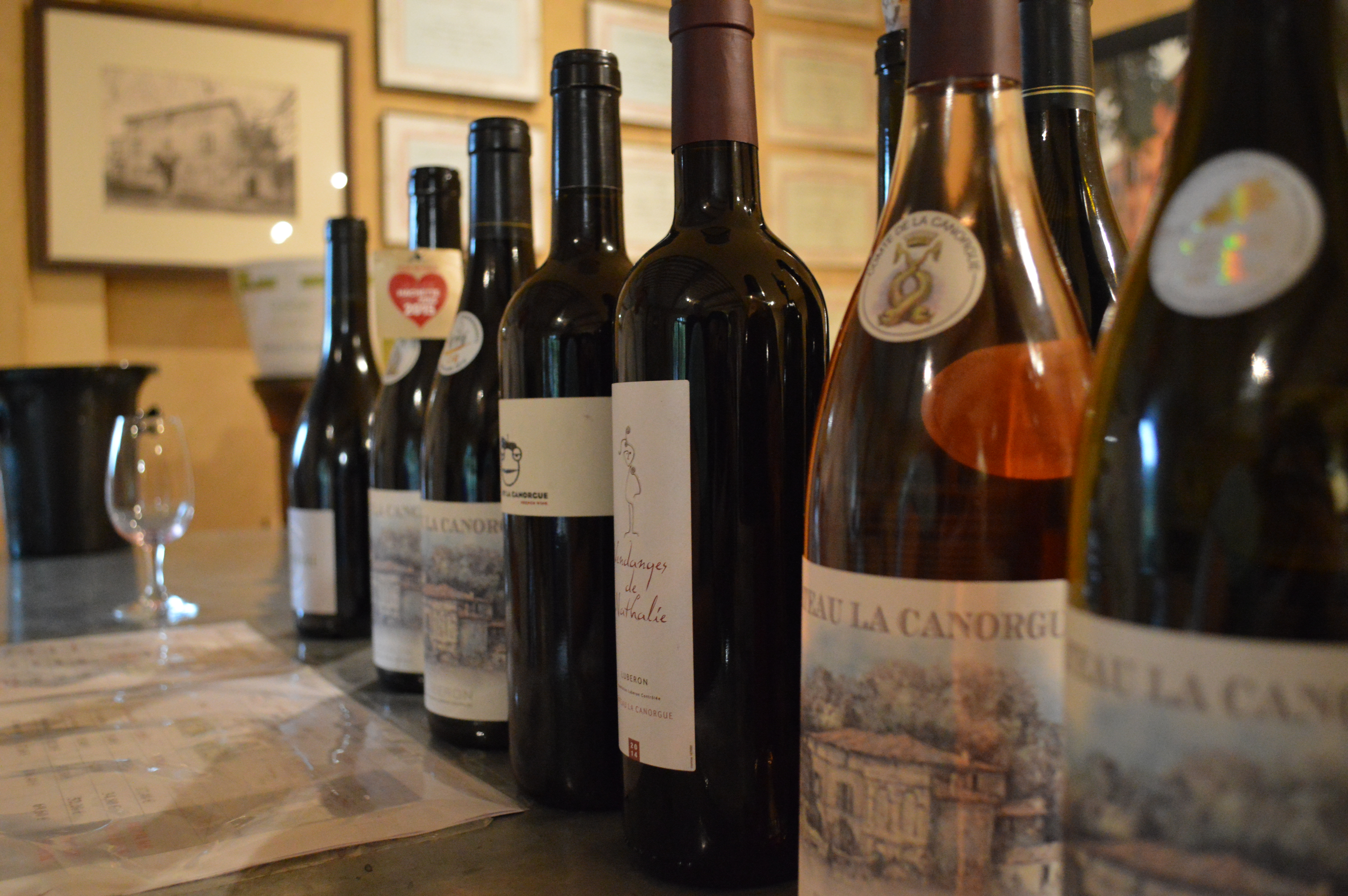
It was getting late, so we got right to a tasting of several of their wines next to a wall that contained a few dozen award certificates that the Chateau had amassed over the years.
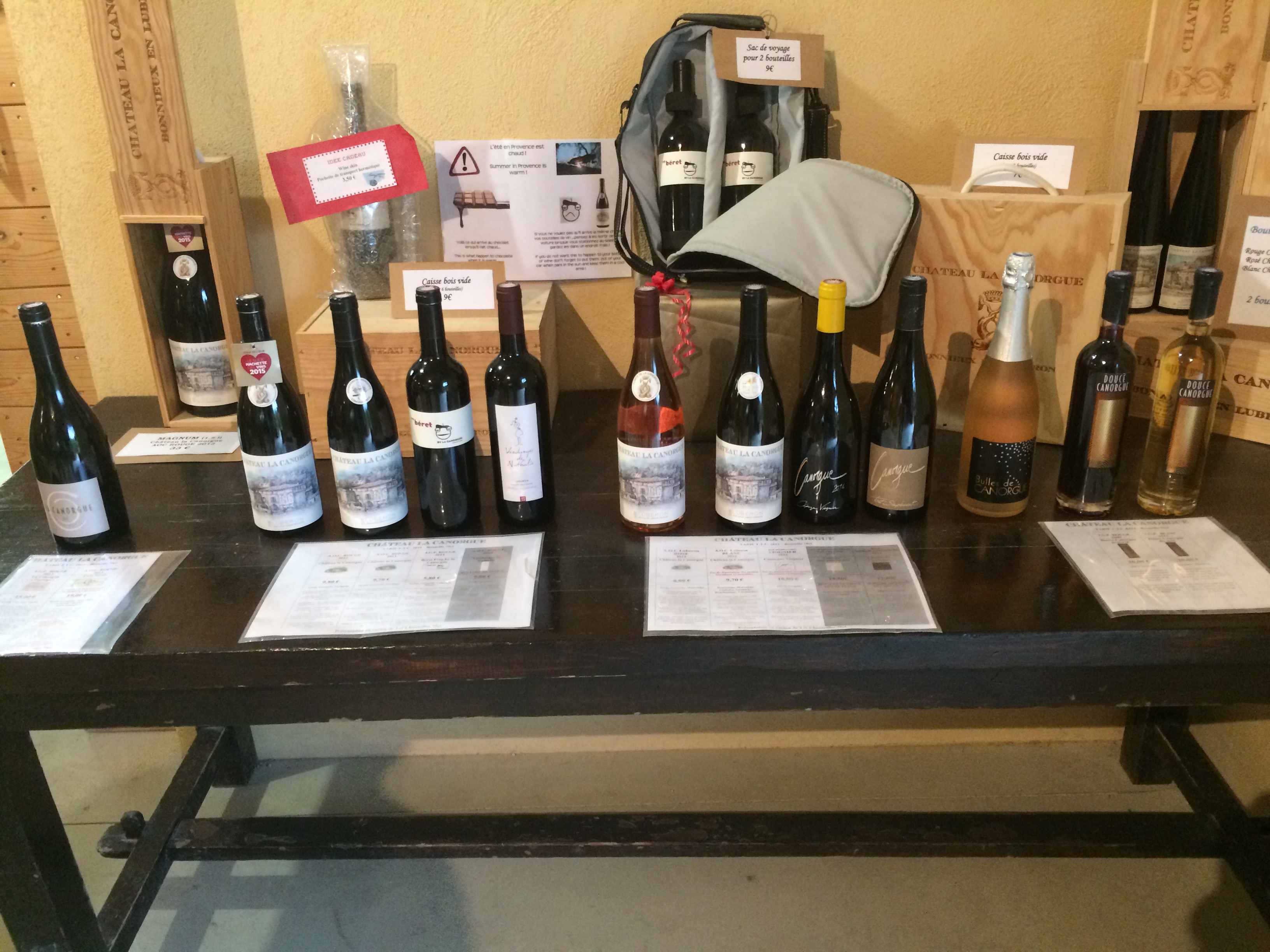
We started with their Château La Canorgue label Luberon Rosé, a blend of Grenache Blanc and Syrah. A nice, refreshing wine.
Then we tasted their Château La Canorgue label Luberon White Blend (LINK), a winner of the Gold Medal in the 2015 Concours Général Agricole Paris. This blend of Rousanne, Marsanne, Clairette and Bourboulenc makes for a very refreshing, complex wine. An excellent white wine – something that I was coming to realize as a trait of this area in the northern reaches of Provence, normally known for the reds produced here.
Next, we tasted their La Canorgue 100% Viognier (LINK), a wine that cannot carry the Chateau label because it does not meet the AOP (formerly known as AOC) regulations for blending. Nathalie Margan said that this wine was so good as a single varietal that they just went ahead and labeled it this way. It is a very fruity and light wine that would be excellent with shellfish, and has a very pleasing, long finish.
Moving to the reds, we started with their second label, Béret Frog, a blend of Cabernet, Grenache,Merlot &Syrah that sells for about 7 euros a bottle. It is a good everyday wine, with some complexity, but is more of a table wine that would be a cut above most vin ordinaire.
Next, the Château La Canorgue label Luberon Red blend (LINK), a blend of 60% Syrah, 30% Grenache, and 10% old vine Carignan and Mourvedre. This is the flagship wine of the property. It is a first-class wine, with great structure, a nose of dark fruit and minerals, and flavor of the terroir balanced nicely with fruit and cassis, and a smooth long finish.
Finally, the 2012 La Canorgue Red, a limited production 100% Grenache. A truly delicious wine with a nice tannic structure. This small production wine is generally absent from the internet, but you can order it from their website.
We purchased 8 bottles of wine to take back to our apartment near Avignon, and headed out to explore another village or two and then have dinner back in Mazan. A great day in The Luberon Valley. If you get up this way, don’t miss Château La Canorgue, a beautiful location with some wonderful wines.
Château La Canorgue, Route du Pont Julien, 84480 Bonnieux
As a wine blogger, I really like to explore the wine regions I visit. We are in the Avignon area for six weeks, and I had been itching to get to Châteauneuf-du-Pape to taste some of their fantastic wines on-site and to learn more about the culture and process of this renowned region. At the recommendation of Lauren, proprietor of the wonderful Art, Wine, and Design Shop in Villeneuve-les-Avignon, I called Valentina of MistralTour.fr and set up an all-day tour this past Friday. Dorianne and our daughter, Grace, joined us. Most of the photographs in this post were taken by Grace – here is a (LINK) to her website.
Valentina is a delight – an Italian who lives in France and speaks perfect English; she is very vivacious and professional. She is an excellent guide.
Our tour took us to the Village of Châteauneuf-du-Pape, where we went up to the ruins of the original chateau and surveyed the beautiful countryside laced with vineyards in all directions. Along the way, Valentina talks about all things wine – she really has a good degree of knowledge and makes everything clear. Châteauneuf-du-Pape is a storied wine region centered around the town of the same name. The AOC (LINK) allows for 18 varietals (not 13 as is commonly believed). From Wikipedia.com:“Both red and white varieties are allowed in both red and white Châteauneuf-du-Pape. There are no restrictions as to the proportion of grape varieties to be used, and unlike the case with other appellations, the allowed grape varieties are not differentiated into principal varieties and accessory varieties. Thus, it is theoretically possible to produce varietal Châteauneuf-du-Pape from any of the eighteen allowed varieties. In reality, most Châteauneuf-du-Pape wines are blends dominated by Grenache. Only one of every 16 bottles produced in the region is white wine.”
I was unfamiliar with whites and rosés from this region, but let me tell you, there are some amazing wines here. U.S. retailers and restaurants should be getting on the bandwagon for the whites and rosés of Châteauneuf-du-Pape and Gigondas.
Chateau de Vaudieu. Side entrance.La Cave at Chateau de Vaudieu.
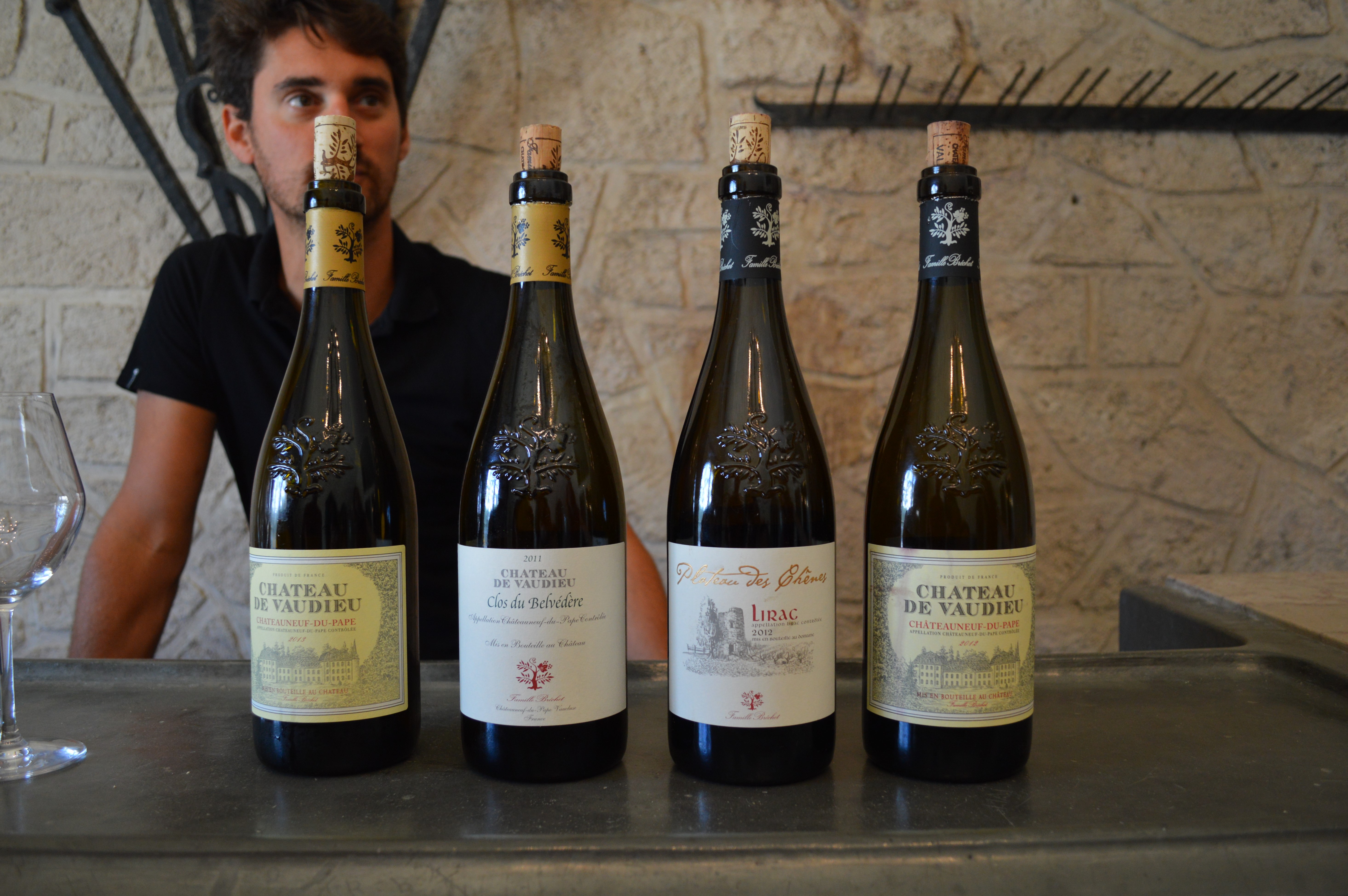
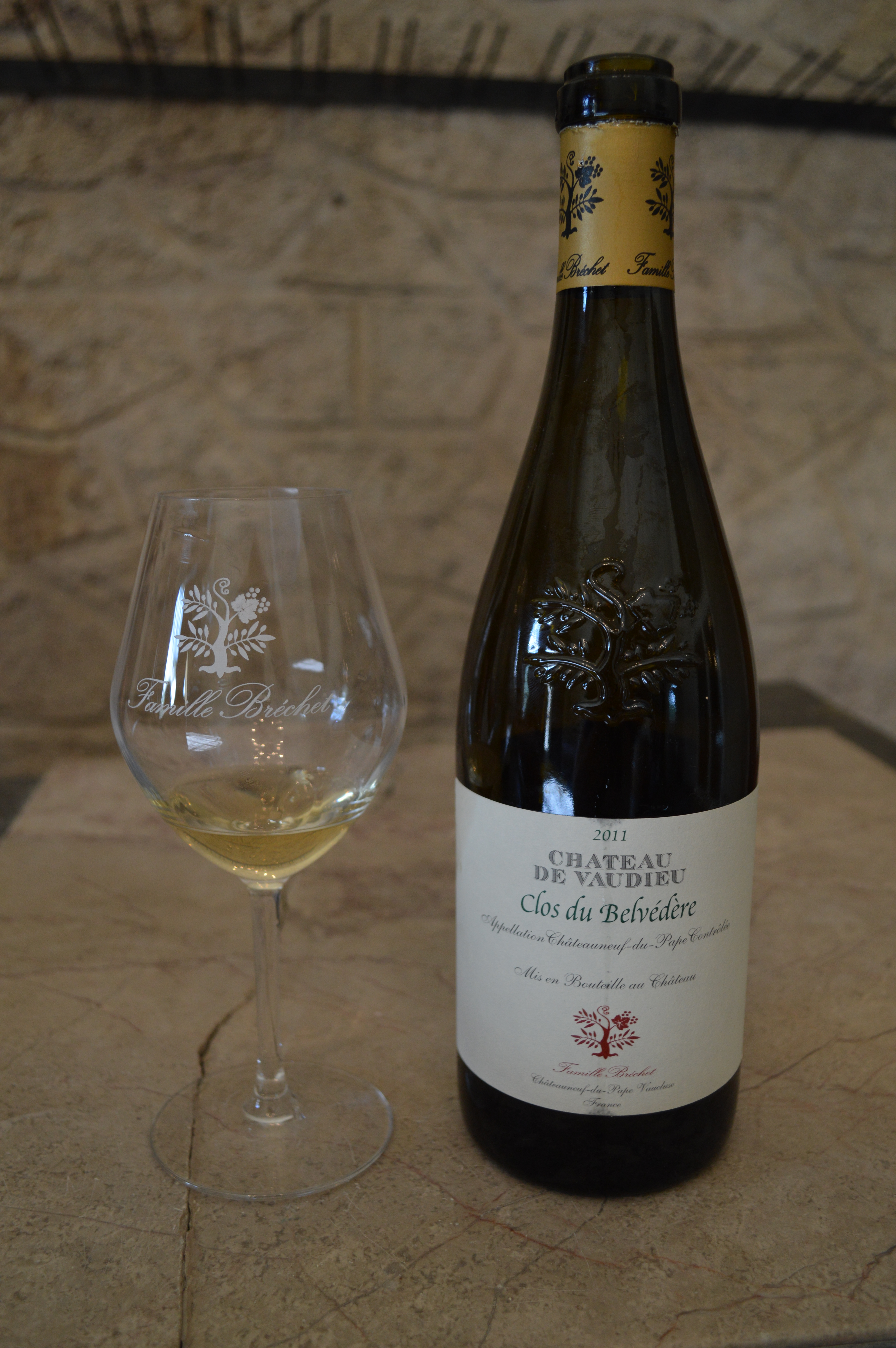
Then we drove just down the road to Chateau de Vaudieu (LINK) for a tour and a private tasting with the winemaker, Christophe. Chateau de Vaudieu dates from 1767. They have 70 hectares (173 acres) of grapes under cultivation, all around the chateau.
Winemaker Christophe and his wines.A White Chateauneuf-du-Pape – whites make up 15% of Chateau de Vaudieu’s production. Grenache 75% – Roussanne 25%.Another White Chateauneuf-du-Pape – whites make up 15% of Chateau de Vaudieu’s production. 100% Grenache Blanc.
Lirac is an AOC just across theRhône Riverfrom Châteauneuf-du-Pape. It has similar varietals and soils, and the wines are a bargain. Quite a few Châteauneuf-du-Pape growers bottle Lirac Wines.
is 2012 Plateau des Red Oak , Lirac. Grenache/Syrah blend.2012 Chateau de Vaudieu Red. AOC CHATEAUNEUF DU PAPE. Grapes : Grenache 74% – Syrah 26%
Next, we went into the village to the wine shop of Domaine Durieu, where the winemaker was also present for part of our stay, then we tasted four of their wines. I should add that Châteauneuf-du-Pape wines are among the best in France. No photos here.
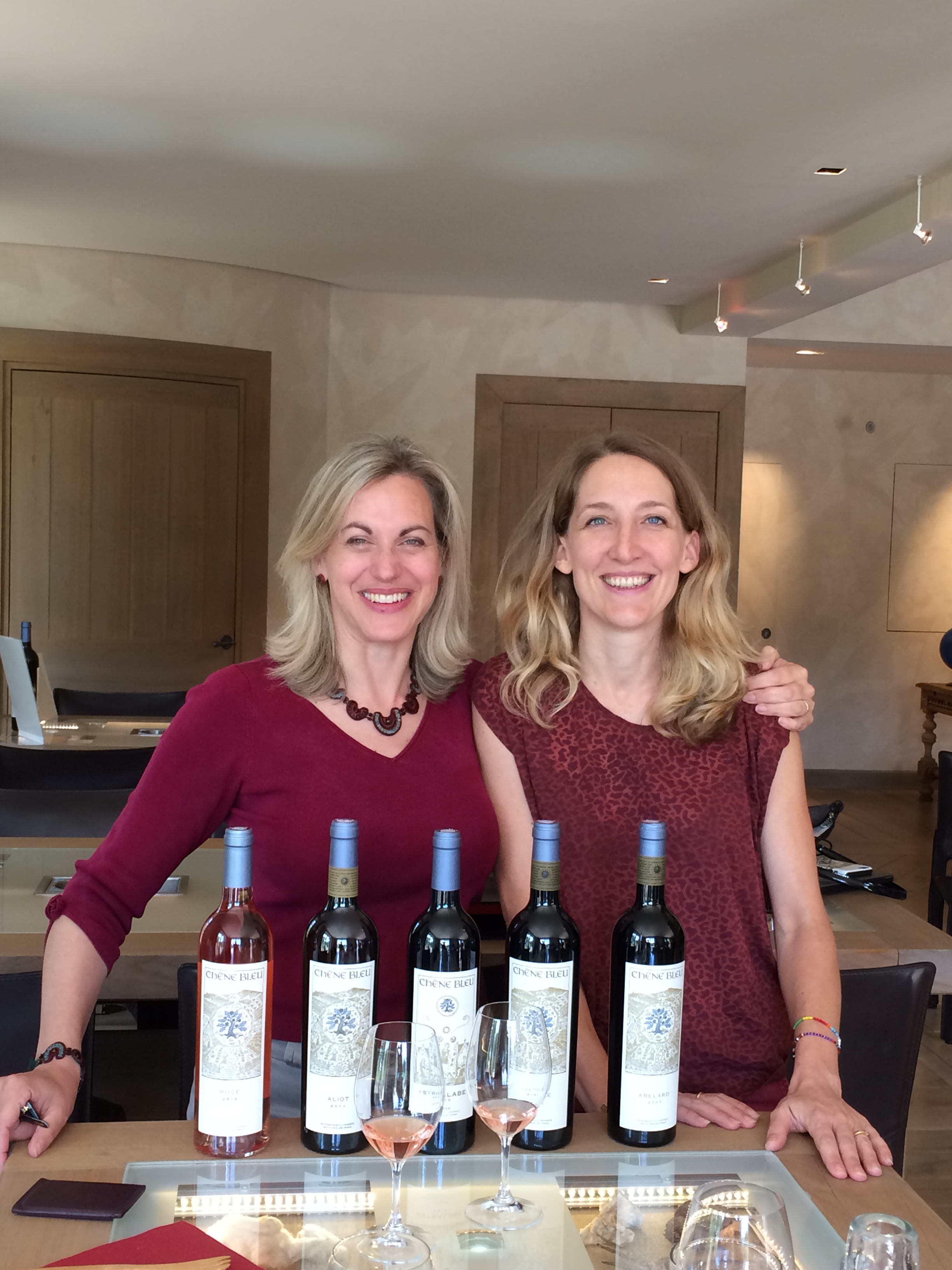
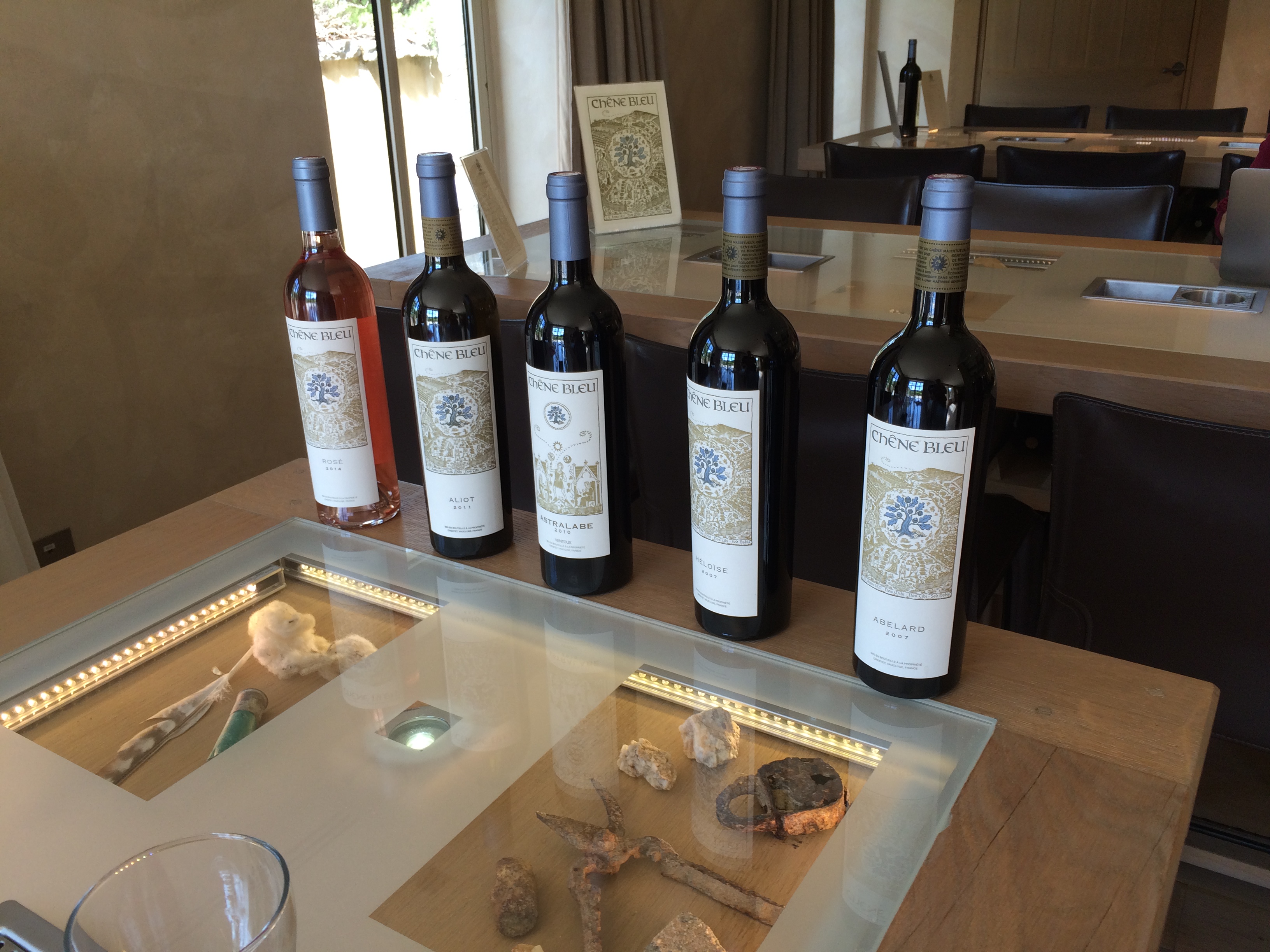
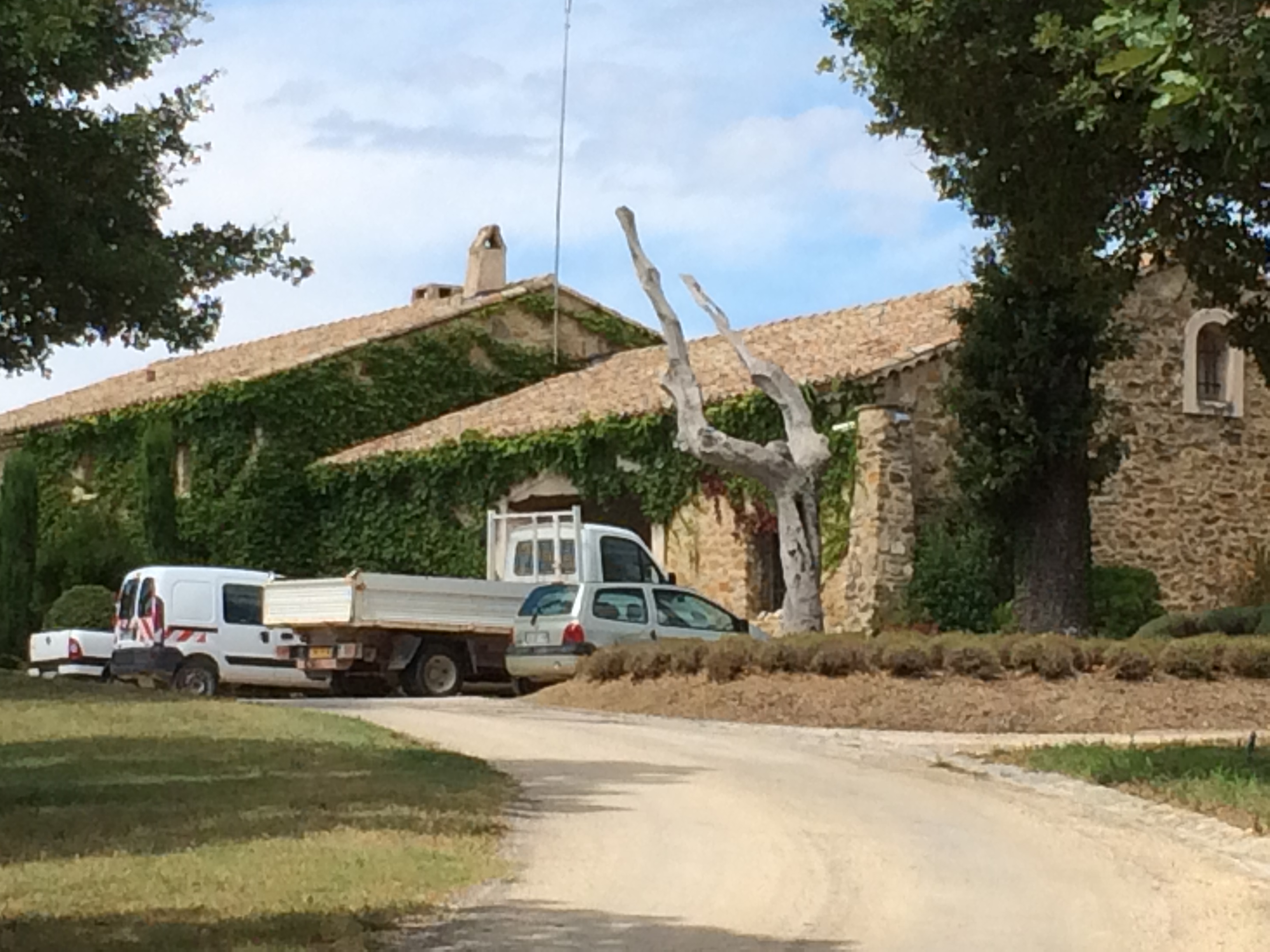
Then a long drive through he region to La Verrière, in Crestet up on a mountain, where we had a wonderful lunch, a conversation with the owner (Nicole Rolet who co-owns with her husband, Xavier) and the winemaker, and tasted the award winning Chene Bleu Rhône wines (LINK); then we had a complete tour of the facilities. This is one of the most beautiful wine estates I have ever seen in France, and after speaking with the principals, I can see why.
This team produces some excellent wines and they have created an atmosphere of success at their beautiful property. The wines were smooth, well-crafted, beautifully balanced and simply delicious. They are available in the U.S. and elsewhere, so check their website (LINK) for more information, or Google the wine names.
Note that the Chene Bleu wines are made outside of the French AOC system – Nicole and Xavier felt too bound by the rules of the local AOC, so they deviated, and it has been a battle for acceptance. Of course, the wines speak for themselves and have received numerous awards and recognitions.
Owner Nicole Rolet, our guide, Valentina, and the wines of Chêne Bleu at Domaine de la Verrière.The Chêne Bleu (Blue Oak) at Domaine de la Verrière – painted with copper paint.The wines of Domaine de la Verrière, labeled Chêne Bleu.
Me and the Winemaker, Jean-Luis Gallucci.
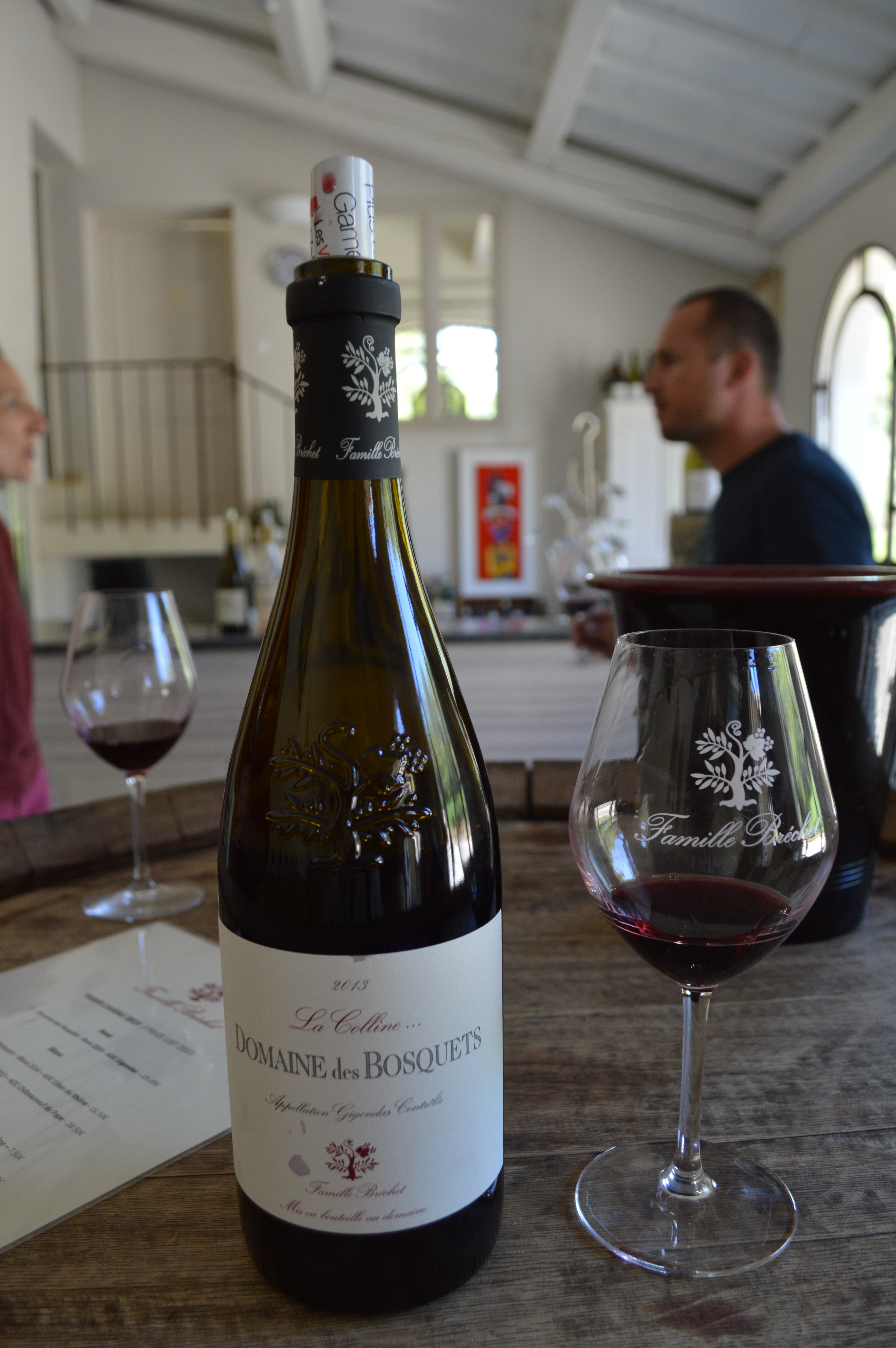
Then we were off to Gigondas, another storied region, for a tasting at Domaine des Bosquets (LINK), owned by the same family as Chateau de Veudieu. We tasted several wines with the owner/winemaker at this location as well. Winemaker Julien Bréchet hosted our tasting. The Gigondas is very similar to Châteauneuf-du-Pape, with a focus on Grenache and Syrah as the primary varietals. The main difference is the type of soil – less gravely and with more limestone and sand than Châteauneuf-du-Pape, plus a higher elevation with more verticality to the vineyards. The wines at Domaine des Bosquets were similar in style to those from Chateau de Veudieu– smooth, well-structured and elegant. The Gigondas is a great wine region.
2014 Domaine des Bosquets Blanc – 80% Grenache – 20% Roussane – This white is made on the high elevation plot called “Cheval Long”. Handpicked, and vinified in oak barrels, only several cases are released.2013 Domaine des Bosquets Rouge cuvée « Le Lieu dit… » – The laying down wine from the estate’s celebrated plot, vinified and matured pure. This is a Grenache in all its splendor, in turn opulent, soft, elegant and blessed with beautiful length on the palate.2013 Domaine des Bosquets Rouge cuvée « La Colline… » – This parcel was planted into the rocks by our ancestors. It overlooks the estate and stretches as far as the edge of the Dentelles de Montmirail.2009 Domaine des Bosquets Rouge cuvée « Le Lieu dit… »Grace (our official photographer for the trip), Me, and Dorianne in the vineyard at Domaine des Bosquets
Then we explored the nearby hilltop town of Gigondas a bit before heading back to our apartment.
It was an amazing day that filled my need to explore somewhat more n depth the areas we visited and to learn more about the wines. We made purchases at every stop! This is a very rich region, part of the overall Rhône Valley Region, so there is much, much more to explore. So we will have to do some more exploring on this trip, and we will have to come back.
And again, I cannot give enough praise to Valentina of MistralTour.fr (LINK) – she is a professional and makes your time together very enjoyable, while giving you as much, or as little inside information as you would like. And her prices really are a bargain.
Dorianne and I are happily ensconced in a nice AirBnB.com apartment in a beautiful village called Villanueve lès Avignon, just across the Rhône River from Avignon. We will be here for six weeks, so five to go. It has been pretty hot here, as is normally the case this time of year (think Southern California with a bit more humidity), so we look for refreshing meals and refreshing wines, which has, for the most part meant rosé wines. Of course we have had some whites and a couple of local reds (they chill them here in summer) from the Luberon, Languedoc-Roussillon and Province, but rosé has been our go-to wine 3/4 of the time. They have been good with lunch, with our late afternoon wine-cheese-and-olive snack (all local, of course), and with our dinners.
We have paid from 4 euros to 17 euros per bottle, and found very little difference in the quality of the wines. Some are a bit sweeter than others, some need to be really cold to drink well, but the degree of separation for most of these wines is minimal.
A Collage of Some of the Southeastern France Rosés We Have Had.
One rosé from Corsica’s (LINK) Vin de Course AOC had Nielluccio, Sciacarello and Grenache as its varietals (not pictured). The wine was a delight and cost 4.50€, or about $4.80 for a bottle.
But mostly, we are drinking the wines of the regions that abut Avignon, which include Luberon, Languedoc-Roussillon, Chateauneuf du Pape, and Provence. I am not sure which, if any of these wines are available in the U.S. or other countries. All I can say is, this summer if you can get your hands on rosés from Southeastern France, do it. We will be touring some local wineries and regions over the next few weeks, so look for more posts about this magical place.
Noma, the Copenhagen restaurant that has been voted “The Best Restaurant in the World” (LINK) over and over, was the site of a recent visit by Dorianne, two friends, and me recently. Here are the links to the first three installments of the series: (LINK TO PART 1)(LINK TO PART 2)(LINK TO PART 3).
This post, the final installment in the series, covers the post-meal tour of the facilities at Noma (LINK)and contains some commentary.
After our meal (see parts 2 & 3 of this series), it was good to stand up. We had been sitting for about two and one-half hours in a very intensive activity – eating new things, drinking new wines, talking about the meal and doing our own internal processing without stopping. When I stood up, I realized two things – I had been sitting quite a while and I had a lot to drink. Wine with 20 courses . . . you do the math.
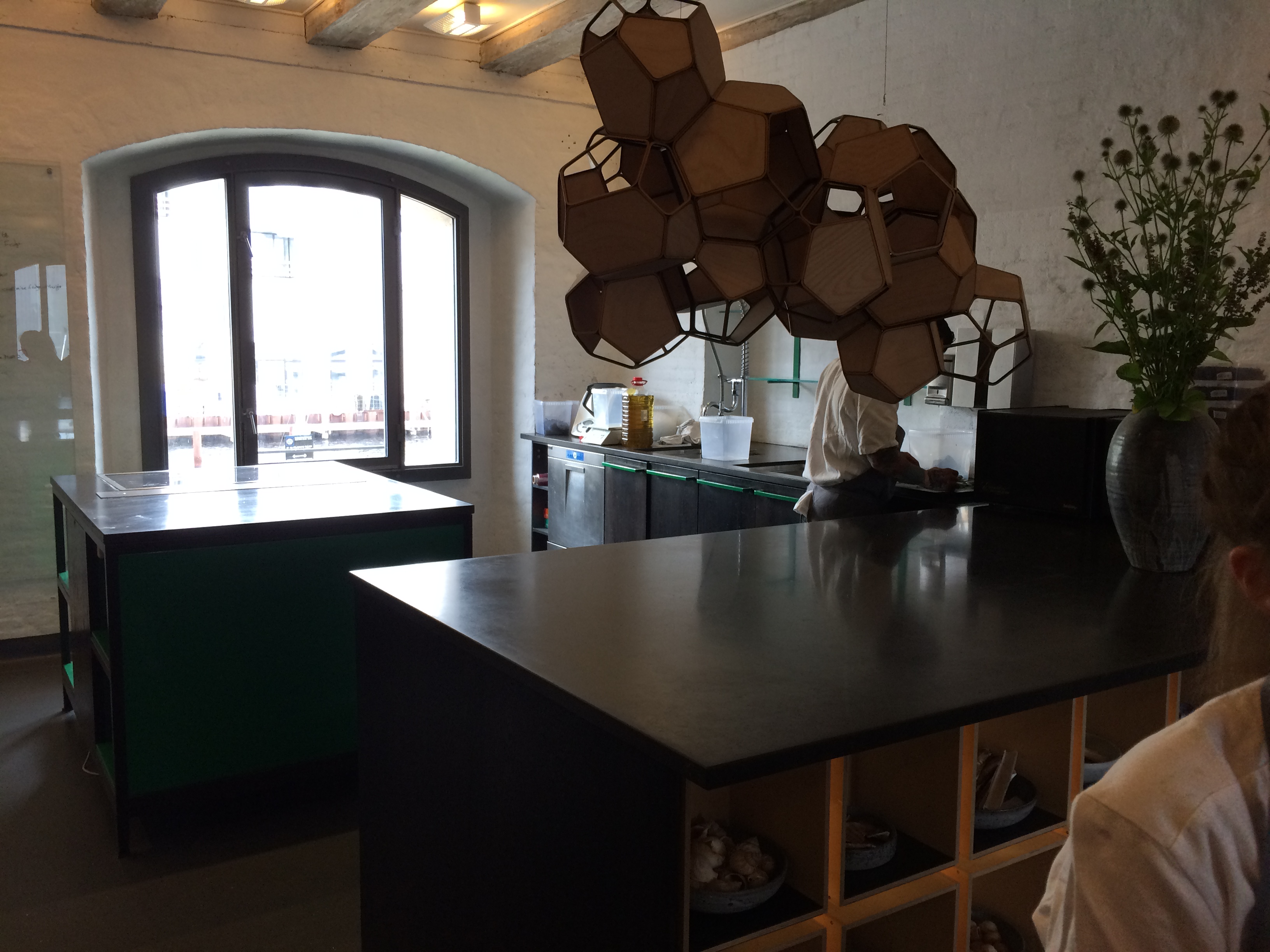
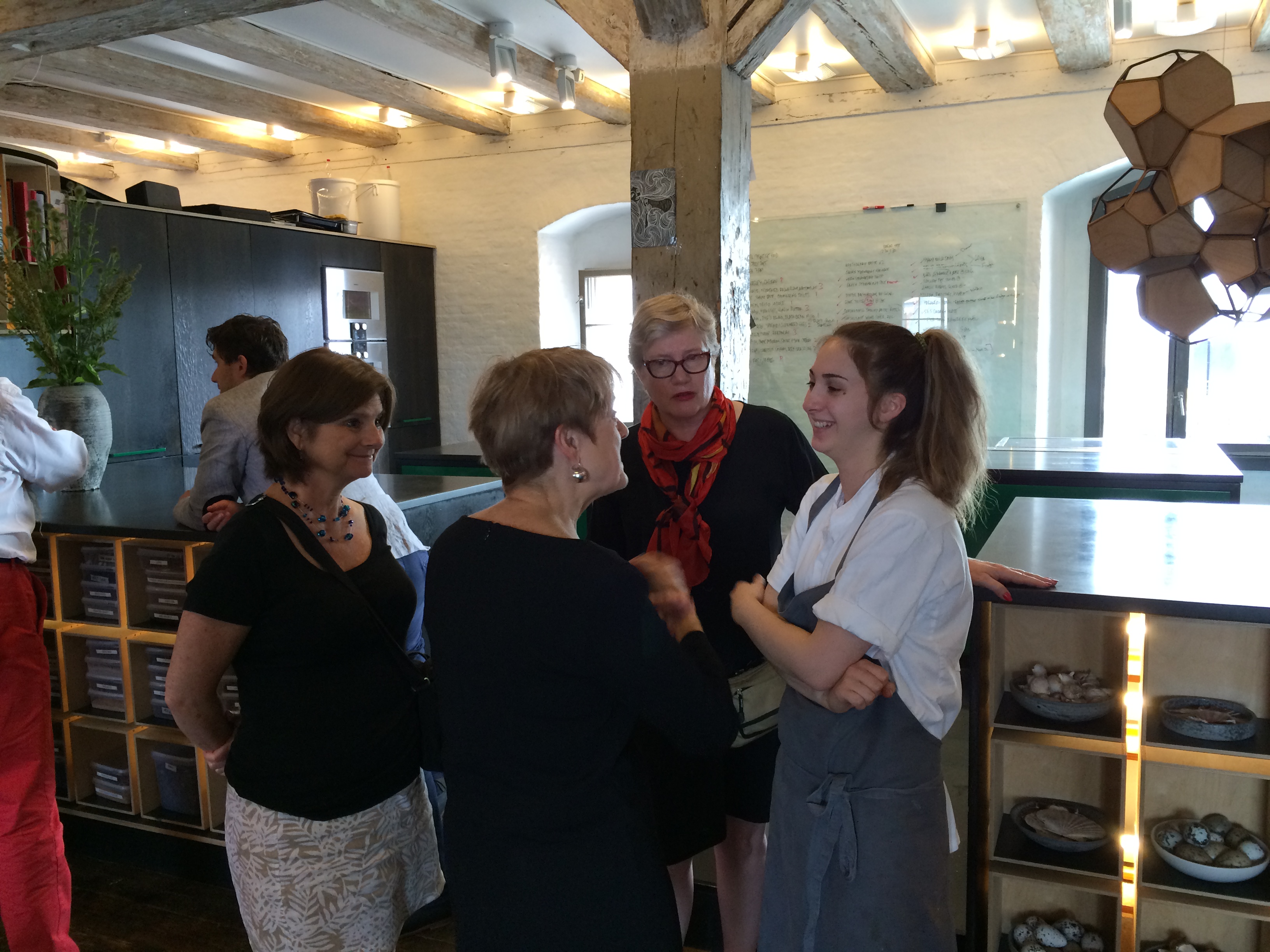
So I went to the restroom and then joined our party in the preparation kitchen, which is adjacent to and visible from the dining room. The tour, being guided by a young woman who is a chef at Noma (she said that she started as an intern a few years back. She is in her early 20’s, and YES, she knows – or says she knows – what an advantage that is for her). I did not get this young woman’s name, but I am sure that I will be seeing her face in a future foodie magazine as a star chef someplace.
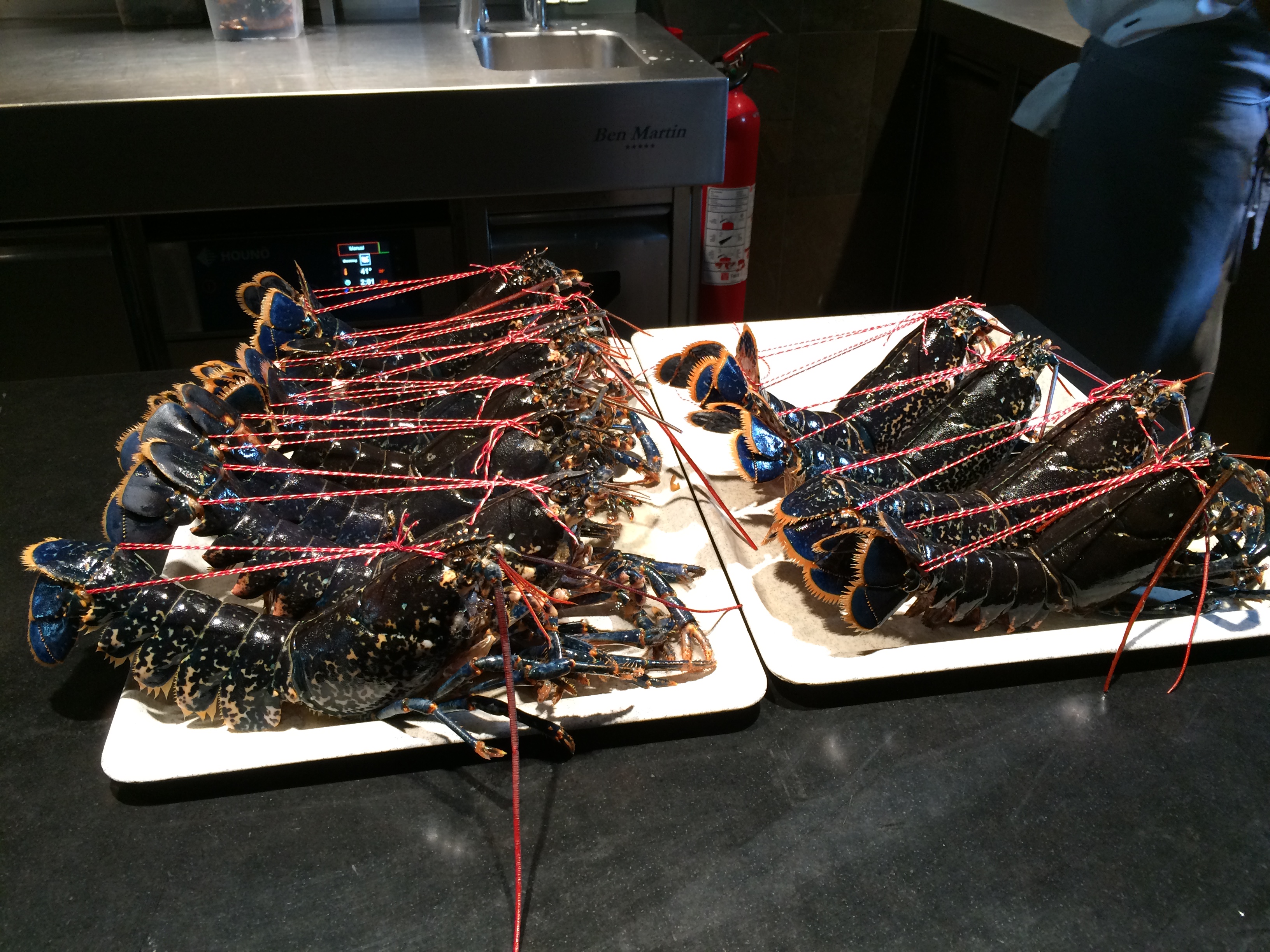
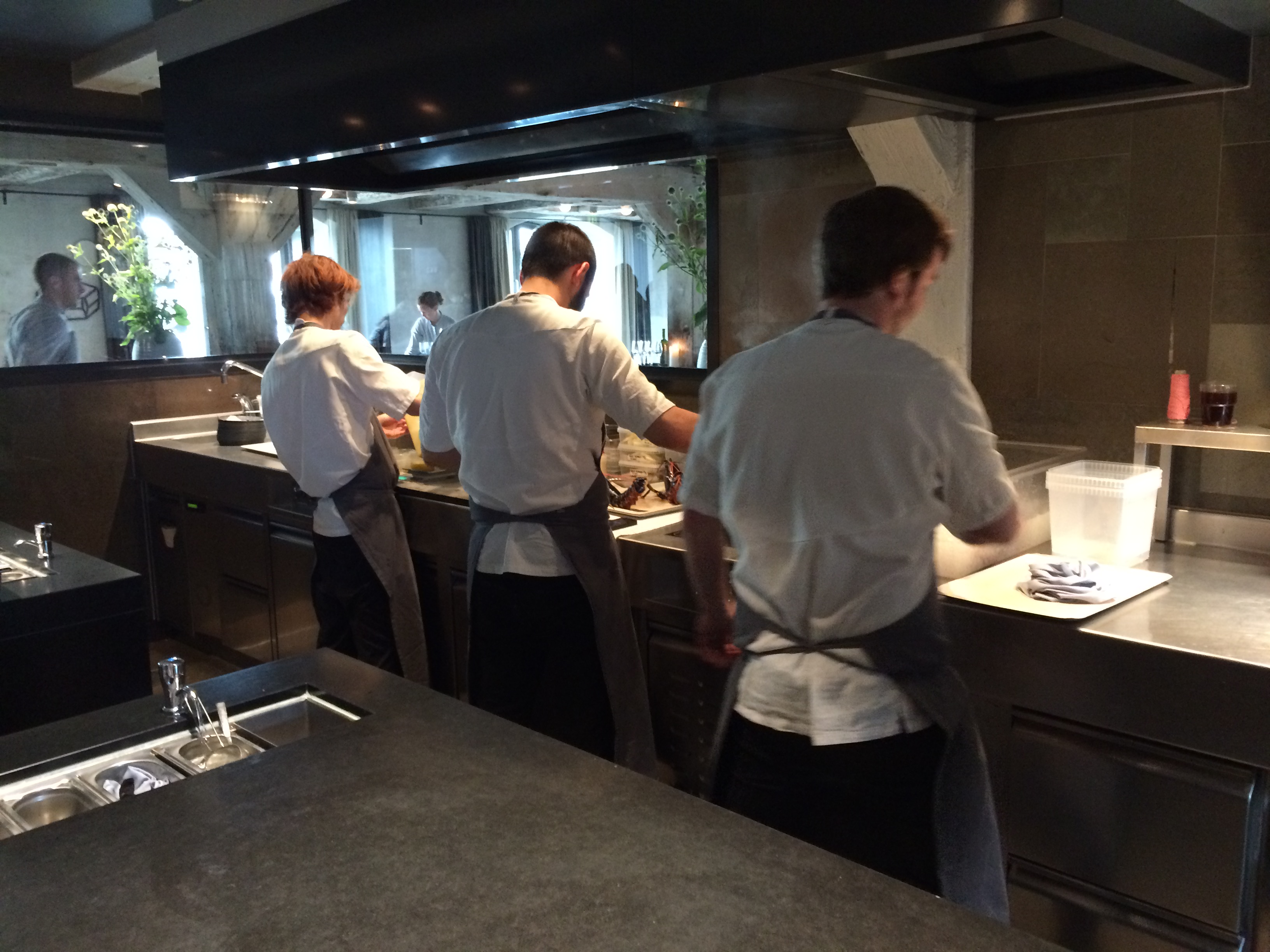
Assembling the Forest Flavors and Chocolate Desserts.North Sea Lobsters all in a Row.Presentation Kitchen Activity.Getting the Egg Liqueur Ready.
This first kitchen is where things are prepared to be served at the table and where some of the cooking is done.
Our Young Chef Tour Guide Showing us Around.
Then we went out back of the restaurant to the Laboratory.
That’s right. The LABORATORY.
The Laboratory Facility.Various Plants, Molds, etc., Being Tested for Various Qualities. All Very Mysterious.Testing How Certain Berries Age.
Here they try things out – there are all kinds of experiments going on to test various ingredients and what happens to them over time in various marinades, and under various conditions, etc. A very interesting part of the operation.
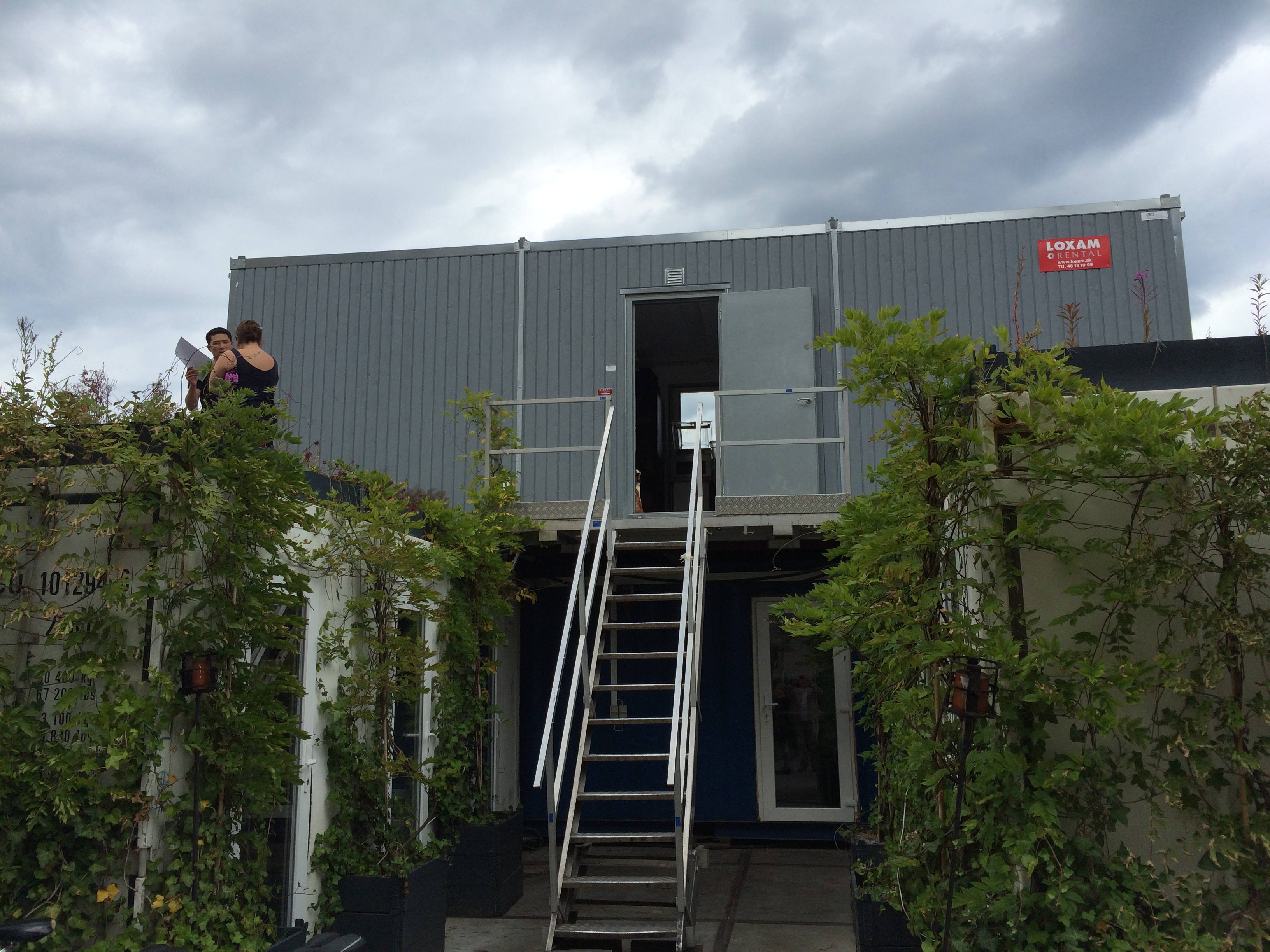
Upstairs, a private dining room that seats up to twenty. You can rent the room for a lot of money (like thousands of Euros) and then PAY FULL PRICE for your Noma meal!
The Private Dining Room on the Second Floor.
The Book Shelves of Noma.
Action in the hallway: Ironing uniforms.
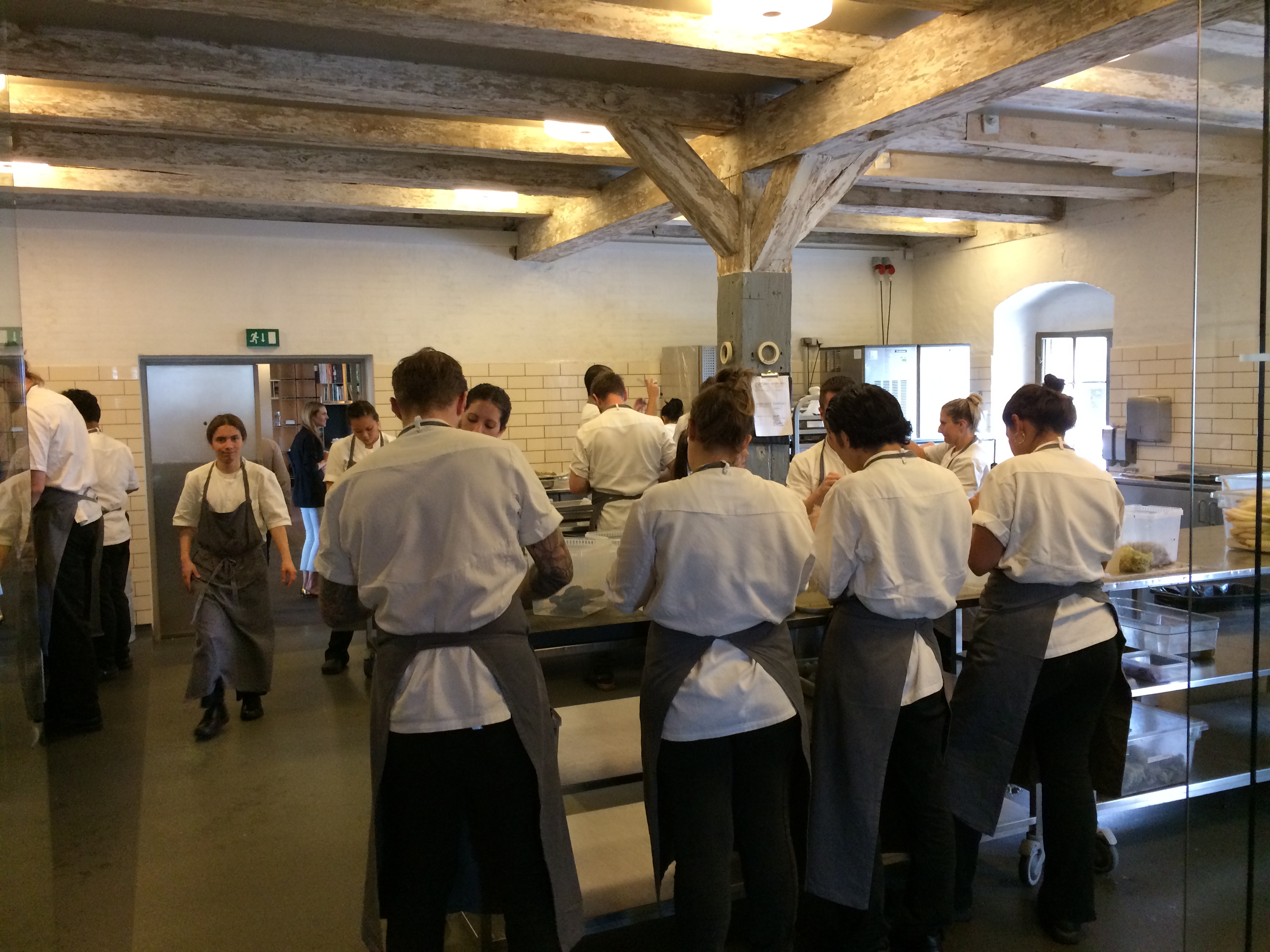
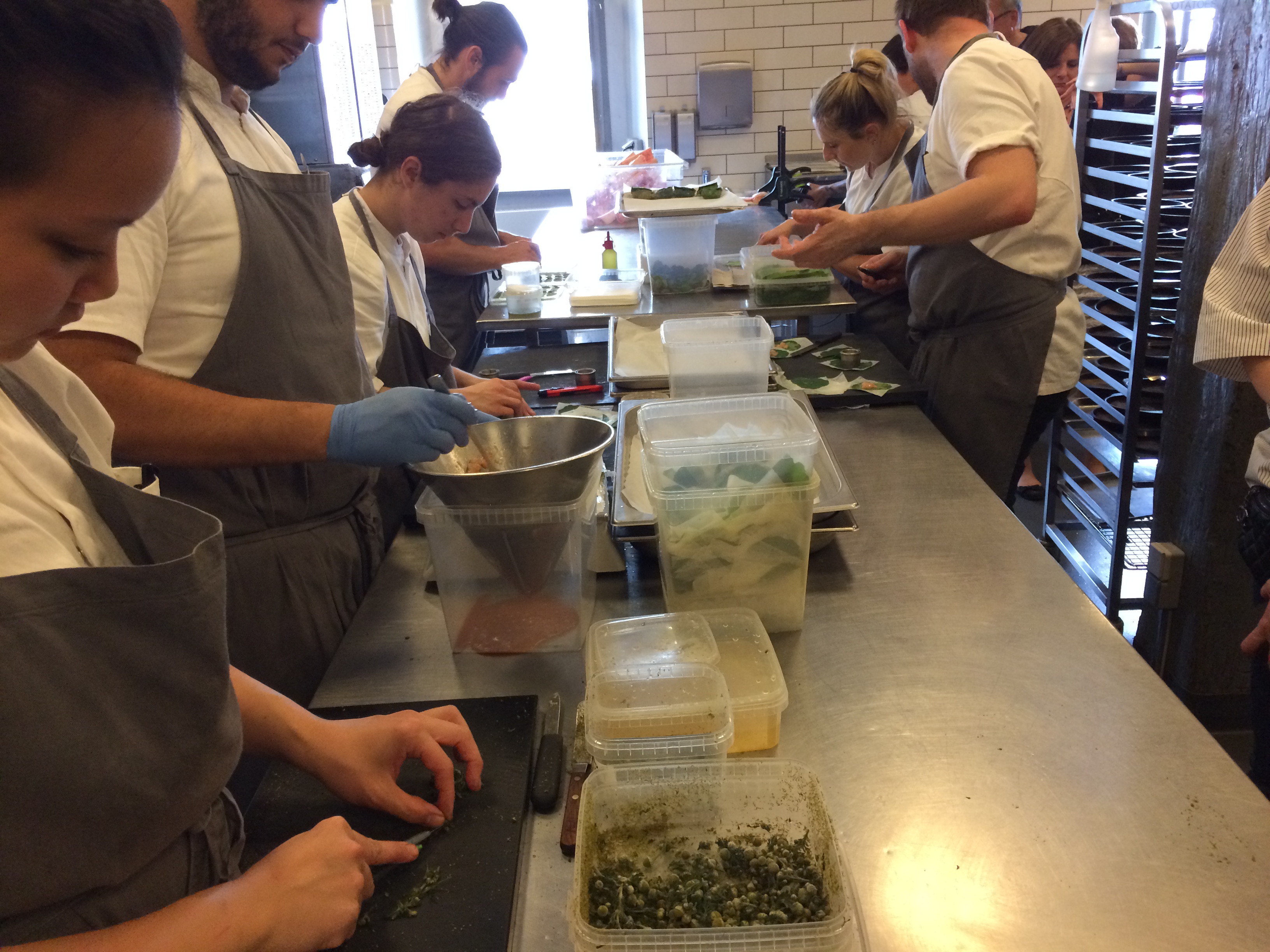
The Prep Kitchen – where the action is.
Cutting Frozen Bones for the Bone Marrow Dish.
Reindeer Moss.The Prep Kitchen Staff – Keep in Mind that Noma Seats 45 or so.
The Staff Room – where cooking, exploring recipe ideas, relaxing, changing clothes, etc. happens. There is a smaller kitchen, an herb garden, and lots of things stored – mushrooms, etc. Here you really get a sense of the Noma Culture, which is think is the glue that makes Noma what it is – one of the best restaurants in the world. You can see that the people who work here have accepted an ethos that they have had a hand in co-creating. René Redzepi, Owner and Founder and Chef de Cuisine is Daniel Giusti were not on the premises that day. They have brought a powerful culture of creativity, innovation, sustainability and success that seems to permeate the staff in a very good way. To work at Noma is to believe in this ethos, even if your intention is to get some experience and move on. While you are there, you are a true believer. Here is a link a partial list of Noma Alumni(LINK).
The Kitchen in the Staff Room.The Kitchen Garden in the Staff Room.Our Group has Lots of Questions for our Guide.
The lounge – near the entry, where you can have a drink before or after, or, I imagine, in lieu of, dinner.
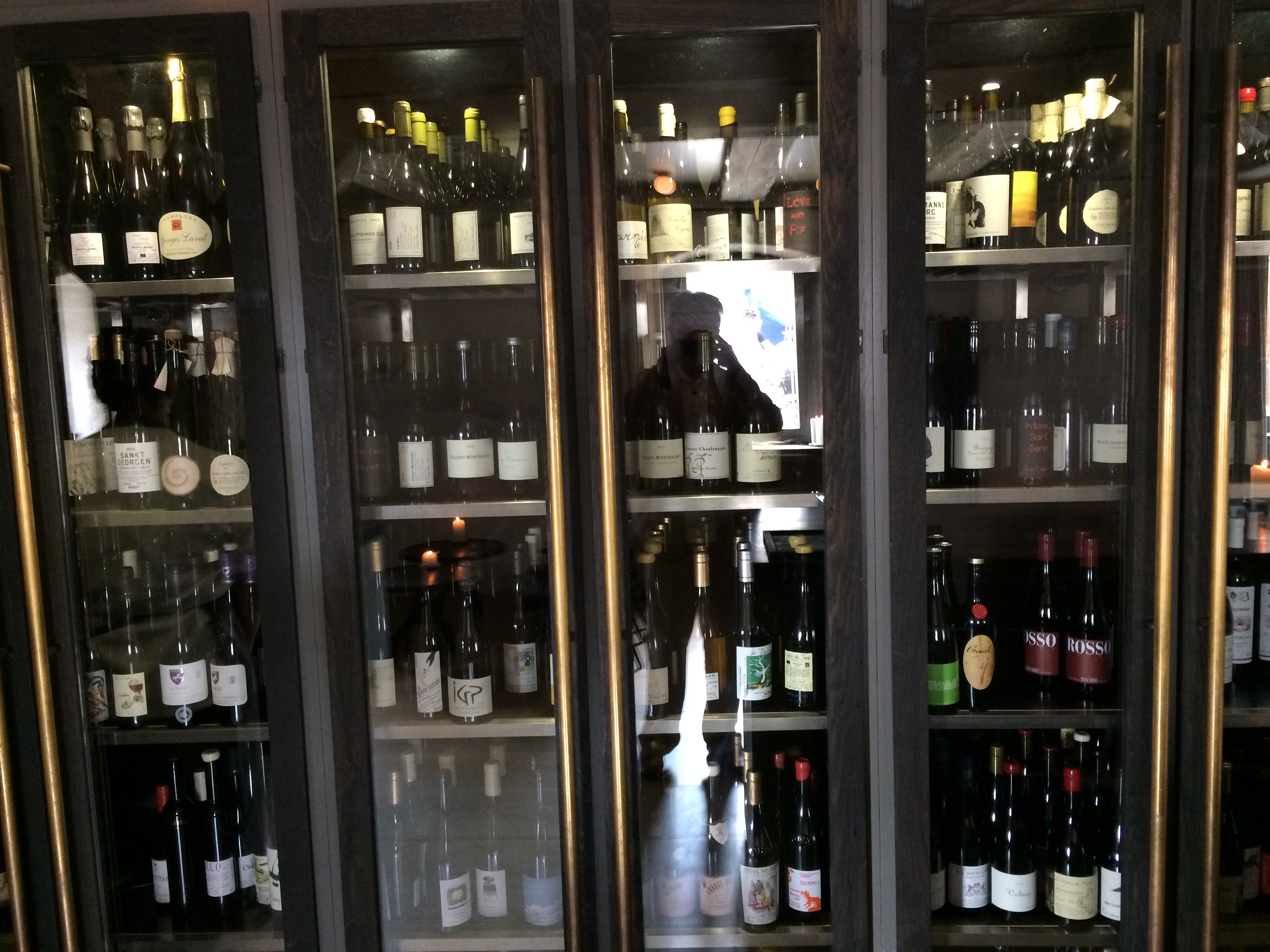
The Lounge at Noma.The Wine Storage in the Lounge.
So ends our tour of Noma. On to some commentary.
Overall, this wonderful experience. While I did not like everything that I was served (probably not possible), I will say that the experience of the food was overall very enjoyable, both in tasting the dishes and in experiencing the creativity.
We were served 20 courses. My main negative about Noma is that the courses came out too quickly.
We had 20 in that time and it was too much too quickly. This is food that you want to savor – to talk about the amazing combinations of ingredients with your table mates, to take some photos (but of course!), and to taste the wine served and to experience the pairing of food and wine; then to reflect privately for a moment or two and then to share with your fellow diners your impressions and experience.
This takes time. But the next course is here!
I don’t think that this is a minor quibble. I like to savor. I don’t like to feel like they need to move me out to get the next seating in (which was not the case, as the next seating was for dinner). So please, Noma, a bit more time. I am not in a hurry when I am spending this kind of money for this kind of experience. I am sure that all of this has been figured out over time, but for me, it was not optimal in regard to truly enjoying the meal at leisure.
I read the other day of a restaurant opening in Barcelona that will serve 50 courses in two and one-half hours. I doubt I’ll be going there.
The wines at Noma were, let me say, unique (LINK TO LIST AS PDF). I have written about each and posted photos of the labels, but you probably won’t be able to find most of them – maybe one or two. I spoke with Sommelier Yukiyasu Kaneko about his choices. He said that he preferred to use only European wines, and that included a wine from Georgia in the former Soviet Union. He also clearly has a preference for young wines to accompany the fauna heavy Noma menu. All of the wines were whites. I found that the pairings worked well with one or two exceptions, and in those cases the wines were either sour or so very young as to have only rough edges, which I guess was intentional, but I did not agree with those choices.
Note that there is a lounge at Noma, where you can come for a drink or some wine before or after dinner, although you get quite a bit of wine with the paring meals – I recommend a taxi or a designated driver. We walked, and got a bit lost on the way back to our apartment.
How much did it cost? The wine pairing meal was 3100 DKK or about $450 per person. the juice pairing was 2500 DKK or about $367. Expensive, I know. It was Dorianne and my 10th Wedding Anniversary gift to one another, so a very special occasion.
Will I go again? Not sure that I need to, but if the opportunity presents itself – I will strongly consider it. I’d like to see what they do next. Have you been to Noma? Your comments are appreciated.













































 Jim Lockard On Wine
