Tag Archives: wine

HEY, IT’S THE HOLIDAYS – GIFT GIVING GUIDE FOR THE PERPLEXED WINE LOVER

Wine-related gift giving is always a bit of a challenge. Do you give wine, wine gadgets, wine books, wine experiences? Do you have some entry-level wine lovers on your list? Some experts (God forbid a Wine Blogger)? Is price a big concern? Are you a bit panic-stricken in the wine department?
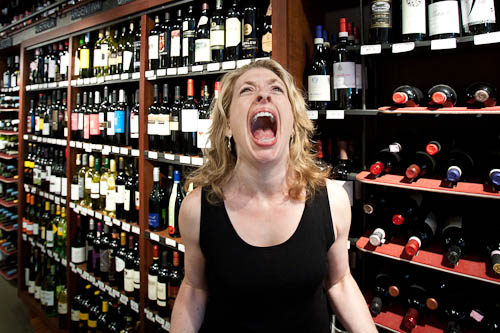
Wine Angst

Well, I know how you feel. The thing to do is to approach your holiday gift giving with a calm sense of purpose and a willingness to give someone something that they may not fully appreciate. Or even like.

Now no one wants to disappoint a loved one or a business colleague, but you’re not a mind reader are you? So do your best, be willing to be flexible, and relax. ‘Tis the season to ENJOY giving and receiving gifts. After all, you are probably more likely to receive a wine basket full of Barefoot Wine than you are to give one, right? (HINT: Do not give Barefoot Wine, Two-Buck Chuck, or “critter wines” – you know, the cheap Australians). No one wants those (they really don’t & they are filled with additives that nobody wants either) and you look, well, cheap and thoughtless for giving them. They are the equivalent of the fruitcake in Holiday wine gift giving.

My recommendation is to give wines that you personally enjoy and that, ideally, have a story. Maybe a little Syrah that you enjoyed at a restaurant or found at a winery that was off the beaten path somewhere; or a gadget that you particularly cherish. When a gift has a personal touch, it is both more fun to prepare and give and more special to receive.

If you live near wine country, or if your gift recipient has a trip planned to a wine region, you might consider the gift of a private tasting that includes a bottle of wine to take away. Most wineries can accommodate such a purchase and you get or make a certificate to give to the recipient. You can gift a wine class to a beginner, or a special wine pairing dinner to someone with more knowledge. And I can help you with the gift of a wine tour in France (if interested, PM me at JimLockardTravels@yahoo.com).

Gadgets are good gifts up to a point. A nice decanter or a set of nice wine glasses are good choices; it tends to go downhill from there. I probably do not keep about 2/3 of the wine gadgets I receive, either because I already have one or because they don’t work, or because it is something I just don’t use. Here is an example:

Wine - Wine Stopper Novelty

This stopper-thing is goofy and was given in fun. It might be okay except that it did not provide a good seal on the bottle. I would rather use the cork or twist cap that came with the wine bottle, because the goal is to preserve the wine.

Wine openers are a good choice, but a personal one. We all have our preferences. Here are links to posts about two openers that I have blogged about that I can recommend. However, you should remember that wine openers are personal and your gift may not be used.


(LINK TO CO2 GAS OPENER)

(LINK TO TRAVEL OPENER)

Wine - Santa Wine

What about wine as a gift?

Always a welcome idea, however, there are some inherent issues in giving wine that you may want to pay attention to.

  1. Shipping. If it needs to be shipped, this can be an issue. There are all kinds of restrictions, most importantly that the USPS, UPS and FEDeX do not take alcohol shipments from private parties. You can have a winery or a wine shop ship for you, but that will often cost more than the wine. I would stick to wine gifts that can be given in person or dropped off. Ship the gadgets.
  2. Shipping Part 2. One exception (and it’s too late for this Christmas) is to use an online service like WTSO.com (LINK) to ship gift wine. You are limited to what they are offering, so you may have to check the site repeatedly, but it is an easier way to ship wine.
  3. Giving the wine. If you take your gift of wine to a holiday party given by the recipient, it may just become part of the bar for the party. That may be fine, but it is not ideal. So bring a bottle for the bar and put your gift, well wrapped, under the tree.
  4. Selection of the wine to give can be a minefield (see the idea of being willing to give something that the recipient may not enjoy). I try to avoid their favorite wines because I know that they will get them for themselves. I go for something unusual for them. Maybe a Petite Sirah for a Cabernet drinker or a Semillion for a Chardonnay drinker. Or a Port or Sauternes, and even Champagne or Cava or a local sparkler for anyone. If they like whites or reds, give them that, but help them to explore a bit. You can also get something like an Australian Cabernet for a Bordeaux drinker. Another idea is to get a mixed case for a new wine drinker; or for me for that matter.
  5. Wine Baskets. The key to a good wine basket is the wine. Rather than picking up a pre-made basket, ask the staff at your wine retailer to make you one that you design yourself. (HINT: Instead of cheese, get a gift card for the cheese and put a description/photos of the recommended cheeses in the basket). Avoid the kinds of cheese that are usually in baskets that are full of preservatives and other non-cheese stuff.
  6. Labels. it is said that 80% of wine purchases are made because of the label. Fine, do that if you must. Get some Skinny Bitch as a joke for a female friend, or some Fat Bastard for that male friend with the not-too-sophisticated sense of humor. Just be aware that it only encourages the bottling of mostly bulk wine with clever labels, thus entrapping another generation of new wine drinkers in rivers of barely drinkable wines full of additives. I’m just sayin’.
  7. Price. It is easy for you to go overboard here. Those top-shelf wines are awfully appealing, especially when you want to impress someone (and many have nice labels, too!). I recommend that you know your budget and stick to it; that will make for a happier January when the credit card bill comes.
  8. Get help. Your local wine shop, or even Costco (but probably not Target – don’t buy gift wine at Target) has someone who knows wine and will help you. Get their advice – you don’t have to take it, but a good wine department employee can be a big help. The same is true if you are buying from a winery. Tell them what you are looking for, they love to talk about their wines and will be helpful.
  9. Status. I know that some are getting wines to give as corporate gifts. I will leave that to you, because you are clearly trying to impress people, which is fine, but that is not what the individual giver should be doing. The sad part of corporate wine giving is that many, if not most, of the wines go to people who do not appreciate them. I had a friend who does not drink wine and who received a case of Joseph Phelps Insignia Cabernet Sauvignon one year. He gave some away and used the rest in spaghetti sauce.

In short, wine-related giving is a field rich in opportunity with a few land mines here and there. I recommend again that you give thoughtfully, within your budget, and that you do your best to enjoy the process. Use your gift-buying time on-line or in stores to explore and expand your own wine experience.

Thanks so much for visiting this site, or even following it, this year. And have a very Happy Holiday Season and a Prosperous and Wine-filled New Year!

Wine - Christmas and Drink Wine


AN ITALIAN OASIS IN OAXACA

Dorianne and I are spending a month in Oaxaca, Mexico. We knew coming in that this culinary capital, known for molè sauces, chocolate, and coffee was not wine country. The drinks here are mescal and cerveza. Indeed, we have had some wonderful meals, both in the city and out in the pueblos, where indigenous people make amazing foods.  But wine – not so much.

There is a large supermercado near our Colonial Reforma AirBnB.com house that has a wine section featuring a few South American and Mexican wines, plus a smattering of French, Italian, and Spanish bottles – all at the lower end of the spectrum.  The U.S. is represented here by Gallo. You don’t really find fine wines here, but some decent bottles are available if you know where to look. Better restaurants feature Mexican wines, but the local cuisine, driven by spicy molès, salsas, etc., does not pair well with wine for the most part. Beer (cerveza) is just fine for most cocina oaxaqueña meals.

And, I was, truth be told, growing a bit weary of the local cuisine after two weeks of nothing  but . . .

T2015-11-27 18.56.15hat is why we were so happy to discover Ristorante Italiano Epicuro (no website, LINK to FB page), an oasis of fine Italian dining with a small, but welcome list of Italian wines – a regular list and an artisanal list with a total of about 30 wines. Stepping in off of Calle Guerro into number 319 one is transported, if not to Italy, to a sophisticated setting that could  be in any major city. The decor consists of light green walls, very high ceilings, with a portion that has a retractable roof for this climate, scenes of things Italian on the walls, and nicely appointed tables. There are not a lot of restaurants in Oaxaca that are not oaxaqueña, so there are really few guidelines for how to handle the mix of cultures in terms of food and decor. Ristorante Italiano Epicuro goes purely Italian on the food and a more general upscale look on the decor.
Our good friends Richard Clark and Mary Stec were in town visiting for a few days. They used to own a gourmet chocolate business and sourced their chocolate and molès from Oaxaca. It was their last night with us in Oaxaca, so we went for dinner early – before 7:00 pm, so the place was nearly empty.

Our waiter, Juan Carlos, a veteran of the high-end Los Angeles restaurant scene (Valentino and others), greeted us warmly and masterfully guided us through the evening. Chef Valter Epifania is from Genoa, and knows his way around the kitchen. He came to our table near the end of the meal. We also met Eder, the owner, who came to Mexico from Italy six years ago and opened the restaurant a year later.

We ordered two bottles of wine from the smaller “artisanal wine list.” All were under 600 pesos, or about $35 U.S. at the current exchange rate of 16.8 pesos to the dollar. The most expensive bottle on either list was an Italian Cabernet Sauvignon on the main wine list for 820 pesos, or about $48 U.S.

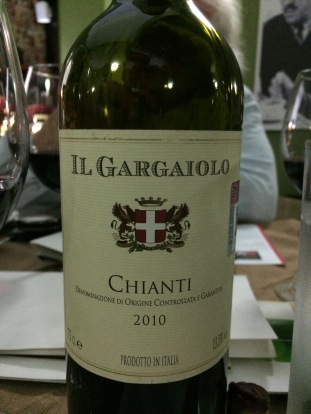
Our first bottle was a 2010 Il Gargaiolo Chianti, 85% Sangiovese & 15% Merlot. It was very dry and tight at first, but it opened up after a while. I would say that the Merlot added a richness to the Sangiovese. A decent, but not a great wine.

2015-11-27 18.56.02

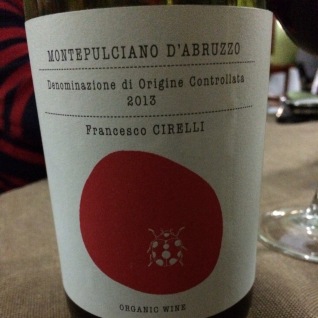
Next we opted for a 2013 Francesco Cirelli Montepulciano d’Abruzzo, and organic wine. Aged in stainless steel, the wine had a sense of terroir and a decent balance of dark fruit, with leather and chocolate overtones. Dorianne was the only one of us who preferred the Chianti to this wine.

2015-11-27 20.04.31

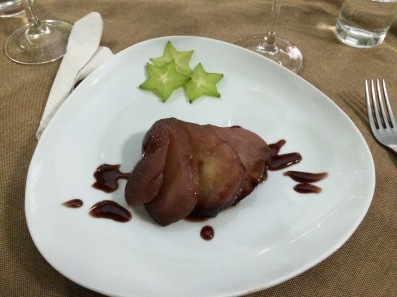
The menu is purely Italian, with first courses, pastas, and secondi (not the terms on the menu). A complimentary eggplant appetizer (deliciously rich) is provided. We also received a sampling of their ice cream dessert after not ordering dessert. When Dorianne could not eat that due to allergies, a pear poached in red wine was substituted by the chef for her. Very nice!

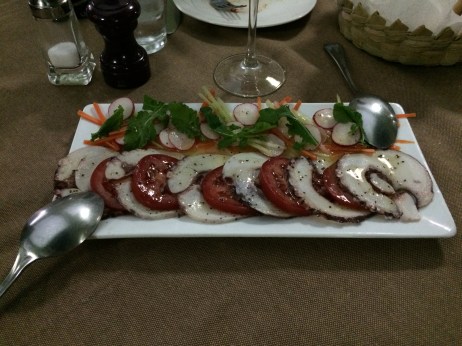
We shared a pulpo carpaccio appetizer that was delicious and reminiscent of the pulpo in Spain. The octopus for this dish was sourced in the Gulf of Mexico we were told.

2015-11-27 19.15.33
Pulpo Carpaccio – Delicious!

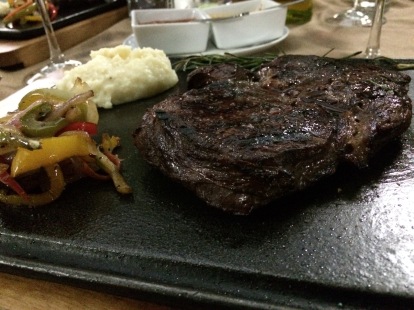
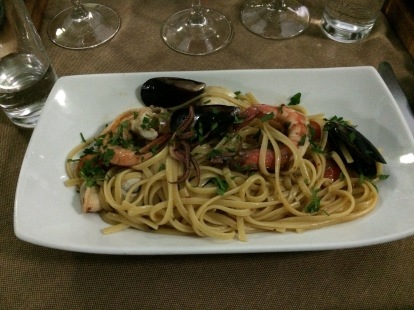
Then, Dorianne opted for a seafood pasta for her main dish. Mary and I ordered the rib-eye steak made with Ecuadorian beef; Richard had the special of the evening – rack of lamb.

2015-11-27 19.43.41
Ecuadorian Beef Rib-Eye Steak
2015-11-27 19.43.29
Seafood Pasta
2015-11-27 20.24.47
Pear Poached in Red Wine

All of the main courses were excellently prepared and delicious. We remarked that this quality of Italian dining in the US would command a much greater price. The bill, with tip, was just over 2440 pesos, or under $150 U.S. for four of us, including two bottles of wine!

Richard and Mary have left, leaving Dorianne and I to return to this Italian Oasis a few times in our two remaining weeks in Oaxaca.


THE GRAND TASTING AT THE GARAGISTÉ FESTIVAL IN PASO ROBLES

The grand finale of the Garagistè Festival is the Grand Tasting, featuring around 70 wine makers who produce 1500 cases or less of their wine in a year. The festival, with newer branches in Solvang and Los Angeles each year, is a great opportunity for these small producers to become known.

This year’s Grand Tasting was held at the Paso Robles Fairgounds in the Frontier Town area. The wine makers were arranged in a figure-eight configuration with a few vendors at the center. There were some wine makers who have been to all five Garagistè Festivals in Paso and some new this year.

The overall quality of the wines presented has greatly improved over the years, as wine making techniques have improved across the board. At the first Garagistè Festival that I attended in 2010, about 20% of the wines were good or better. Today, that figure is closer to 60%.

Garagiste Photo
The Garagistè Festival logo artwork.

The Grand Tasting runs from 2:00 pm to 5:00 pm, with VIP ticket holders who also attended the morning seminars (LINK TO POST) getting first crack for an extra hour from 1:00 to 2:00. The scene gets louder as the day goes along – there are a lot of rookie wine drinkers here who don’t know how to taste, or don’t care, so a few drunks are about by 3:00 or so.

I will point out some of the better wine makers (IMHO) in the photos – also see the post on the Friday Night Wine Makers’ Mixer (LINK TO POST) for the best from that evening, almost all of whom were also at the Grand Tasting.

2015-11-07 14.50.01
Broken M Wine’s Karl Wicka. He and his wife, Heidi are owner-operators of this very nice operation.

Missing Leg’s Website: (LINK)

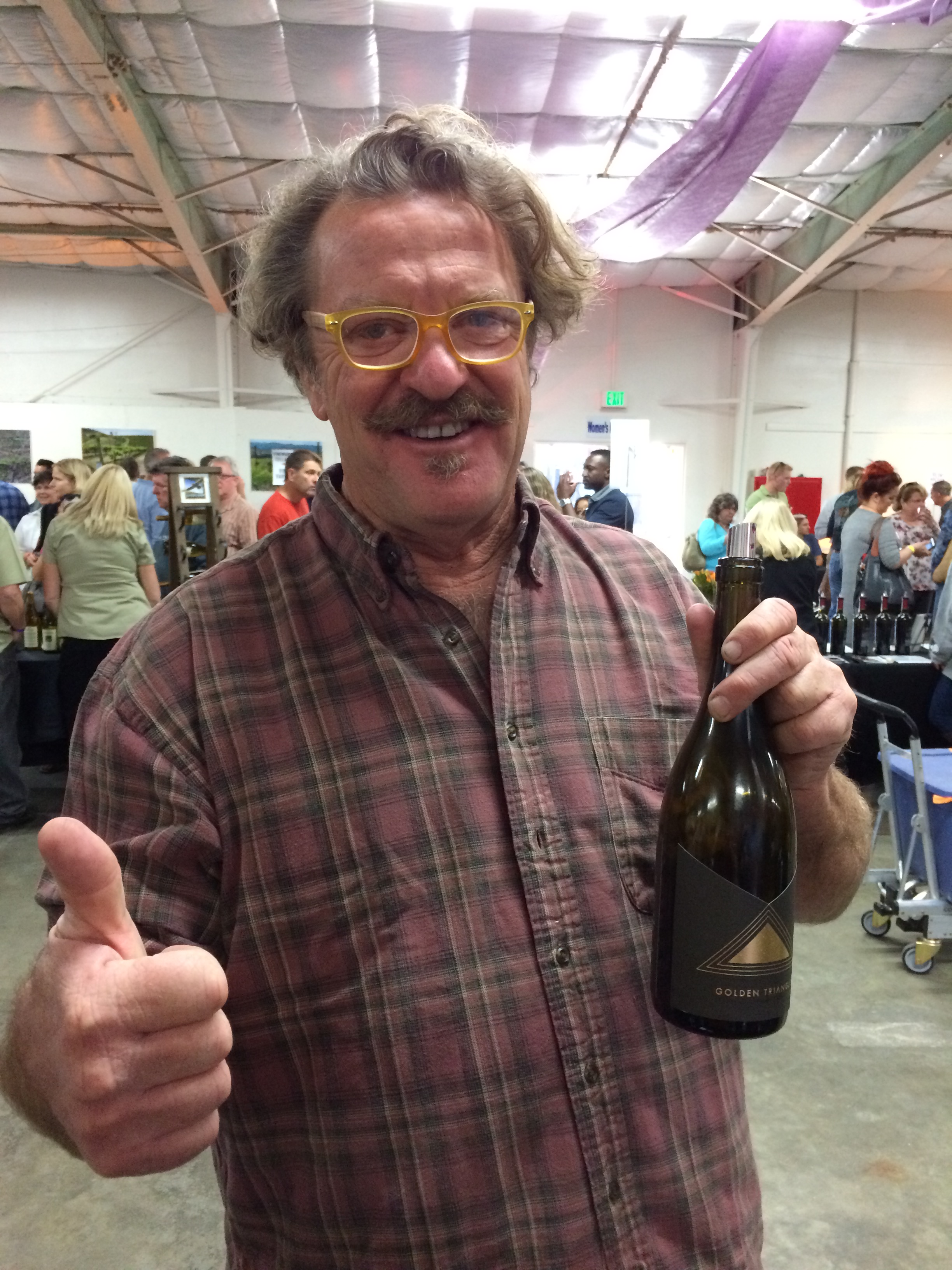
Stewart McLennan of Golden Triangle Wines - one of the Festival's coordinators.
Stewart McLennan of Golden Triangle Wines – one of the Festival’s coordinators.

Golden Triangle Website: (LINK)

Michael Rose of Michael Rose Cellars.
Michael Jones (and Rose?) of Michael Rose Cellars.

Michael Rose Website: (LINK) 

Paul Quinn & James Schreiner of TW Ferm Comany Wines. Cabernets only!

TW Ferm Co Website: (LINK)

2015-11-07 15.39.18
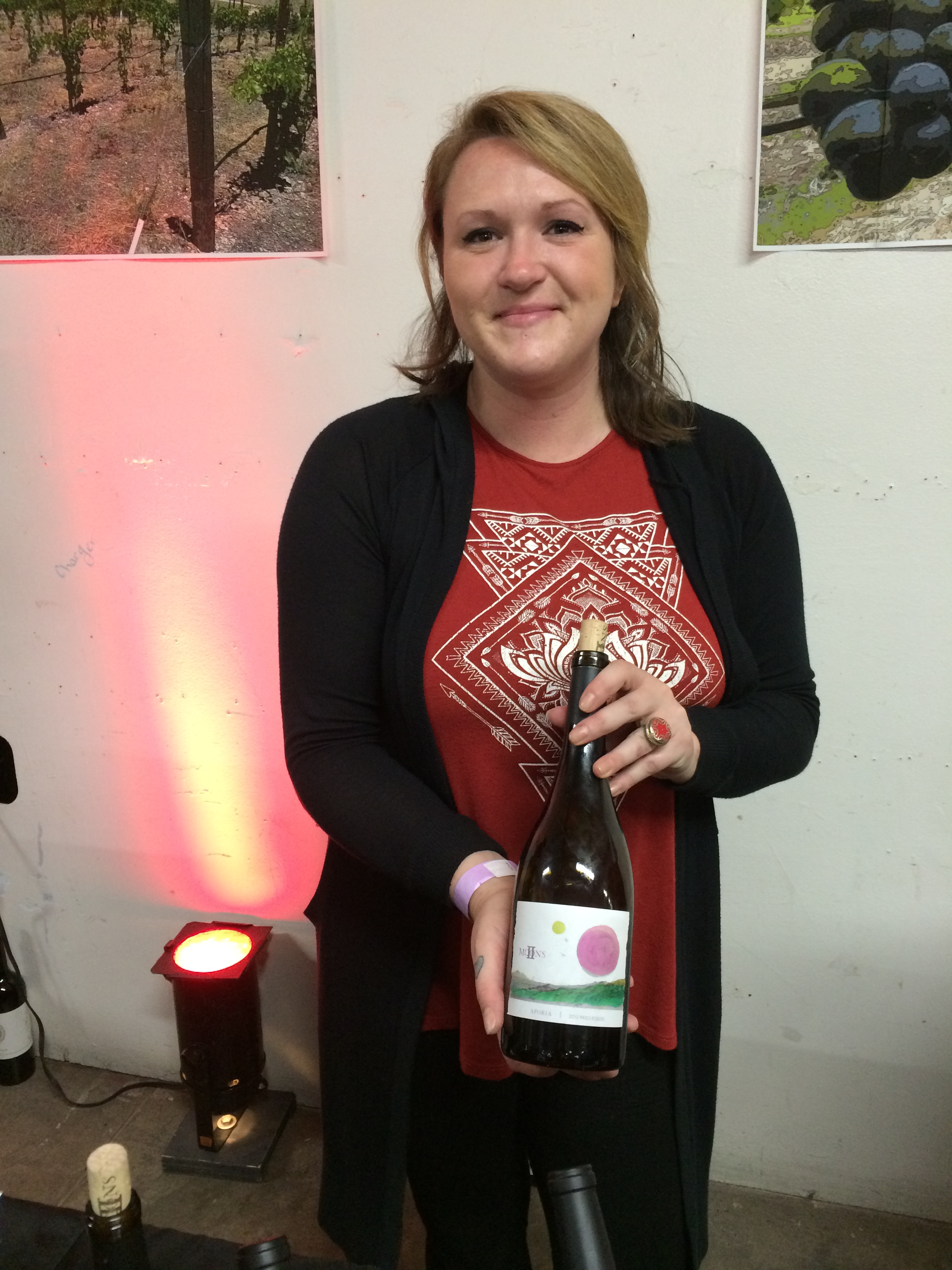
Amber Bierworth pouring Two Moons Rhone-style wines.

Two Moons Website: (LINK)

And our friend John from Alma Sol Winery was there again, pouring his amazing Bordeaux Blends and  Cabernet Sauvignons.

2014-08-09 18.44.38

Alma Sol Winery website: (LINK)

The Garagistè Festival is a great event, one that I highly recommend. If you want to discover the up and coming and the intentionally small wine makers of California’s Central Coast and beyond, this is your ticket.

WINE SEMINARS AT 2015 GARAGISTÉ FESTIVAL IN PASO ROBLES

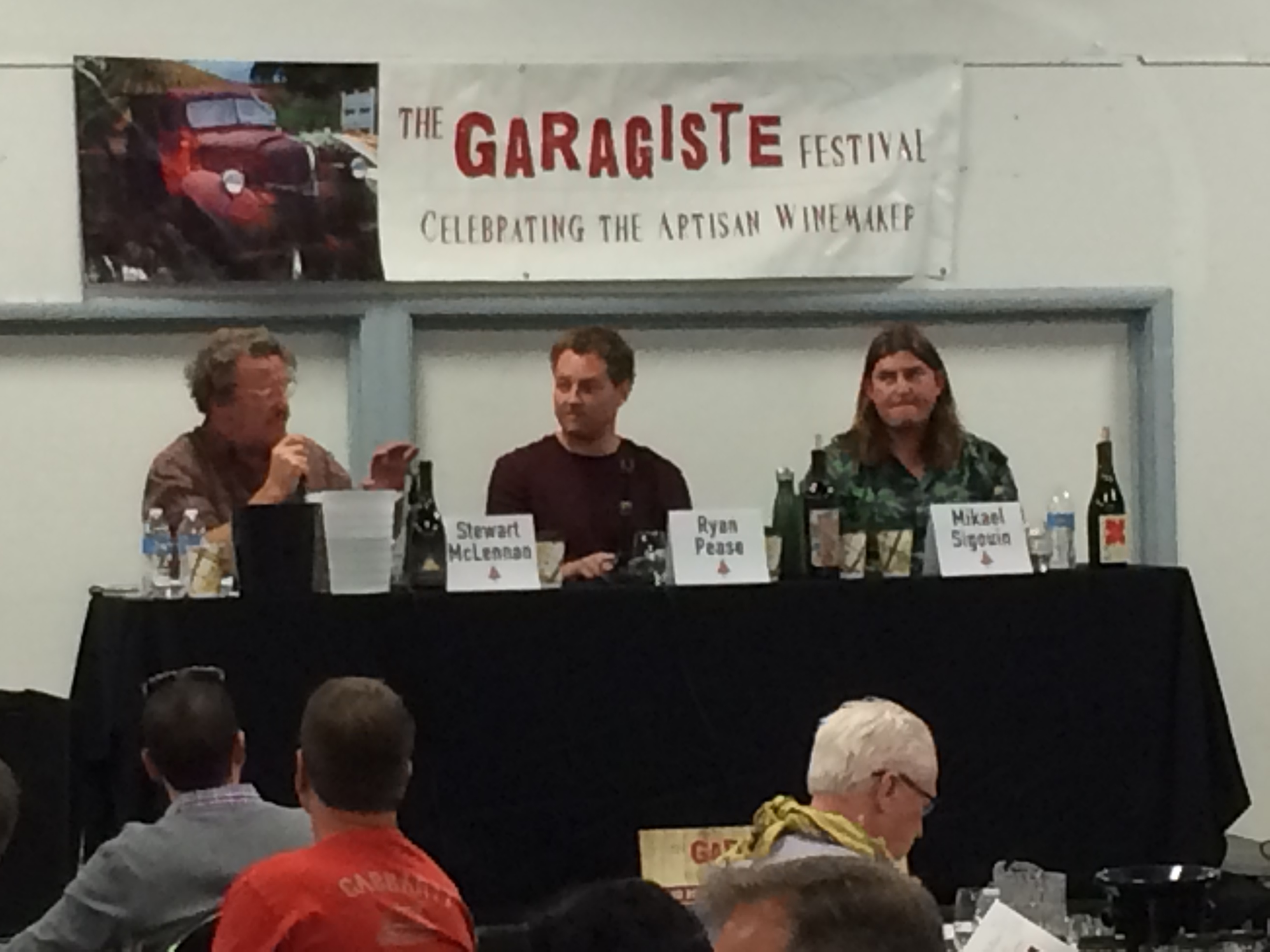
Each year at the Garagistè Festival, there are two seminars held as part of the VIP package for the Saturday events. This year’s seminars were “Exploring the Aroma Wheel” with Madeline Puckette of WineFolly.com (LINK) and “Techniques of the Garagistè: The Secret of Stems,” with Mikael Sigouin, Ryan Pease, and Stewart McLennan.

2015-11-07 11.28.21
“Exploring the Aroma Wheel” Seminar.

Exploring the Aroma Wheel” explored how to discover the various aromas of wine and how to go a bit deeper than the normal surface sniff of the glass. Madeline Puckette is a very good presenter and the seminar was interactive. Each table had 8 covered and numbered coffee cups, each containing a different scent. We were to begin by sniffing each cup and noting what we thought the aroma was. Then, we were provided two glasses, one with Pinot Noir, the other Cabernet Sauvignon. We were asked to sniff the glasses (some instructions were given) and to list three fruit aromas and three non-fruit aromas that we noted in each.

Madeline Puckette of WineFolly.com

Then, we were asked to sniff one or two of the cups again, and then sniff the wines. The experience of most people was that the aroma of the wine changed after sniffing one or two of the cups (the cups had odors like chocolate, mint, vanilla, smoke, etc.). Ms. Puckette noted that sniffing the aroma in the cup tended to eliminate that odor from the wine for the person sniffing; that changed the aromatic experience of the wine. The workshop was a good experience, and yes, we did get to drink the wine.

Mikael Sigouin of Kaena Wine Co., Ryan Pease of Paix sur Terre, and Stewart McLennan of Golden Triangle on the panel.

Techniques of the Garagistè: The Secret of Stems” featured three Paso Robles winemakers: Mikael Sigouin of Kaena Wine Company (LINK), Ryan Pease of Paix Sur Terre (LINK), and Stewart McLennan of Golden Triangle (LINK). Each of these winemakers uses stems and whole clusters in making some or all of their wines. The idea is to bring more of the sense of the terroir to the wines and to broaden the flavor profile beyond the fruit itself.

The wines were:2015-11-07 12.32.14

Kaena: 2013 Grenache – Terra Alta Vineyard

Paix Dur Terre: 2013 “The Other One,” 100% Mourvedre

Golden Triangle: 2013 50% Cabernet Sauvignon 50% Syrah

Each was very different in character, although all were the result of whole cluster fermentation. It was very interesting to hear what each winemaker seeks to get from the process and how this process is impractical for large-scale producers.

After the seminars, a lunch was served and then the VIP ticket holders had first shot at the Grand Tasting, with over 70 Garagistè winemakers, producers making under 1500 total cases each year.

We will explore the Grand Tasting in the next post.

WINEMAKERS’ MIXER AT THE 2015 GARAGISTÉ FEST IN PASO ROBLES.

The Garagistè Festival (LINK), for the uninitiated, is a gathering that promotes and celebrates small production winemakers from Paso Robles and elsewhere in California. These are folks who produce under 1500 cases per year. Some are new and plan to grow into the future Mondavis or Kendall-Jacksons of the world; others are doing it as a labor of love and have no plans to expand; still others are winemakers for larger concerns and this is their hobby-like “side venture.”  There are also now Garagistè Festivals in Solvang and in Los Angeles each year.

This is the fifth annual Paso Robles event, and I have attended all of them. Dorianne and I drove up from LA County where we are staying with friends for last night’s Winemakers’ Mixer and today’s workshops and Grand Tasting (which I will blog about later).

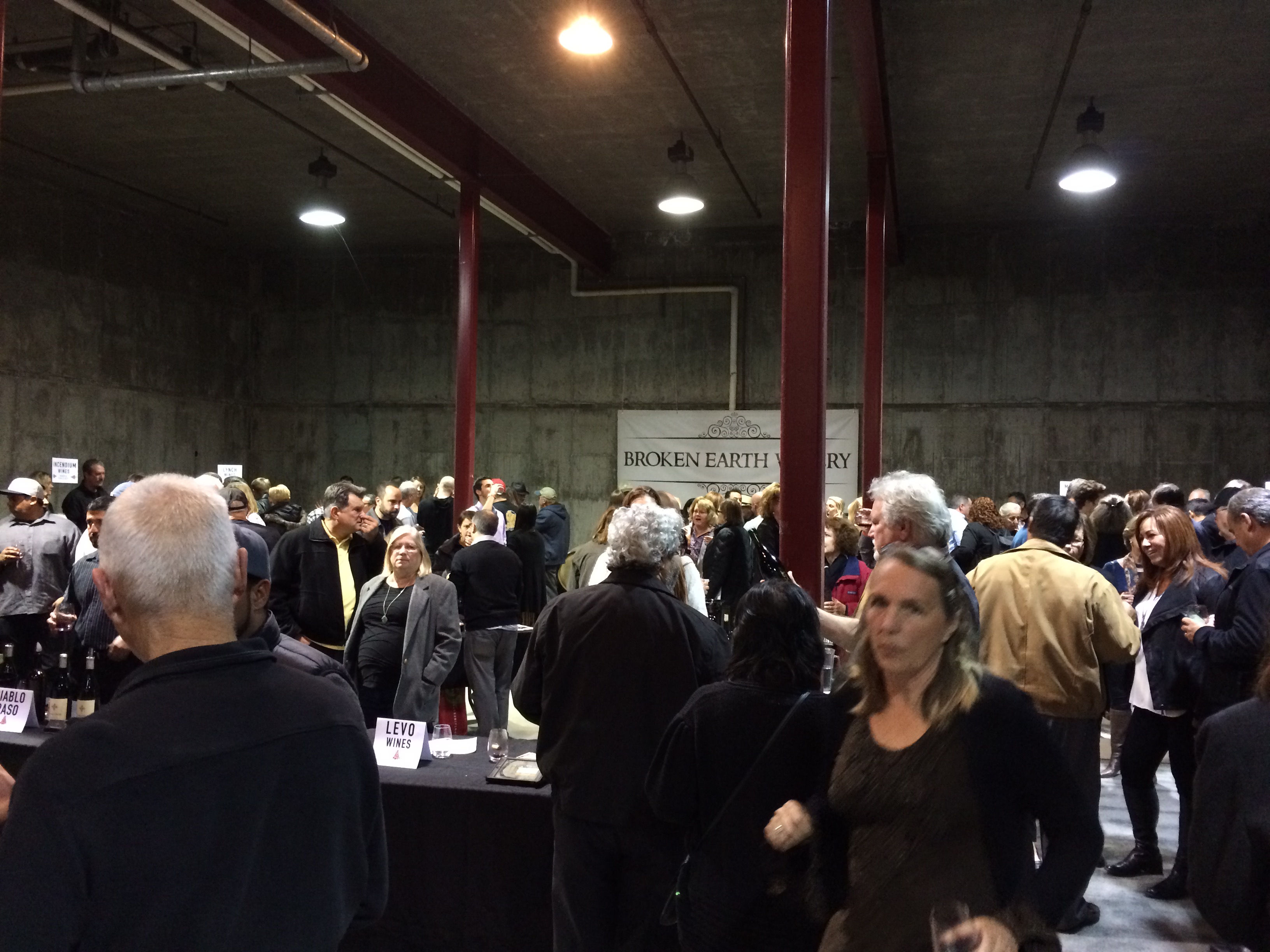
The mixer was added a few years ago, and has been held in different places. This year, it was in the barrel room at Broken Earth Winery (LINK). There were about 35 wineries represented (and one local hard cider maker), including about 1/2 dozen who had been at all five festivals. There were some snacks provided and the Pairing Knife Food Truck (LINK) was also on hand with some great food.

2015-11-06 19.47.54

The focus of the evening was new releases and tastings of wines that had not yet been released. You might say that this concept is loosely observed. There were some new releases, and some yet-to-be-released wines (one, just pressed and served from a 5 gallon plastic container), but there were also some 2007 Cabernets and other regular production wines, but really, who cares?

The fun of this evening was meeting young (and not-so-young) winemakers who are following their dream and doing what they love. They are eager to talk about their wines and really enjoy it when someone with some knowledge shows up. There were over 70 wines to taste, so spitting was in order. The general quality of the wines at the Garagistè Festival has improved significantly over the past five years. But, there is still a pretty wide range of quality, which is also part of the fun.

Here are a few highlights from the evening for us – we did not taste every single wine (you can get wines from most of these small producers via their website):

Ascension Cellars (LINK), Paso Robles. Currently produces 8 wines in the Rhône style. We tasted their GSM called Trinity and a Syrah – both were very well-crafted and balanced.

Deno Wines (LINK), Templeton, CA. The last wine we tasted before departing, the wine was a pre-release of the blend of 50% Zinfandel and a 50% GSM blend. This surprising combination produced a very spicy and well-balanced wine. Dennis Sharpe will have some other GSM’s out today for the Grand Tasting.

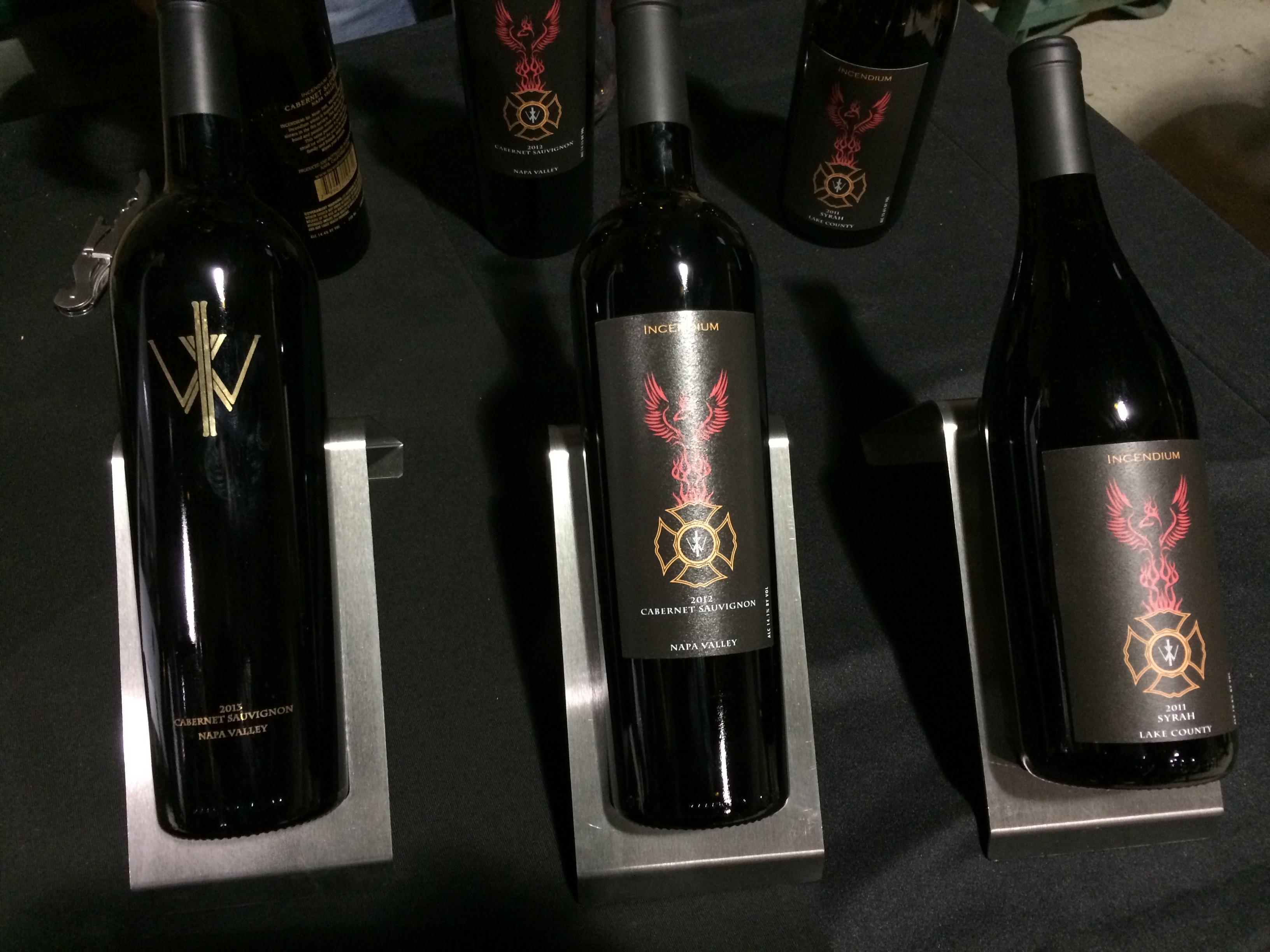
Incendium Wines (LINK), Napa Valley, CA. Winemaker Vince Kalny is a firefighter for Cal Fire. His wines reflect his primary calling, with beautifully designed labels. A portion of the proceeds from sales go to The National Fallen Fire Fighters Foundation. That said, his wines are very well made. There were 3 Chardonnays, 2 Cabernet Sauvignons and a Syrah to taste. The Cabs (2012 & 2013 – pre-release) stood out as very well-crafted and were smooth and ready to drink.

2015-11-06 19.33.04
Incendium Wines – The Reds
2015-11-06 19.33.22
Vince Kalny – Firefighter and Winemaker.

Stanger Vineyards (LINK), Paso Robles, CA. Last year, when we entered the mixer, the first person we saw was J.P. French holding a 5 gallon plastic water jug that was filled with Malbec that had just been pressed. He sloshed some of the juice into our glasses and moved on. Later, we returned to his table and discovered some amazing wines. J.P. was back this year, with the 2015 Cabernet Sauvignon in the plastic jug – again, just pressed. He also had a 2007 Cabernet Sauvignon that was spicy, earthy, but with nice red fruit on the nose and palate. If you are into wine, Stanger Vineyards is a good bet.

Theopolis Vineyards (LINK), Anderson Valley, CA. Theopolis, run by Theodora Lee, a Texan and an attorney by trade, had 7 or 8 wines (we were well into the tasting) on display. Theopolis  has a focus on Petite Syrah on the red side, and the Symphony Grape – a California crossing of Muscat of Alexandria and Grenache Gris developed in 1948 (but not commercially released until 1982) by the late Harold Olmo, professor of viticulture at the University of California, Davis.   As its pedigree suggests, it is a seductively aromatic wine with delightfully captivating aromas that are markedly floral with slightly spicy flavors (from their website). She also produces a very seductive Petite Syrah Rosè. The wines were among the best of the evening and I look forward to visiting her again today at the Grand Tasting.

2015-11-06 20.20.26
Theodora Lee of Theopolis Vineyards

2015-11-06 20.20.30

Turiya Wines (LINK), Lompoc, CA.  Turiya means “pure consciousness” in Sanskrit. Winemaker Angela Soleno brings a consciousness to winemaking that produces some exceptional wines. We tasted a Sangiovese  and a Bordeaux Blends, and both were excellent. A one-woman operation, Angela produces about 200 cases annually, all reds, featuring a number of varietals – Red Blends, Cabernet Sauvignon, Syrah, Malbec, Merlot, Petit Verdot, Cabernet Franc and Sangiovese. Wine prices begin at about $100/bottle and you have to be on the allocation list to receive wine. Visit the website for more information.

Angela Soleno of Turiya Wines.

Vinemark Cellars (LINK), Paso Robles, CA. Mark Wasserman, who runs Vinemark with his wife, Julie, was present with two wines, a 2013 Reserve Pinto Noir and a 2012 Mezzanote, a blend of 75% Primitivo and 25%  Petite SyrahMark is the classic Garagistè, in it for the love of winemaking. He loves to talk about his wines, and they are wonderful.

Mark Wasserman of Vinemark Cellars.

So that is a taste of the tasting mixer. There were a number of other quality wines present and, again, try as we might, Dorianne and I did not get to taste everything. Today – the Classic Tasting with about 70 producers and a couple of hundred wines. We will do our best.

2015-11-06 19.47.59

THE NEW “WINE DEMOCRACY” WHERE EVERY OPINION IS EQUALLY VALID. THOUGHTS?

In Matt Kramer’s column on WineSpectator.com, posted on Nov 3rd (LINK TO POST), he speaks of a growing phenomenon that he labels “Wine Democracy,” or the emergence of a more egalitarian approach to wine criticism as a whole.

Where in the past, only those with access to some “journalistic real estate in a newspaper or magazine” had a voice in the wine world – the rest of us were more passive consumers of the opinions of these few critics and taste makers. Now, via social media and the blogosphere, everyone can be a critic. And while there are certainly tiers of influence, the audience for wine opinion is doubtlessly more varied and diverse than it used to be; and that audience contains many who also feel free to give opinion (like yours truly).

But there is more to this phenomenon than technological innovation. There is also a cultural evolution process that is unfolding, and egalitarianism is part of where many people are finding themselves in terms of values. The old ways of looking to “experts” to define opinion and then following that opinion without much questioning, is fading fast. Now, a values system variously labeled “postmodernism,” Cultural Creative,” and Green (in Spiral Dynamics) has emerged and is becoming more and more prevalent.

spiral-dynamics Levels 2

Some of the key values of this level of cultural development are:

  • a high value for egalitarianism – anti-hierarchical.
  • all voices must be heard on any issue before a decision is made.
  • all (or almost all) opinions have equal validity.
  • feelings are more important than outcome – it is important that everyone feel good about what is decided.

Here is a link to some information about this phenomenon (LINK). You can see some of these values expressed in the column, but like most people, Kramer is apparently unaware of the cultural evolutionary models (as most people are), so instead of seeing a naturally unfolding way of being human, he sees people being different and, for the most part, wrong.

A quote from Mr. Kramer:  “These determined detectors of snobbery and elitism are like old-fashioned anti-communists: they’re sure that subversive snobs and elitists are lurking everywhere.

“In today’s wine democracy, equality of opportunity (to express oneself) too often is steamrollered into a much more simplistic ‘equality.’ All wines are equally good because all opinions are equally valid. Any deviation from that is seen as, well, you know.” 

What Mr. Kramer is describing is something that is not going away. In fact, it will grow as more and more people evolve culturally toward this level of being. In the meanwhile, get used to people turning away from the few “experts” and finding ways to not only form their own opinions, but to express them as well. Not all of these opinions will be of equal value, as the post by Mr. Kramer points out, but the days of a wide audience of consumers following a few select wine critics are over.

It’s the times; they’re a changin’.  As always, your comments are welcome.

Wine - Redness

POURING PENFOLD’S GRANGE DOWN THE SINK? ONE WINE RETAILER DID

As some of you know, my primary bucket list wine is Penfold’s Grange – the classic great Shiraz from Australia. One of these days, I will get a well-aged bottle and enjoy one of those legendary wine experiences, hopefully with a good friend.

Note to self – probably NOT the 2011 vintage!

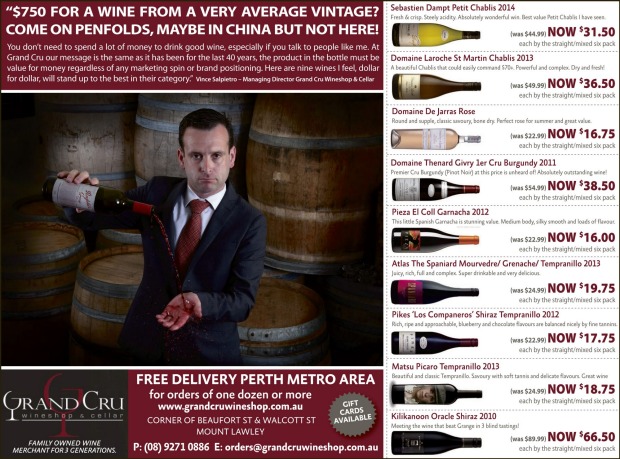
Apparently, the latest vintage of the wine is not up to normal standards. In fact, one Perth, Australia wine merchant poured two bottles down to sink to show his distaste for the current vintage (and to get a bit of publicity), according to an online article in the Australian Financial Review.

A sad state of affairs. I just want to let the good people at Penfold’s know that I am available to give a second opinion on the 2011 vintage of their Grange.

I live to serve.

You can read the story for yourself at the link.  (LINK TO ARTICLE)

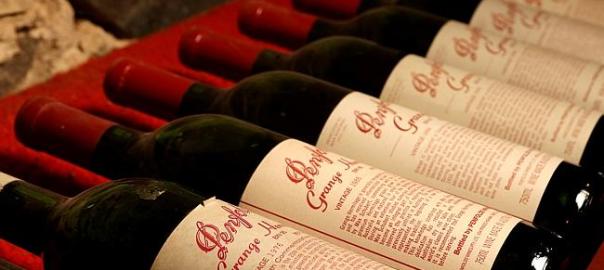
Wine - Penfolds Grange Poured Out

FIVE GOOD REASONS TO BUY WHEN YOU VISIT THE WINERY – FROM LAZENNE.COM

Our friends at Lazenne.com (LINK), makers of wine luggage and wine travel accessories, have posted an excellent article giving five reasons to purchase wine at the winery. Here is a quote from the article by Chrissie McClatchie for Lazenne:

“In France alone there are over 300 AOC’s (Appellation d’Origine Contrôlée, or Controlled Designation of Origin), some counting just one or two producers (Palette in Provence) to hundreds (the simple Bordeaux AOC). Considering the scope, it’s easy to imagine how many of these wines don’t leave their region of origin. I lead wine tours through the Bellet AOC in the hills of Nice, one of France’s oldest and smallest appellations, boasting only eleven vineyards. With such a small production, the wineries can little keep up with the local demand, let alone consider opening up export markets. For most people, therefore, purchasing direct is the only access they have to wines which are simply not available in their home country.” – (LINK TO FULL ARTICLE)

2015-08-29 13.57.42
Tasting Room at Chateau Manissy in Tavel, France

I would add that many of the same reasons hold true when you are visiting domestic wineries – good values, wines that are not otherwise available due to limited production, and knowing the provenance are also reasons to buy at the winery in California, New York, or Virginia.

2015-02-07 12.46.55
Tasting at LaFond Winery in the Santa Rita Hills of California.

Dorianne and I will be visiting California’s Central Coast twice in the next two months, and Napa-Sonoma-Mendocino areas early in the new year. We are looking forward to tasting and buying some amazing wines.

Jim at Broc Winery
Me Tasting at Broc Winery in Berkeley, California.

Copyright 2015 by Jim Lockard

WINE TIPS FOR TRAVELERS

Dorianne and I have been on the road since March, in Europe and the U.S., and I have been blogging along the way. I thought it might be helpful to do a post about Wine Tips for Travelers.

And, of course, if you love wine travel – join me for our Tour of Bordeaux, Paris, and Champagne in March (LINK).

BEST TRAVEL CORKSCREW

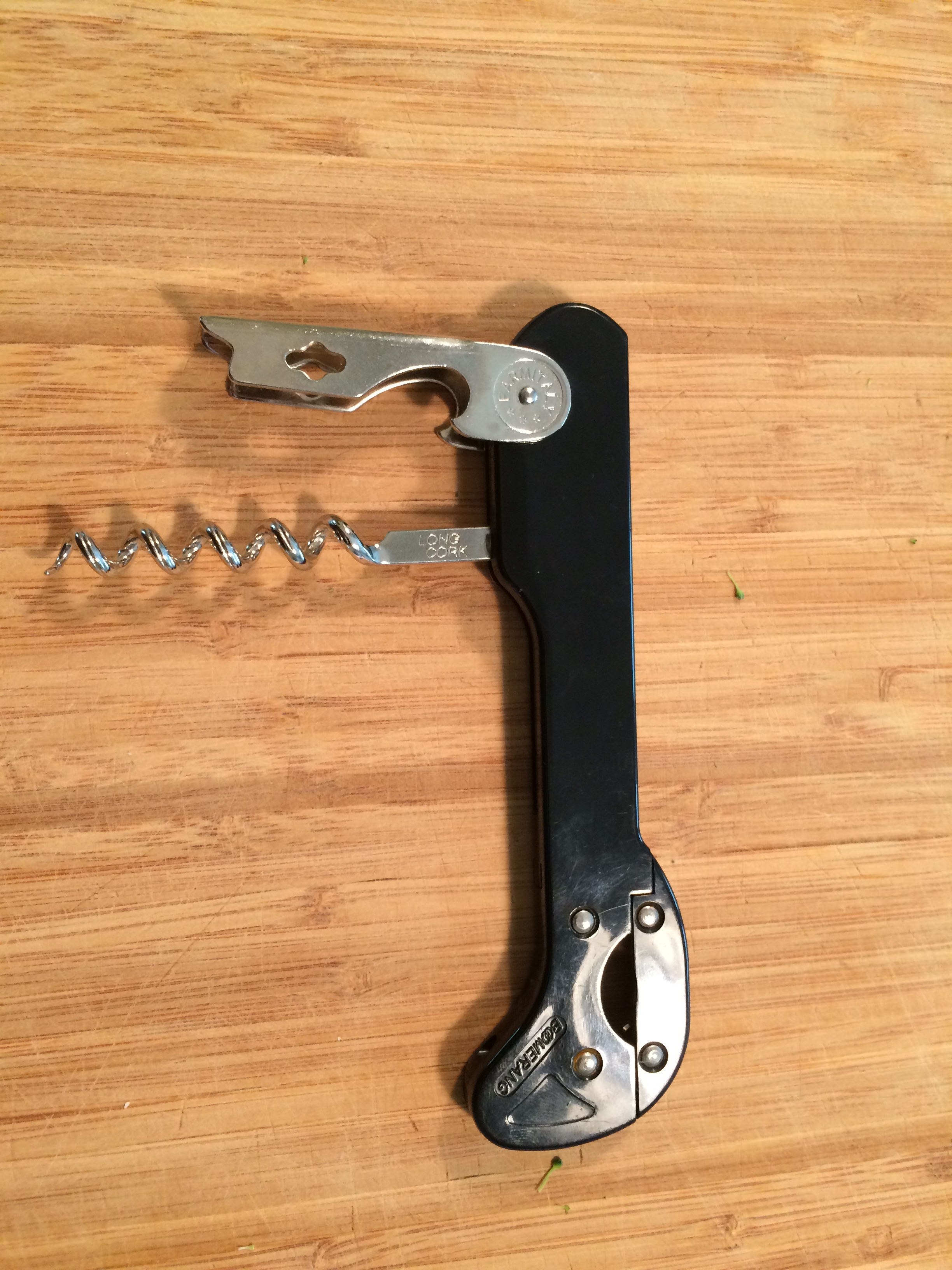
The best travel corkscrew that I have found is this little gem, The Boomerang, I purchased for $6.99. After having a number of corkscrews confiscated by TSA agents at U.S. airports, I began to look for one that did not have a knife blade as a foil cutter. This one has four discs that cut very evenly around the top of the foil. The corkscrew itself seems a bit fragile, but I have opened over 100 bottles with it with no sign of it slowing down. I do, however, carry a backup.

2015-10-21 13.20.47 2015-10-21 13.20.56 2015-10-21 13.21.07

The history since 9-11 is that all corkscrews were originally banned from carry-on luggage because of the knife blade as a foil cutter AND the corkscrew itself. This was relaxed a few years ago, but the ban on the knife blade has continued.

Since I always take a corkscrew with me and I fly dozens of times a year, I needed to find one that I could take in my carry-on luggage, because, well, you never know. A case in point – I was flying across country, and a friend happened to be one of the
flight attendants. My wife and I were in coach. The flight attendant brought us a package wrapped in plastic bags and said, “Mr. Lockard, you left this in the front of the plane.” Opening it, I found a bottle of very nice Chardonnay and two glasses from the first class cabin. My corkscrew was in the pocket of my backpack under the seat in front of me!

I have also blogged about the Best Corkscrew (LINK), the Cork Pops Legacy Wine Opener, but that model, being powered by gas capsules, is not suitable for travel. If you can only afford one of these, get the traveler – it’s much cheaper, and you can use it at home or on the road.

TRAVELING WITH WINE

There are a couple of things that you might want to know about taking wine with you on airlines and cruise ships. First, is how to pack the wine so that it is safe and does not spill onto the contents of your suitcase.

Many times, I have traveled with wine bottles in my checked luggage. What I usually do, if it is just a bottle or two, is either use a special wine bottle protector, or, absent that, wrap the wine in some clothing like a sweatshirt or a bathrobe (what, you don’t travel with a bathrobe?). It is best, of course, to have the protector.

If you are flying with more wine, like a case or so, it is best to get wine luggage and check it through. There are a number of products on the market. I like Lazenne (LINK), a light but stable product that works great for most uses. They also make wine bottle protectors.

Lazenne Wine Case Suitcase
Wine Bottle Protector

I did a blog post on bringing wine into the U.S. and customs duties, etc. Here is the (LINK TO THAT POST). Actually, duties on wine are lower than you might expect, and paying the extra airline fee, if there is one, to ship a case of wine is a relative bargain.

Cruise ships can be another story. Oceangoing cruise lines often have a policy restricting bringing alcohol on board. If you make purchases on shore excursions, the booze is often taken upon re-boarding and held until you disembark. You can usually get away with having some wine in your luggage initially, but that will, of course, be somewhat limited. If you are concerned about this, check with the cruise line to see what their policy is.

River cruises are often different. We recently went on a Viking Cruise Lines (LINK) ship on the Rhine River. We were encouraged to bring wine purchases aboard to have with dinner – no corkage fees. The reason for this is that this cruise offers complimentary wine with meals, so any wine that you bring on board saves them money. I still liked the policy, and we did bring some wine on board to consume.

WINE APPS FOR TRAVEL

I am not a big fan of any of the wine apps I have used so far. I guess the best is Delectable (LINK), which lets you scan the label and view a bit of info and any other reviews that happen to have been posted. It also lets you review the wine. The problem is that, while it recognizes most wines that you find only in Europe, there is a paucity of information and very few, if any reviews on them.

For locating wine venues, from wine bars to châteaus to good wine restaurants, I use TripAdvisor.com and occasionally, Yelp.com and Google.com/maps. These work as well in Europe as in the U.S., meaning that they are okay, not really great. Better to find a local wine bar or wine shop, make friends with the bartender or proprietor and ask questions about the local wine scene. If you know of something better, please leave a comment to this post.

SOME PLACES JUST AREN’T GREAT FOR WINE

While wine has become more and more prevalent in many parts of the world, there are some places where wine either isn’t available, isn’t good when it is available, or is so pricey that there are better options.

We were in Iceland (LINK TO THAT POST) in May for a few days. There is wine there, but it is extremely expensive due to shipping costs and UK duties on New World Wines. As my post at the time indicates, we found some great local beers and did just fine.

Prague is near some decent wine regions, particularly in Hungary, but I found that my lack of knowledge of the local wines was a problem. So we went with the huge array of excellent beers there as well.

Next month, we head to Oaxaca, Mexico for a month of Spanish Immersion Classes and the amazing cuisine of that region (think chocolate, mole sauces, and coffee). Not a wine region in sight, and if there is wine, it will be served at room temperature – about 80 degrees Fahrenheit. No, we will stick with beer and the fantastic Mescals of the area.

FINAL TIPS

So my tips include:

  1. Take a good travel corkscrew and a backup.
  2. Select one or two good options for carrying wine with you.
  3. Learn your online and local wine resources.
  4. Remember – when there isn’t wine, there is always something else.

So never let your travels be dictated by your own failure to prepare. Sampling the local wines when you travel is a great experience (even if the wines aren’t always so good), and the people in the wine industry, from the vineyards to the retail shops, have been great people wherever we have traveled.

We aren’t done. After Cleveland, we head to Southern California, then Mexico, then Hawaii, then Southern and Northern California through January – then, who knows? But you can be sure that I will be blogging all the way.

Journey to French Wine Country 2