Tag Archives: Foodie

WEEKEND IN PORTLAND WITH WINE (AND FOOD)

Dorianne and I spent Easter weekend in Portland, Oregon, staying downtown at the Westin Hotel. This post is an overview of the food and wine experiences of our weekend. I realize that we only experienced a sampling of what this great city has to offer.

Upon arrival at the Westin Hotel (LINK) on Friday, we were greeted with a wine tasting in the hotel lobby. ENSO (LINK), an Urban Winery featuring varietals and blends sourced from Oregon, California, and Washington. The tasting featured a white blend, a 2012 Counoise (unusual for these parts), and a red blend. All were very drinkable, especially the red blend which had low acidity and a very smooth viscosity. The Counoise was heavier and more viscous, with nice notes of red fruit and a hint of minerality.

After chatting with Kimberly Parks, the Enso Wine Club Coordinator and a number of other hotel guests about wine and travel, it was time to go upstairs and change for our dinner reservation at Jake’s Famous Crawfish (LINK), a member of the Landry’s Group. We walked the four block from our hotel in the crisp evening weather, passing the iconic Portland Food Trucks surrounding the park nearby (almost all closed at night).

Jake’s is that quintessential downtown seafood house – lots of wood, excellent and experienced servers, a long menu of selections and a great wine list. We ordered a bottle of Ponzi Pinot Gris (LINK) (LINK to NOTES), one of the better known Willamette Valley (LINK) producers. We were not disappointed – light and crisp with balanced acidity, mushrooms on the nose, and pear and pepper on the palate. A very nice wine. It went well with our Kamiai oysters, with Dorianne’s halibut and with my horseradish encrusted steelhead. It was a wonderful meal in a great atmosphere – not really adventurous, but solid and everyone knew what they were doing.
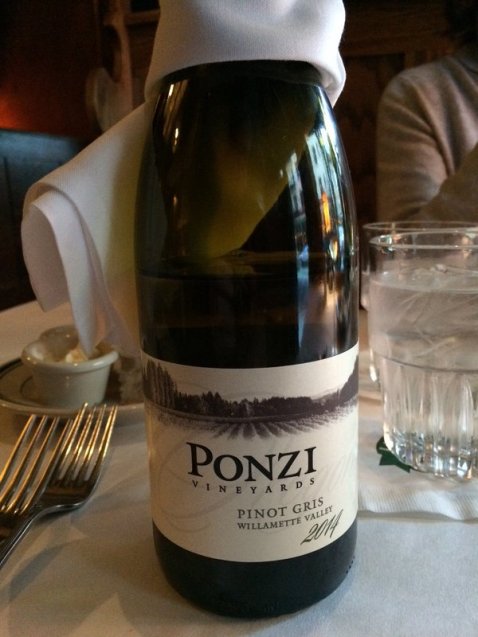
IMG_9299

Lunch on Saturday at Bamboo Sushi SW (LINK), one of four in Portland, for some really excellent food accompanied by a Sapporo draft beer. The lunch specials here are really a great value. We spent the afternoon on a city tour with good friends David Alexander and Patience Muanza and her son, Josh. The tour included walking along 23rd Street in Nob Hill (LINK) and sampling some food (dessert!) and a flight of Willamette Pinot Noirs at Papa Hayden Café (LINK).

Dinner on Saturday was with good friends Laura Berman and Craig Benelli (LINK) at Luc Lac Vietnamese Kitchen (LINK), a very busy place with more of a Portland feel to it. Crowded – with a system where you wait in line, order, then wait for a table, and they bring you your food – and loud, it was a fun evening very different from our other dinners in town. The Pho was great. Luc Lac has wines by the glass or 1/2 bottle only (!); we discovered a very nice Rosé from Tavel (LINK), the only AOP in France that produces only rosé wines. As an added bonus, we ran into Dorianne’s nephew, Brian Nelson and his wife, Krista, from LA.

Sunday we went to the New Thought Center for Spiritual Living (LINK) in Lake Oswego for Easter service, where Rev. Dr. David Alexander presides over a large and vibrant spiritual community. Then off to lunch/brunch at St. Honoré Boulangerie (LINK) near the lake. Amazing baked goods – very French – and wonderful sandwiches accompanied by a French Pinot Gris made for a nice repast.
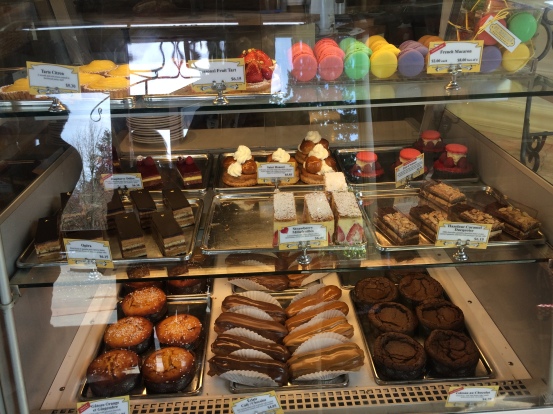
2016-03-27 13.00.46
The Patisserie Case at St. Honore Cafe in Lake Oswego

After a relaxing afternoon of napping and surfing the web in our hotel room it was time for what would become the highlight of our Portland visit, food and wine wise. Our dinner reservations at Veritable Quandry (LINK), was a very special experience indeed. A friend recommended it to us (we had already made reservations) and noted that her brother, Matt, works there.  Matt made us feel very welcome indeed, as did our excellent server, but it is Chef Annie Cuggino who is the star of this show. The food was simply excellent – no other word will do. A wine list that is appropriately heavily Oregon-centric but with a good number of other global wine regions represented, rounded out a marvelous dining experience.
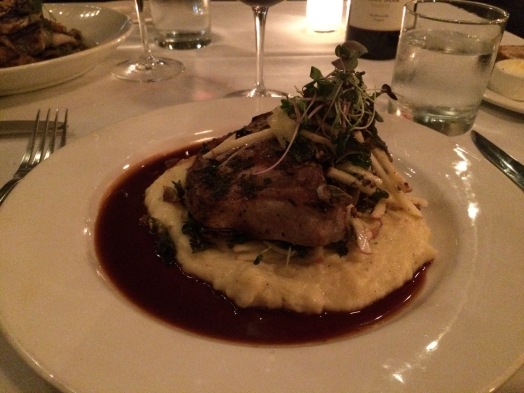
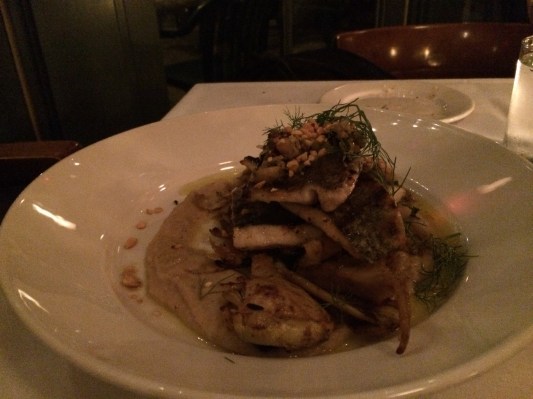
2016-03-27 20.35.09
Pork Chop in Cider & Ale Sauce
2016-03-27 20.35.15
Trout in Cannelloni Bean Puree

2016-03-27 20.01.57

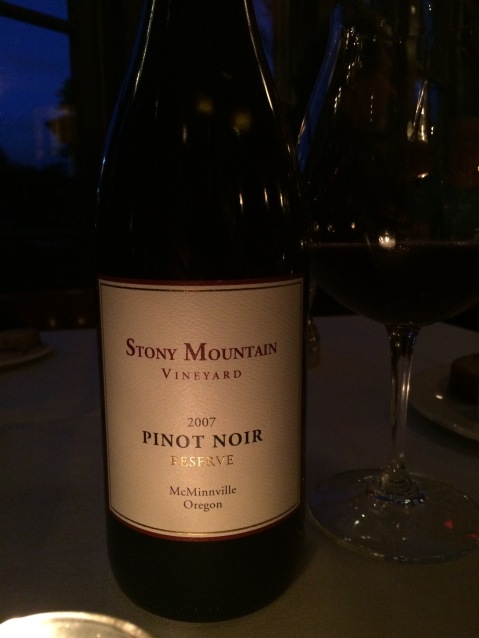
Located in a lovely garden-style building of brick and steel near the river on the edge of downtown, Veritable Quandry is a local gem and has been since 1971. The garden seating is closed now, but we were seated at a table next to a floor to ceiling window. The long bar is also inviting – you pass by it as you enter. I was tempted to order a cocktail, but that wine list was simply too inviting. We selected a 2007 Stone Mountain Vineyard Reserve Willamette Valley Pinot Noir (LINK) from a list of about three dozen Oregon Pinots. It was an amazing wine – smooth, peppery, light enough to accompany Dorianne’s trout and enough body to hold up to my pork chop in a cider and ale sauce. Then house made sorbets and an Inniskillin Ice Wine for dessert. A truly delicious meal in every respect.
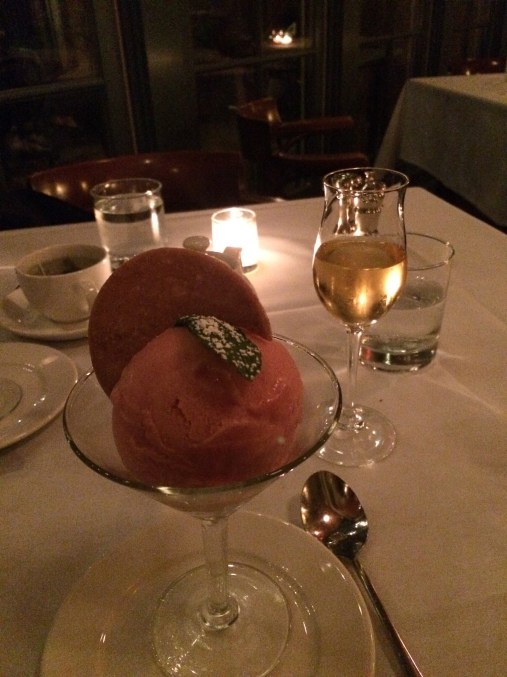
2016-03-27 21.05.37

The sad news: Veritable Quandry is slated to close in the next several months – the city is taking the land for a new court house and the owner has decided not to relocate. So get here soon! Some photos of the meal experience are above.

As we depart Portland after this short visit, I know that we will return – there is too much left undone and some things we want to experience again!
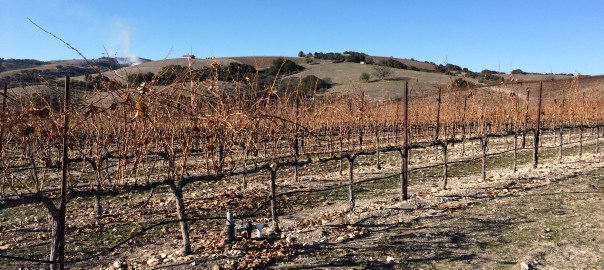
 

PASO ROBLES TRIP, PART 2.TABLAS CREEK VINEYARD AND CALCAREOUS WINERY

As I noted in my last post (LINK), Dorianne and I went to Paso Robles  along California’s Central Coast region for three nights and two days of wine tasting with her sister and brother-in-law, Debby and Mike. Our daughter, Grace, joined us on the first day of wine tasting, but the four of us were on our own as we set out on Tuesday morning. We decided to keep it to two wineries to allow time for a nature walk later in the day.

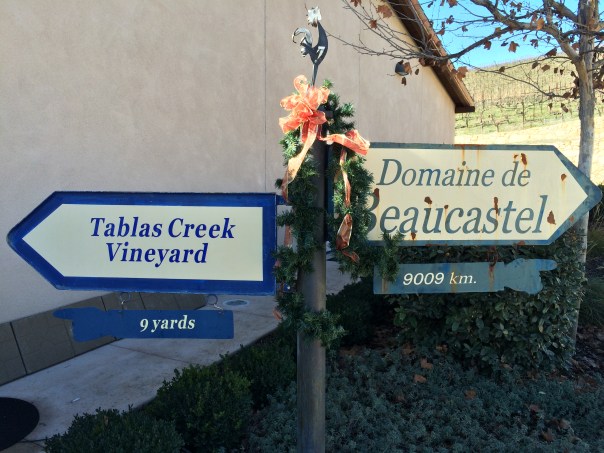
Our first stop on the west side was Tablas Creek Vineyards (LINK) in the Adelaida AVA of west Paso Robles. Long known for their expertise in Rhône varietalsTablas Creek has a Rhône River partner, Chateau Beaucastel (LINK) in France. You could spend months studying the Tablas Creek history, viticulture, wine making techniques, and tasting their wines (maybe a lifetime on that), but we only had a couple of hours.

2015-12-29 11.38.53

From the website (LINK) with embedded links:

Tablas Creek Vineyard is the result of a decades-long friendship between the Perrin family of Château de Beaucastel and Robert Haas, longtime importer and founder of Vineyard Brands. The families created a partnership in 1985 and in 1989 purchased a 120-acre property in the hilly Las Tablas district of west Paso Robles for its similarities to Châteauneuf du Pape: limestone soils, a favorable climate, and rugged terrain.

The partners imported the traditional varietals grown on the Perrins’ celebrated estate, including Mourvèdre, Grenache Noir, Syrah, and Counoise for reds, and Roussanne, Viognier, Marsanne, and Grenache Blanc for whites. These imported vines passed a rigorous 3-year USDA testing program, were propagated and grafted in our on-site nursery, and used to plant our organic estate vineyard.

Dorianne and I were members of the Tablas Creek wine club for a couple of years before we moved from Southern California. Their wines are beautifully crafted and many of their varietals are unique on the Central Coast, or even in all of California. They produce a few dozen wines, only three of which, called their core blends, are distributed widely. Here is the link to their wines page (LINK) for a more thorough description of each one.

Tablas Creek Vineyards and Tasting Room is located at the far west end of the Paso Robles area, which means that they are closer to the Pacific Ocean and its cooling influence. The tasting room is modern and state-of-the-art, with views into the winery. Several tasting stations surround a central core with displays of wines and other things for sale. As you approach the entryway, a display of grape vines for sale and a tub of stainless steel water bottles for guests to use during their visit.

The tasting room was crowded when we arrived. We found some space at a station being staffed by Suphada Rom, a very knowledgeable and well-traveled young woman from Vermont. Like many of the winery and tasting room workers in California, she arrived after some experience in Old World wine regions and developed a love for wineSuphada writes a wine blog (LINK).

The tasting experience at Tablas Creek involves the core blends and one or two varietals. To keep it short, I will just say that the core blends are always of a very high caliber. What I seek out at Tablas Creek are the single varietals. Our tasting included the 2013 Viognier and the 2013 Cabernet Sauvignon. Both were very good – the Cabernet being smoother and lighter, more elegant  than the typical Paso Robles-style Cabernet, which are big powerful wines.

Before departing Tablas Creek, we purchased a four-pack of varietals that included the 2013 Cabernet, 2012 Tannat2012 Picpoul Blanc (a varietal we enjoyed in France), and the 2013 Vermentino – a set that should provide many pleasures in the coming months.

Our next stop was farther east, up on a very high hill closer to Paso Robles on the border between the Adelaida and Willow Creek AVAsCalcereous (pronounced with two hard “C’s”) is another wonderful Paso Robles wine experience. The name comes from the limestone soils of the area.

From their website (LINK): “Father and daughter Lloyd Messer and Dana Brown realized their dream of finding a place to express their passion for wine in 2000, when they established Calcareous Vineyards on one of the highest limestone plateaus on Paso Robles’ westside. Both Lloyd and Dana, experienced wine distributors in their native Iowa, recognized the westside of Paso Robles had potential to produce world class wines. Their acquisition of 342 acres atop solid calcareous rock reaching 1,800 feet above sea level confirmed their dedication to producing the highest quality, terroir driven wines possible.  It is a labor of love to cultivate fruit on this challenging land, but the reward is immediately apparent when tasting the wines.”


Everything about Calcereous is beautiful – the wines, the land, the tasting room, and the experience. Our tasting room host, Karl Jepsen, is from Denmark. He gave an animated and informative “wine seminar” as we tasted six wines (five from the list and one additional).

2015-12-29 13.20.04

Karl led us through the tasting, going over the provenance of each wine and adding some additional bits of information, such as how to determine which aspects of the bouquet of the wine come from the fruit and which come from the barrel.

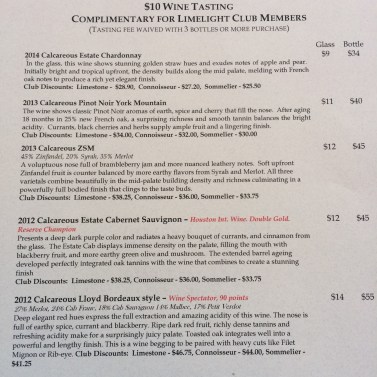
Calcereous wines are premium wines – every wine we tasted was in the 90’s in my own mental ratings chart. We were given an impromptu tour of the  vineyard & winery as well. I think we spent nearly 3 hours there. Wine highlights were the 2014 Estate Chardonnay, the 2013 ZSM (a fantastic blend of Zinfandel, Syrah & Merlot), and the 2012 Lloyd Bordeaux-style Blend, a truly exceptional wine Our 1/2 case purchase contained all three of those.

A note about the restaurant where we ate lunch after these great winery experiences – Fish Gaucho (LINK) in downtown Paso Robles did not disappoint. Very good Mexican dishes, large portions, and a nice atmosphere with good service. It’s worth a look when you are in Paso Robles.

There are over 200 wineries in Paso Robles, California. We visited just five of the more established producers on this short trip. I look forward to returning soon and exploring some of the smaller and newer producers.

As always, your comments are welcome.

And it was chilly – here are Dorianne and Debby clearing the ice from the car in the morning.

2015-12-30 08.46.55


Copyright 2016 – Jim Lockard

LUXURY WINE TOURS TO FRANCE – BORDEAUX – PARIS – CHAMPAGNE

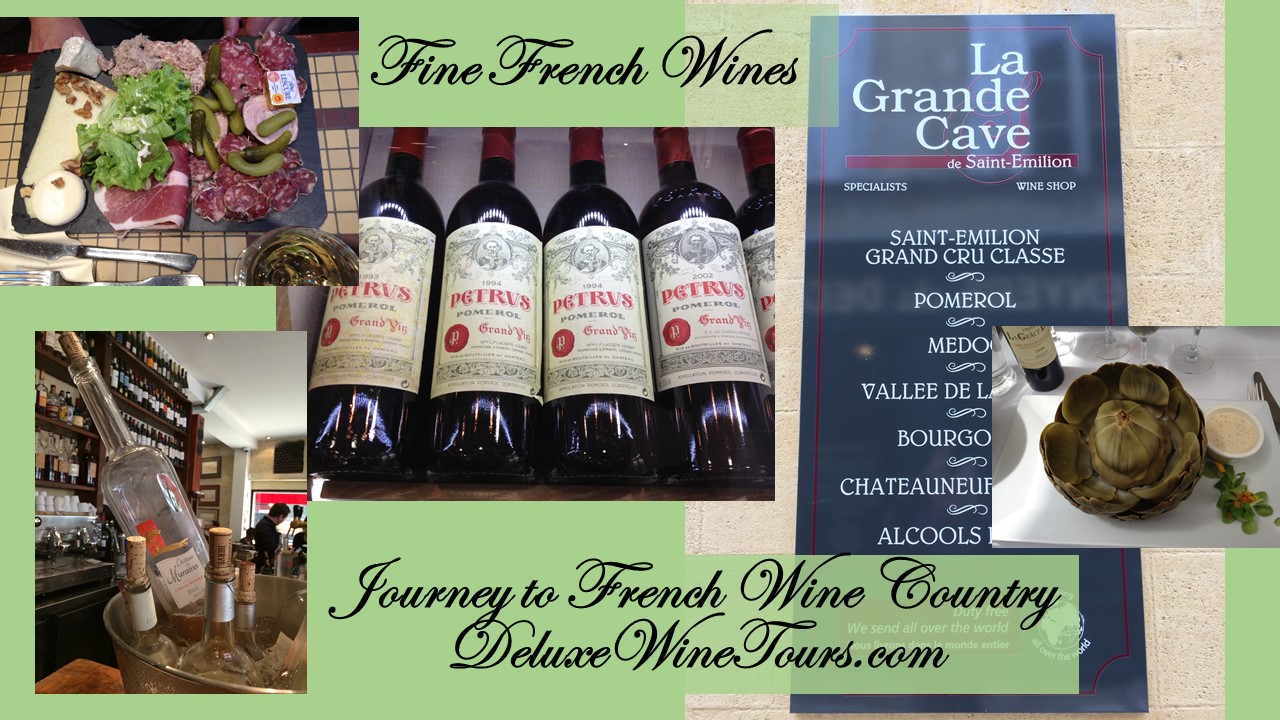
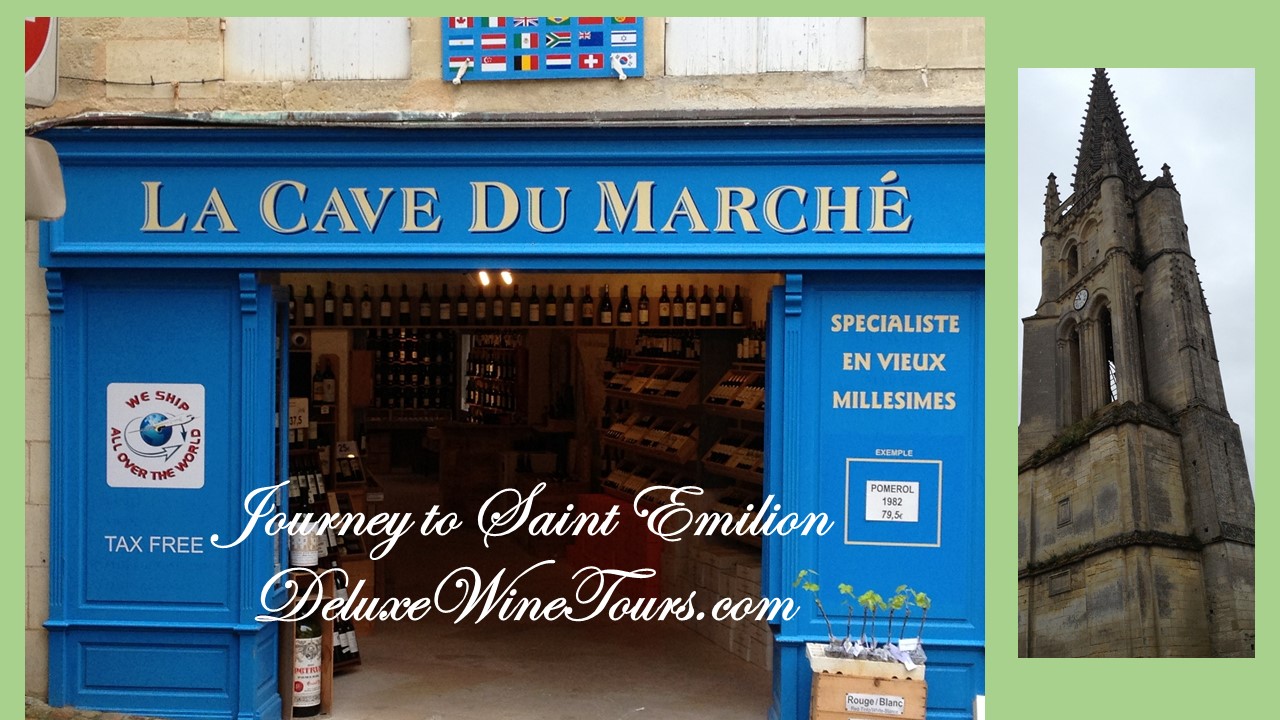
A very special experience awaits you. If you are a wine lover and are eager to experience some of the greatest wine regions in the world, we have a journey for you. Seven nights in France, with time on the left and right banks of the Gironde River to explore the tastes of Bordeaux wines, followed by time in Paris, the City of Light, and a day in the Champagne Region to savor the famous wines of that historic area. This intimate, small group tour features lodging in fine hotels, meals in châteaus, visits to the legendary vineyards, and tastings of some of the great wines of the world.

Journey to French Wine Country 3

In Paris, we will pair wine and food at specially selected restaurants, have a literary walking tour with a local author, and even have some free time to explore on your own or just relax and sit in a sidewalk cafè. All the while, you will learn more about wine in the vineyard and at the château. All tours will be in English, but there will be interactions with French people.

Bordeaux Treasures

Led by American wine blogger Jim Lockard (JimLockardOnWine.com), who has traveled extensively in France and who will be joined by local experts, you will get the inside story of some of the great wines of Bordeaux and Champagne and have access to places not generally available to the traveling public. This small group experience will give you the opportunity to interact with the guides and the winemakers and sommeliers. You will be joined by a few other wine lovers and share gourmet meals and luxury transportation.

St Emilion Image

“The Bordeaux/Paris/Champagne Tour is unlike anything offered in the travel industry today. I looked for the trip I wanted to take and could not find it – so I created it, in partnership with travel expert Steve Hooks of Journey Different.” ~ Jim Lockard

Now you have the opportunity to join them for the wine experience of a lifetime.

For more information and to register visit  DeluxeWineTours.com (LINK)

“THE BEST RESTAURANT IN THE WORLD:” COPENHAGEN’S NOMA – PART 4: BACKSTAGE AT NOMA AND SOME COMMENTARY

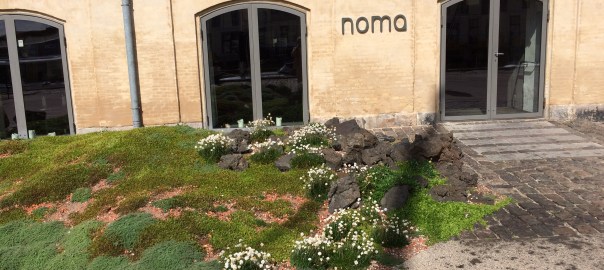
Noma, the Copenhagen restaurant that has been voted “The Best Restaurant in the World” (LINK) over and over, was the site of a recent visit by Dorianne, two friends, and me recently. Here are the links to the first three installments of the series: (LINK TO PART 1) (LINK TO PART 2) (LINK TO PART 3).

This post, the final installment in the series, covers the post-meal tour of the facilities at Noma (LINK) and contains some commentary.

After our meal (see parts 2 & 3 of this series), it was good to stand up. We had been sitting for about two and one-half hours in a very intensive activity – eating new things, drinking new wines, talking about the meal and doing our own internal processing without stopping. When I stood up, I realized two things – I had been sitting quite a while and I had a lot to drink. Wine with 20 courses . . .  you do the math.

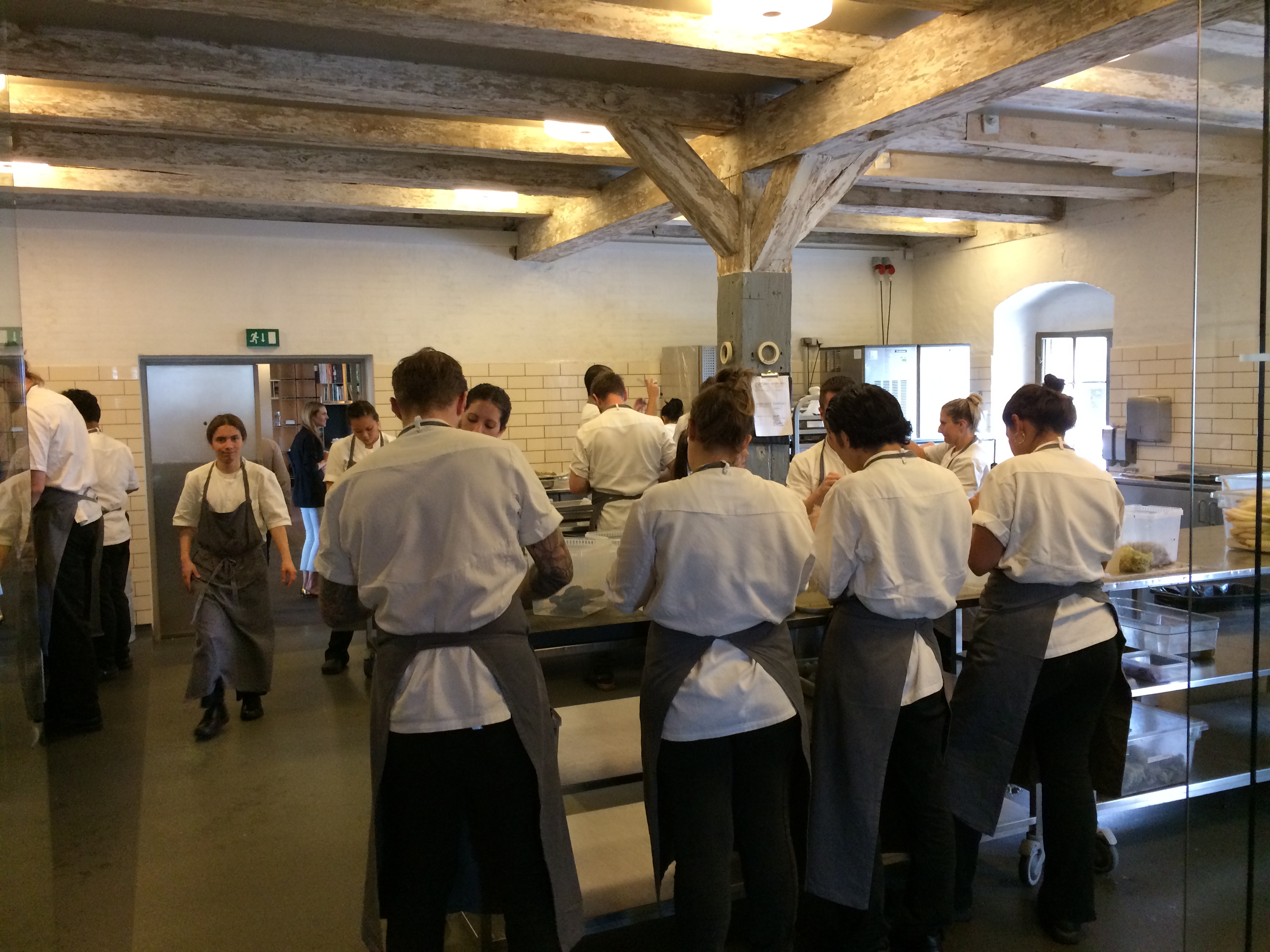
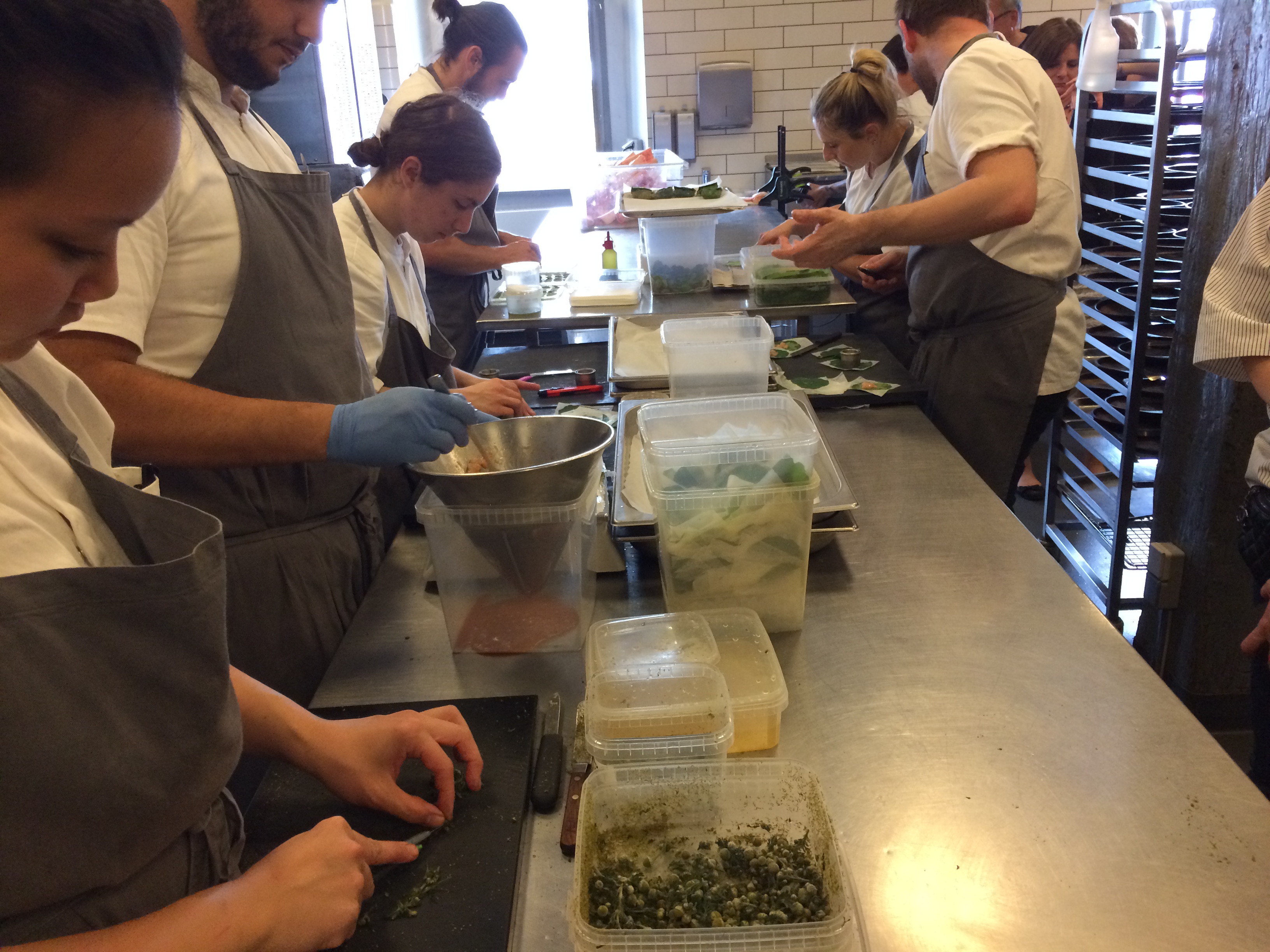
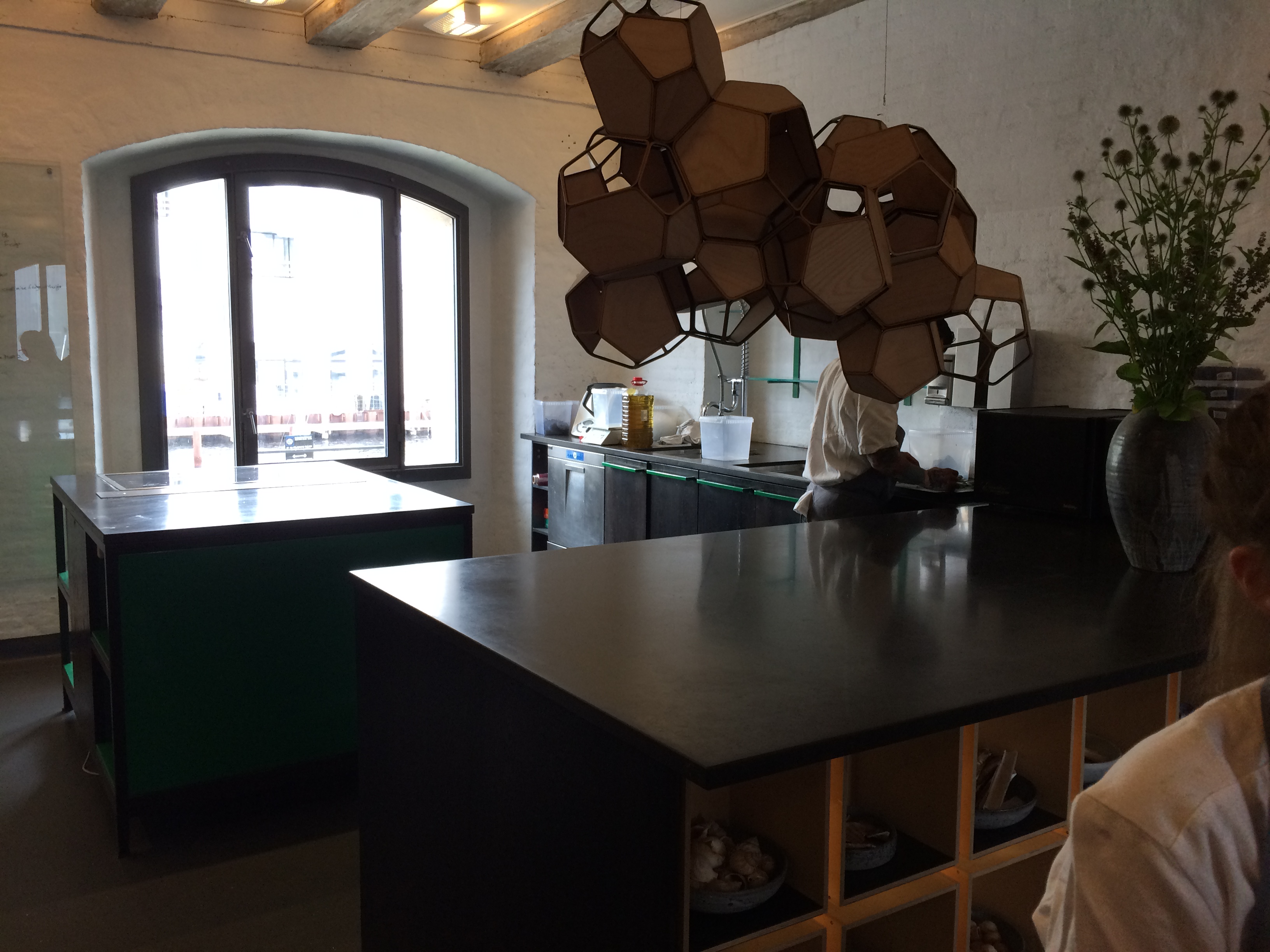
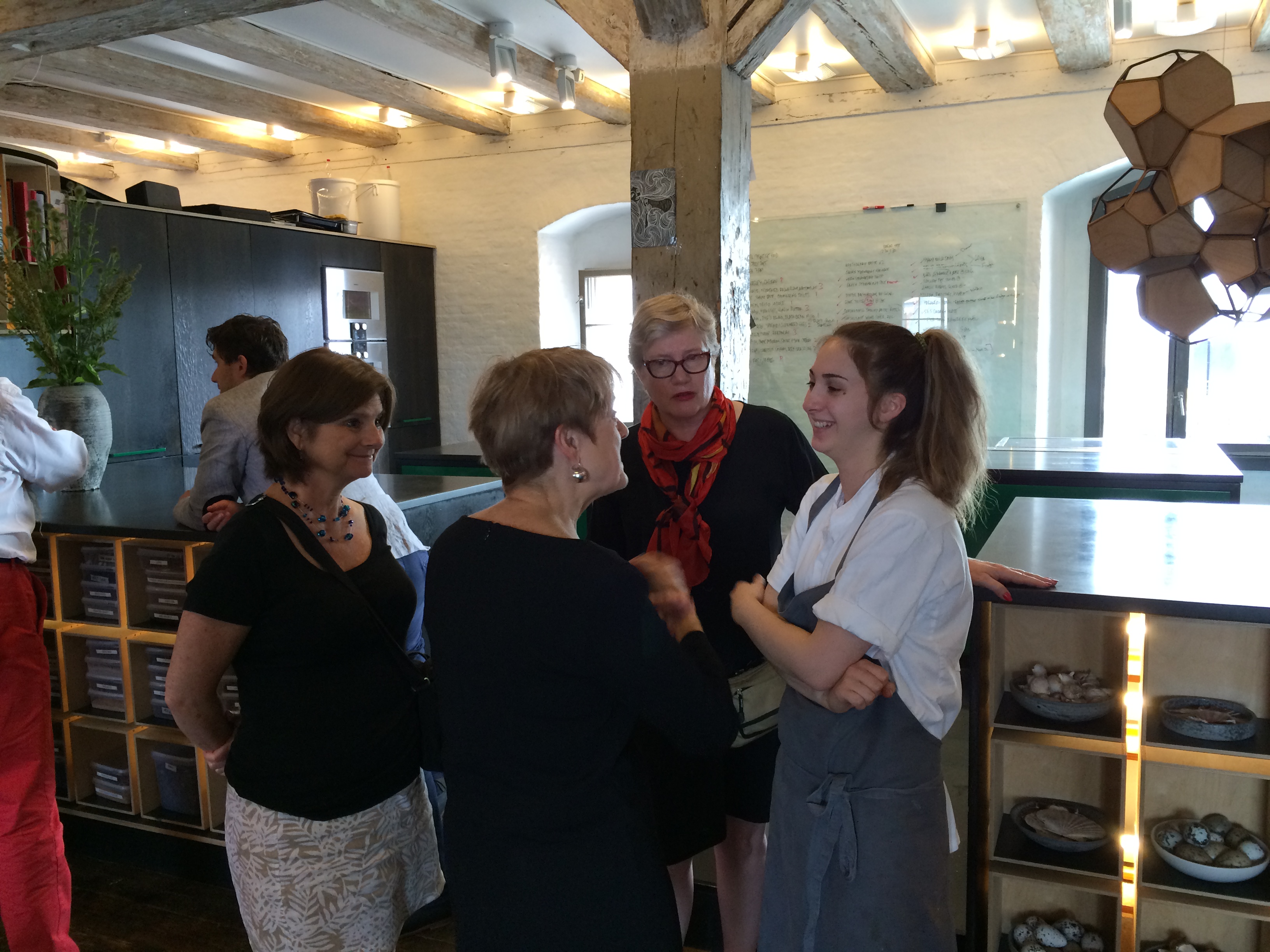
So I went to the restroom and then joined our party in the preparation kitchen, which is adjacent to and visible from the dining room. The tour, being guided by a young woman who is a chef at Noma (she said that she started as an intern a few years back. She is in her early 20’s, and YES, she knows – or says she knows – what an advantage that is for her). I did not get this young woman’s name, but I am sure that I will be seeing her face in a future foodie magazine as a star chef someplace.

2015-07-22 15.35.08
Assembling the Forest Flavors and Chocolate Desserts.
2015-07-22 15.35.19
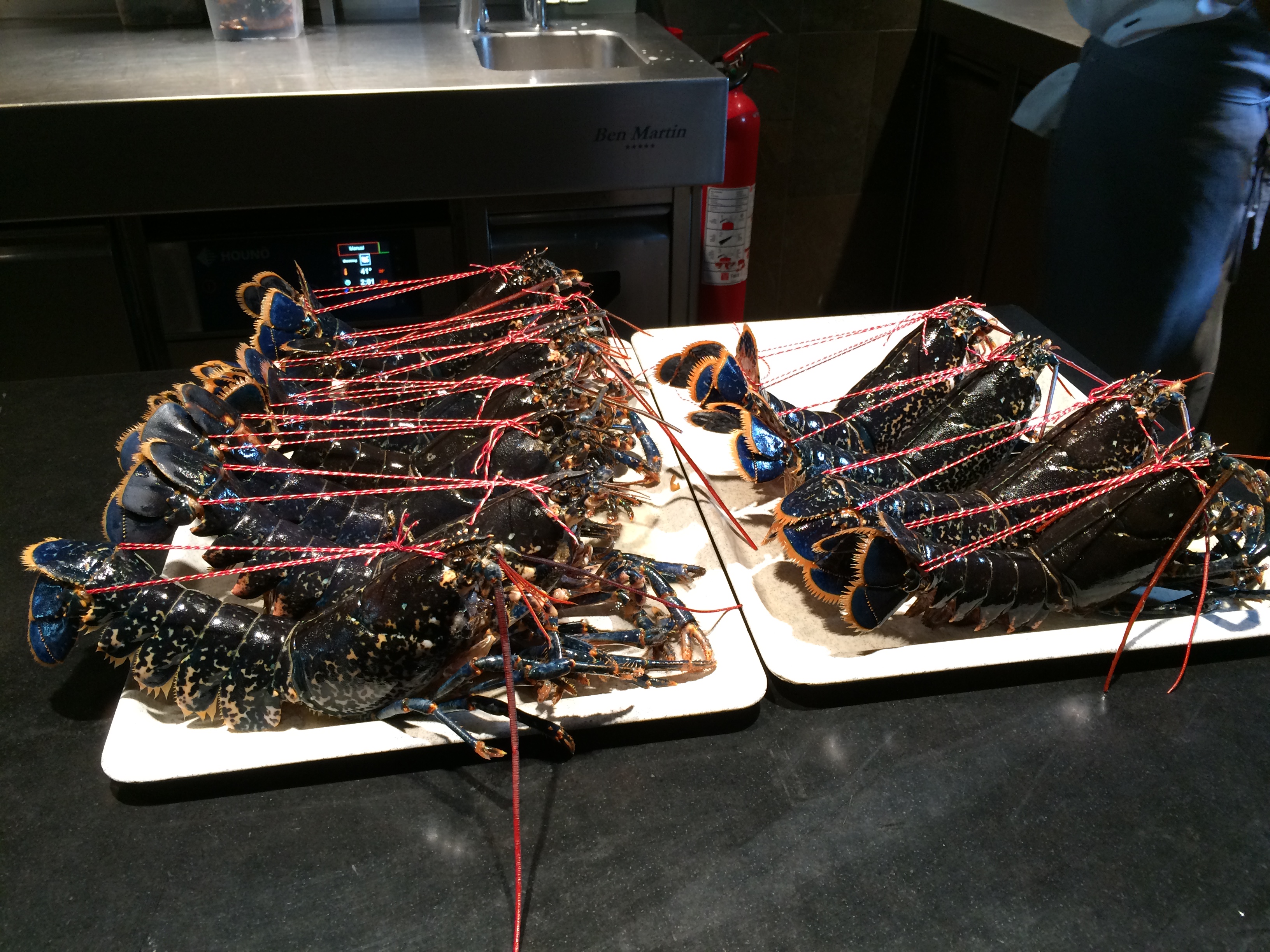
North Sea Lobsters all in a Row.
2015-07-22 15.35.39
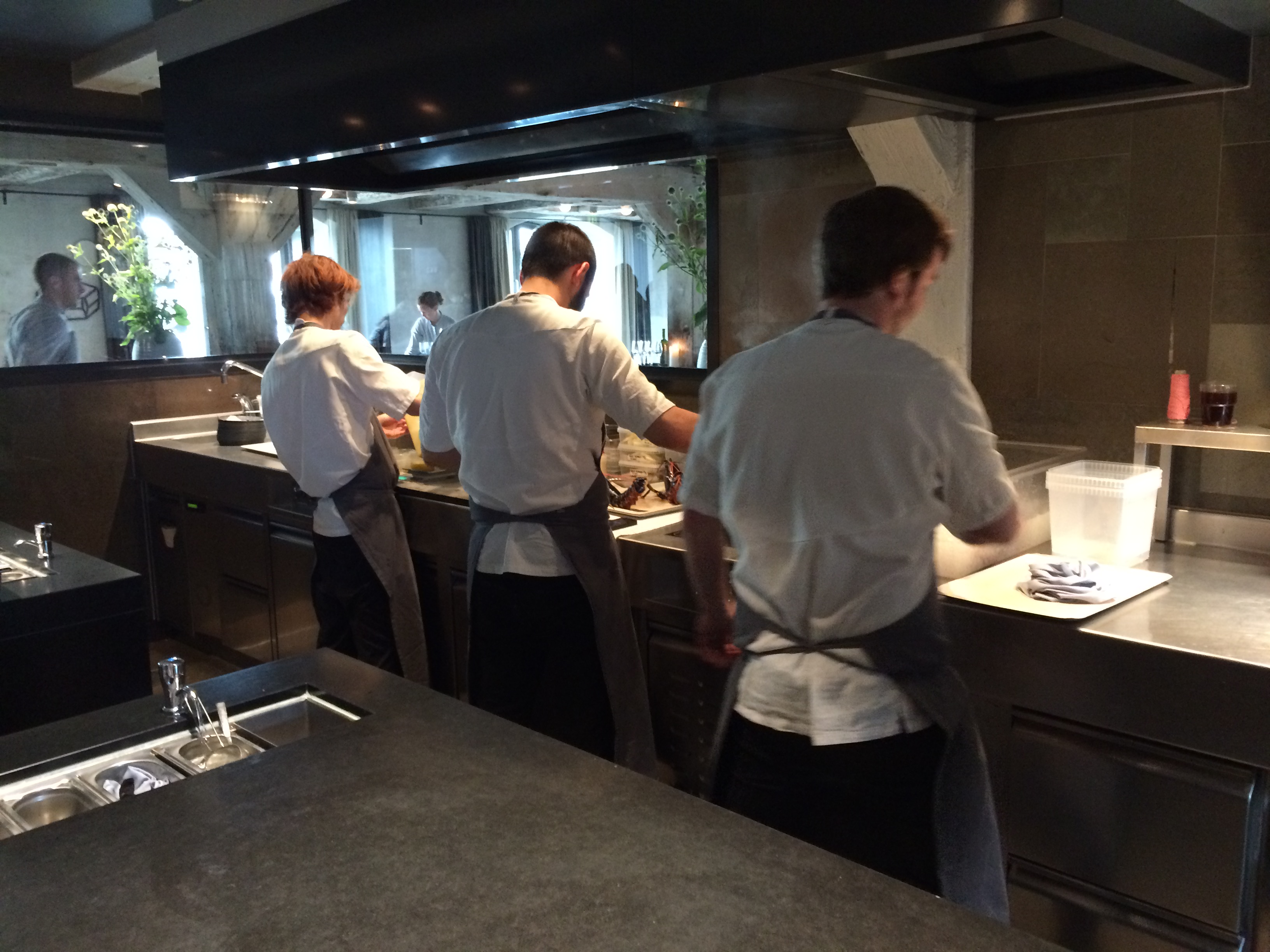
Presentation Kitchen Activity.
2015-07-22 15.35.53
Getting the Egg Liqueur Ready.

This first kitchen is where things are prepared to be served at the table and where some of the cooking is done.

2015-07-22 15.39.41
Our Young Chef Tour Guide Showing us Around.

Then we went out back of the restaurant to the Laboratory.

That’s right. The LABORATORY.

2015-07-22 15.42.11
The Laboratory Facility.
2015-07-22 15.43.11
Various Plants, Molds, etc., Being Tested for Various Qualities. All Very Mysterious.
2015-07-22 15.43.45
Testing How Certain Berries Age.

Here they try things out – there are all kinds of experiments going on to test various ingredients and what happens to them over time in various marinades, and under various conditions, etc. A very interesting part of the operation.

Upstairs, a private dining room that seats up to twenty. You can rent the room for a lot of money (like thousands of Euros) and then PAY FULL PRICE for your Noma meal!

2015-07-22 15.47.11
The Private Dining Room on the Second Floor.

The Book Shelves of Noma.

2015-07-22 15.38.51 2015-07-22 15.48.14

Action in the hallway: Ironing uniforms.

2015-07-22 15.51.24

The Prep Kitchen – where the action is.

2015-07-22 15.53.27
Cutting Frozen Bones for the Bone Marrow Dish.
2015-07-22 15.52.56
Reindeer Moss.
2015-07-22 15.50.22
The Prep Kitchen Staff – Keep in Mind that Noma Seats 45 or so.

2015-07-22 15.55.11

The Staff Room – where cooking, exploring recipe ideas, relaxing, changing clothes, etc. happens. There is a smaller kitchen, an herb garden, and lots of things stored – mushrooms, etc. Here you really get a sense of the Noma Culture, which is think is the glue that makes Noma what it is – one of the best restaurants in the world. You can see that the people who work here have accepted an ethos that they have had a hand in co-creating. René Redzepi, Owner and Founder and Chef de Cuisine is Daniel Giusti were not on the premises that day. They have brought a powerful culture of creativity, innovation, sustainability and success that seems to permeate the staff in a very good way. To work at Noma is to believe in this ethos, even if your intention is to get some experience and move on. While you are there, you are a true believer. Here is a link a partial list of Noma Alumni (LINK).

2015-07-22 15.56.30
The Kitchen in the Staff Room.
2015-07-22 15.57.16
The Kitchen Garden in the Staff Room.
2015-07-22 16.03.45
Our Group has Lots of Questions for our Guide.

2015-07-22 15.56.11 2015-07-22 16.07.23 2015-07-22 16.07.32

The lounge – near the entry, where you can have a drink before or after, or, I imagine, in lieu of, dinner.

2015-07-22 15.34.14
The Lounge at Noma.
2015-07-22 16.11.20
The Wine Storage in the Lounge.

So ends our tour of Noma.  On to some commentary.

Overall, this wonderful experience. While I did not like everything that I was served (probably not possible), I will say that the experience of the food was overall very enjoyable, both in tasting the dishes and in experiencing the creativity.

We were served 20 courses. My main negative about Noma is that the courses came out too quickly.

We had 20 in that time and it was too much too quickly. This is food that you want to savor – to talk about the amazing combinations of ingredients with your table mates, to take some photos (but of course!), and to taste the wine served and to experience the pairing of food and wine; then to reflect privately for a moment or two and then to share with your fellow diners your impressions and experience.

This takes time. But the next course is here!

I don’t think that this is a minor quibble. I like to savor. I don’t like to feel like they need to move me out to get the next seating in (which was not the case, as the next seating was for dinner). So please, Noma, a bit more time. I am not in a hurry when I am spending this kind of money for this kind of experience. I am sure that all of this has been figured out over time, but for me, it was not optimal in regard to truly enjoying the meal at leisure.

I read the other day of a restaurant opening in Barcelona that will serve 50 courses in two and one-half hours. I doubt I’ll be going there.

The wines at Noma were, let me say, unique (LINK TO LIST AS PDF). I have written about each and posted photos of the labels, but you probably won’t be able to find most of them – maybe one or two. I spoke with Sommelier Yukiyasu Kaneko about his choices. He said that he preferred to use only European wines, and that included a wine from Georgia in the former Soviet Union. He also clearly has a preference for young wines to accompany the fauna heavy Noma menu. All of the wines were whites. I found that the pairings worked well with one or two exceptions, and in those cases the wines were either sour or so very young as to have only rough edges, which I guess was intentional, but I did not agree with those choices.

Note that there is a lounge at Noma, where you can come for a drink or some wine before or after dinner, although you get quite a bit of wine with the paring meals – I recommend a taxi or a designated driver. We walked, and got a bit lost on the way back to our apartment.

How much did it cost? The wine pairing meal was 3100 DKK or about $450 per person. the juice pairing was 2500 DKK or about $367. Expensive, I know. It was Dorianne and my 10th Wedding Anniversary gift to one another, so a very special occasion.

Will I go again? Not sure that I need to, but if the opportunity presents itself – I will strongly consider it. I’d like to see what they do next. Have you been to Noma? Your comments are appreciated.

Photos and text, Copyright 2015 by Jim Lockard

“THE BEST RESTAURANT IN THE WORLD:” COPENHAGEN’S NOMA – PART 3: THE LAST HALF OF THE MEAL

Noma, the Copenhagen restaurant that has been voted “The Best Restaurant in the World” (LINK) over and over, was the site of a recent visit by Dorianne, two friends, and me recently. Here are the links to the first two installments of the series: (LINK TO PART 1)  (LINK TO PART 2).

This post covers the second half of our 18 (actually 20) course meal and wine pairing.

Course #10:

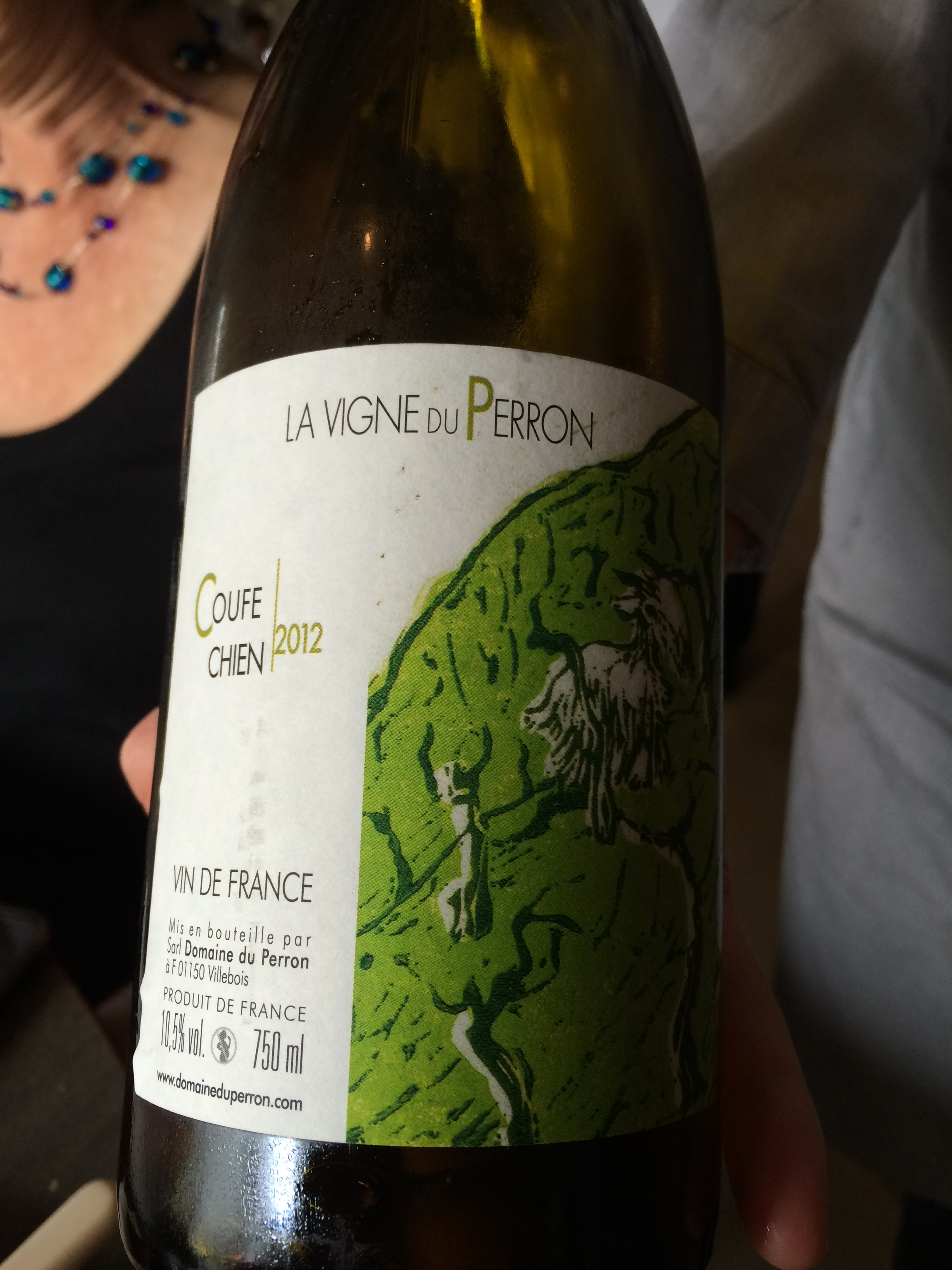
2015-07-22 13.22.07
2012 Coufe Chien, Domaine du Perron, Bugey – Savoie
2015-07-22 13.22.44
Mahogany Clam and Grains.
2015-07-22 13.22.48
Mahogany Clam and Grains.

Our wine for this and the next course is a 2012 Coufe Chien, Domaine du Perron, Bugey – Savoie, Chardonnay (LINK to the 2011) from the Rhone Valley. Young and high in acid with an aromatic nose and hints of citrus, it was a perfect accompaniment to the Mahogany Clam.

The single clam was mounted on a bowl of wet stones (which we were advised not to eat). The uncooked clam meat was sitting in a marinade with a dusting of samfire (LINK) around the top of the shell. The dish was to eaten with a wooden fork. It was delicious – I could have eaten the rest of the dozen, but alas, it was not to be.

Next:

2015-07-22 13.31.40
Monkfish Liver on Toast.
2015-07-22 13.31.45
Monkfish Liver on Toast.

This course, Monkfish liver, cooked then chilled and served very cold on toast, sitting atop a folded napkin. This was a particularly succulent dish, with a great texture and flavor. The Coufe Chien was a beautiful match for this dish. Eaten with fingers.

Next:

2015-07-22 13.43.49
White Asparagus, Goosefoot, and Barley.
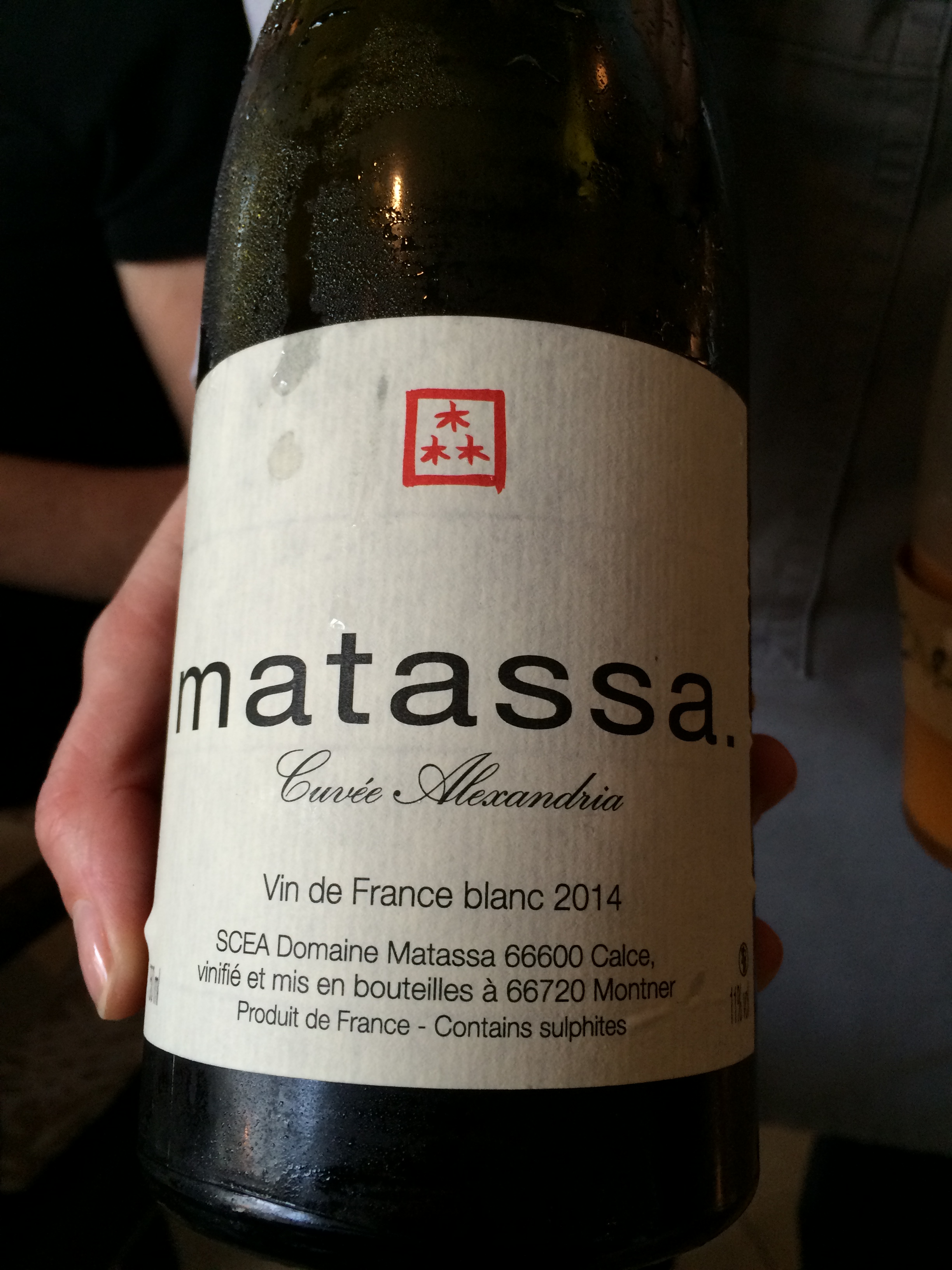
2015-07-22 13.44.28
2014 Cuvée Alexandria, Domaine Matassa, Calce – Cote Catalan

Our next wine, a 2014 Cuvée Alexandria, Domaine Matassa, Calce – Cote Catalan (LINK – click on Cuvée Alexandria), is described as a “raw wine,” made from a grape called Muscat d’Alexandria. You won’t find much about this wine, from the Catalan hills in extreme southwest France, online, and I doubt that you will be finding this wine in your local wine shop. The wine is unfiltered, very young and is very raw. I would describe it as bitter and a bit sour. Not for sipping. It reminded me of the must right after fermentation, while the wine is still in the fermentation vessel.

It was served with only one dish, a white asparagus, goosefoot (LINK), and barley plate, this one eaten with utensils. The asparagus was amazing – tender and delicious, the goosefoot and barley added notes of green sour and some texture. And, I was surprised to see that there was some justification for the wine pairing. The Cuvée Alexandria was a decent match, adding to the sour notes of the dish (you would have to like sour), and extending the flavors through a long finish. Intriguing.

For the next course, a new wine:

2015-07-22 13.50.39
The Glasses Accumulate.
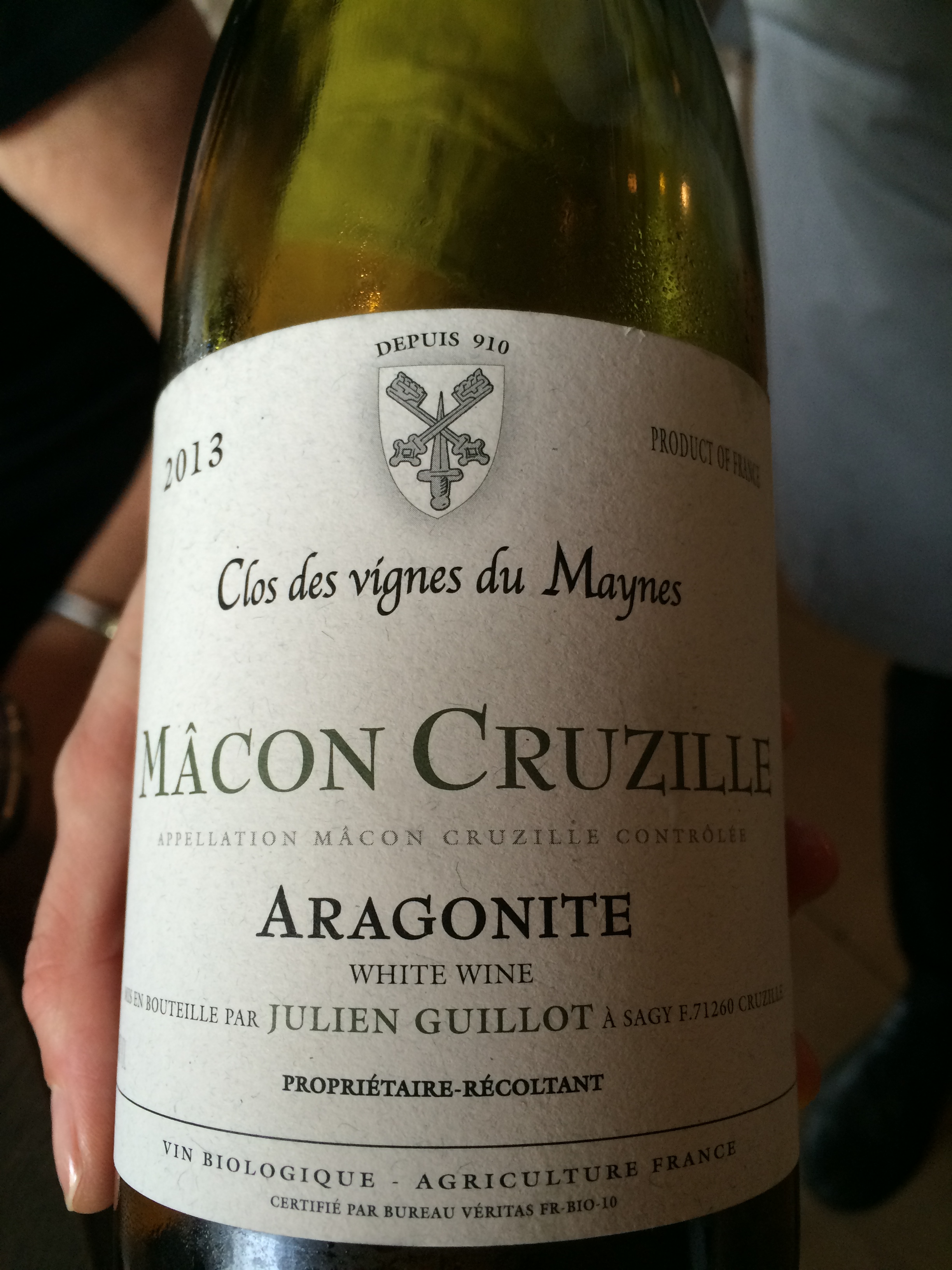
2015-07-22 13.53.44
2013 “Aragonite” Julien Guillot, Cruzille – Macon
2015-07-22 13.54.19
Vegetable Flower.

The new wine, a 2013 “Aragonite” Julien Guillot, Cruzille – Macon (LINK)Burgundian Chardonnay, was a return to wine-normalcy for me. Fragrant, well-structured, and clean, the wine drank very well.

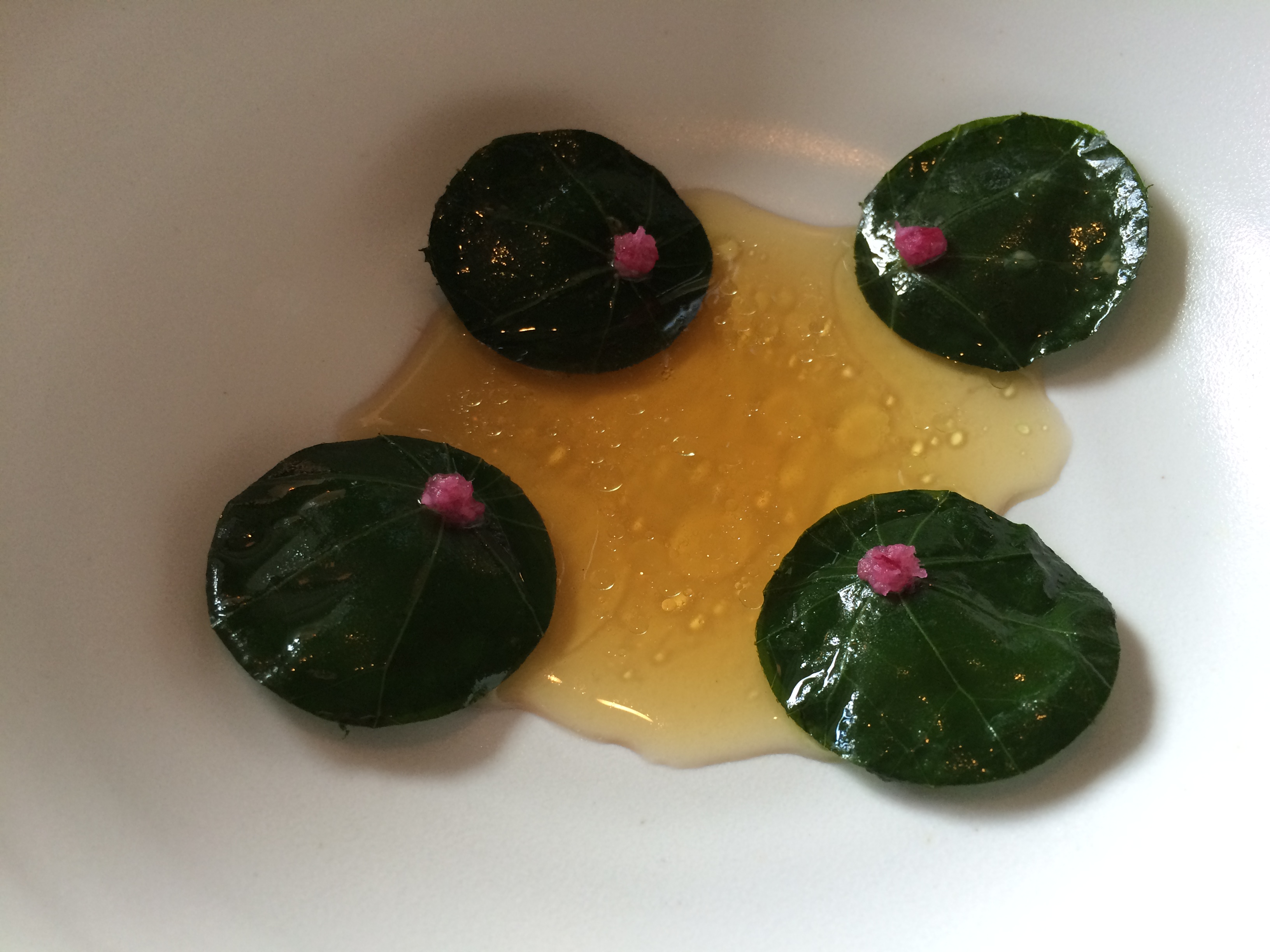
The first of two pairings with this wine was called vegetable flower. As you can see, it was nasturtium flowers in a vegetable broth. Delicious and delicate, the wine did not overpower this dish.

Then:

2015-07-22 14.01.53
Lobster and Nasturtium.
2015-07-22 14.02.06
Lobster and Nasturtium.

Lobster and nasturtium was next. A North Sea lobster tail served with nasturtium leaves attached. Paired with the Julien Guillot Chardonnay, it was one of the highlights of the meal.

Now, we enter into a bit more unusual territory:

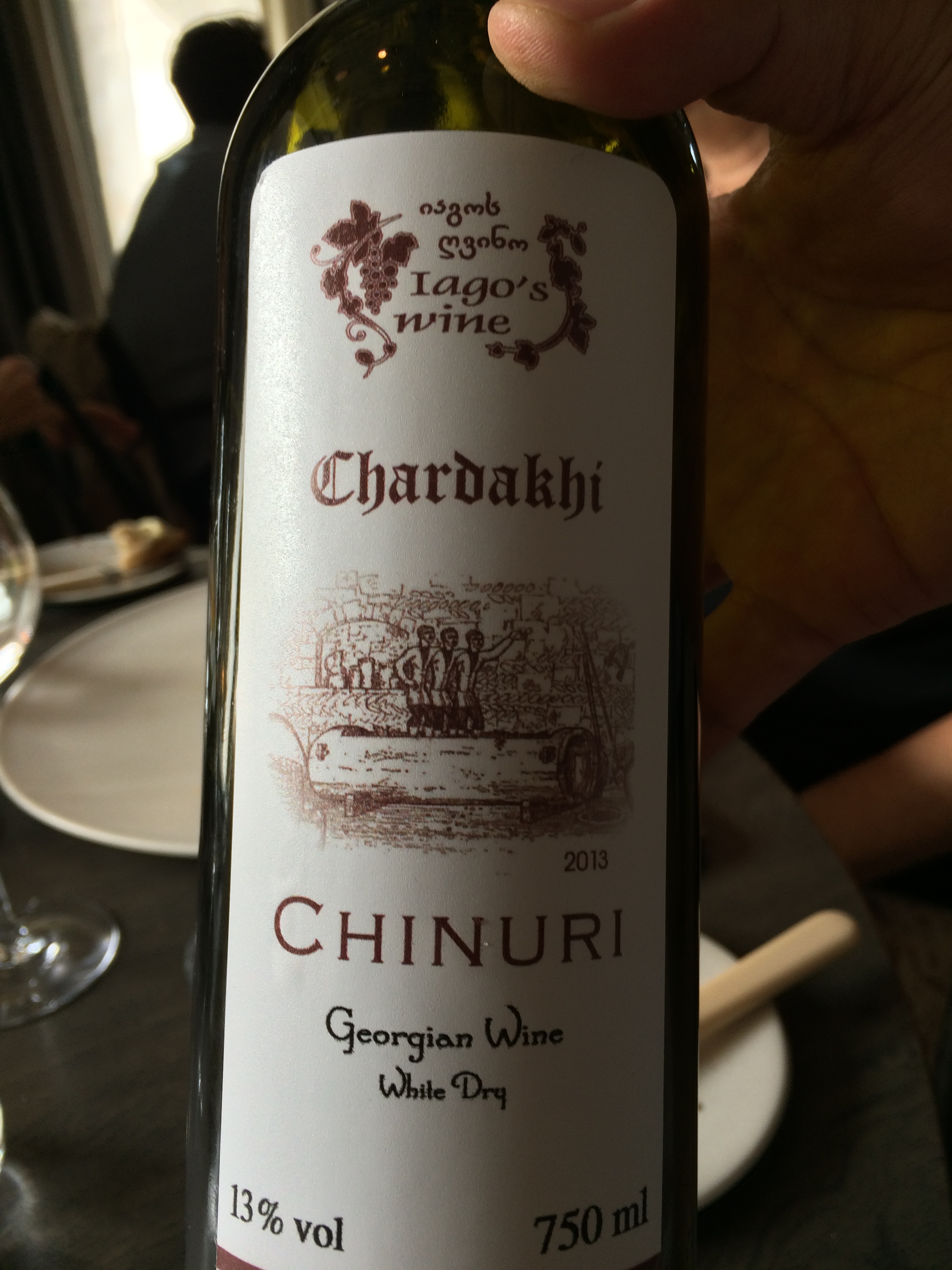
2015-07-22 14.18.24
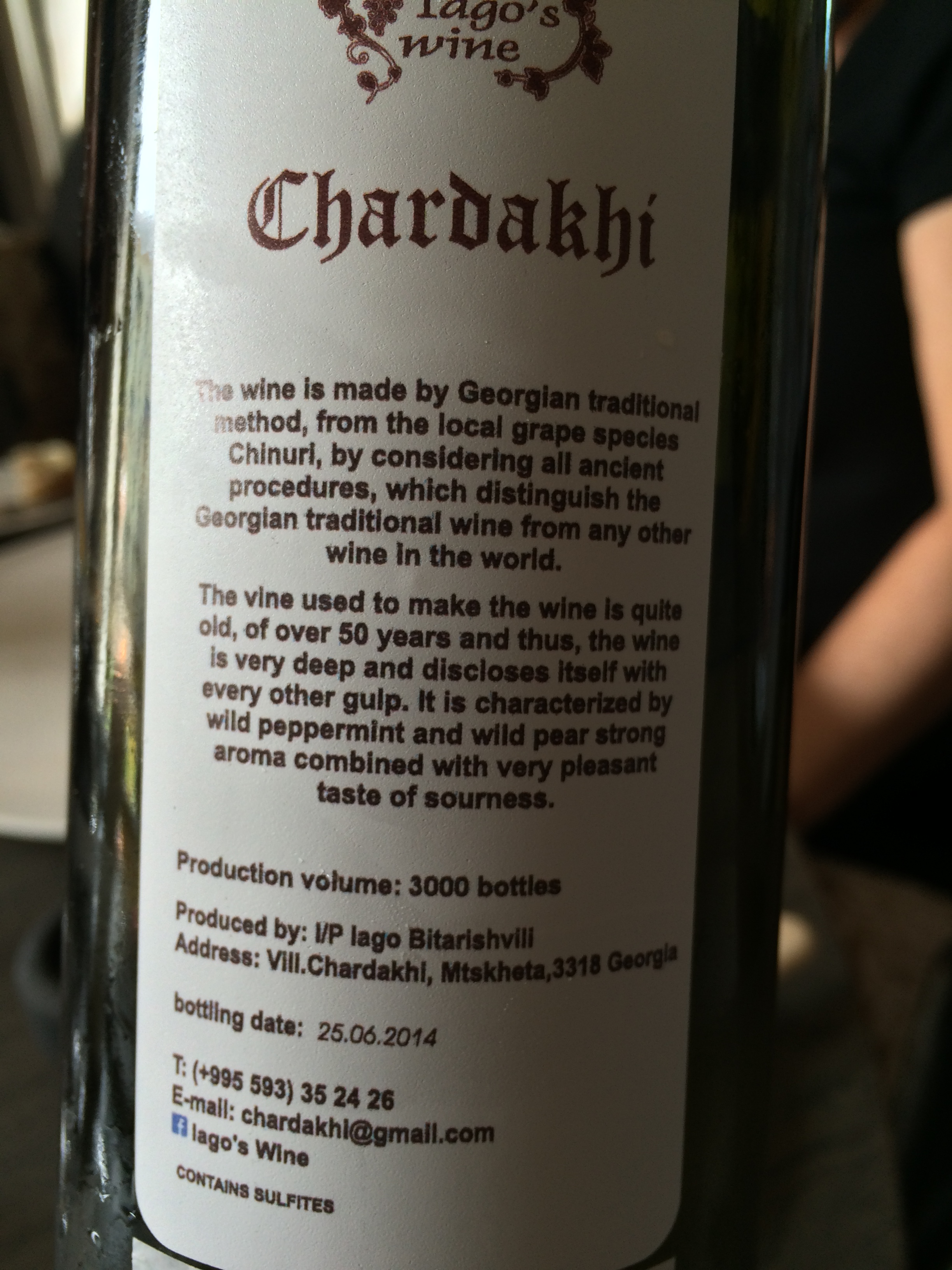
2013 Chinuri, Iago’s Wine, Chardakhi – Georgia.
2015-07-22 14.18.34
2013 Chinuri, Iago’s Wine, Chardakhi – Georgia. Back Label in English!

2015-07-22 14.21.34The next wine, a 2013 Chinuri, Iago’s Wine, Chardakhi – Georgia (LINK)was most unusual. Unfiltered, young, sour. Even more so than the Cuvée Alexandria mentioned earlier. This wine was almost unpleasant – there was wine in the mix somewhere, it was just hard to find.

The first pairing was a dried fruit “leather” shaped into a leaf with a number of other items on it, including some garlic and grasshopper flour. It had the consistency but not the flavor of licorice and was very good.

Next:

2015-07-22 14.24.51
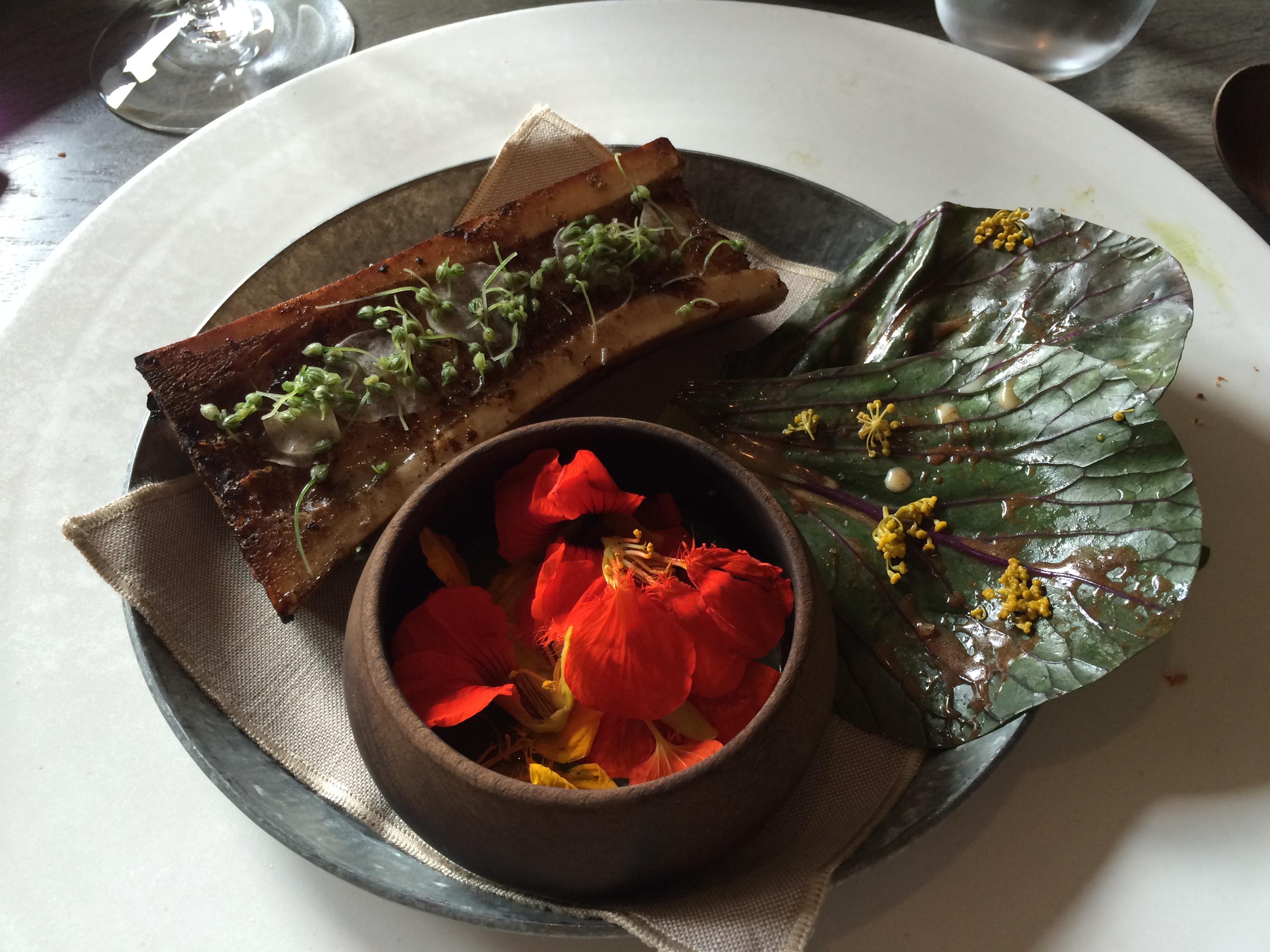
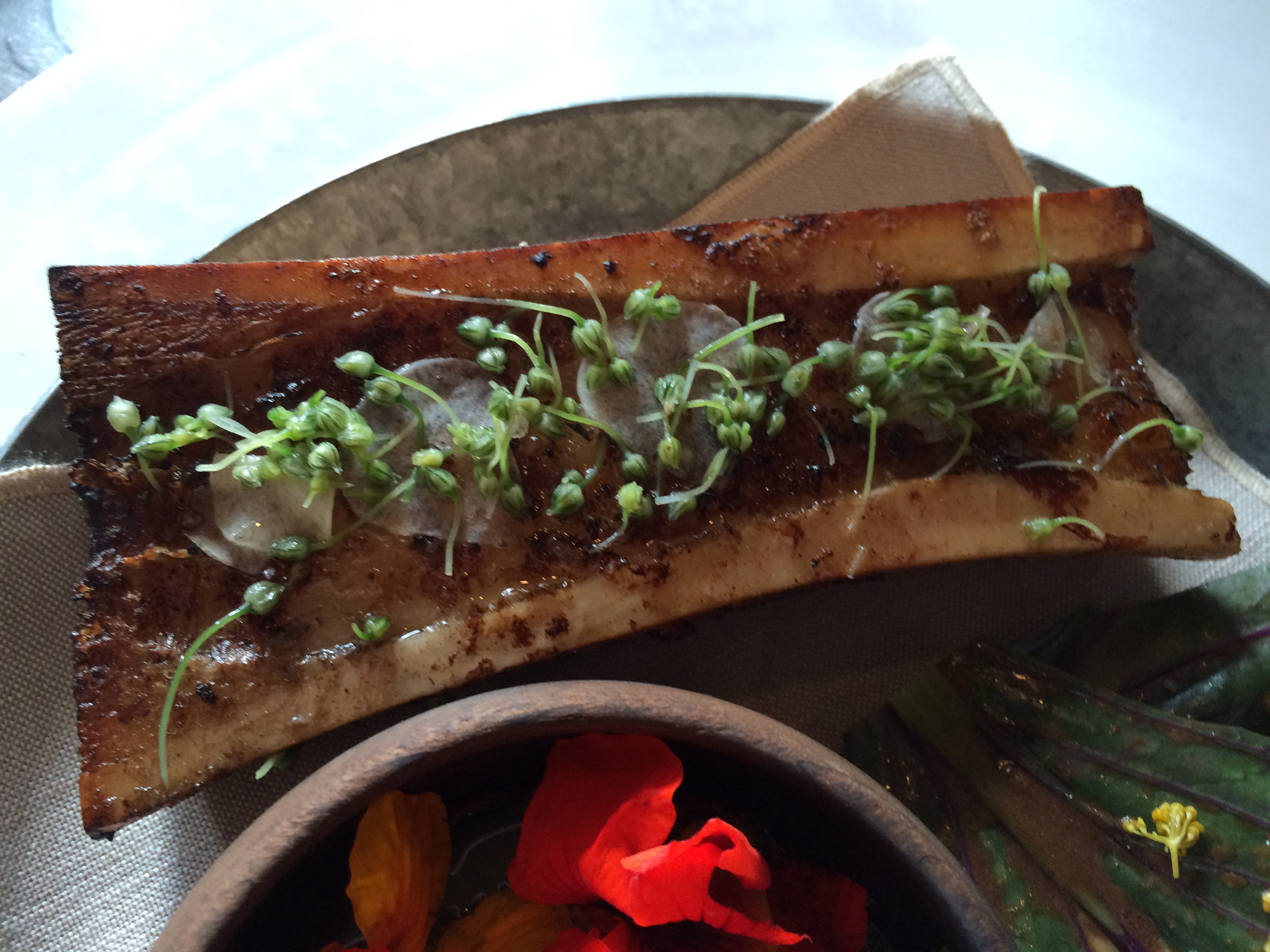
Bone Marrow with Flower Soup and Nasturtium Leaves.
2015-07-22 14.24.56
Bone Marrow with Flower Soup and Nasturtium Leaves.

Then, a dish not on our printed menu – beef bone marrow with a “soup” of flowers, and nasturtium leaves. This dish was the only one served that might have called for a red wine, but the Chardonnay did it’s job of pairing pretty well.

At this point, we were visited by the Sommelier, Yukiyasu Kaneko of Japan.

2015-07-22 14.22.09
Noma Sommelier, Yukiyasu Kaneko of Japan.

He answered our questions (I had a longer chat with him later) and explained his theory of using younger wines to compliment Noma’s unique cuisine.

Next:

2015-07-22 14.43.37
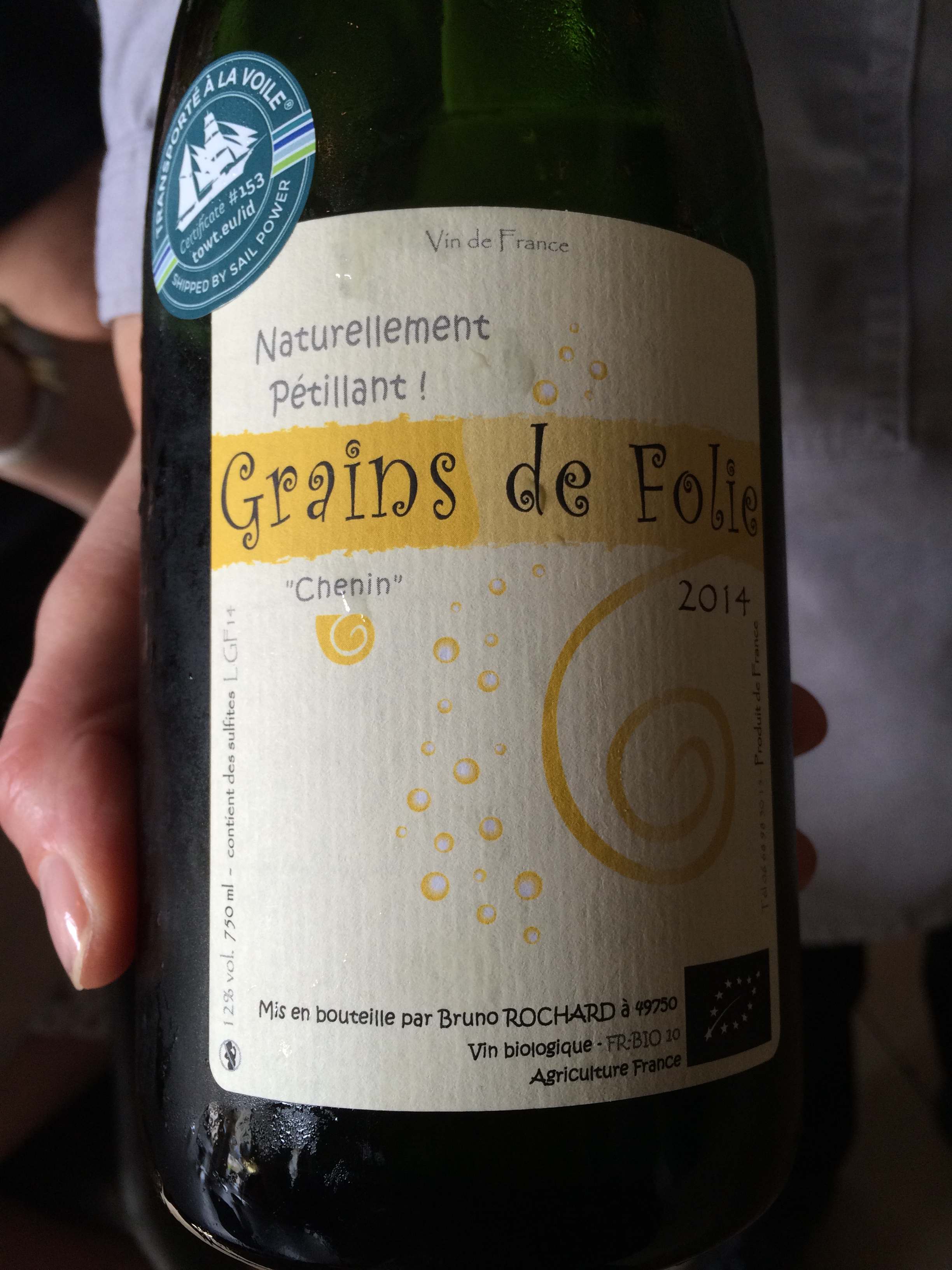
2014 Grains de Folie, Bruno Rochard, Coteaux du Layon – Loire.
2015-07-22 14.45.53
The Cheese Course – Not Sure of the Ingredients beyond a Creamy Cow’s Cheese.

The next wine, a 2014 Grains de Folie, Bruno Rochard, Coteaux du Layon – Loire Valley, Chenin Blanc (LINK – Related) comes from a region known for sweet wines. This wine, was a bit on the sweet side of dry. It was light, refreshing, and a nice pairing for the cheese course (also not on the written menu). The pairing worked well. The cheese was light and creamy, in a vegetable broth. Very good.

Now, on to Desserts:

2015-07-22 14.31.37
Berries and Greens Soaked in Vinegar for One Year.
2015-07-22 15.00.24
Forest Flavors – Deep Fried Reindeer Moss Dipped in Chocolate.
2015-07-22 15.00.28
Creme and Dipping Sauce.
2015-07-22 15.00.36
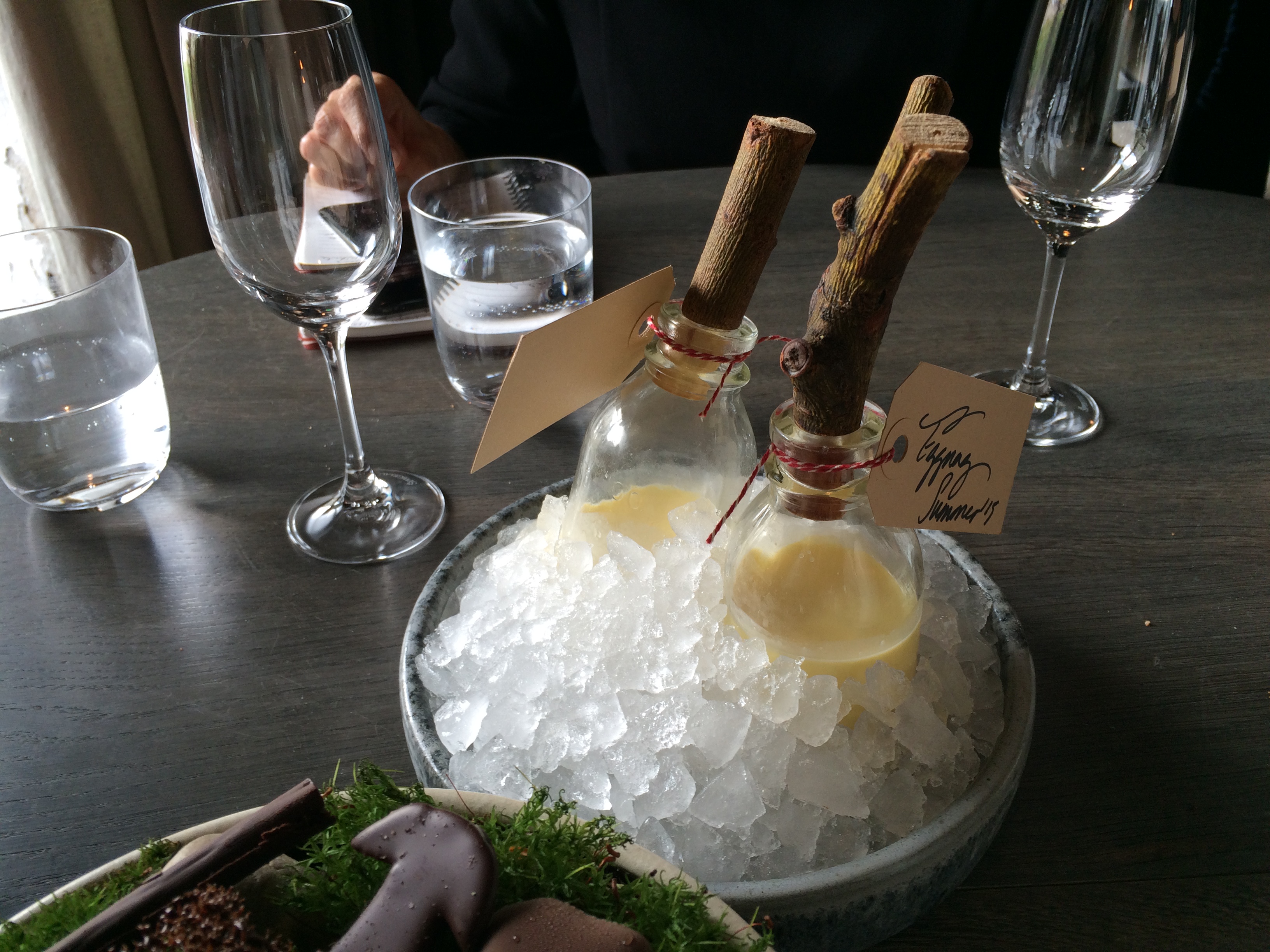
Egg Liqueur.
2015-07-22 15.14.07
Espresso to Finish.

Desserts were a flurry of items, pickled and sweet, with egg liqueur and espresso. The berries and greens soaked in vinegar for one year were very good – each retained much of its original flavor, but the textures were very unusual. The forest greens dipped in chocolate were a combination of tart, sour and sweet – the creme dipping sauce could tip it to the sweet side if you preferred, plus there were some more conventional chocolates on the plate. The egg liqueur was very smooth, much thinner than eggnog, and refreshing.

I should point out that Dorianne has allergies to beef and cow dairy, and the Noma staff made every effort to accommodate her in this regard, substituting ingredients, etc. You let them know 30 days in advance of your reservation about any allergies.

Wow. What a meal! The 18 courses turned out to be 20. We were well-fed, entertained, amazed, and, actually, ready for more. In the next and final installment of this series, I will let you know about the tour that you are offered of the Noma Complex and what you learn about the unique Noma Culture.

Photos and text, Copyright 2015 by Jim Lockard

“THE BEST RESTAURANT IN THE WORLD:” COPENHAGEN’S NOMA – PART 2: THE FIRST HALF OF THE MEAL

The food at Noma changes, sometimes daily. It is based on the seasons, on what has been foraged that morning, on what the chefs are trying to do, and, I am sure, on other factors that I know nothing about. Everything that we had was unique and clearly well thought out. I did not like everything, but I did not hate anything served. There was quite a bit of “sour” taste on the menu, and some on the wine list. There were some dishes that were interesting but not memorable. And there were some that soared. Those experiences were different for each of us at our table for four – Dorianne, me, and friends Ginger and Patricia. Three of us opted for the wine paring, Ginger opted for the juice pairing – a different juice blend comes at the same time that new wines are introduced. She raved about the juices, and we all tasted some and they were very, very good.

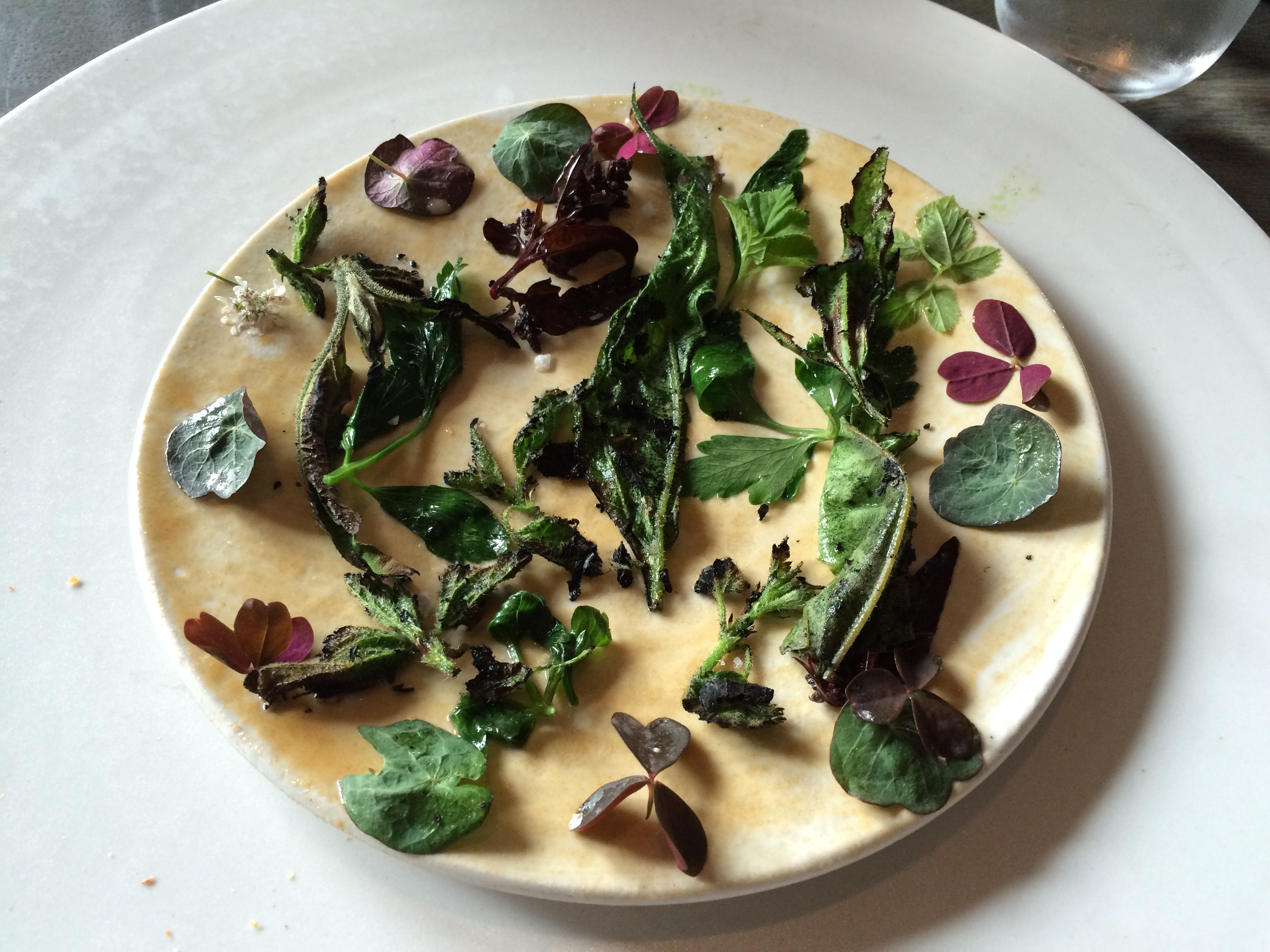
The presentations were unique, generally attractive and appealing, and mostly, delicious. There were lots of flowers, some rocks, mushrooms, moss, leaves, dough, lobster, bone marrow, berries, and many things that I had never seen on a plate before.

The restaurant is very nicely appointed, but not flashy at all. Rough-hewn wood, lots of gray colored fabrics and surfaces; you might say that the dining room is understated, as you might expect in Denmark.

2015-07-22 12.05.24
The Dining Room with the Wine and Juice Cooler.

The tables are simply set. There is a clear effort to have guests feel welcome and to make the experience as unpretentious as possible. Staff are friendly, direct, and relatively informal. They do what they do very well, are always in motion, but have time for any query or request.

THE MEAL

2015-07-22 12.00.21
Turnip and Unripe Strawberry Marinated in Aquavit with chamomile and other berries. Served on Ice.
2015-07-22 11.54.48
The First Wine – Not on the Menu – A Champagne.
2015-07-22 12.07.16
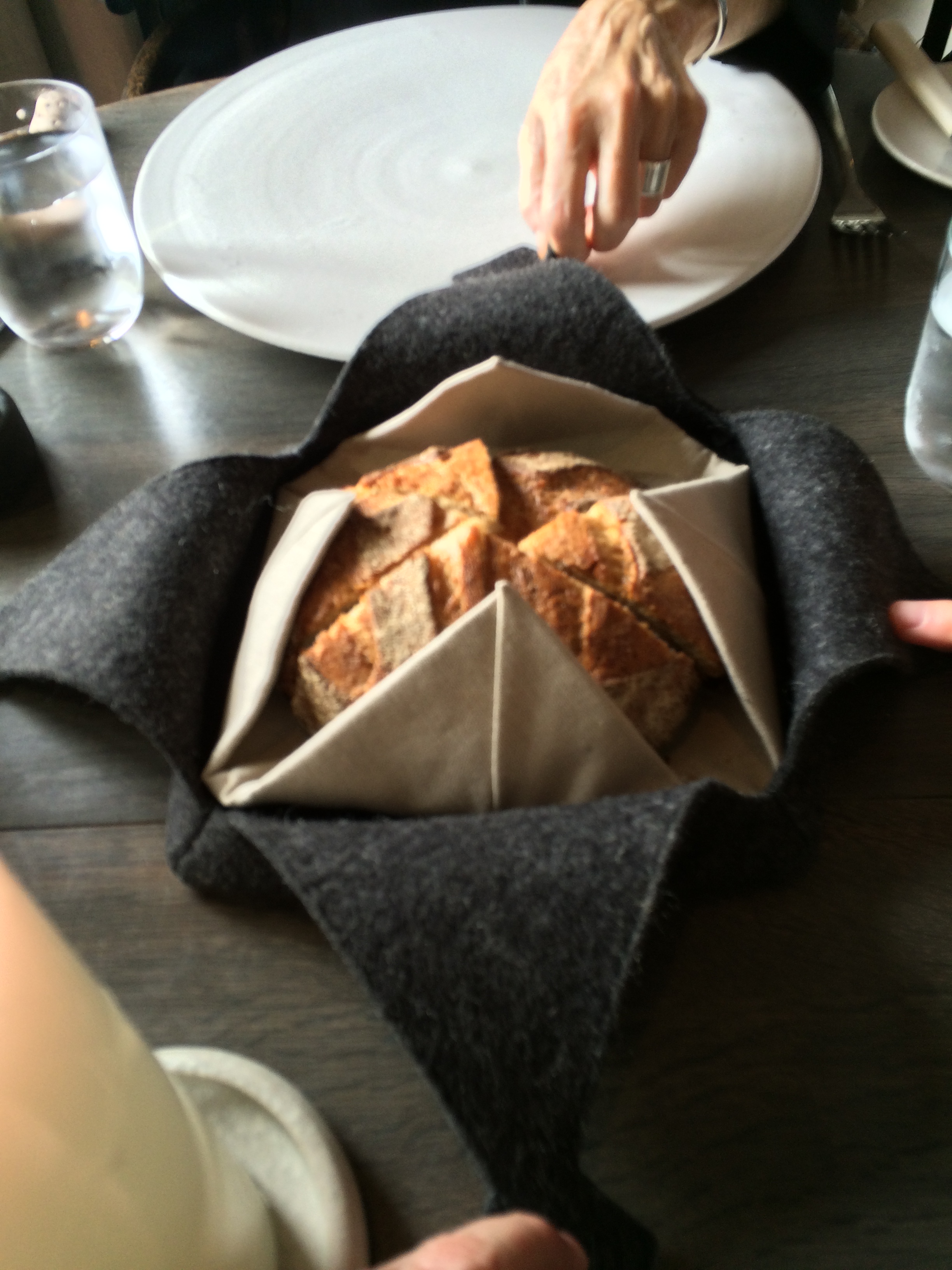
The Bread Bowl.

The first three courses are not considered a part of the pairing dinner. We were served a Champagne for all of these courses, a dufour par charles champagne “les instantanes”, which I could not find in an internet search (found the producer, but not this wine). Suffice to say that it was very well made, light and crisp, and you likely will only get it at Noma. The first item served to us was a small bowl of ice topped with turnip and unripe strawberry marinated in Aquavit. There are obviously other things sitting on top of the slice of turnip and the strawberry, berries, flowers and such – there are always other things on the dishes that are not described on the menu, but are described by the server. The server, by the way, will be either one of the wait staff or someone from the kitchen who worked on the dish being served.

This dish, eaten with the fingers, was very tart (Aquavit and unripe things) and the Champagne was a wonderful match, giving a sense of ripeness, but not too much. I was thinking that they know what they are doing. Smiles, oohs and aahs, and photo taking all around the table (I stopped the server to photograph each wine bottle as it was served – they were wonderfully patient). A very good start.

The bread, served in a felt basket, made from native Oland wheat and accompanied by both butter and rapeseed oil was delicious. The basket was refilled at least twice during the meal.

2015-07-22 12.09.24
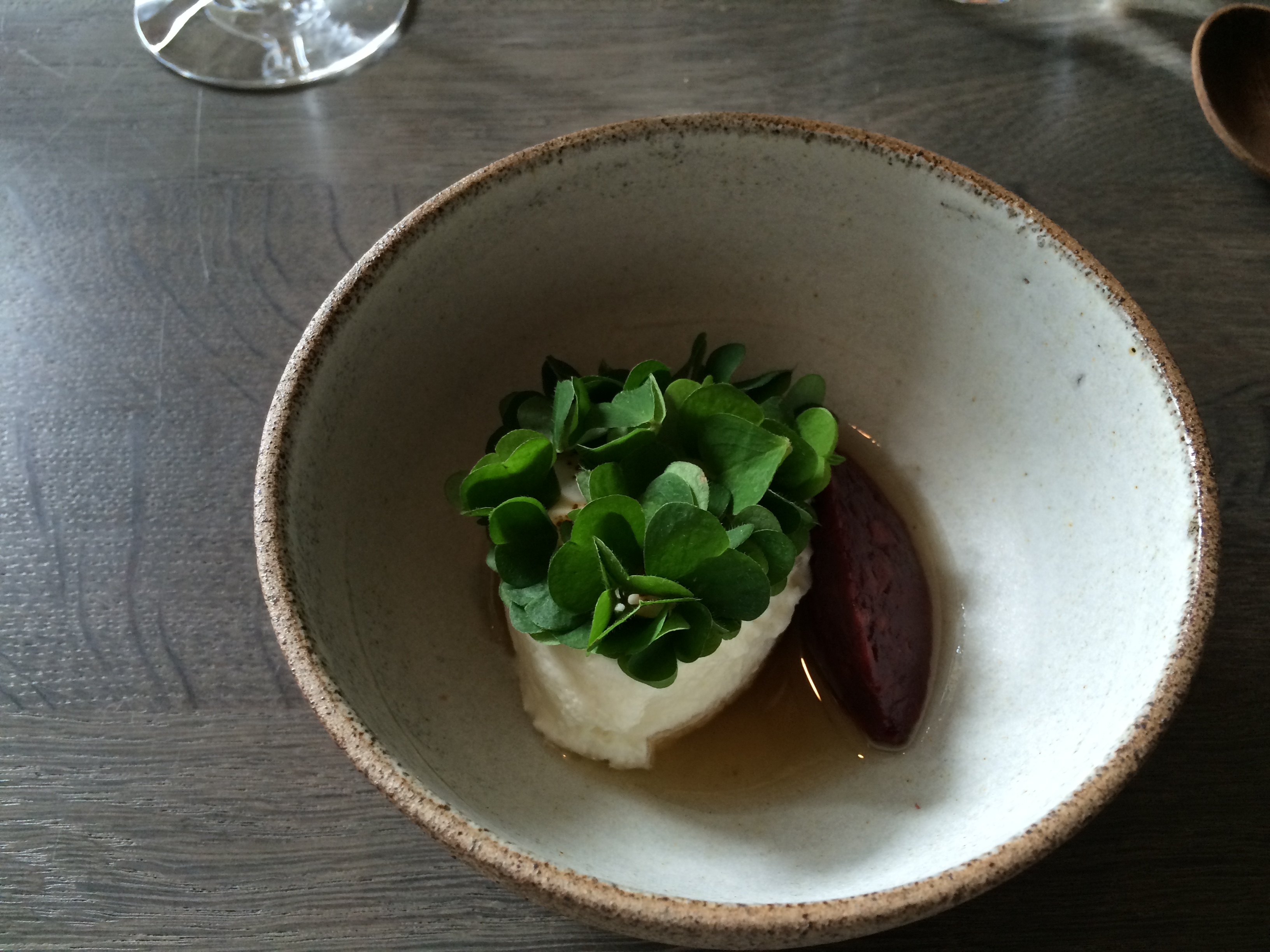
Summer Cabbage Leaves and White Currants.
2015-07-22 12.09.44
The sauce being added to the Summer Cabbage for Patricia.

Next came summer cabbage with white currants and a white currant broth that was added at the table. This continued the tendency toward sour, unripened flavors. It could be classified as a soup, I suppose. Again, the Champagne was right there to extend and ripen the experience of the food.

2015-07-22 12.19.39
The First Shoots of the Season with Scallop Marinade.
2015-07-22 12.20.21
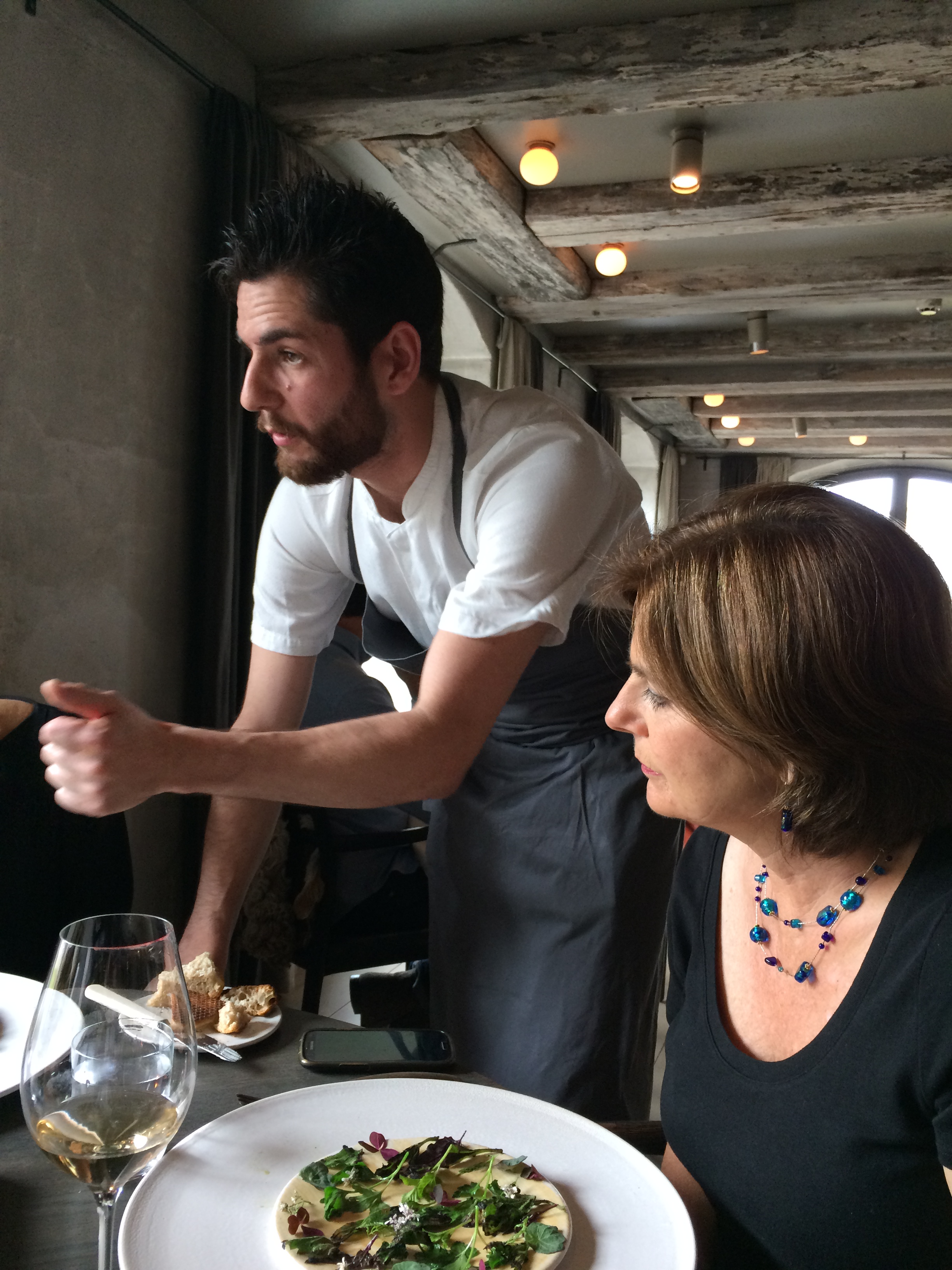
Dorianne Looks On as the Dish is Explained.

Next, course #3, the first shoots of the season with a scallop marinade, again with the Champagne. The plants were tiny and tender, some of them toasted, and after enjoying the presentation, you mix them all together in the thin layer of marinade and eat them in a few bites with your fingers. The rush of various flavors and the marinade tasting of the sea was delicious. After doing yeoman’s duty, it was time to part with the Champagne. Note: they do refill your glasses as often as you like.

2015-07-22 12.30.272015-07-22 12.30.33

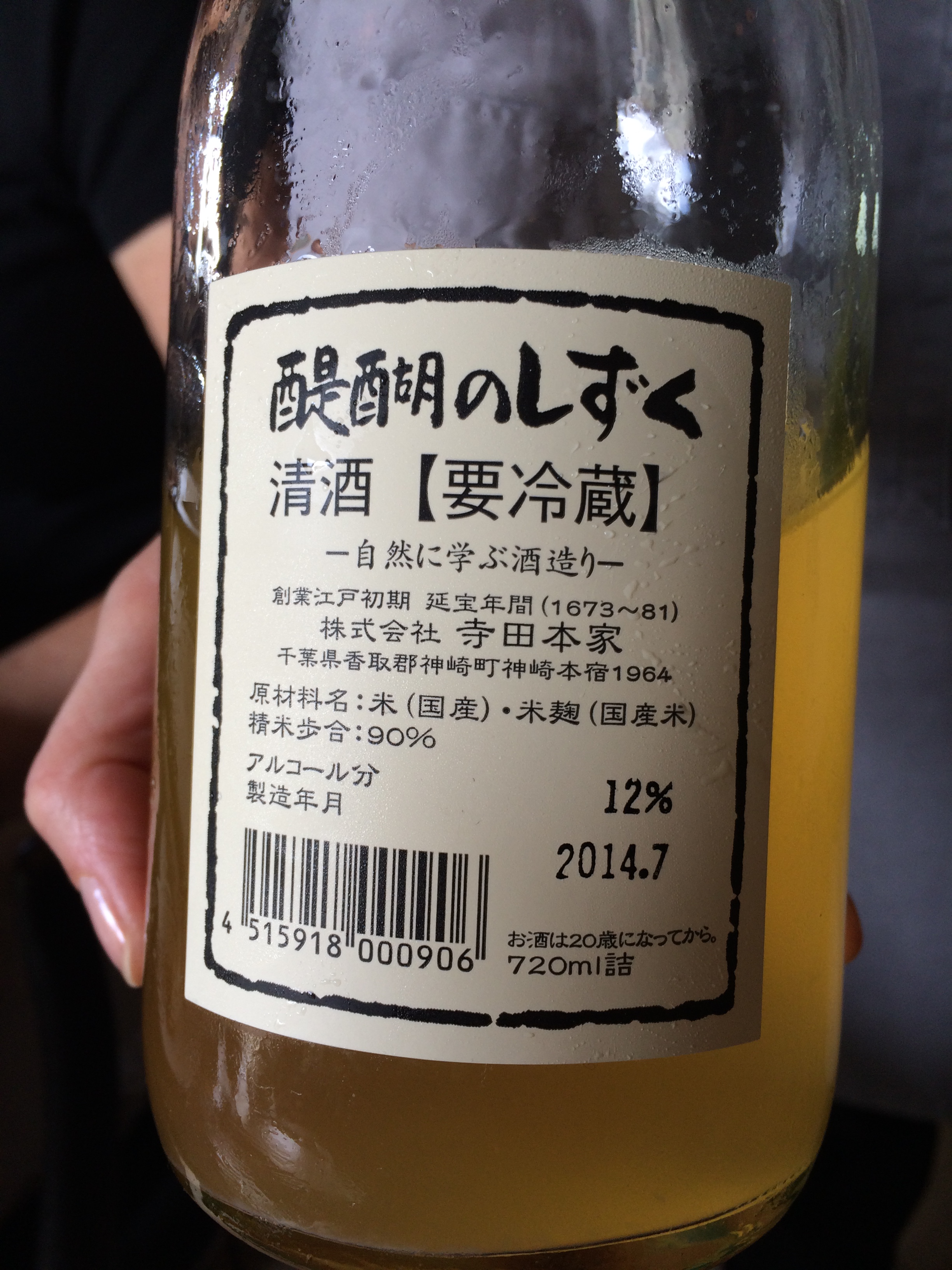
Now, the actual wine pairing begins! With Sake! A 2014 Daigo No Shizuku Terada Honke (LINK), to be exact, which would take us through the next three courses. Full-bodied with a soft and approachable taste; hints of citrus and a long finish.

2015-07-22 12.31.02
Sweet Peas and Sliced Kelp.
2015-07-22 12.31.08
Sweet Peas and Sliced Kelp – Close Up.

The first course of the pairing was sweet peas with sliced kelp. There was a cheese under the kelp – like a ricotta but not a ricotta; and nasturtiums in with the peas (we will see more nasturtiums), all in a sauce. Very tasty with a mixture of textures and flavors. The sake went well with this.

2015-07-22 12.45.43
Flower Tart.

One of the most picturesque dishes, the flower tart. Various petals over a vegetable spread and placed on something like a cracker. We ate it like a small slice of pizza. The sake was less successful here, as it was far more tart than the “tart,” so to speak. This experience reminded me of my childhood, sampling most of the flora in the neighborhood. This dish prompted a nice discussion of all of the things that we ate as children that were not from the home larder. A delicious and fun dish.

2015-07-22 12.49.37
New Danish Potato and Lavage.
2015-07-22 12.51.56
New Danish Potato and Lavage – Opened.

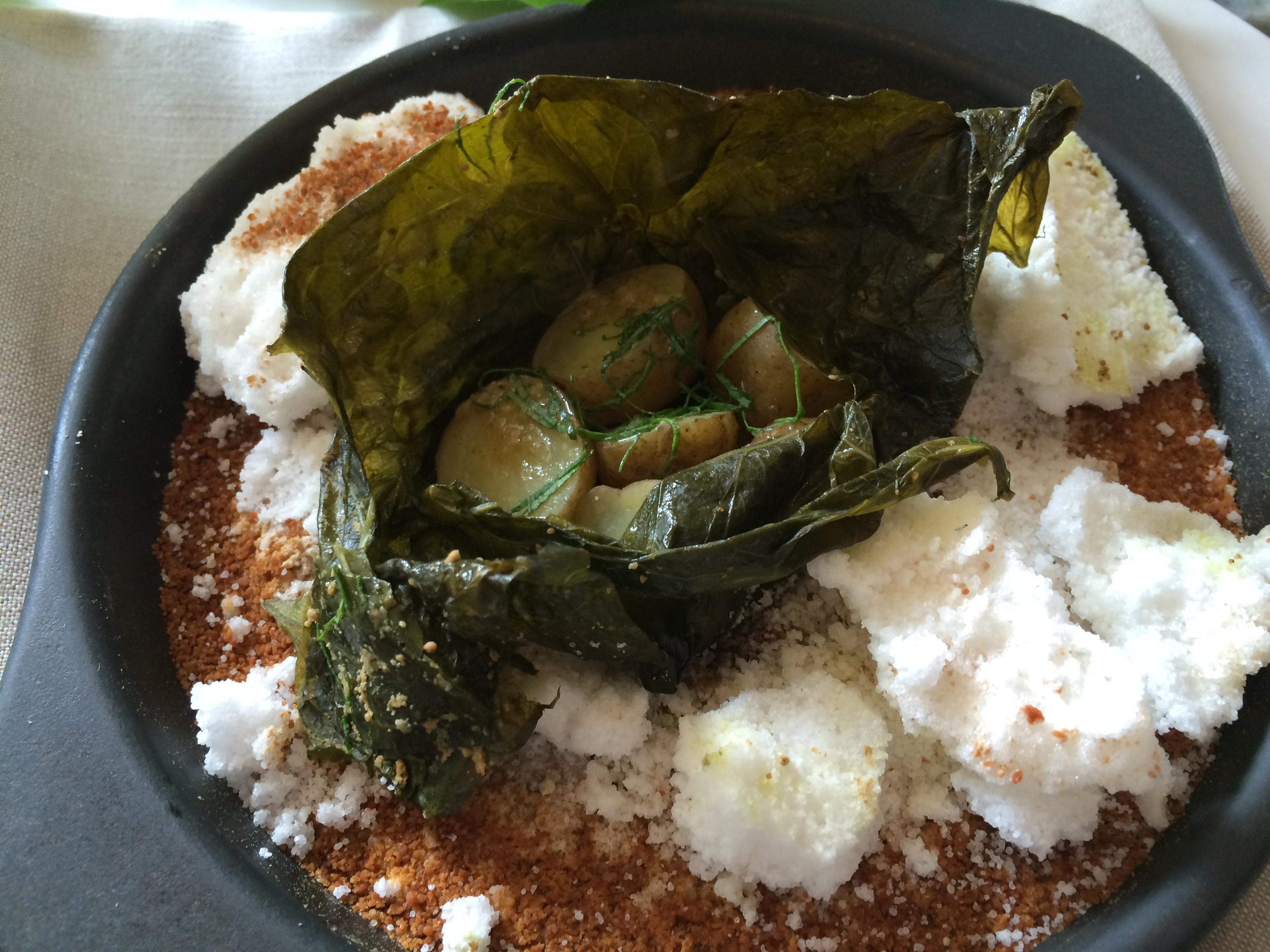
Next came new Danish potatoes wrapped in a lavage leaf, residing on a bed of two kinds of salt (it was recommended that we not eat the salt). This dish was intriguing. The potatoes, once revealed by opening the leaf, were to be eaten with a sharpened Elm twig (very Paleo). They were warm, soft, and, when touched to the salt, delicious! The leaf was also edible, but had absorbed too much salt to be enjoyable. The sake added a fullness to the experience and was a good pairing for this dish, and it completed its duty with this serving.

2015-07-22 13.00.03
Sweet Shrimps Wrapped in Nasturtium Leaves.
2015-07-22 13.00.51
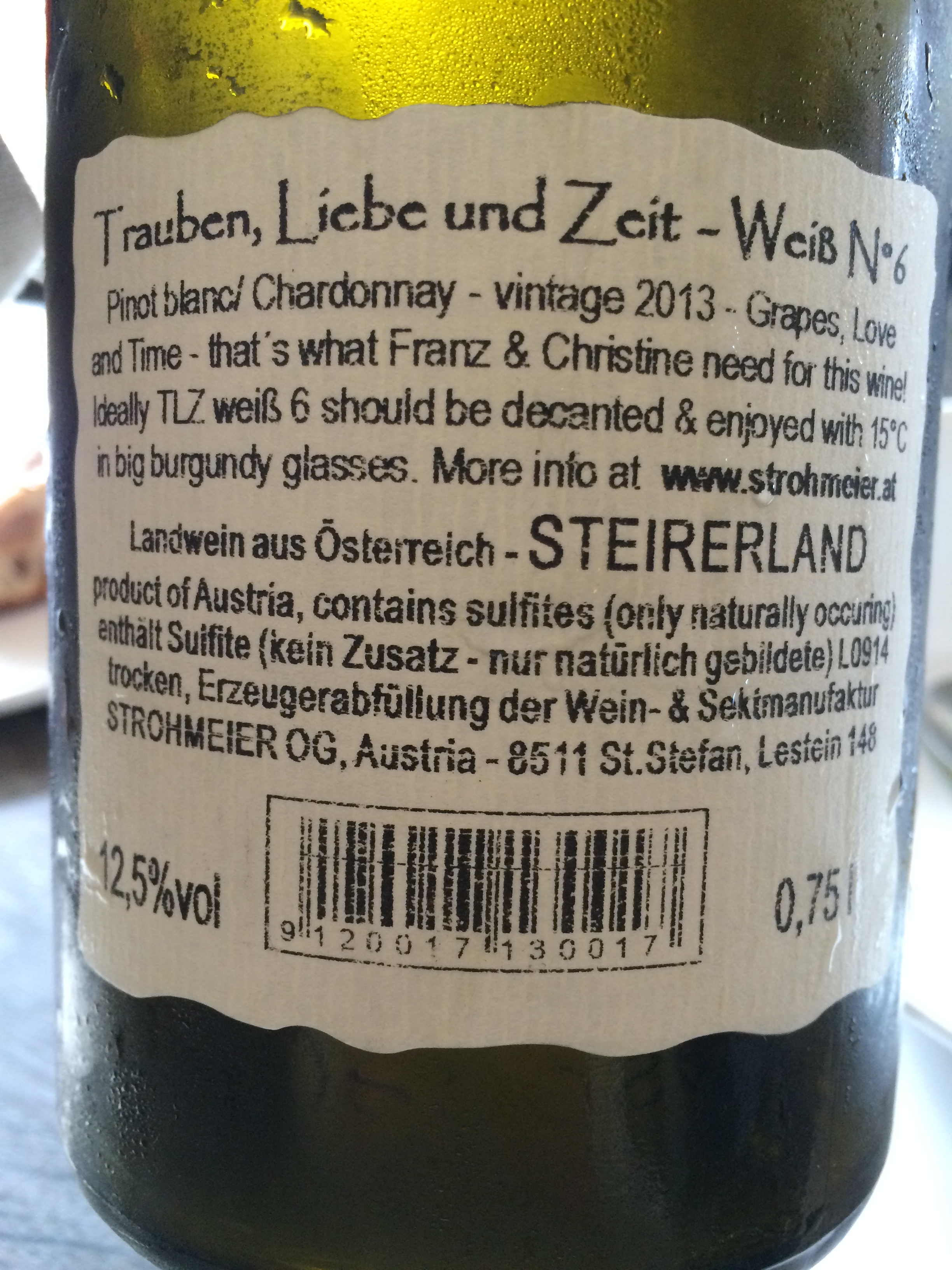
2013 Strohmeier Weiss #6 – Tromen Liebe and Zeit, 50/50 Chardonnay and Pinot Blanc. Austria.

2015-07-22 13.07.46

The next course was sweet shrimps wrapped in nasturtium leaves with a seafood broth. Very tasty – the shrimp and the leaves were a good mix of textures and flavor. The next wine was 2013 Strohmeier Weiss #6 – Tromen Liebe and Zeit, 50/50 Chardonnay and Pinot Blanc from Austria (LINK). This is really a nice white wine. I have loved the whites (weiss) of Austria since visiting there in 2009. I am a particular fan of Grüner Veltliner, the wonderful white grape so popular there and now being grown in California. But I digress – the Strohmeier has the nice acidity that one expects from Austrian whites, plus, the Chardonnay gives it a fuller mouth feel. It was a great accompaniment to the shrimps in nasturtium. Of course, this could be my appreciation for a more familiar wine after the sake.

2015-07-22 13.11.05
Cabbage and Roses.
2015-07-22 13.11.48
Cabbage and Roses Uncovered.

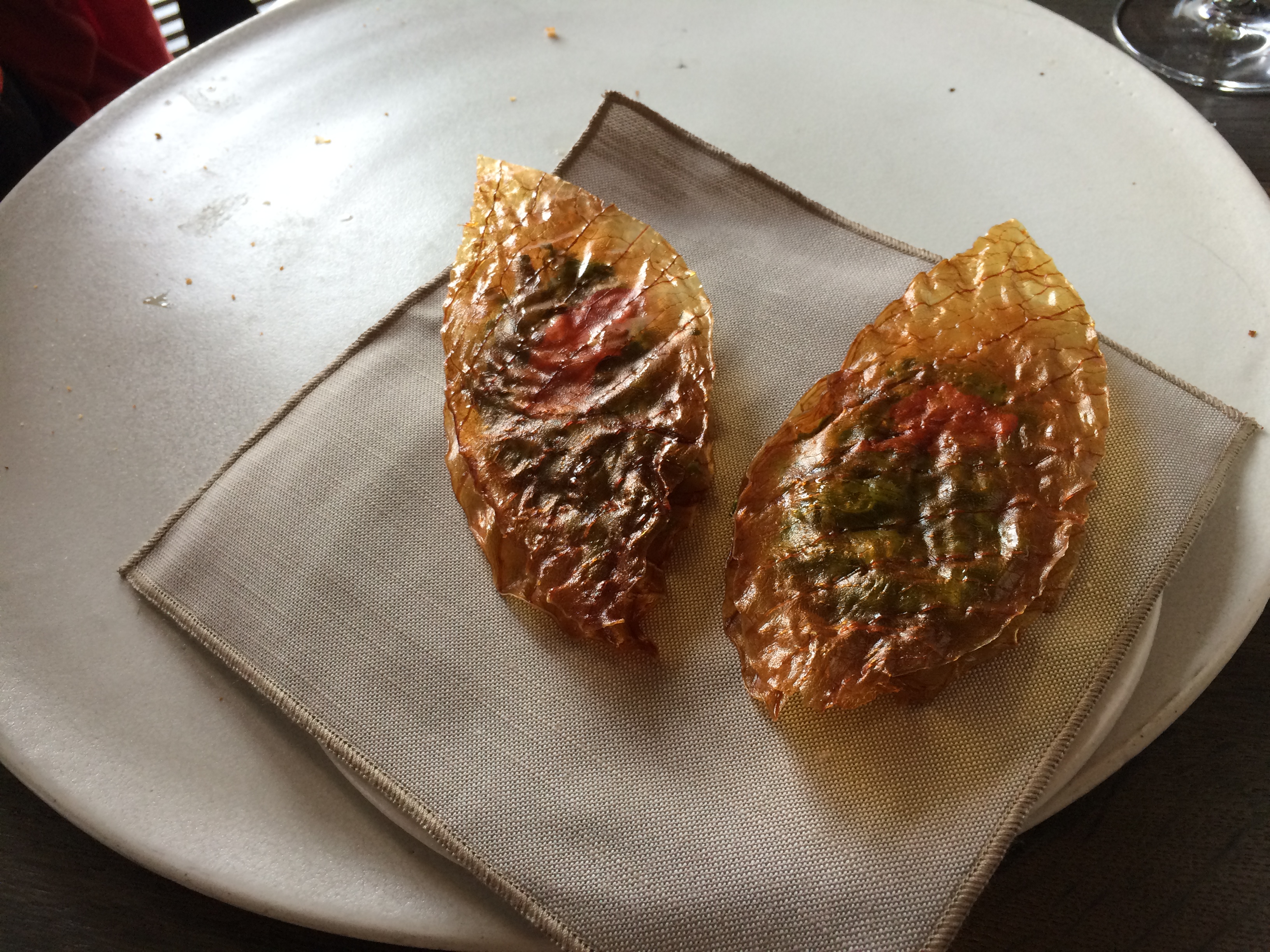
Next came cabbage and roses; dried and candied cabbage leafs sandwiched around samphire (sea asparagus) and rose petals. The leaves were crunchy and the middle was soft and creamy. Eaten with your hands. The 2013 Strohmeier Weiss #6 accompanied this dish very well, giving a smoothness to the experience.

So that is the first half of the Noma dinner, nine courses with nine more to go; and five more wines (by the way, no red wines)! Those will be depicted and described in the next installment, Part 3.

Photos and text, Copyright 2015 by Jim Lockard

“THE BEST RESTAURANT IN THE WORLD:” COPENHAGEN’S NOMA – PART 1

How does one blog about a visit to Copenhagen’s Noma, the “best restaurant in the world”? Do you focus on the food, the changing menu of everyday and very unusual ingredients put together in ways that, well, us regular people never would think to do? Do you focus on the wine, paired with the many courses from some of the most obscure and unusual wineries in Europe (only European wines!). Do you focus on the culture of Noma, which can be observed from the friendly greeting from EVERYONE as you enter, through the service of the exceptional and long meal, and via the tour of the premises that is offered after you finish eating? Do you focus on the price – not crazy expensive these days, but an investment nonetheless?

I will attempt to do a bit of everything in this series of four posts, for my visit to Noma with Dorianne and two friends was, if nothing else, an event. It was more than the food, more than the wine, more than the service, more than the culture, more than the location. It was more in just about every sense of the word. It is over 24 hours after we left and I am still not feeling normal, physically, mentally or emotionally. How does a visit to a restaurant do that to someone?

We began to plan our visit to Noma over six months ago. Imagine a 45 seat restaurant with a staff of 45 or more! With a food lab on the premises! That serves 18 or so courses of totally creative dishes! Much of which is foraged! With wine! We decided to go, but getting there was not without its complications and moments of fear.

I researched several websites that were about Noma or about visits to Noma (LINK) (LINK) (LINK). I looked at Noma’s unassuming website (LINK) to find out how to get reservations. They put a month’s worth up at a time, about 3 months in advance. Since we wanted to come in July around the date of our tenth wedding anniversary, I discovered that we needed to be online on April 6th at 10:00 am Copenhagen time.

We were in Spain at the time. I got online a bit late, about 10:10 am, and was informed that I was number 2499 and that there were 2278 people ahead of me waiting to be served. My waiting time would be about 90 minutes. I did not do the math of about 2 seatings a say of 45 people for 31 days, as some of those ahead of me would not be getting the dates they wanted, etc.

About 70 minutes later, I was in. We had booked an apartment in Copenhagen for July 21-24, so I requested a table for four (another couple was going to join us on the trip) on the 23rd through the website (all automated). The response was that I was booked for lunch. Great! That was comparatively easy.

A few days later as expected, I got an email from Noma requesting a credit card number (they have a policy that charges you if you change your reservation), and saying that they were looking forward to seeing us on APRIL 23RD!!!

NO!

I called Noma to try to get this changed and eventually connected with the reservations director. She told me that I made the reservation for April 23rd via the website. I told her that I thought that only July reservations were available on that day. She told me that there were also cancellations available via the website (you heard that here first!). I told her that we would not be in Copenhagen until July, so was there a way to change the reservation?

She checked and said that July 23rd was fully booked. I asked about July 22nd. She said that there was a spot for lunch for four. I said we would take it. Then I hung up and had a glass of wine.

Then, in May, the couple who was going to go to Copenhagen and to Noma with us, cancelled. This put us in the position of either changing our reservation and paying the fine(!!) or finding someone else to go with us. We were in Barcelona when we go the news. What to do?

The next evening in Barcelona, where we were attending and presenting at the Spirituality and Creativity in Management Congress 2015, at the Esade Graduate School, we went to dinner with some of the other attendees and presenters. There we met Ginger Grant, who just happened to be teaching at a graduate program in Copenhagen in July. Match made in heaven! Ginger agreed to come and bring someone to make a party of four.

The Big Day came. We arrived in Copenhagen in the evening on July 21st, had a quiet dinner on the Nyhavn canal, and turned in at our 5th floor walk-up AirBnB.

2015-07-22 20.37.46
Nyhavn Canal area in Copenhagen.

At the appointed hour on July 22nd, we walked the kilometer or so to Noma, met our dining companions outside. A Noma staff member came out and invited us to come in. About 25 staff were gathered inside the front entrance to greet us. It was as international a group as you can imagine, mostly young. We were shown to a table in the rustic, rough-hewn dining room. And the show began.

2015-07-22 16.22.41

The meal and (very unusual) wine pairings will be described in the next two posts, followed by the tour of the restaurant, kitchen, the lab, and the staff room in the final installment over the next few days.

ANOTHER FOODIE HAVEN IN AMSTERDAM – WITH A FOCUS ON WINE

Forgive the foodie flavor of this series of posts, but we are in Amsterdam and Copenhagen this week and sampling some truly amazing restaurants, which will include the legendary Noma in Copenhagen in my next post.

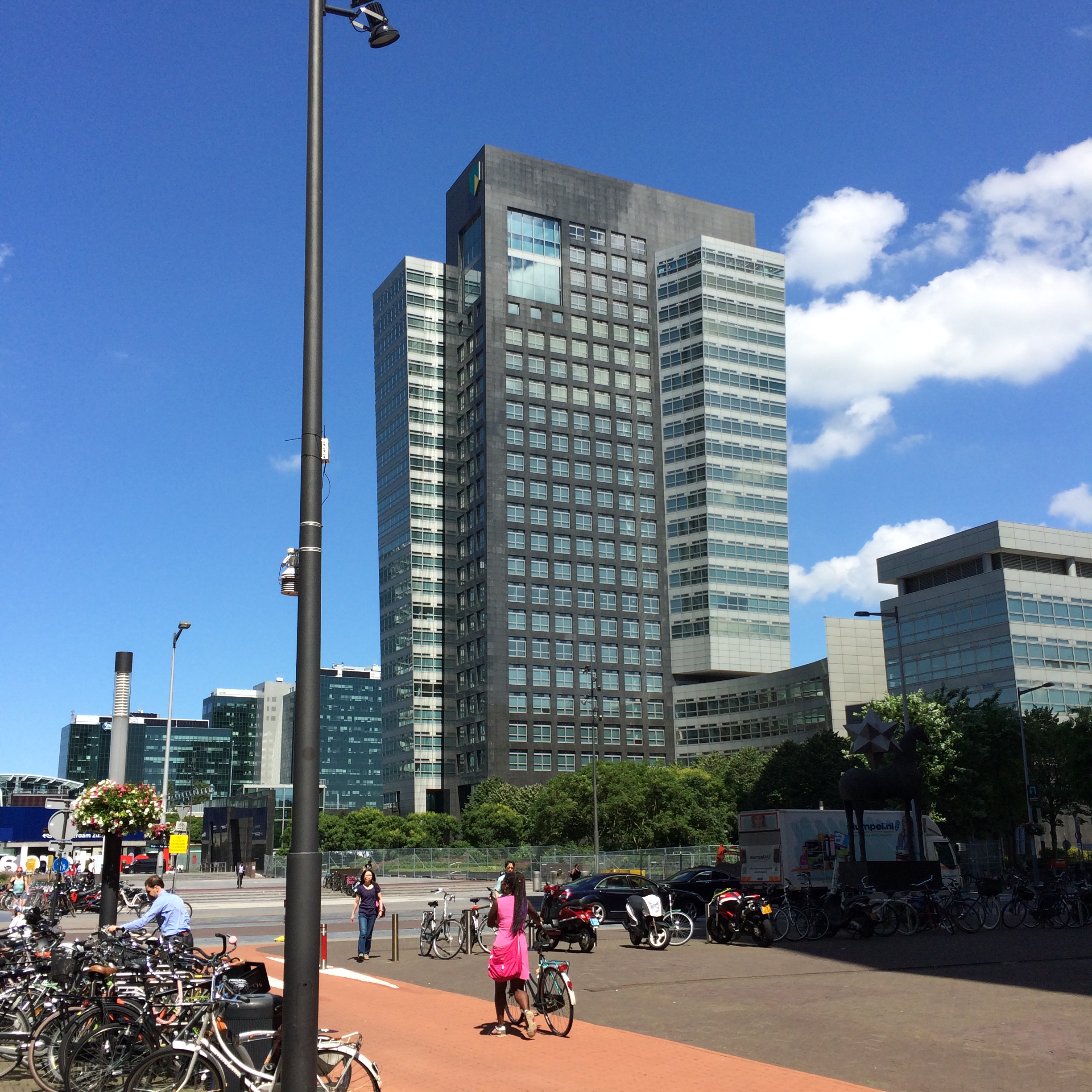
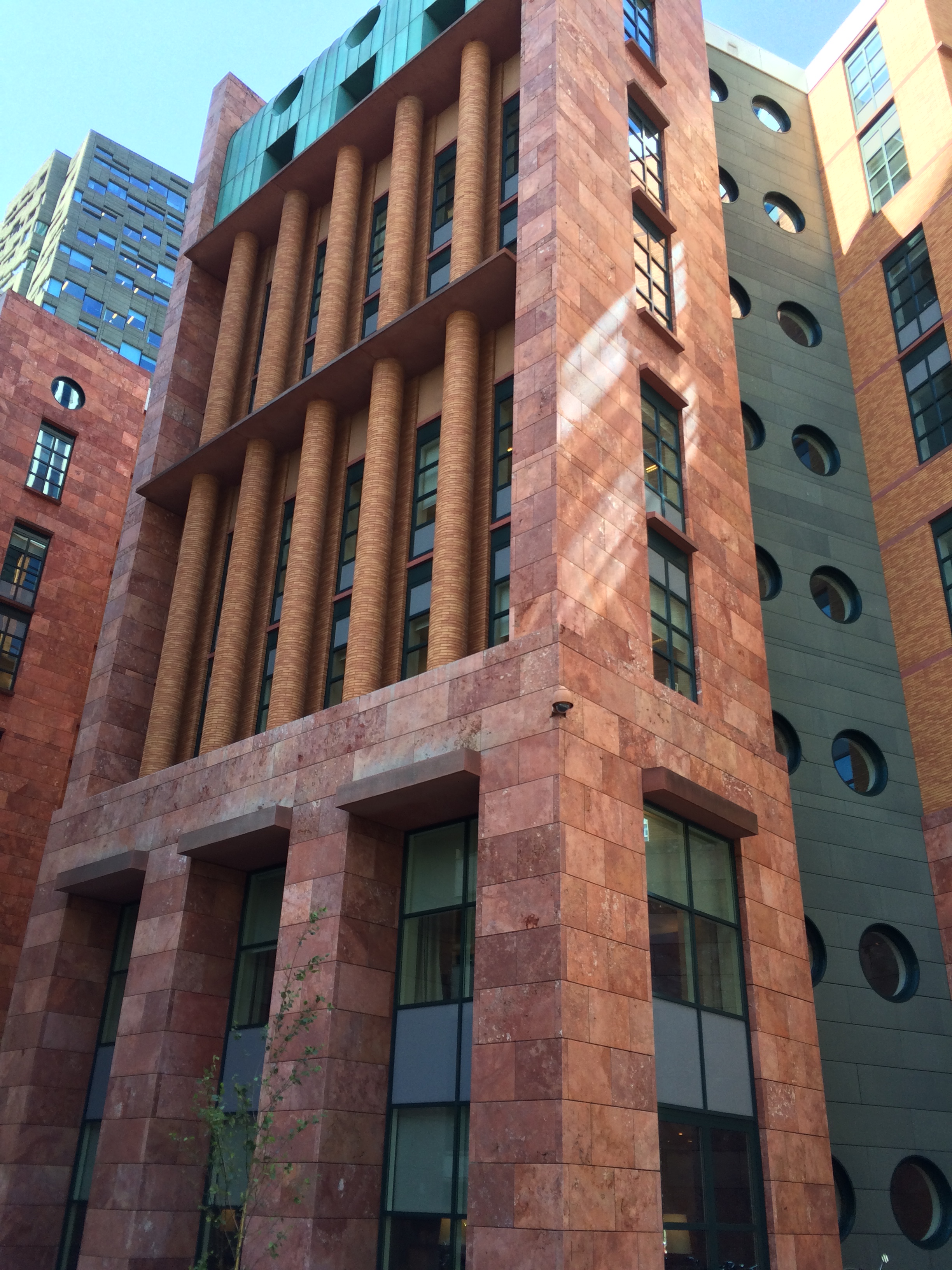
Yesterday, before departing Amsterdam, we strolled down by the Amsterdam Zuid (South) station and a rising complex of very modern buildings, both office and residential towers. Here are a few examples.

2015-07-21 14.11.48 2015-07-21 14.14.58 2015-07-21 14.23.13

Our target was a restaurant that we had read about, BOLENIUS (LINK), that emphasized wine, local ingredients – especially vegetables, an open kitchen, and beautiful design. we were there for lunch before an early evening flight to Copenhagen.

2015-07-21 12.46.44

First, let me say that our meal was splendid. Co-owner Xavier Giesen greeted us, told us a bit about the restaurant and their nearby organic garden, and oversaw (and participated in) our service through the meal. BOLENIUS has a mostly prix-fix menu with a variety of choices of complete dinners (up to 99 euros), one two-course lunch that varies day to day (34.50 euros), and a few à la carte items. The separate wine list is on an iPad and is very nicely put together with broad rather than deep range of wines from various areas of Europe.

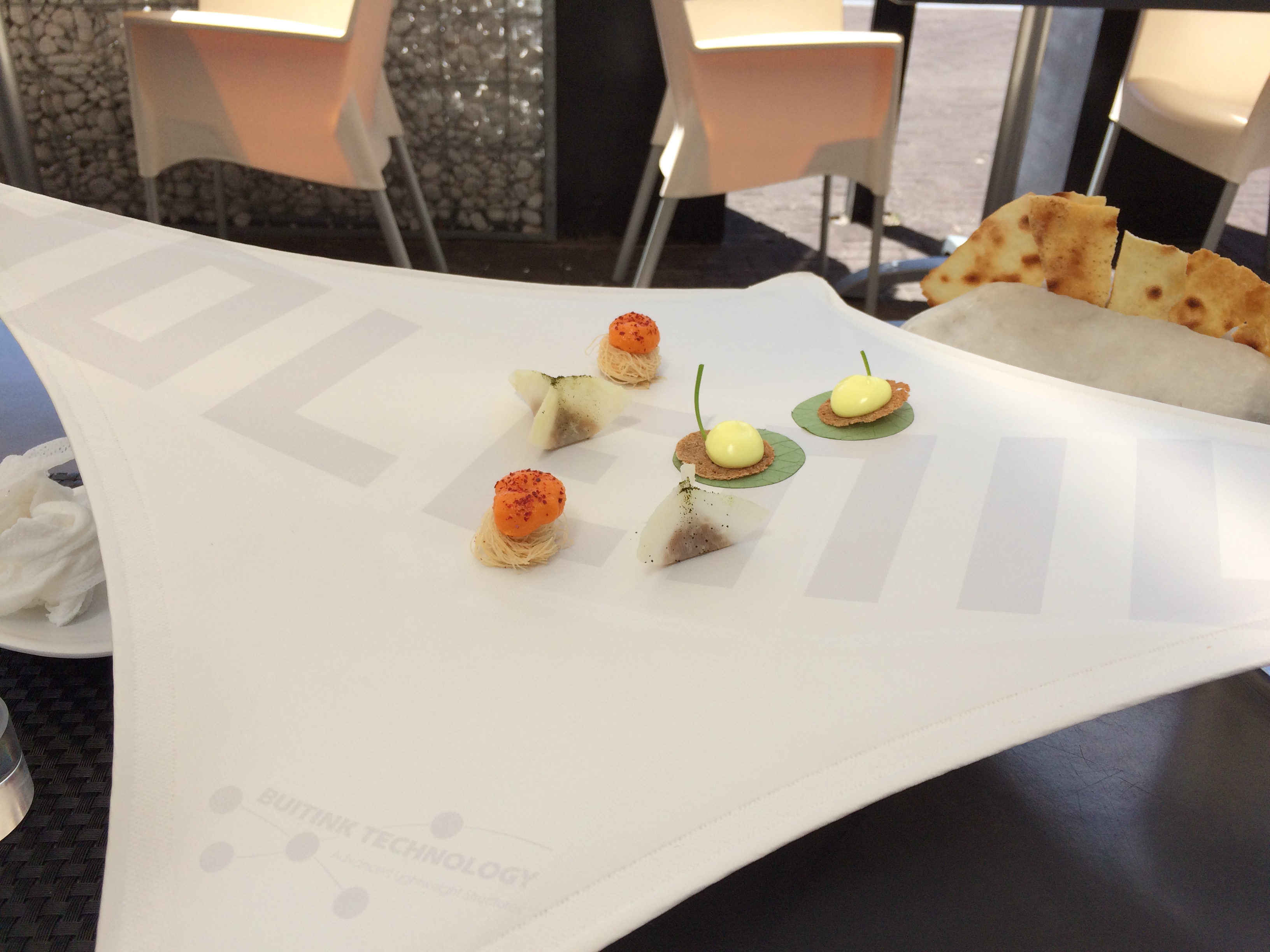
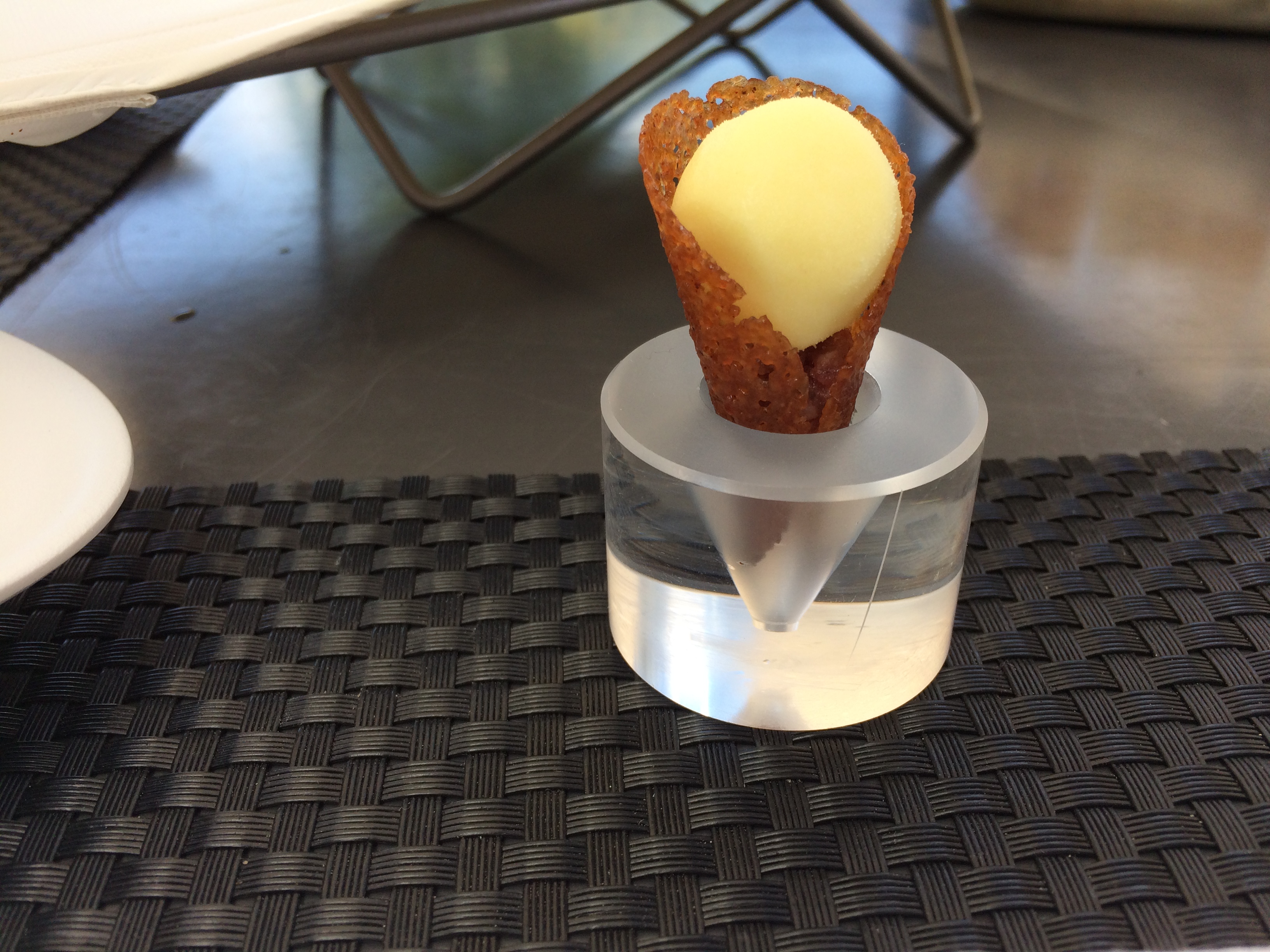
We opted for the two-course lunch menu, which consisted of a first course based upon vegetables from the organic garden near the restaurant and a second course of cod with mashed potatoes and vegetables. But first, a “tray” of complimentary appetizers on a “sail” that matched their outdoor awnings, then an amuse-bouche, a tiny ice cream cone – the ice cream made from sweet Netherlands onions was sitting atop a piece of warm beef sausage in a tiny waffle cone. Odd-sounding, but delicious. Then, a bowl was brought out which contained four small objects. A very small first course, I thought. But no, this was a palate cleanser – a bit of beet sitting atop a small dollop of aioli, two halves of a sliced blueberry, and a baby beet covered with grated hazelnut.

2015-07-21 12.42.59 2015-07-21 12.43.03 2015-07-21 12.52.28

The wine came at this point – we ordered a 2013 Albariño d Fefiñanes from Palacio de Fefiñanes in Rias Baixas, Spain (LINK). The wine was smooth and well balanced, with nice round mouth feel and hints of green fruit. It was a perfect compliment to the meal, and one of the best Albariño’s I have had.

2015-07-21 13.00.56

The fish course was beautifully prepared and presented:

2015-07-21 13.15.35 2015-07-21 13.15.39

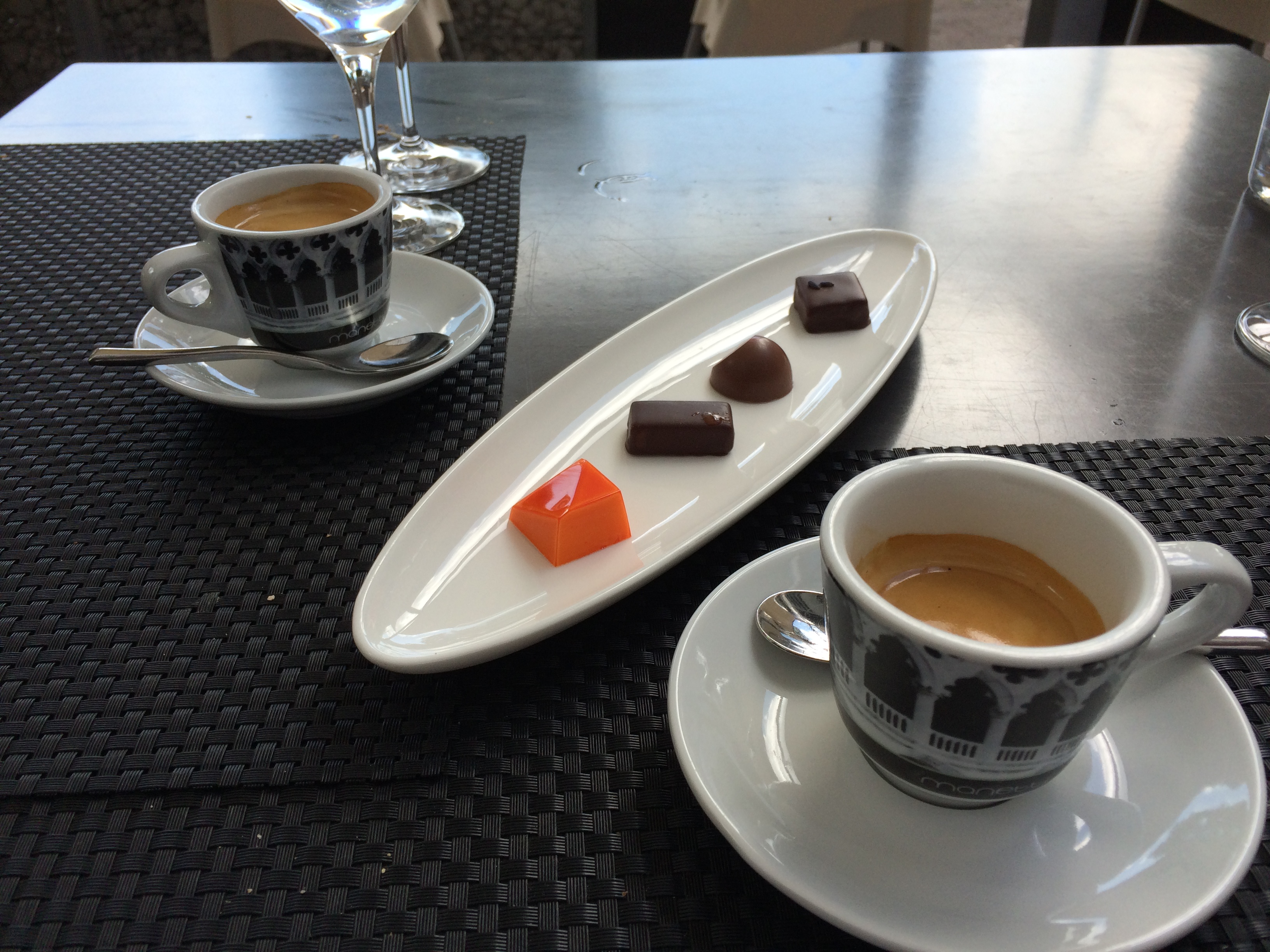
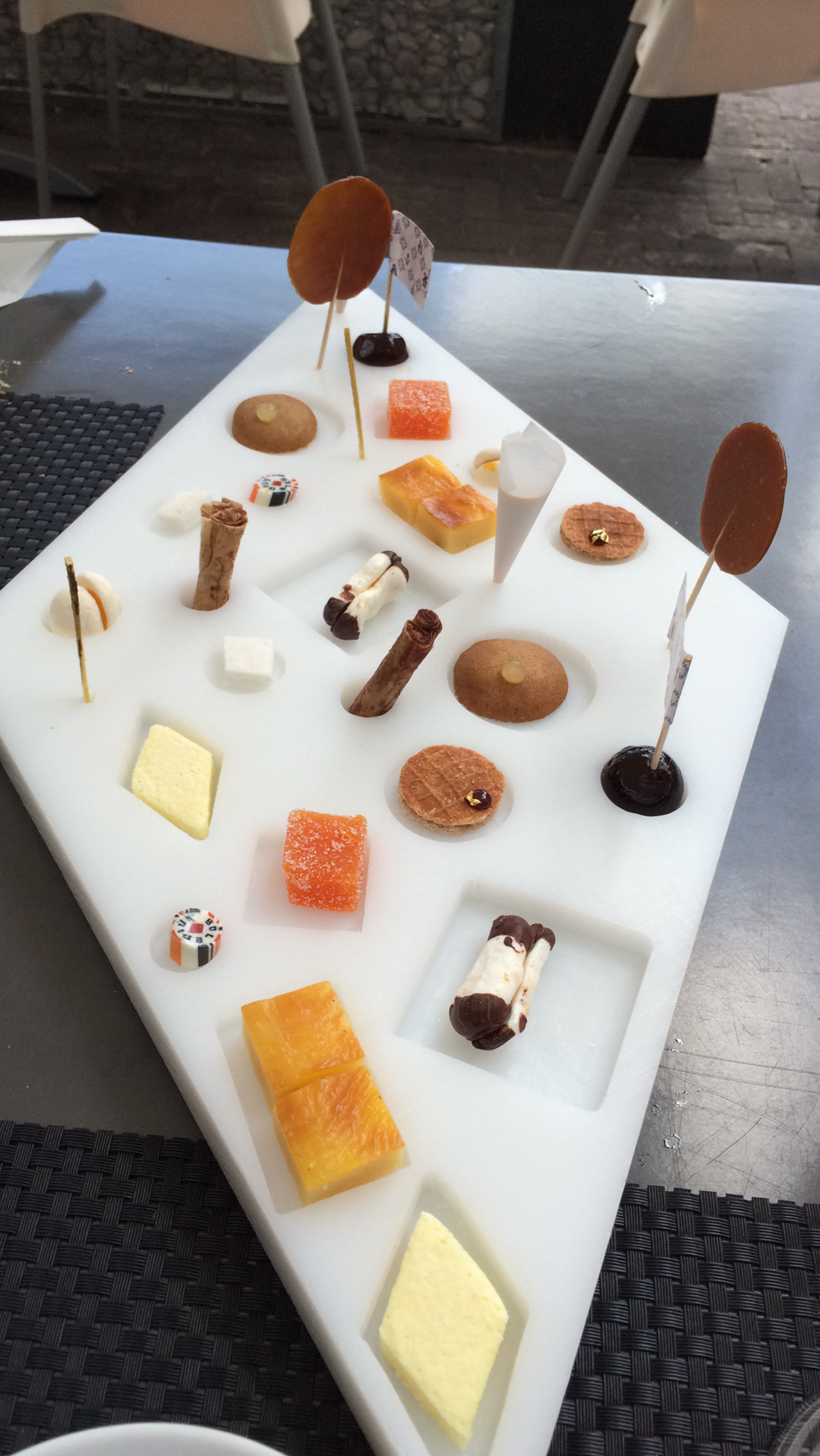
Afterward, espresso, chocolates, and a very special tray of assorted treats for us to enjoy.

2015-07-21 13.42.59 2015-07-21 13.47.55

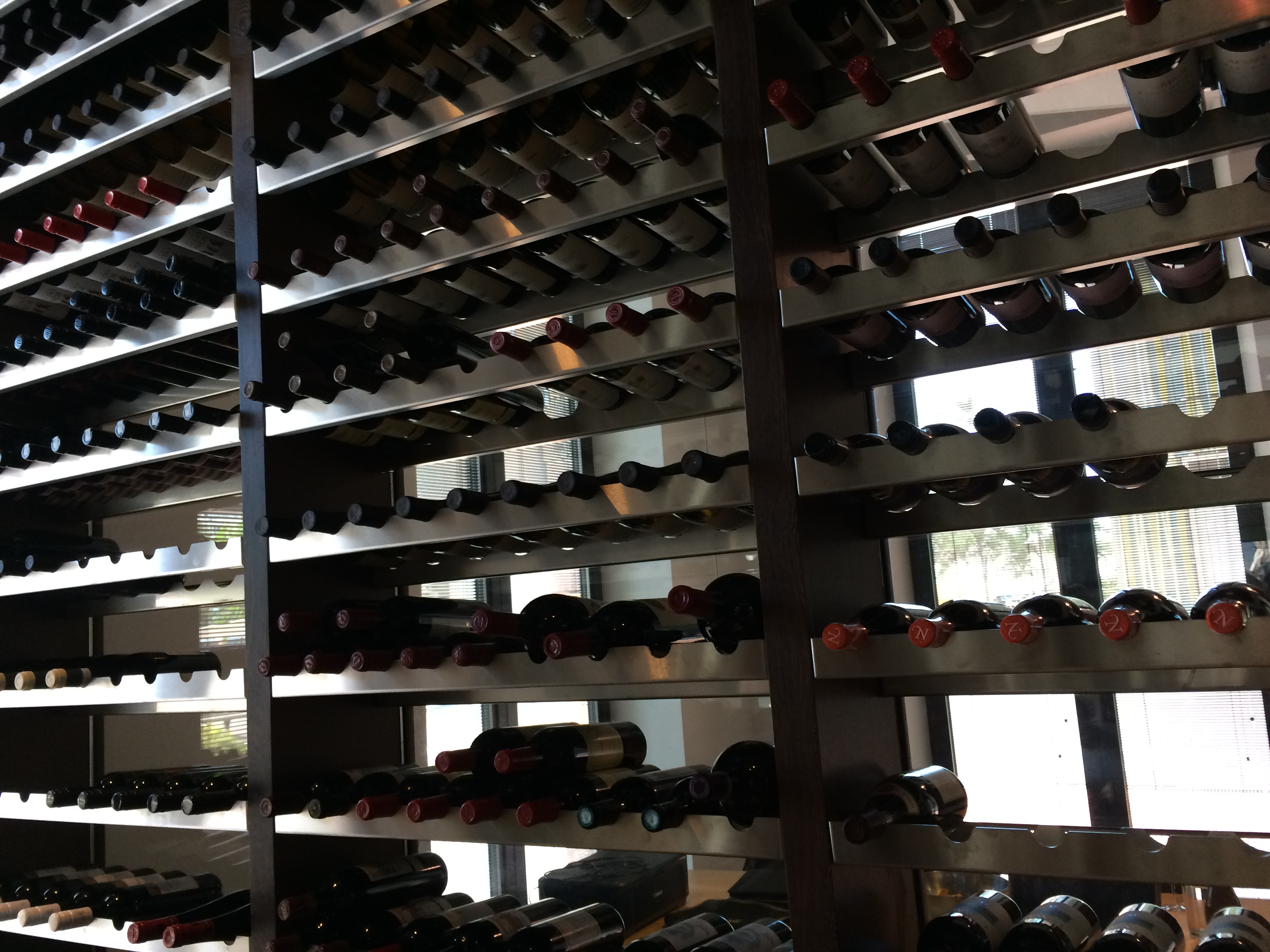
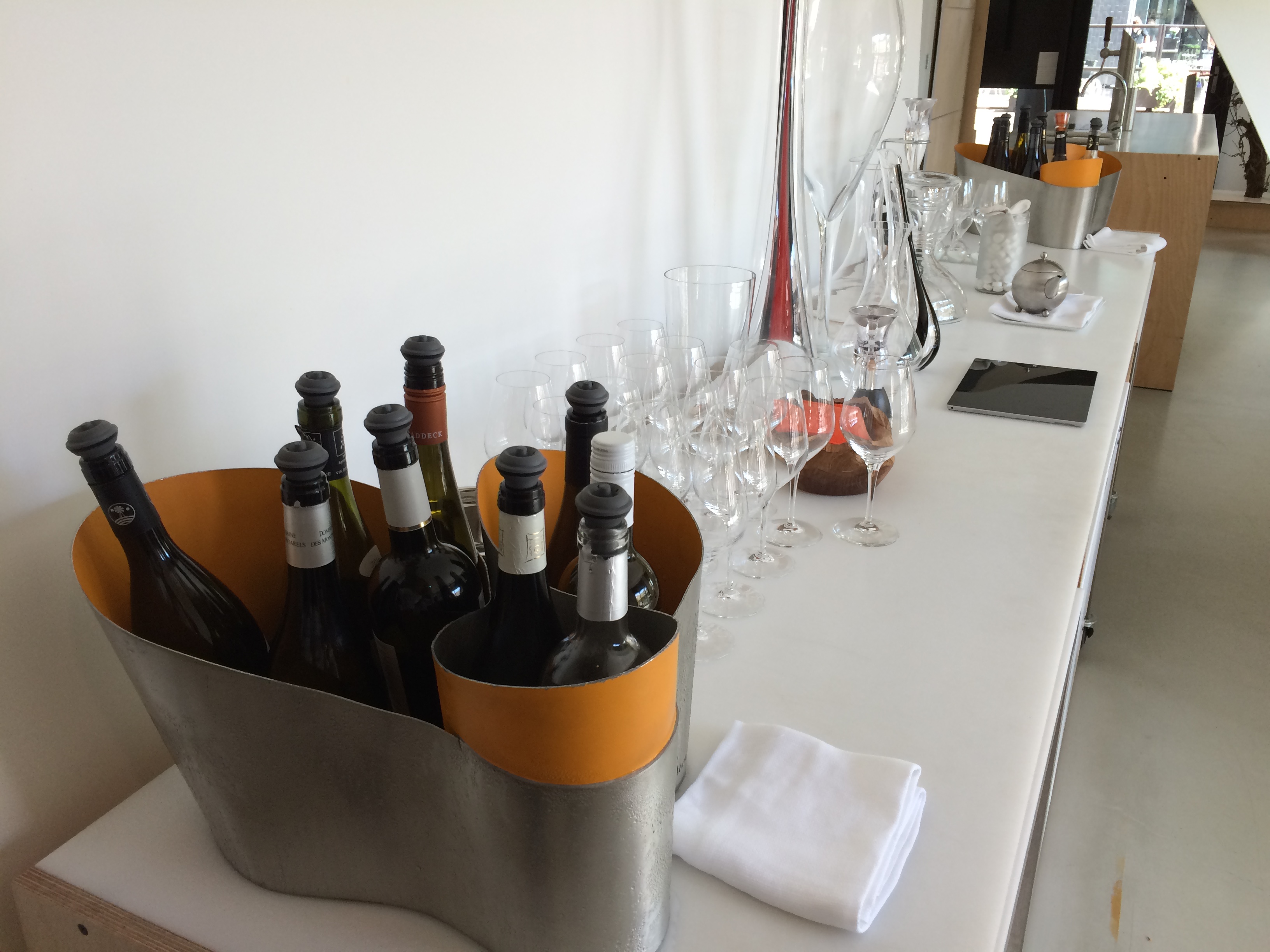
After our meal, Xavier took us to the kitchen and the wine storage area, where we talked about wine, his love of Spain, and his desire to have a wine list that represents the best of Europe. The care, pride, and professionalism of the owners and staff of this excellent restaurant was evident in every aspect of the experience, and Xavier was very generous with his time to share much of it with us. It was truly a very special experience. We will definitely be returning to Amsterdam!
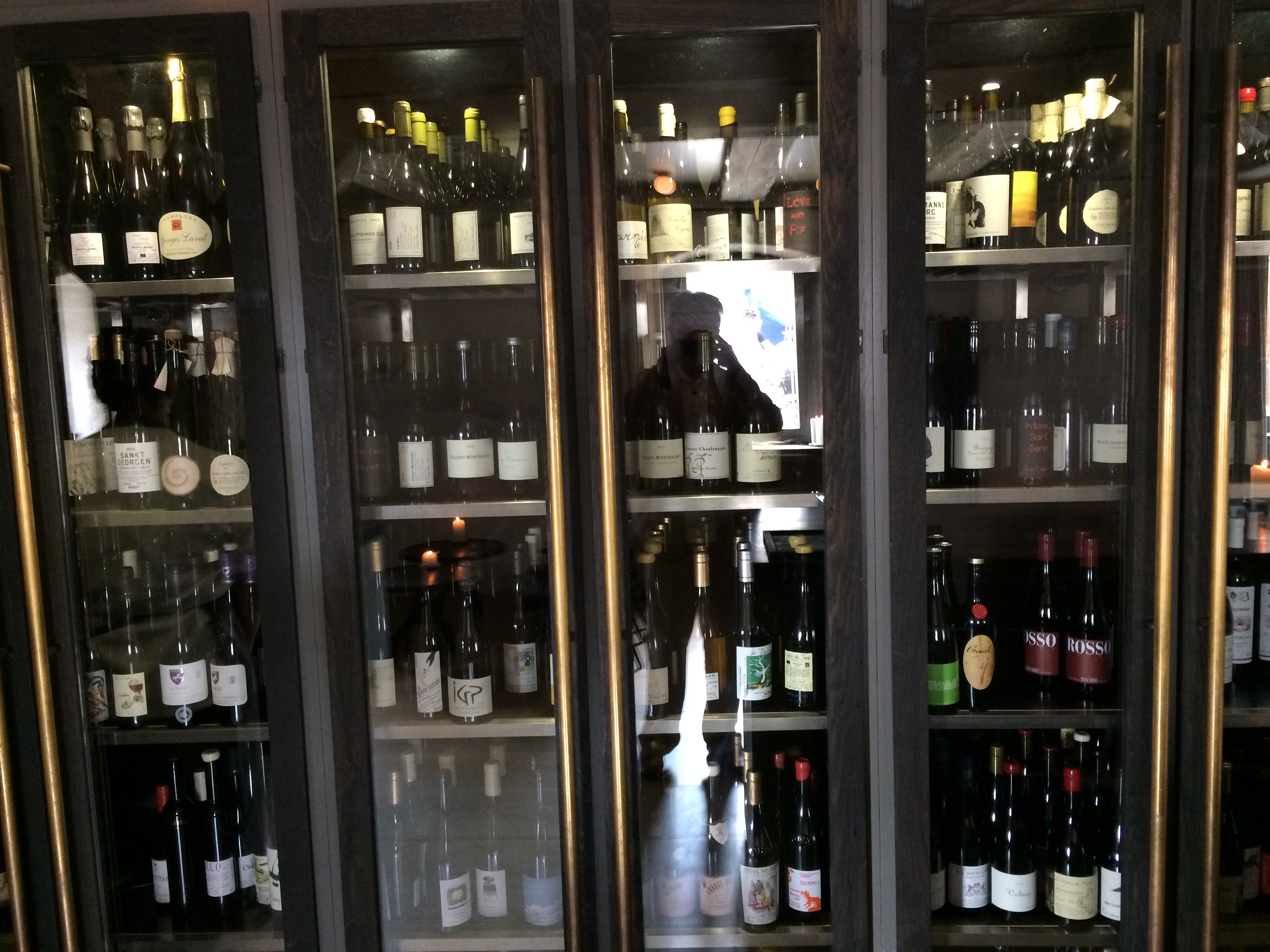
2015-07-21 13.56.46
The Open Kitchen.
2015-07-21 13.57.16
The Wine Room
2015-07-21 13.57.54
The Cheese Table in the Wine Room
2015-07-21 13.56.28
The Wine–By-The-Glass Area