Tag Archives: Chardonnay

PASO ROBLES TRIP, PART 1. EBERLE, TOBIN JAMES & CASS WINERIES

Dorianne and I did a post-Christmas trip to Paso Robles this week. We were accompanied by her sister Debby and Debby’s husband, Mike, who live in Oklahoma, but love wine very much. The trip was really a good experience, so I will cover it in two posts.

Paso Robles has become the premier region of California’s Central Coast, which is saying something, as there are a lot of great wines coming from Santa Barbara, San Luis Obispo and Monterey Counties. With over 200 producers, Paso Robles is the largest region (it includes 11 AVA’s), but it is also the place where the most experimentation and innovation is happening, which is by design. The focus is mainly on Cabernet Sauvignon and Zinfandel, but there are dozens of varietals being grown and the Rhône-style wines produced there are world-class.

I have written before of our trips there to attend the Garagiste Festivals (LINKS). This time, we selected just a few wineries to visit, three on the east side and two on the west side; HWY 101 is the divider. This post will speak to the east side and Part 2 the west side.

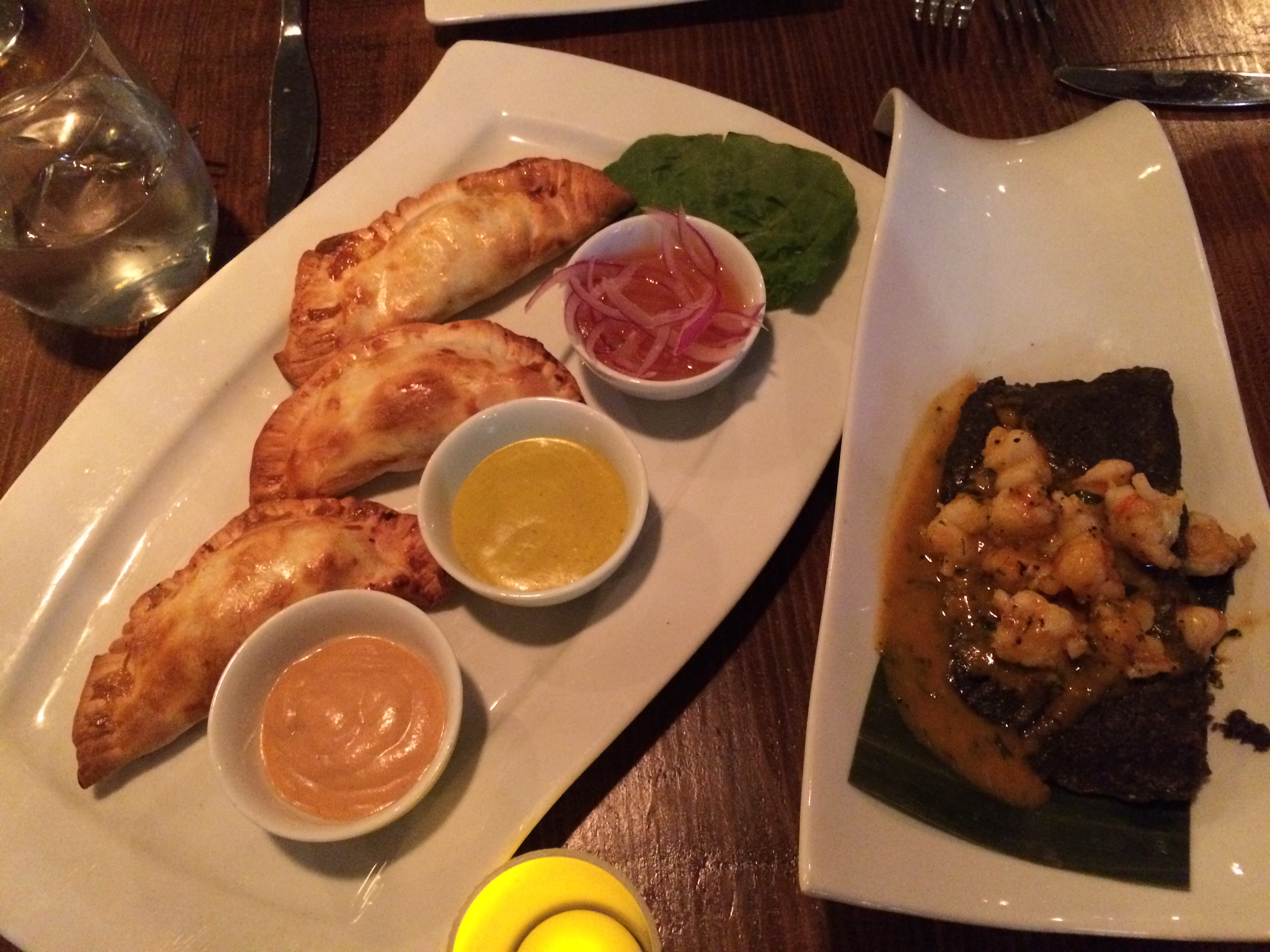
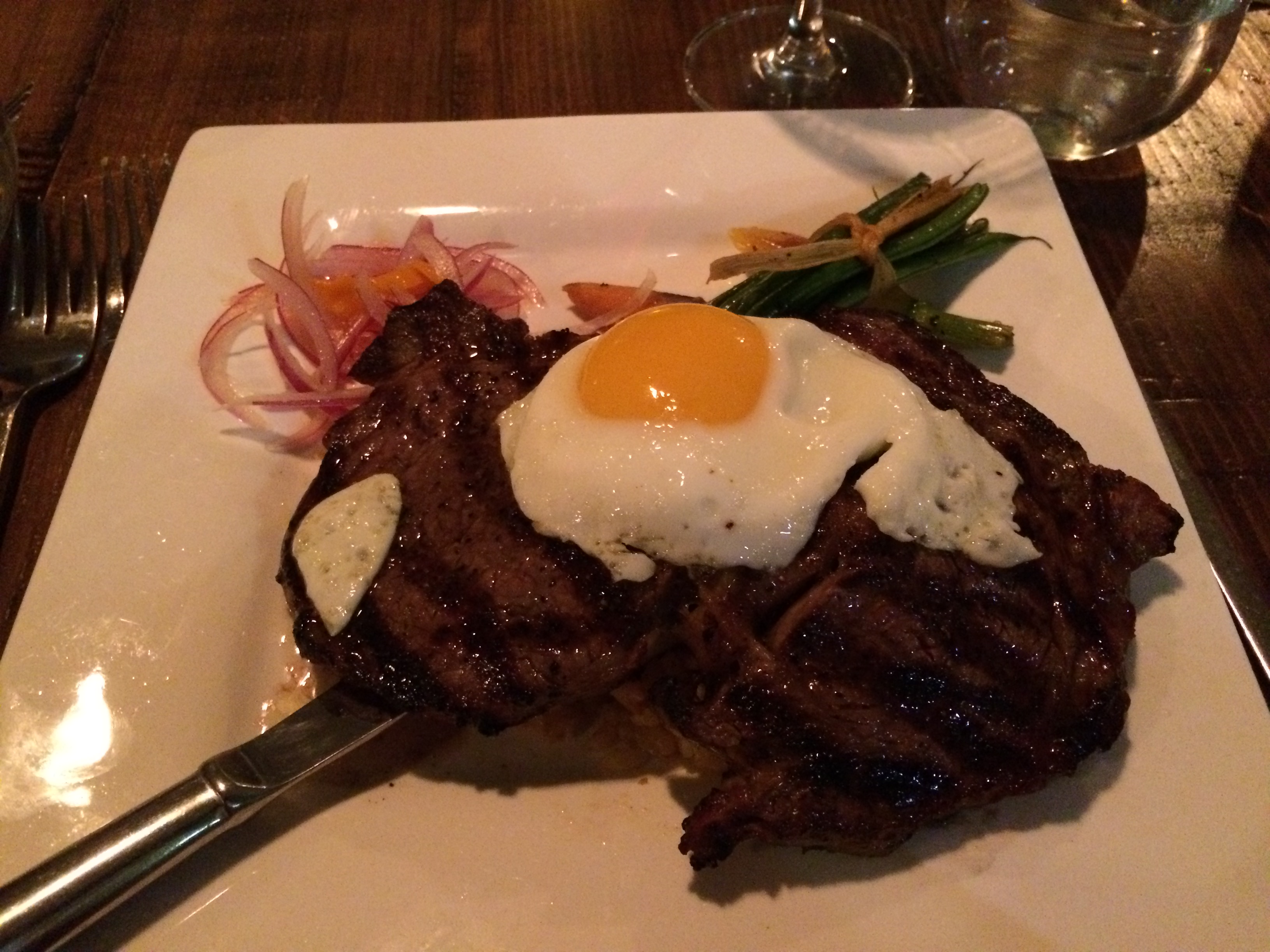
Our arrival on Sunday night began with dinner at Mistura (LINK), a Peruvian themed restaurant located at a golf course on the east side of town. This highly rated restaurant was an excellent choice for food and beverage, but our timing was off. The Sunday after Christmas is a very unpredictable night, and they were a bit over-crowded. We did not get seated for our 7:00 pm reservation until about 7:45 pm and our dinner did not arrive until almost 8:30 pm. That said, the staff was very gracious and helpful the wine list is very good, and the venue is very nice. Avoid the holidays and you should have a great experience.
2015-12-27 20.33.27 2015-12-27 20.55.30 2015-12-27 20.55.40 2015-12-27 20.55.47

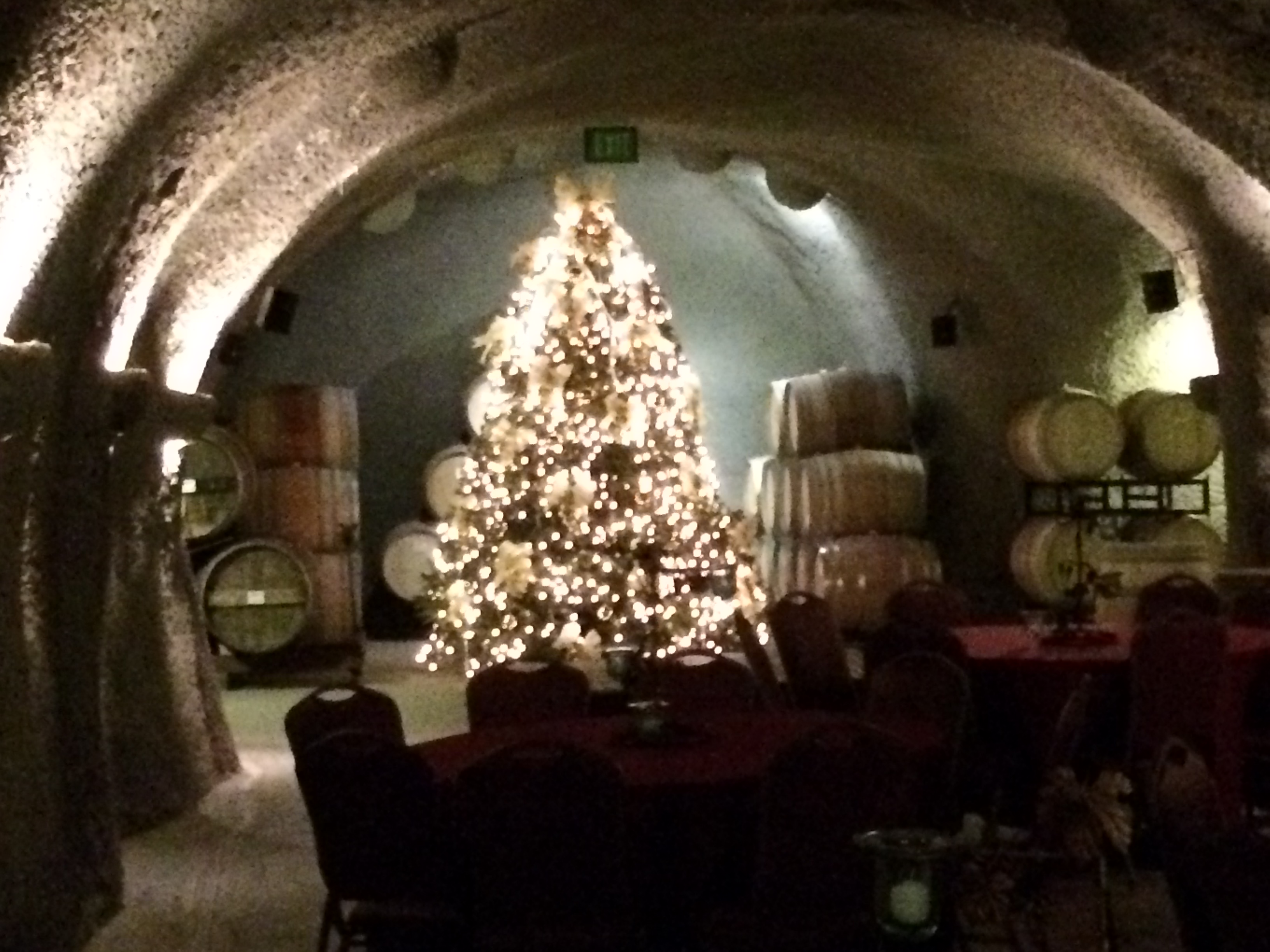
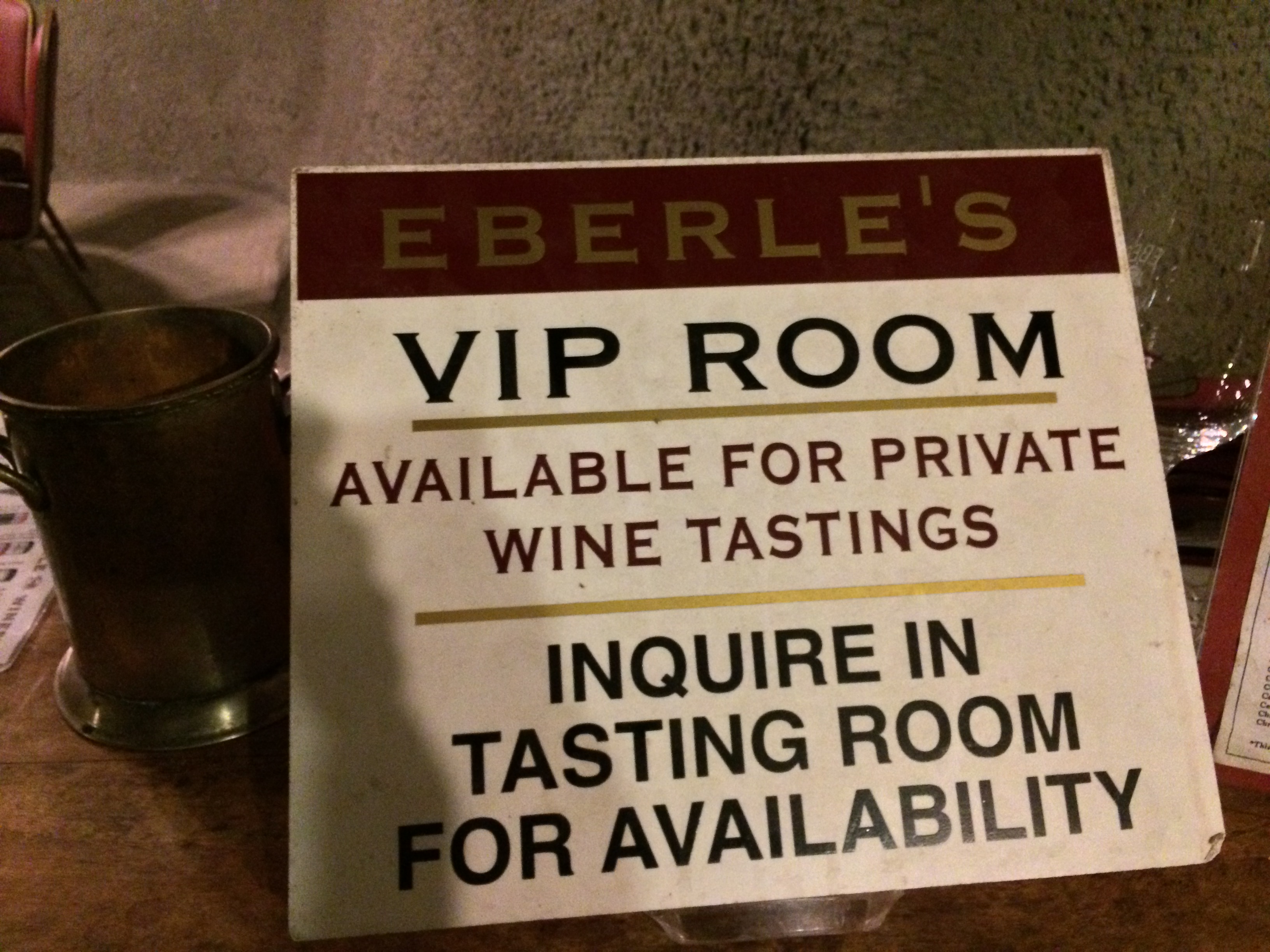
On Monday, joined by our daughter, Grace, who was in the area with her father for the holidays, we began our tours at Eberle Winery (LINK) on Route 46. A relatively large producer for Paso RoblesEberle provides a very good customer experience when you visit: complimentary tastings and winery tours (Dave Olcott and his team do a very professional job), a nicely appointed main tasting room, and knowledgeable staff. We felt well cared for and enjoyed our tour and experience very much. The venue is also available for special occasions and there is a VIP Tasting experience in the Wine Caves offered for a fee that looked very nice. Some photos from Eberle.

2015-12-28 10.44.54 2015-12-28 11.01.35

2015-12-28 11.07.27 2015-12-28 11.06.17 2015-12-28 11.15.48 2015-12-28 11.16.15

The wines at Eberle range from whites like ChardonnayViognier, and a Côtes-du-Rhône Blanc blend; a Syrah Rosé; and reds that include BarberaSyrahZinfandelCabernet Sauvignon, and a red blend. Most of the wines on their website are available for tasting. You get to choose up to five wines to taste. Overall, I would rate Eberle as a very competent wine producer and many of their wines are good values. We particularly enjoyed (and purchased) the 2014 Viognier, Mill Road Vineyard, the 2013 Zinfandel, and the 2013 Barbera.

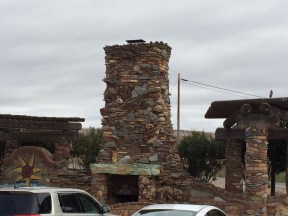
The next stop was Tobin James Cellars (LINK), farther east just off of Route 46 East. Tobin James has a unique branding look and their tasting room facility is set like a saloon in the wild west. Very campy. The place was packed when we arrived (about noon on a Monday), with three large bars pouring complimentary tastings. One thing that appeals to me – they have Tommy Bahama brand (LINK) shirts with their logo and name on them. Probably 2/3 of my wardrobe is Tommy B.
2015-12-28 11.44.132015-12-28 11.44.32

2015-12-28 12.17.00
Bethany

Tobin James takes a little getting used to for the serious wine drinker – getting past the colorful hype if you will. In the tasting room, you have your choice of a variety of wines on the tasting menu, but only one Zinfandel. Since I know Tobin James as a producer of high-quality Zinfandels, I asked Bethany, our very personable and competent tasting room staff person, if there was another menu. She smiled and produced a second menu with 6 Zinfandels, a Primitivo, and seven other Reserve wines. Also complimentary for tasting. Now we were getting somewhere.

Dorianne and I did side-by-side tastings of the 6 Zins, which were all excellent. We purchased three after getting Grace to expand her pallet a bit. When you get to the higher-end wines, Tobin James excels. Their other wines are good for everyday use as well.
2015-12-28 11.50.47
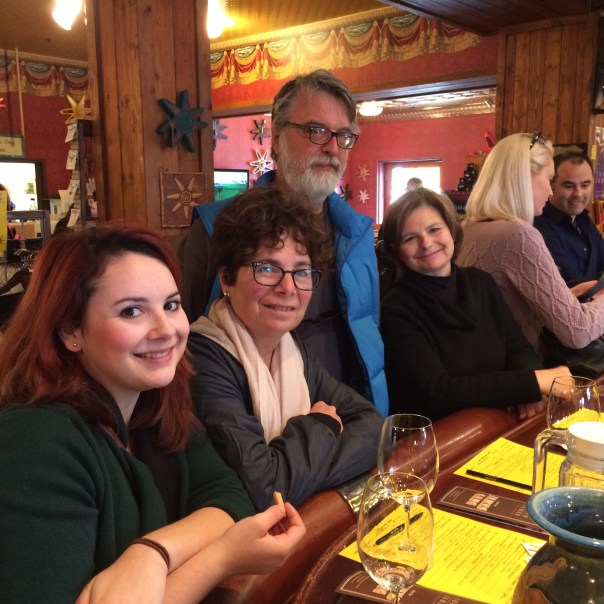
The Gang at Tobin James

ORoussanne-2014-webur final stop of the day was a Cass Winery (LINK) in Creston, just southeast of Paso Robles. We know Cass Winery as a primary source of fruit for our Agoura Hills-based wine cooperative that I have posted about in the past (LINK)Cass, run by Steve Cass, is very well-known as both a reliable and innovative producer of a number of varietals. With 17 wines featured on their website, they are also very versatile. I am a big fan of Cass’s Rhône-style whites, particularly the Rousanne and Marsanne varietals.

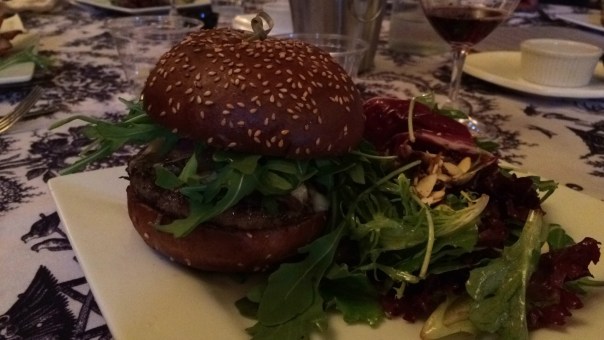
Since our tasting included lunch in the winery cafe, it was an opportunity to experience their wines with some food. I opted for their award-winning burger, which was not the best choice for the whites, but . . . I was hungry.

Suffice to say that the Rousanne and Marsanne that we tasted were excellent – rich and fruity with a nice sense of minerality. The reds, a Syrah and a Cabernet Sauvignon, were also very nice.
2015-12-28 13.18.59
The Burger at Cass Winery

So our first day of tasting came to a close at about 2:30 pm. Then we said farewell to Grace and headed for the market to get chicken and some other provisions for dinner at our AirBnB house that evening. The Eberle Viognier and Zinfandel purchased that morning would prove up to the task of the appetizer and main courses.

Wine travel is indeed rewarding, the wines, the places, and the people.

Next post – Paso Robles’ west side, featuring Tablas Creek and Calcareous Wineries, and a great Mexican restaurant.


HEY, IT’S THE HOLIDAYS – GIFT GIVING GUIDE FOR THE PERPLEXED WINE LOVER

Wine-related gift giving is always a bit of a challenge. Do you give wine, wine gadgets, wine books, wine experiences? Do you have some entry-level wine lovers on your list? Some experts (God forbid a Wine Blogger)? Is price a big concern? Are you a bit panic-stricken in the wine department?

Wine Angst

Well, I know how you feel. The thing to do is to approach your holiday gift giving with a calm sense of purpose and a willingness to give someone something that they may not fully appreciate. Or even like.

Now no one wants to disappoint a loved one or a business colleague, but you’re not a mind reader are you? So do your best, be willing to be flexible, and relax. ‘Tis the season to ENJOY giving and receiving gifts. After all, you are probably more likely to receive a wine basket full of Barefoot Wine than you are to give one, right? (HINT: Do not give Barefoot Wine, Two-Buck Chuck, or “critter wines” – you know, the cheap Australians). No one wants those (they really don’t & they are filled with additives that nobody wants either) and you look, well, cheap and thoughtless for giving them. They are the equivalent of the fruitcake in Holiday wine gift giving.

My recommendation is to give wines that you personally enjoy and that, ideally, have a story. Maybe a little Syrah that you enjoyed at a restaurant or found at a winery that was off the beaten path somewhere; or a gadget that you particularly cherish. When a gift has a personal touch, it is both more fun to prepare and give and more special to receive.

If you live near wine country, or if your gift recipient has a trip planned to a wine region, you might consider the gift of a private tasting that includes a bottle of wine to take away. Most wineries can accommodate such a purchase and you get or make a certificate to give to the recipient. You can gift a wine class to a beginner, or a special wine pairing dinner to someone with more knowledge. And I can help you with the gift of a wine tour in France (if interested, PM me at JimLockardTravels@yahoo.com).

Gadgets are good gifts up to a point. A nice decanter or a set of nice wine glasses are good choices; it tends to go downhill from there. I probably do not keep about 2/3 of the wine gadgets I receive, either because I already have one or because they don’t work, or because it is something I just don’t use. Here is an example:

Wine - Wine Stopper Novelty

This stopper-thing is goofy and was given in fun. It might be okay except that it did not provide a good seal on the bottle. I would rather use the cork or twist cap that came with the wine bottle, because the goal is to preserve the wine.

Wine openers are a good choice, but a personal one. We all have our preferences. Here are links to posts about two openers that I have blogged about that I can recommend. However, you should remember that wine openers are personal and your gift may not be used.


(LINK TO CO2 GAS OPENER)

(LINK TO TRAVEL OPENER)

Wine - Santa Wine

What about wine as a gift?

Always a welcome idea, however, there are some inherent issues in giving wine that you may want to pay attention to.

  1. Shipping. If it needs to be shipped, this can be an issue. There are all kinds of restrictions, most importantly that the USPS, UPS and FEDeX do not take alcohol shipments from private parties. You can have a winery or a wine shop ship for you, but that will often cost more than the wine. I would stick to wine gifts that can be given in person or dropped off. Ship the gadgets.
  2. Shipping Part 2. One exception (and it’s too late for this Christmas) is to use an online service like WTSO.com (LINK) to ship gift wine. You are limited to what they are offering, so you may have to check the site repeatedly, but it is an easier way to ship wine.
  3. Giving the wine. If you take your gift of wine to a holiday party given by the recipient, it may just become part of the bar for the party. That may be fine, but it is not ideal. So bring a bottle for the bar and put your gift, well wrapped, under the tree.
  4. Selection of the wine to give can be a minefield (see the idea of being willing to give something that the recipient may not enjoy). I try to avoid their favorite wines because I know that they will get them for themselves. I go for something unusual for them. Maybe a Petite Sirah for a Cabernet drinker or a Semillion for a Chardonnay drinker. Or a Port or Sauternes, and even Champagne or Cava or a local sparkler for anyone. If they like whites or reds, give them that, but help them to explore a bit. You can also get something like an Australian Cabernet for a Bordeaux drinker. Another idea is to get a mixed case for a new wine drinker; or for me for that matter.
  5. Wine Baskets. The key to a good wine basket is the wine. Rather than picking up a pre-made basket, ask the staff at your wine retailer to make you one that you design yourself. (HINT: Instead of cheese, get a gift card for the cheese and put a description/photos of the recommended cheeses in the basket). Avoid the kinds of cheese that are usually in baskets that are full of preservatives and other non-cheese stuff.
  6. Labels. it is said that 80% of wine purchases are made because of the label. Fine, do that if you must. Get some Skinny Bitch as a joke for a female friend, or some Fat Bastard for that male friend with the not-too-sophisticated sense of humor. Just be aware that it only encourages the bottling of mostly bulk wine with clever labels, thus entrapping another generation of new wine drinkers in rivers of barely drinkable wines full of additives. I’m just sayin’.
  7. Price. It is easy for you to go overboard here. Those top-shelf wines are awfully appealing, especially when you want to impress someone (and many have nice labels, too!). I recommend that you know your budget and stick to it; that will make for a happier January when the credit card bill comes.
  8. Get help. Your local wine shop, or even Costco (but probably not Target – don’t buy gift wine at Target) has someone who knows wine and will help you. Get their advice – you don’t have to take it, but a good wine department employee can be a big help. The same is true if you are buying from a winery. Tell them what you are looking for, they love to talk about their wines and will be helpful.
  9. Status. I know that some are getting wines to give as corporate gifts. I will leave that to you, because you are clearly trying to impress people, which is fine, but that is not what the individual giver should be doing. The sad part of corporate wine giving is that many, if not most, of the wines go to people who do not appreciate them. I had a friend who does not drink wine and who received a case of Joseph Phelps Insignia Cabernet Sauvignon one year. He gave some away and used the rest in spaghetti sauce.

In short, wine-related giving is a field rich in opportunity with a few land mines here and there. I recommend again that you give thoughtfully, within your budget, and that you do your best to enjoy the process. Use your gift-buying time on-line or in stores to explore and expand your own wine experience.

Thanks so much for visiting this site, or even following it, this year. And have a very Happy Holiday Season and a Prosperous and Wine-filled New Year!

Wine - Christmas and Drink Wine


WINEMAKERS’ MIXER AT THE 2015 GARAGISTÉ FEST IN PASO ROBLES.

The Garagistè Festival (LINK), for the uninitiated, is a gathering that promotes and celebrates small production winemakers from Paso Robles and elsewhere in California. These are folks who produce under 1500 cases per year. Some are new and plan to grow into the future Mondavis or Kendall-Jacksons of the world; others are doing it as a labor of love and have no plans to expand; still others are winemakers for larger concerns and this is their hobby-like “side venture.”  There are also now Garagistè Festivals in Solvang and in Los Angeles each year.

This is the fifth annual Paso Robles event, and I have attended all of them. Dorianne and I drove up from LA County where we are staying with friends for last night’s Winemakers’ Mixer and today’s workshops and Grand Tasting (which I will blog about later).

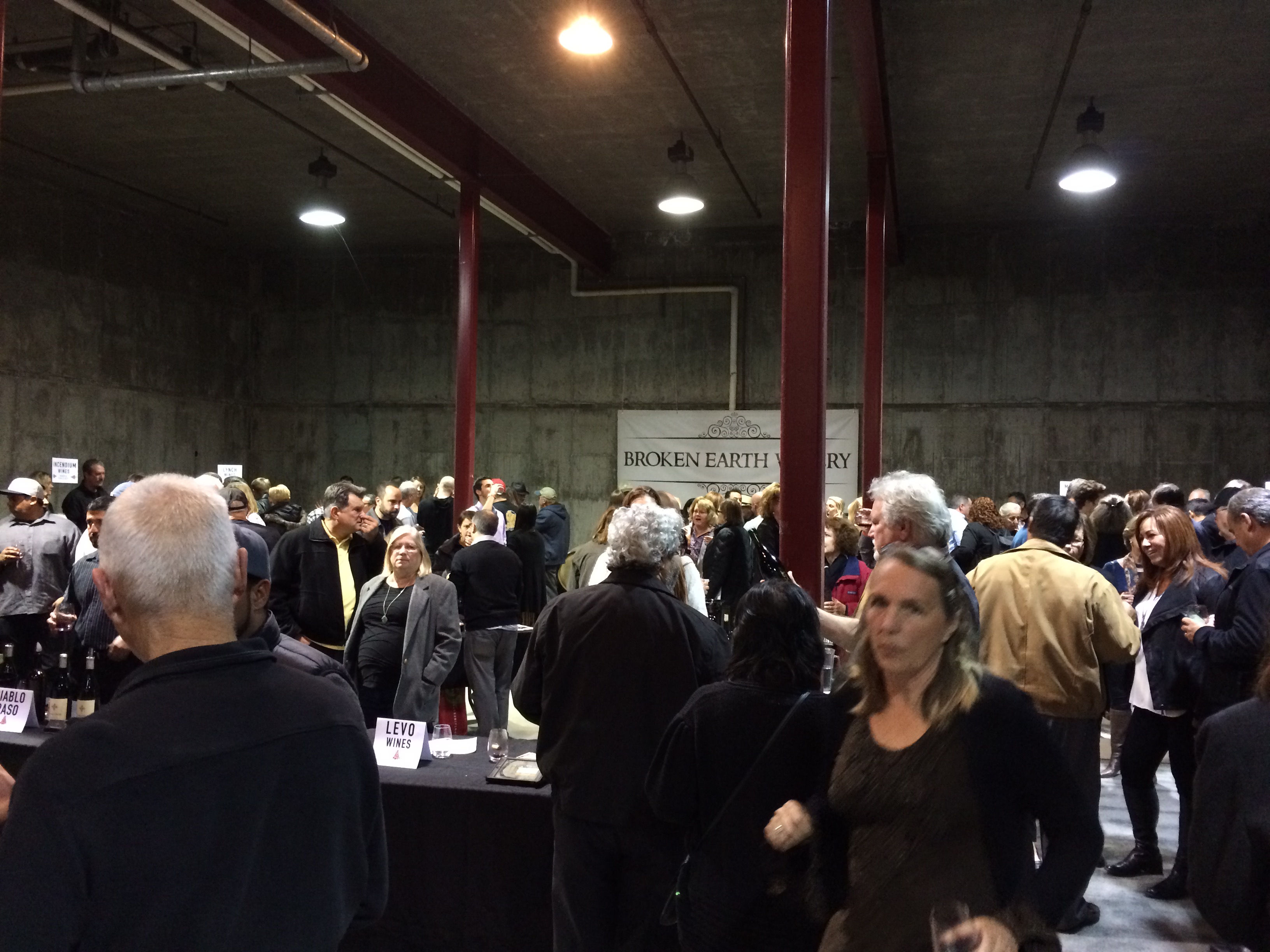
The mixer was added a few years ago, and has been held in different places. This year, it was in the barrel room at Broken Earth Winery (LINK). There were about 35 wineries represented (and one local hard cider maker), including about 1/2 dozen who had been at all five festivals. There were some snacks provided and the Pairing Knife Food Truck (LINK) was also on hand with some great food.

2015-11-06 19.47.54

The focus of the evening was new releases and tastings of wines that had not yet been released. You might say that this concept is loosely observed. There were some new releases, and some yet-to-be-released wines (one, just pressed and served from a 5 gallon plastic container), but there were also some 2007 Cabernets and other regular production wines, but really, who cares?

The fun of this evening was meeting young (and not-so-young) winemakers who are following their dream and doing what they love. They are eager to talk about their wines and really enjoy it when someone with some knowledge shows up. There were over 70 wines to taste, so spitting was in order. The general quality of the wines at the Garagistè Festival has improved significantly over the past five years. But, there is still a pretty wide range of quality, which is also part of the fun.

Here are a few highlights from the evening for us – we did not taste every single wine (you can get wines from most of these small producers via their website):

Ascension Cellars (LINK), Paso Robles. Currently produces 8 wines in the Rhône style. We tasted their GSM called Trinity and a Syrah – both were very well-crafted and balanced.

Deno Wines (LINK), Templeton, CA. The last wine we tasted before departing, the wine was a pre-release of the blend of 50% Zinfandel and a 50% GSM blend. This surprising combination produced a very spicy and well-balanced wine. Dennis Sharpe will have some other GSM’s out today for the Grand Tasting.

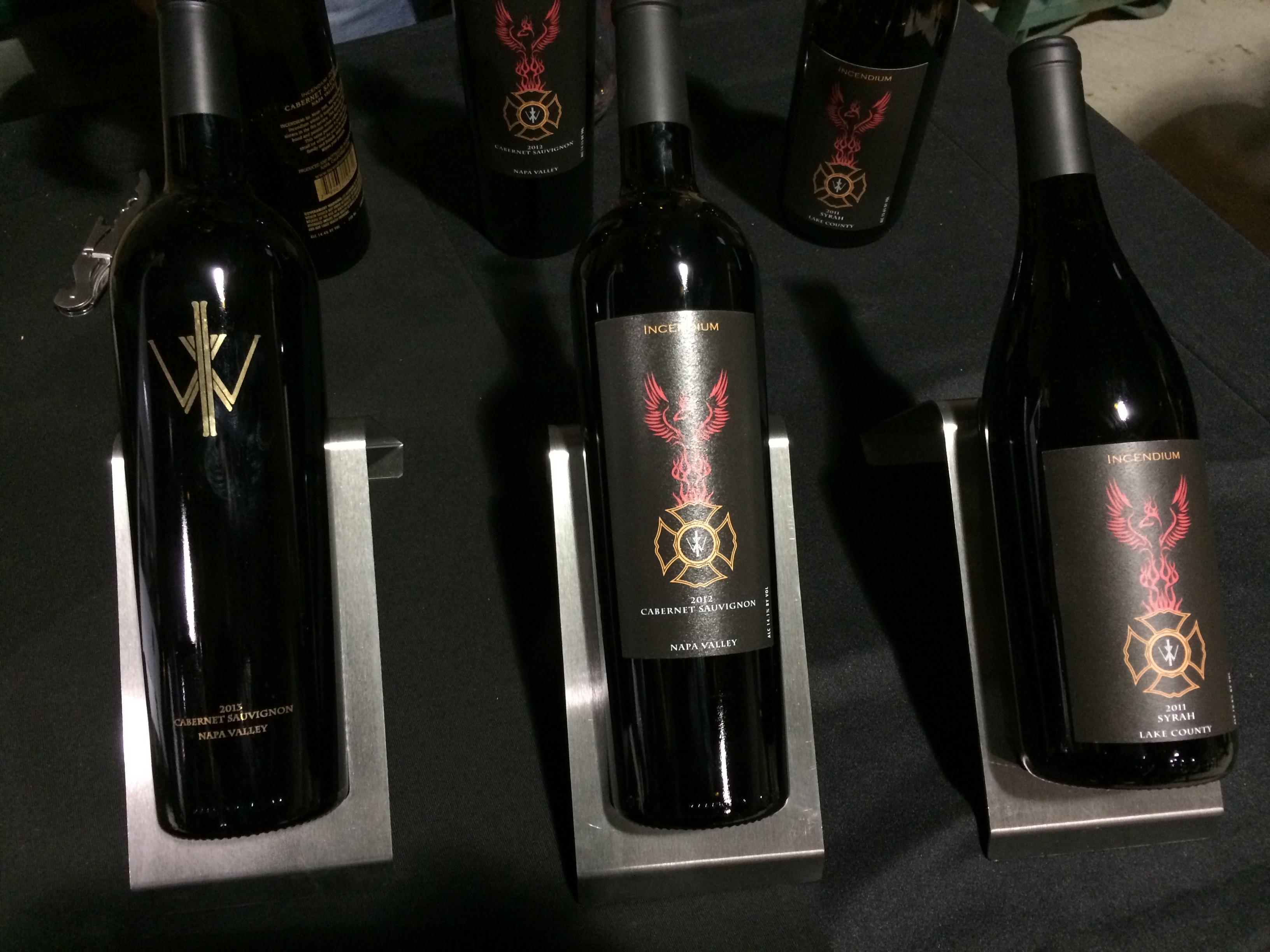
Incendium Wines (LINK), Napa Valley, CA. Winemaker Vince Kalny is a firefighter for Cal Fire. His wines reflect his primary calling, with beautifully designed labels. A portion of the proceeds from sales go to The National Fallen Fire Fighters Foundation. That said, his wines are very well made. There were 3 Chardonnays, 2 Cabernet Sauvignons and a Syrah to taste. The Cabs (2012 & 2013 – pre-release) stood out as very well-crafted and were smooth and ready to drink.

2015-11-06 19.33.04
Incendium Wines – The Reds
2015-11-06 19.33.22
Vince Kalny – Firefighter and Winemaker.

Stanger Vineyards (LINK), Paso Robles, CA. Last year, when we entered the mixer, the first person we saw was J.P. French holding a 5 gallon plastic water jug that was filled with Malbec that had just been pressed. He sloshed some of the juice into our glasses and moved on. Later, we returned to his table and discovered some amazing wines. J.P. was back this year, with the 2015 Cabernet Sauvignon in the plastic jug – again, just pressed. He also had a 2007 Cabernet Sauvignon that was spicy, earthy, but with nice red fruit on the nose and palate. If you are into wine, Stanger Vineyards is a good bet.

Theopolis Vineyards (LINK), Anderson Valley, CA. Theopolis, run by Theodora Lee, a Texan and an attorney by trade, had 7 or 8 wines (we were well into the tasting) on display. Theopolis  has a focus on Petite Syrah on the red side, and the Symphony Grape – a California crossing of Muscat of Alexandria and Grenache Gris developed in 1948 (but not commercially released until 1982) by the late Harold Olmo, professor of viticulture at the University of California, Davis.   As its pedigree suggests, it is a seductively aromatic wine with delightfully captivating aromas that are markedly floral with slightly spicy flavors (from their website). She also produces a very seductive Petite Syrah Rosè. The wines were among the best of the evening and I look forward to visiting her again today at the Grand Tasting.

2015-11-06 20.20.26
Theodora Lee of Theopolis Vineyards

2015-11-06 20.20.30

Turiya Wines (LINK), Lompoc, CA.  Turiya means “pure consciousness” in Sanskrit. Winemaker Angela Soleno brings a consciousness to winemaking that produces some exceptional wines. We tasted a Sangiovese  and a Bordeaux Blends, and both were excellent. A one-woman operation, Angela produces about 200 cases annually, all reds, featuring a number of varietals – Red Blends, Cabernet Sauvignon, Syrah, Malbec, Merlot, Petit Verdot, Cabernet Franc and Sangiovese. Wine prices begin at about $100/bottle and you have to be on the allocation list to receive wine. Visit the website for more information.

Angela Soleno of Turiya Wines.

Vinemark Cellars (LINK), Paso Robles, CA. Mark Wasserman, who runs Vinemark with his wife, Julie, was present with two wines, a 2013 Reserve Pinto Noir and a 2012 Mezzanote, a blend of 75% Primitivo and 25%  Petite SyrahMark is the classic Garagistè, in it for the love of winemaking. He loves to talk about his wines, and they are wonderful.

Mark Wasserman of Vinemark Cellars.

So that is a taste of the tasting mixer. There were a number of other quality wines present and, again, try as we might, Dorianne and I did not get to taste everything. Today – the Classic Tasting with about 70 producers and a couple of hundred wines. We will do our best.

2015-11-06 19.47.59

“THE BEST RESTAURANT IN THE WORLD:” COPENHAGEN’S NOMA – PART 3: THE LAST HALF OF THE MEAL

Noma, the Copenhagen restaurant that has been voted “The Best Restaurant in the World” (LINK) over and over, was the site of a recent visit by Dorianne, two friends, and me recently. Here are the links to the first two installments of the series: (LINK TO PART 1)  (LINK TO PART 2).

This post covers the second half of our 18 (actually 20) course meal and wine pairing.

Course #10:

2015-07-22 13.22.07
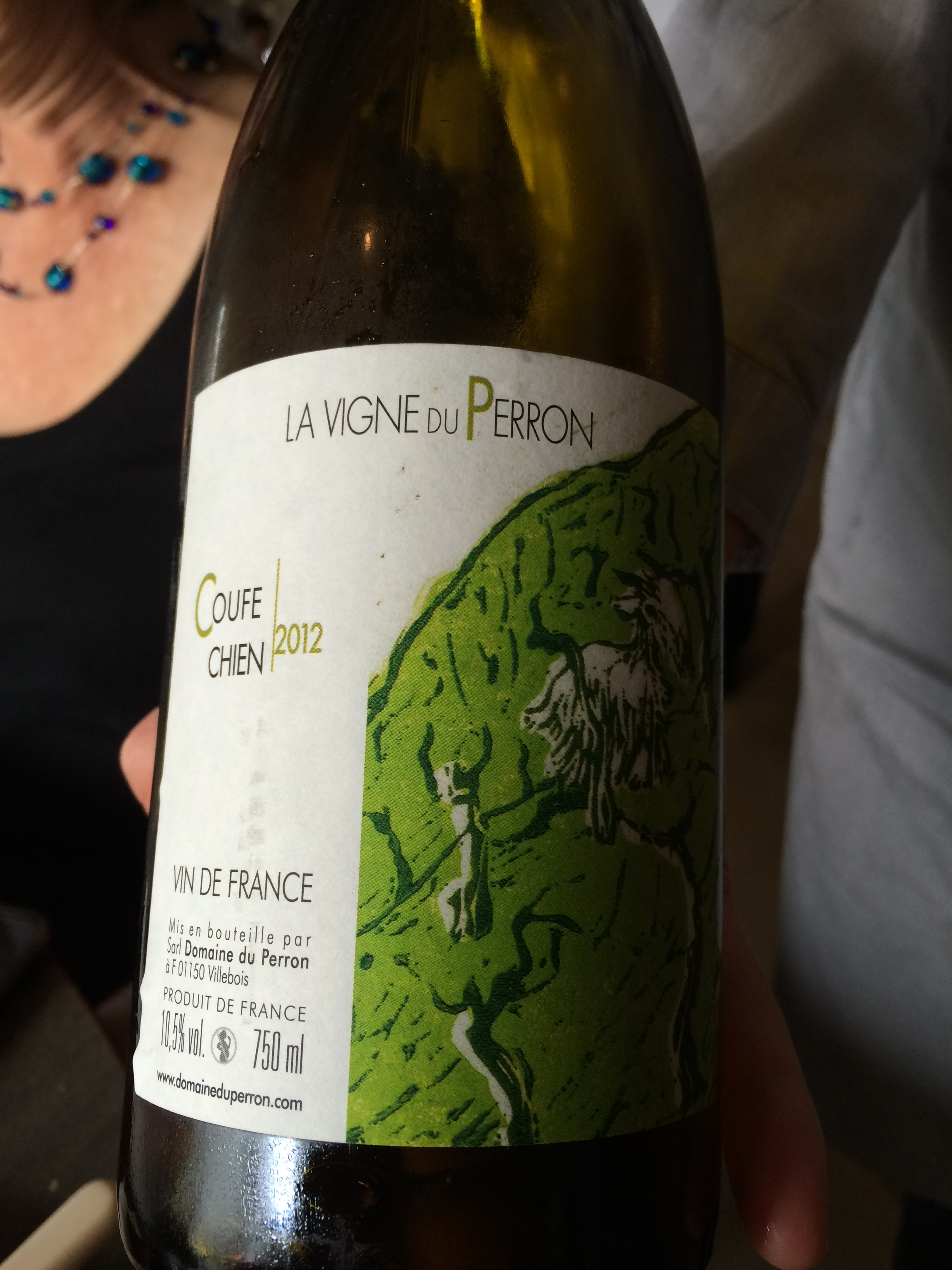
2012 Coufe Chien, Domaine du Perron, Bugey – Savoie
2015-07-22 13.22.44
Mahogany Clam and Grains.
2015-07-22 13.22.48
Mahogany Clam and Grains.

Our wine for this and the next course is a 2012 Coufe Chien, Domaine du Perron, Bugey – Savoie, Chardonnay (LINK to the 2011) from the Rhone Valley. Young and high in acid with an aromatic nose and hints of citrus, it was a perfect accompaniment to the Mahogany Clam.

The single clam was mounted on a bowl of wet stones (which we were advised not to eat). The uncooked clam meat was sitting in a marinade with a dusting of samfire (LINK) around the top of the shell. The dish was to eaten with a wooden fork. It was delicious – I could have eaten the rest of the dozen, but alas, it was not to be.

Next:

2015-07-22 13.31.40
Monkfish Liver on Toast.
2015-07-22 13.31.45
Monkfish Liver on Toast.

This course, Monkfish liver, cooked then chilled and served very cold on toast, sitting atop a folded napkin. This was a particularly succulent dish, with a great texture and flavor. The Coufe Chien was a beautiful match for this dish. Eaten with fingers.

Next:

2015-07-22 13.43.49
White Asparagus, Goosefoot, and Barley.
2015-07-22 13.44.28
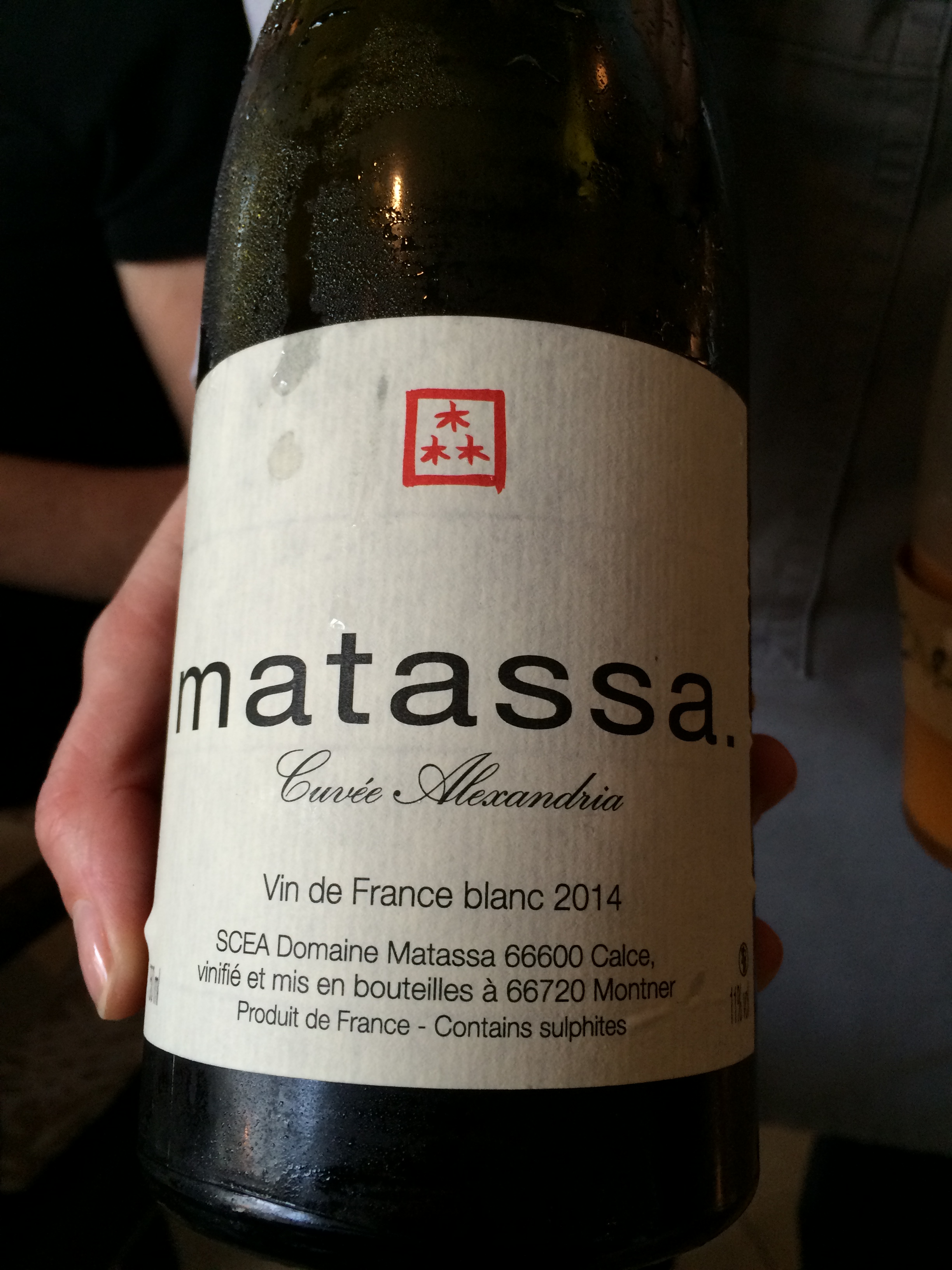
2014 Cuvée Alexandria, Domaine Matassa, Calce – Cote Catalan

Our next wine, a 2014 Cuvée Alexandria, Domaine Matassa, Calce – Cote Catalan (LINK – click on Cuvée Alexandria), is described as a “raw wine,” made from a grape called Muscat d’Alexandria. You won’t find much about this wine, from the Catalan hills in extreme southwest France, online, and I doubt that you will be finding this wine in your local wine shop. The wine is unfiltered, very young and is very raw. I would describe it as bitter and a bit sour. Not for sipping. It reminded me of the must right after fermentation, while the wine is still in the fermentation vessel.

It was served with only one dish, a white asparagus, goosefoot (LINK), and barley plate, this one eaten with utensils. The asparagus was amazing – tender and delicious, the goosefoot and barley added notes of green sour and some texture. And, I was surprised to see that there was some justification for the wine pairing. The Cuvée Alexandria was a decent match, adding to the sour notes of the dish (you would have to like sour), and extending the flavors through a long finish. Intriguing.

For the next course, a new wine:

2015-07-22 13.50.39
The Glasses Accumulate.
2015-07-22 13.53.44
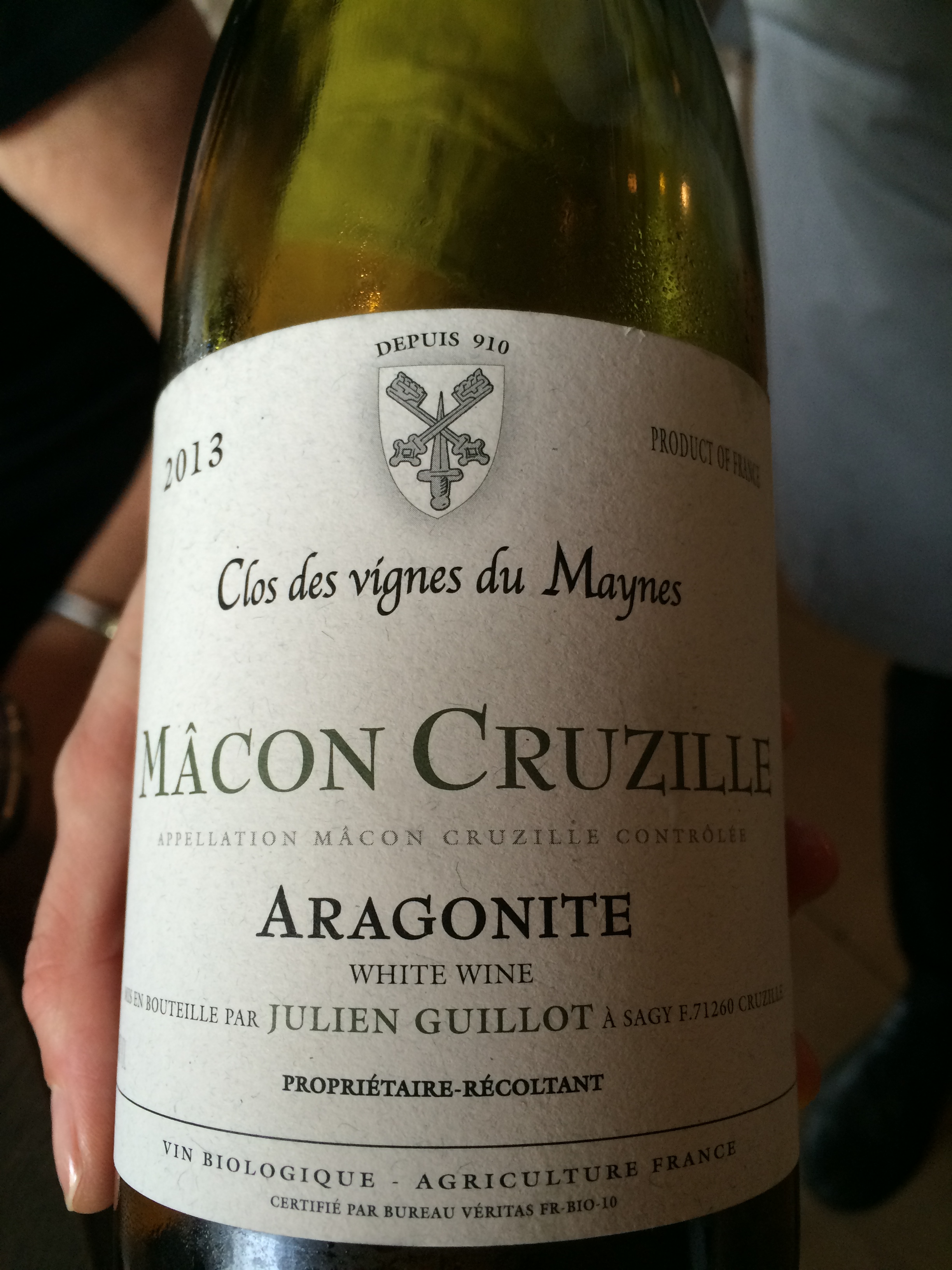
2013 “Aragonite” Julien Guillot, Cruzille – Macon
2015-07-22 13.54.19
Vegetable Flower.

The new wine, a 2013 “Aragonite” Julien Guillot, Cruzille – Macon (LINK)Burgundian Chardonnay, was a return to wine-normalcy for me. Fragrant, well-structured, and clean, the wine drank very well.

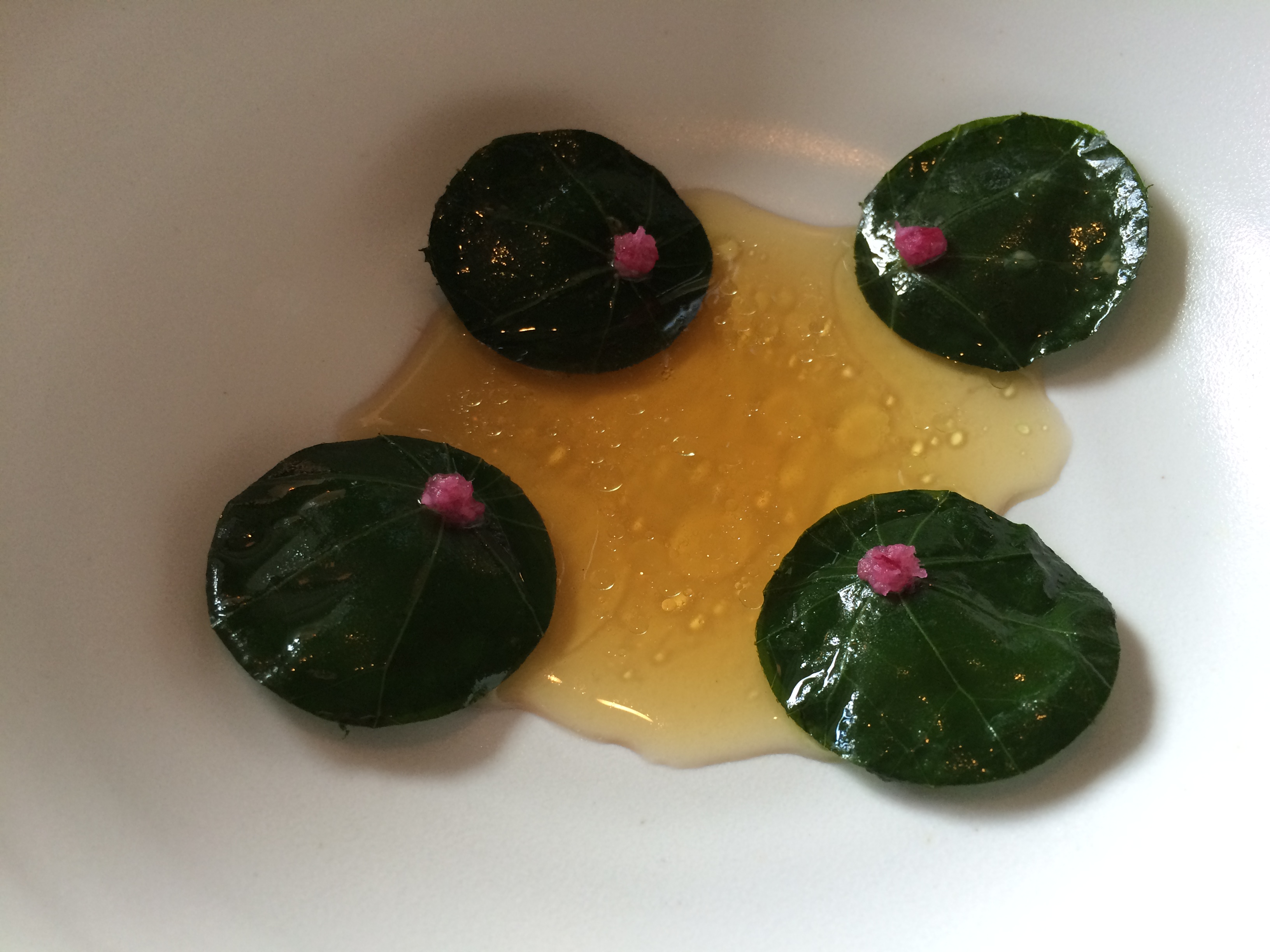
The first of two pairings with this wine was called vegetable flower. As you can see, it was nasturtium flowers in a vegetable broth. Delicious and delicate, the wine did not overpower this dish.

Then:

2015-07-22 14.01.53
Lobster and Nasturtium.
2015-07-22 14.02.06
Lobster and Nasturtium.

Lobster and nasturtium was next. A North Sea lobster tail served with nasturtium leaves attached. Paired with the Julien Guillot Chardonnay, it was one of the highlights of the meal.

Now, we enter into a bit more unusual territory:

2015-07-22 14.18.24
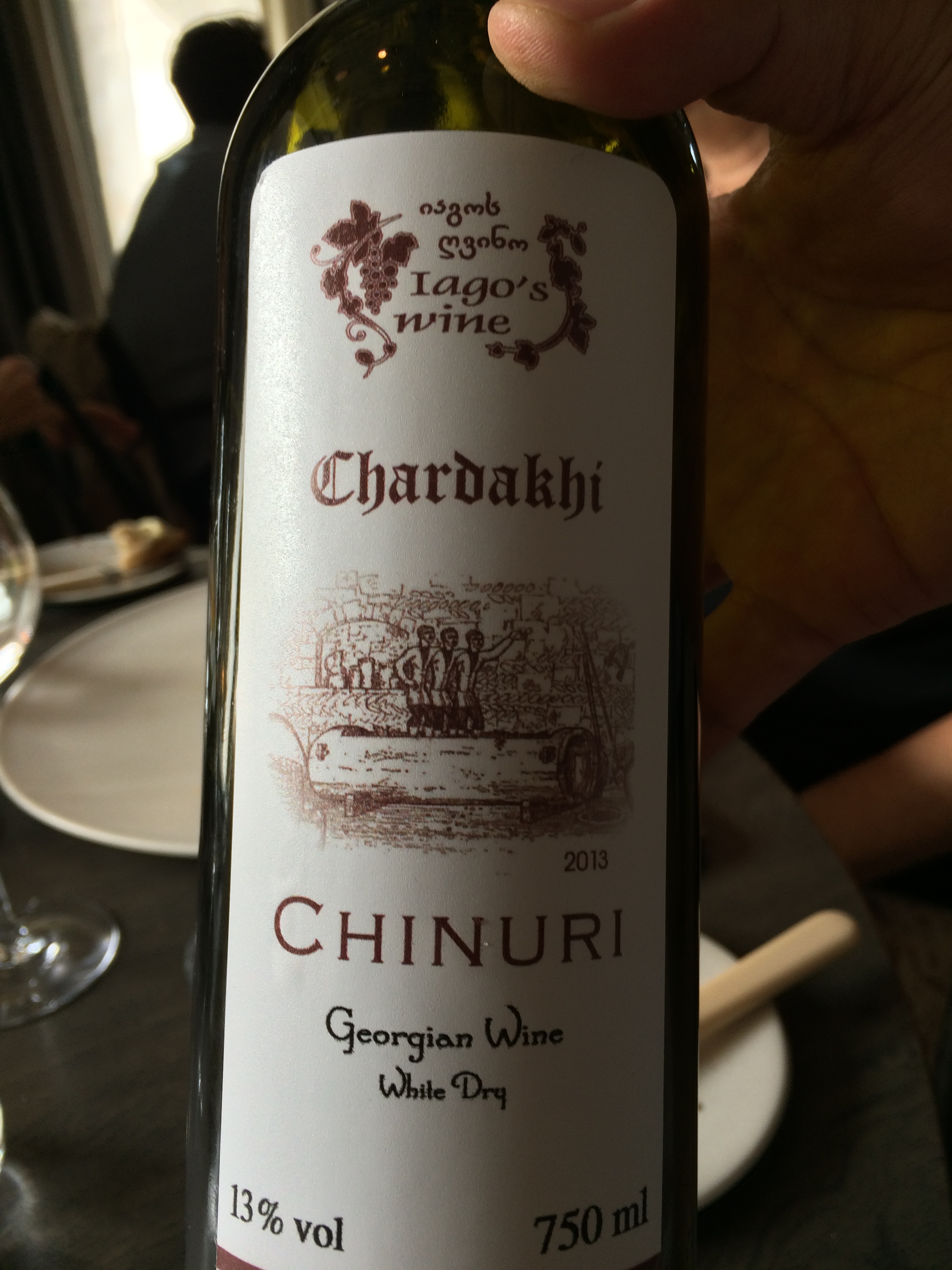
2013 Chinuri, Iago’s Wine, Chardakhi – Georgia.
2015-07-22 14.18.34
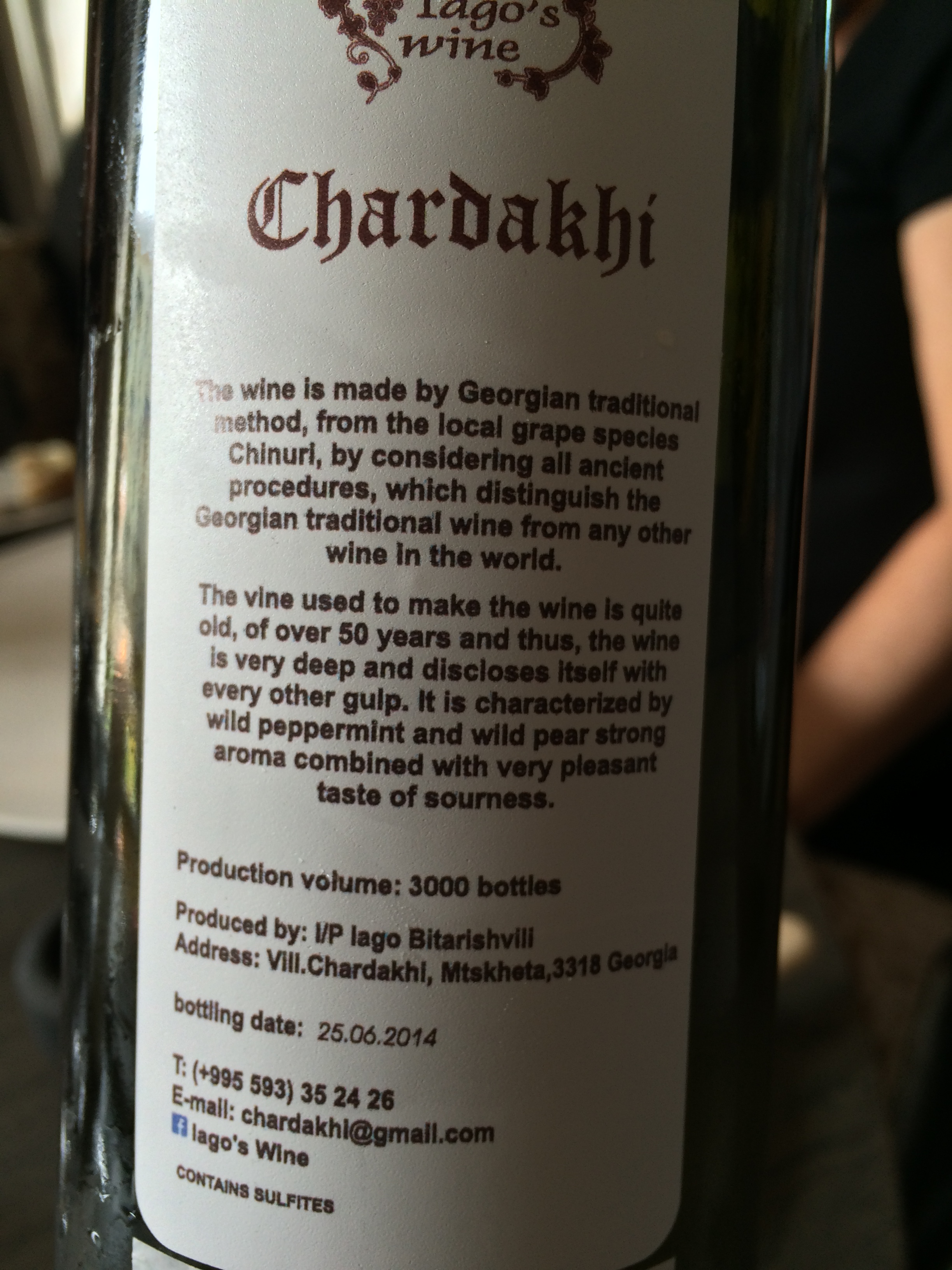
2013 Chinuri, Iago’s Wine, Chardakhi – Georgia. Back Label in English!

2015-07-22 14.21.34The next wine, a 2013 Chinuri, Iago’s Wine, Chardakhi – Georgia (LINK)was most unusual. Unfiltered, young, sour. Even more so than the Cuvée Alexandria mentioned earlier. This wine was almost unpleasant – there was wine in the mix somewhere, it was just hard to find.

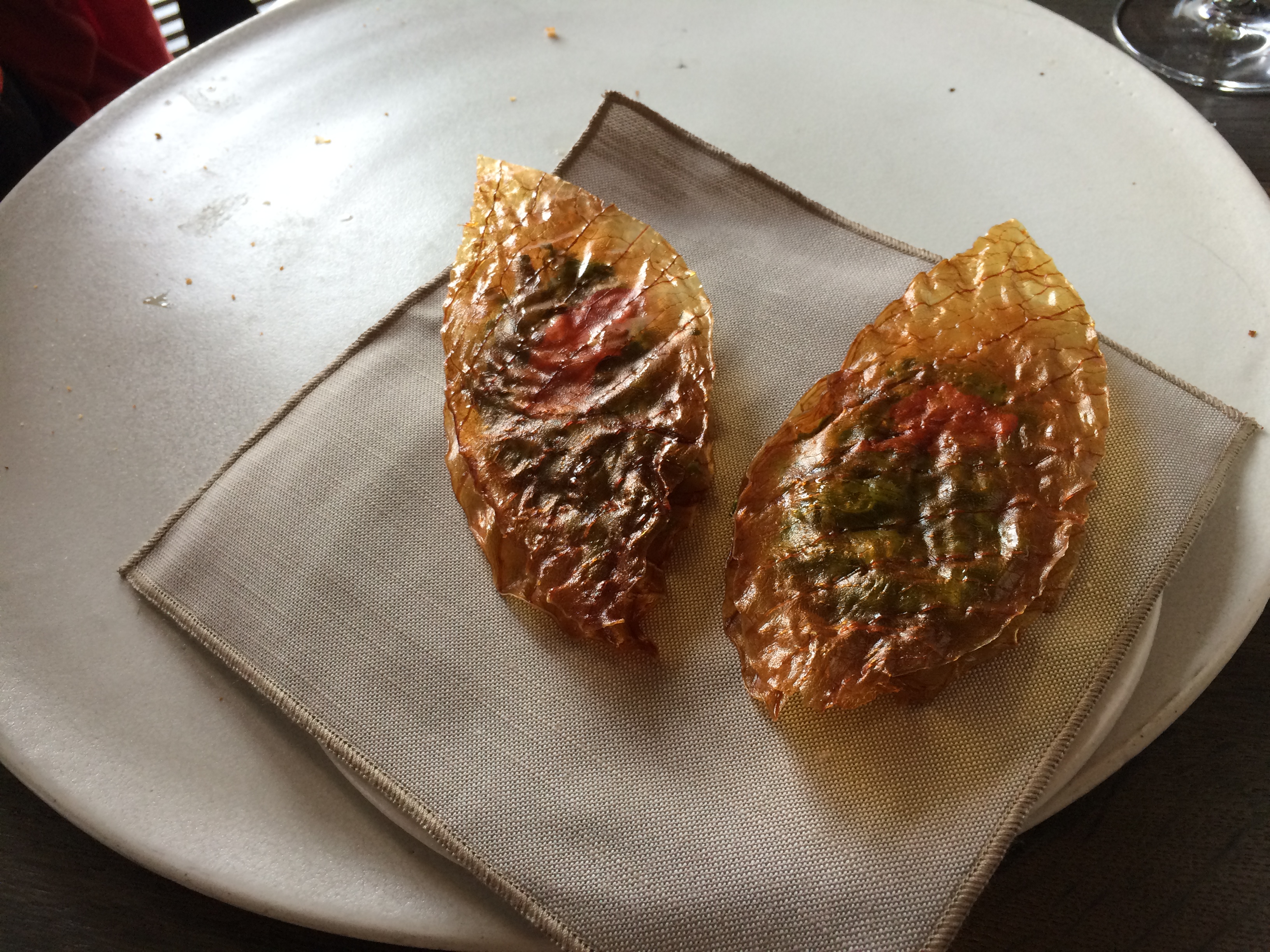
The first pairing was a dried fruit “leather” shaped into a leaf with a number of other items on it, including some garlic and grasshopper flour. It had the consistency but not the flavor of licorice and was very good.

Next:

2015-07-22 14.24.51
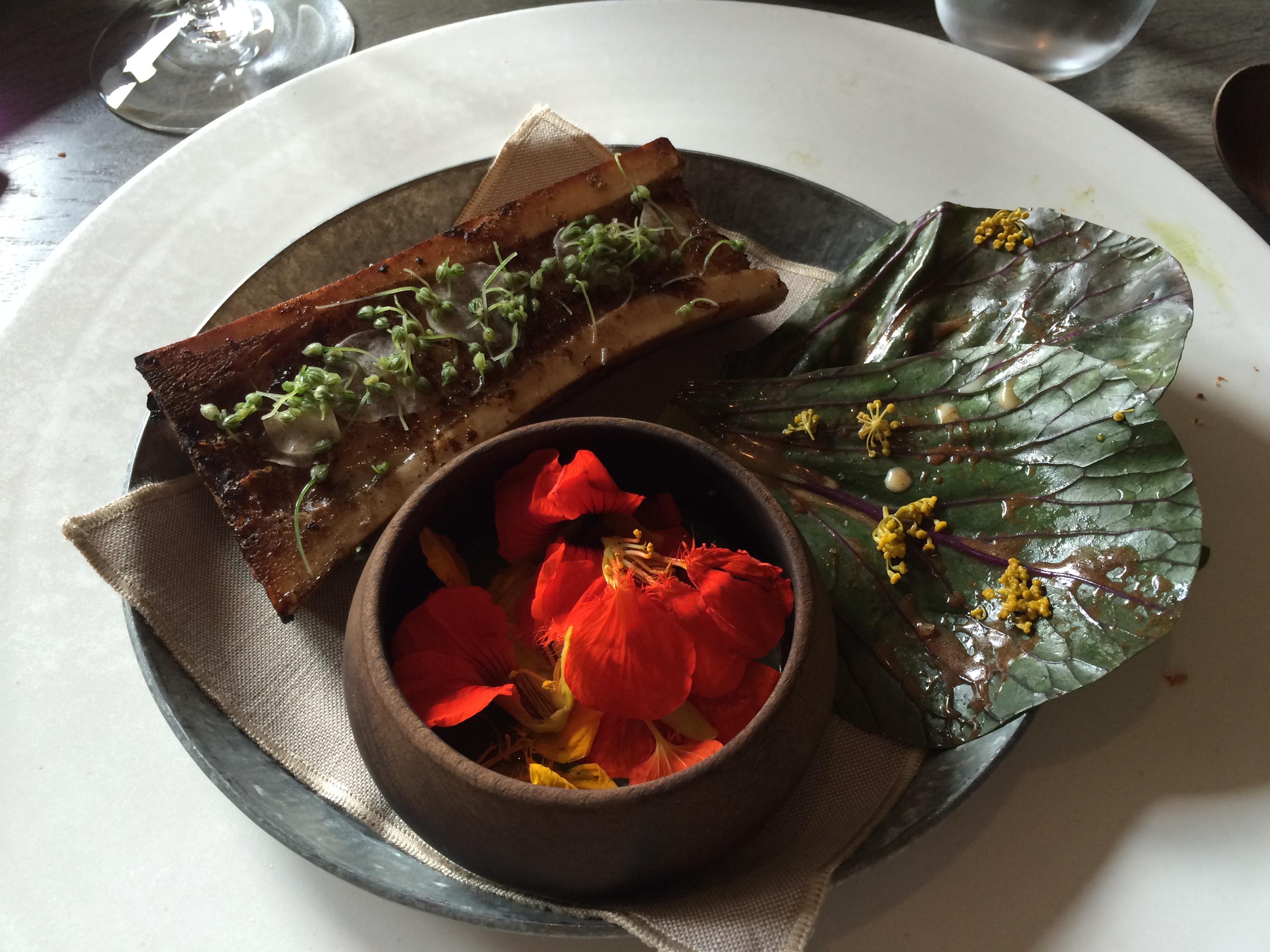
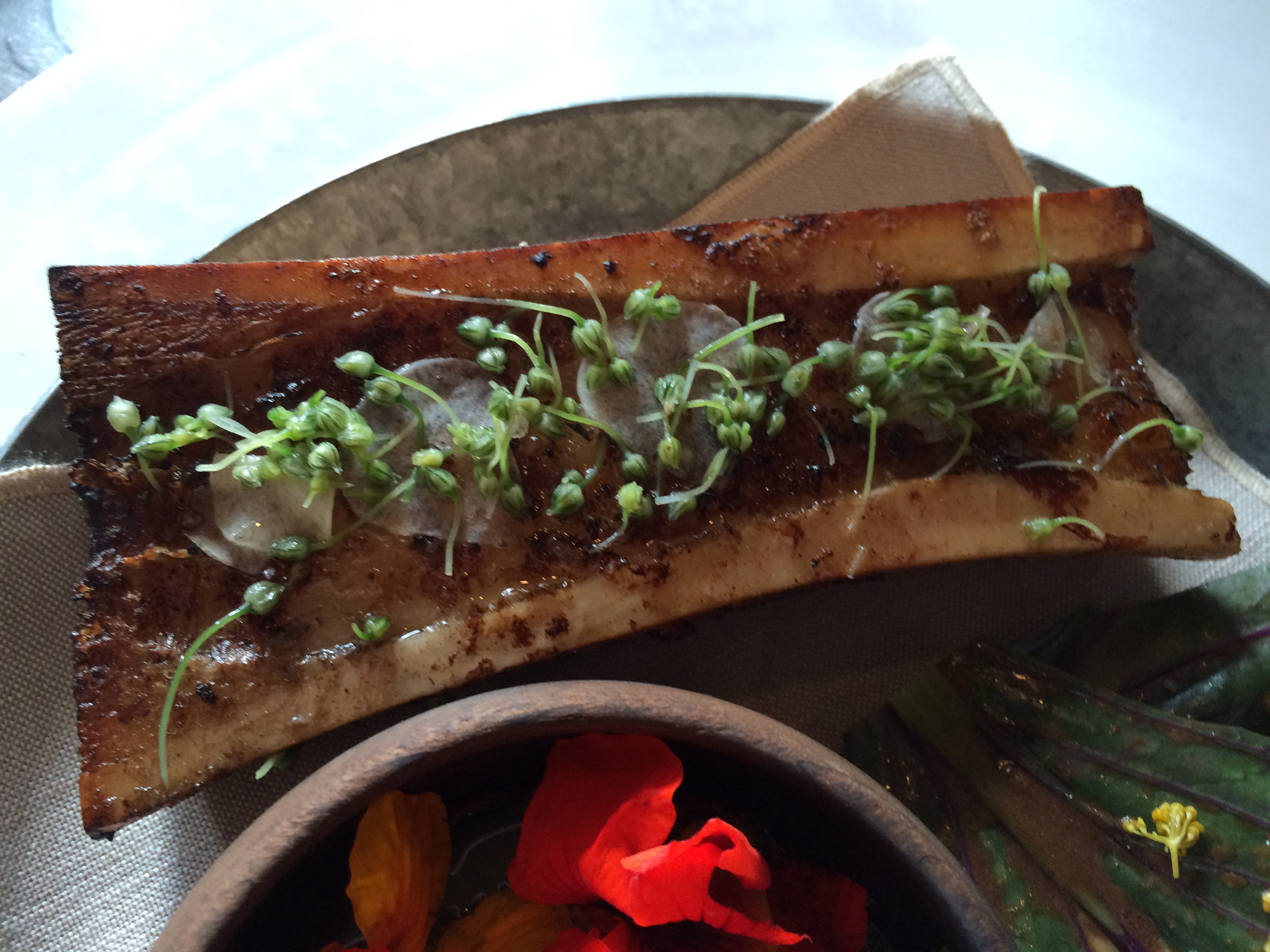
Bone Marrow with Flower Soup and Nasturtium Leaves.
2015-07-22 14.24.56
Bone Marrow with Flower Soup and Nasturtium Leaves.

Then, a dish not on our printed menu – beef bone marrow with a “soup” of flowers, and nasturtium leaves. This dish was the only one served that might have called for a red wine, but the Chardonnay did it’s job of pairing pretty well.

At this point, we were visited by the Sommelier, Yukiyasu Kaneko of Japan.

2015-07-22 14.22.09
Noma Sommelier, Yukiyasu Kaneko of Japan.

He answered our questions (I had a longer chat with him later) and explained his theory of using younger wines to compliment Noma’s unique cuisine.

Next:

2015-07-22 14.43.37
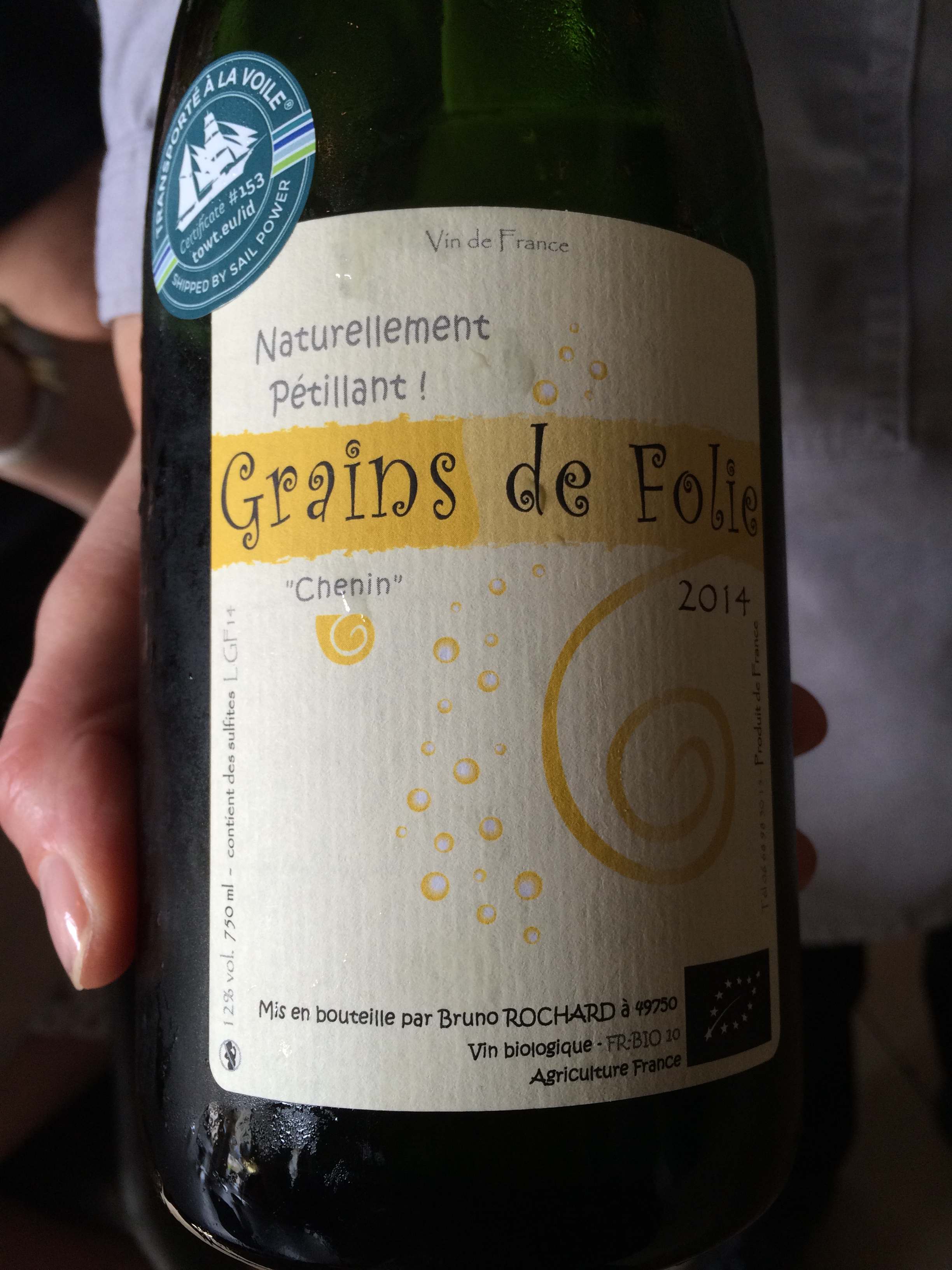
2014 Grains de Folie, Bruno Rochard, Coteaux du Layon – Loire.
2015-07-22 14.45.53
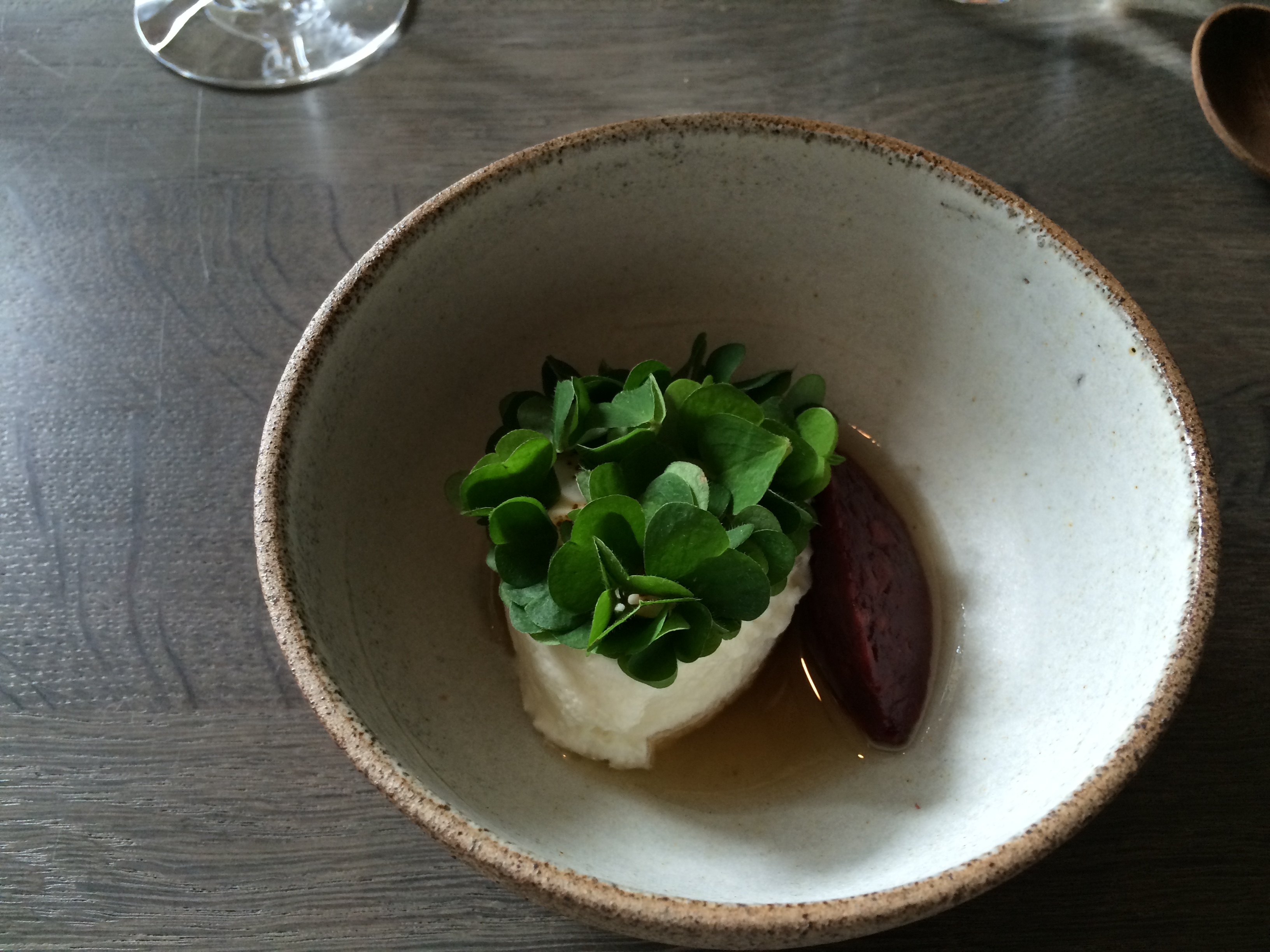
The Cheese Course – Not Sure of the Ingredients beyond a Creamy Cow’s Cheese.

The next wine, a 2014 Grains de Folie, Bruno Rochard, Coteaux du Layon – Loire Valley, Chenin Blanc (LINK – Related) comes from a region known for sweet wines. This wine, was a bit on the sweet side of dry. It was light, refreshing, and a nice pairing for the cheese course (also not on the written menu). The pairing worked well. The cheese was light and creamy, in a vegetable broth. Very good.

Now, on to Desserts:

2015-07-22 14.31.37
Berries and Greens Soaked in Vinegar for One Year.
2015-07-22 15.00.24
Forest Flavors – Deep Fried Reindeer Moss Dipped in Chocolate.
2015-07-22 15.00.28
Creme and Dipping Sauce.
2015-07-22 15.00.36
Egg Liqueur.
2015-07-22 15.14.07
Espresso to Finish.

Desserts were a flurry of items, pickled and sweet, with egg liqueur and espresso. The berries and greens soaked in vinegar for one year were very good – each retained much of its original flavor, but the textures were very unusual. The forest greens dipped in chocolate were a combination of tart, sour and sweet – the creme dipping sauce could tip it to the sweet side if you preferred, plus there were some more conventional chocolates on the plate. The egg liqueur was very smooth, much thinner than eggnog, and refreshing.

I should point out that Dorianne has allergies to beef and cow dairy, and the Noma staff made every effort to accommodate her in this regard, substituting ingredients, etc. You let them know 30 days in advance of your reservation about any allergies.

Wow. What a meal! The 18 courses turned out to be 20. We were well-fed, entertained, amazed, and, actually, ready for more. In the next and final installment of this series, I will let you know about the tour that you are offered of the Noma Complex and what you learn about the unique Noma Culture.

Photos and text, Copyright 2015 by Jim Lockard

“THE BEST RESTAURANT IN THE WORLD:” COPENHAGEN’S NOMA – PART 2: THE FIRST HALF OF THE MEAL

The food at Noma changes, sometimes daily. It is based on the seasons, on what has been foraged that morning, on what the chefs are trying to do, and, I am sure, on other factors that I know nothing about. Everything that we had was unique and clearly well thought out. I did not like everything, but I did not hate anything served. There was quite a bit of “sour” taste on the menu, and some on the wine list. There were some dishes that were interesting but not memorable. And there were some that soared. Those experiences were different for each of us at our table for four – Dorianne, me, and friends Ginger and Patricia. Three of us opted for the wine paring, Ginger opted for the juice pairing – a different juice blend comes at the same time that new wines are introduced. She raved about the juices, and we all tasted some and they were very, very good.

The presentations were unique, generally attractive and appealing, and mostly, delicious. There were lots of flowers, some rocks, mushrooms, moss, leaves, dough, lobster, bone marrow, berries, and many things that I had never seen on a plate before.

The restaurant is very nicely appointed, but not flashy at all. Rough-hewn wood, lots of gray colored fabrics and surfaces; you might say that the dining room is understated, as you might expect in Denmark.

2015-07-22 12.05.24
The Dining Room with the Wine and Juice Cooler.

The tables are simply set. There is a clear effort to have guests feel welcome and to make the experience as unpretentious as possible. Staff are friendly, direct, and relatively informal. They do what they do very well, are always in motion, but have time for any query or request.

THE MEAL

2015-07-22 12.00.21
Turnip and Unripe Strawberry Marinated in Aquavit with chamomile and other berries. Served on Ice.
2015-07-22 11.54.48
The First Wine – Not on the Menu – A Champagne.
2015-07-22 12.07.16
The Bread Bowl.

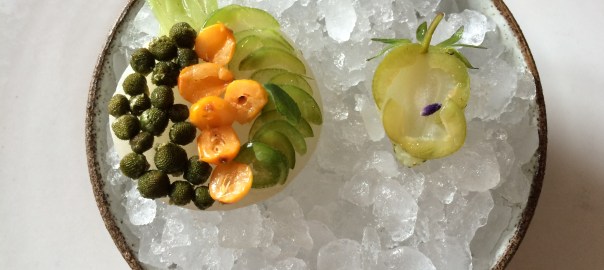
The first three courses are not considered a part of the pairing dinner. We were served a Champagne for all of these courses, a dufour par charles champagne “les instantanes”, which I could not find in an internet search (found the producer, but not this wine). Suffice to say that it was very well made, light and crisp, and you likely will only get it at Noma. The first item served to us was a small bowl of ice topped with turnip and unripe strawberry marinated in Aquavit. There are obviously other things sitting on top of the slice of turnip and the strawberry, berries, flowers and such – there are always other things on the dishes that are not described on the menu, but are described by the server. The server, by the way, will be either one of the wait staff or someone from the kitchen who worked on the dish being served.

This dish, eaten with the fingers, was very tart (Aquavit and unripe things) and the Champagne was a wonderful match, giving a sense of ripeness, but not too much. I was thinking that they know what they are doing. Smiles, oohs and aahs, and photo taking all around the table (I stopped the server to photograph each wine bottle as it was served – they were wonderfully patient). A very good start.

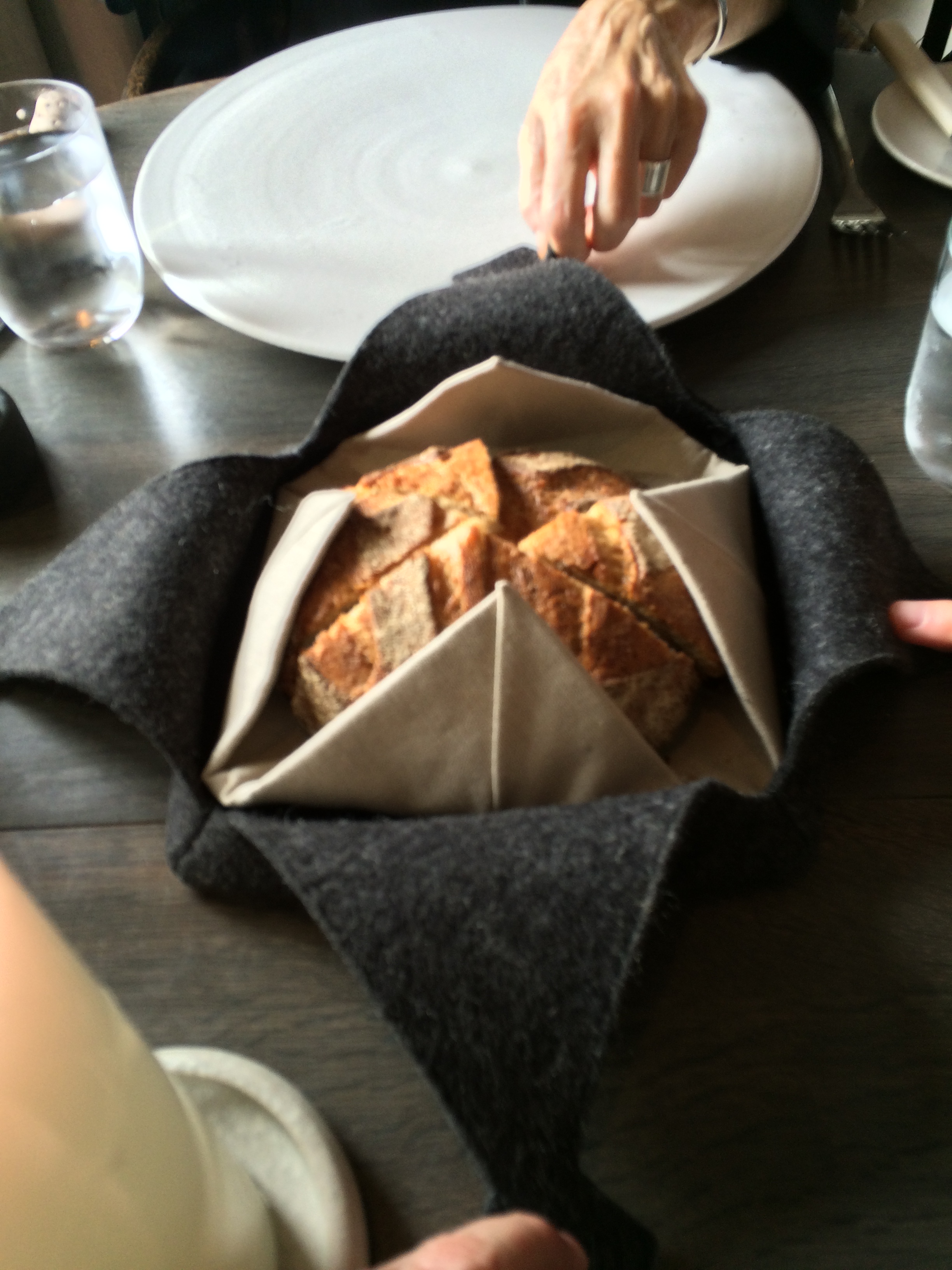
The bread, served in a felt basket, made from native Oland wheat and accompanied by both butter and rapeseed oil was delicious. The basket was refilled at least twice during the meal.

2015-07-22 12.09.24
Summer Cabbage Leaves and White Currants.
2015-07-22 12.09.44
The sauce being added to the Summer Cabbage for Patricia.

Next came summer cabbage with white currants and a white currant broth that was added at the table. This continued the tendency toward sour, unripened flavors. It could be classified as a soup, I suppose. Again, the Champagne was right there to extend and ripen the experience of the food.

2015-07-22 12.19.39
The First Shoots of the Season with Scallop Marinade.
2015-07-22 12.20.21
Dorianne Looks On as the Dish is Explained.

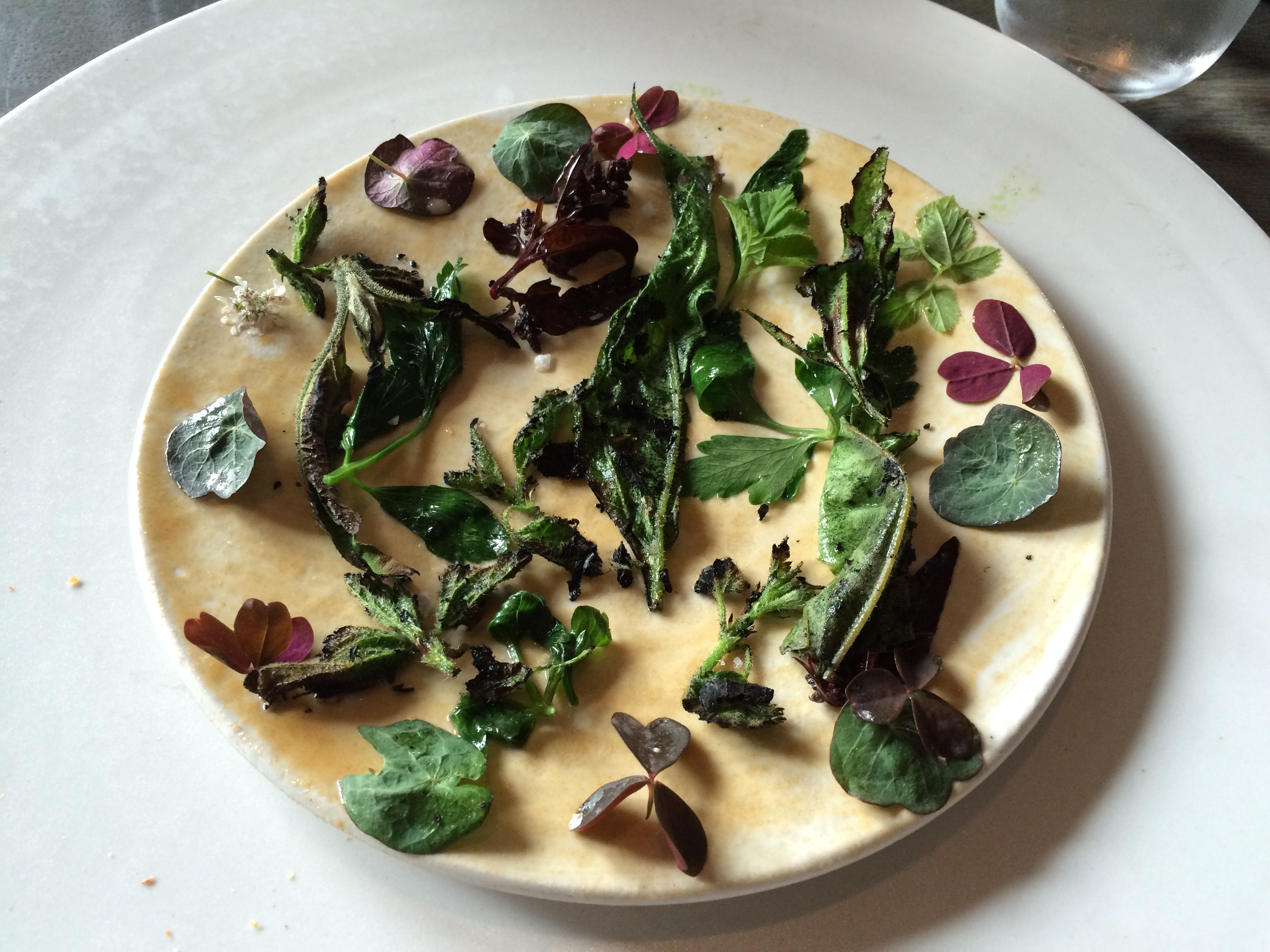
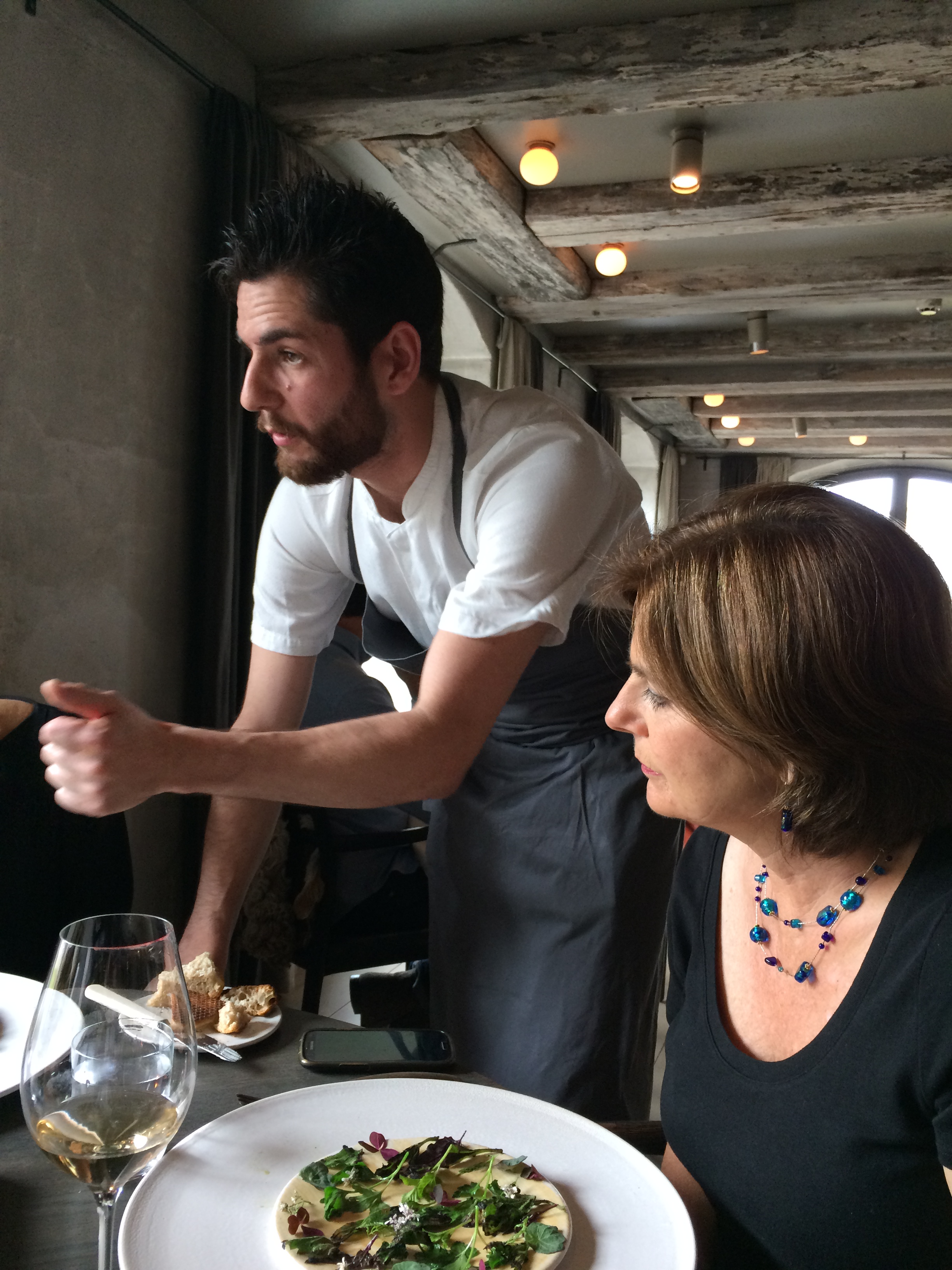
Next, course #3, the first shoots of the season with a scallop marinade, again with the Champagne. The plants were tiny and tender, some of them toasted, and after enjoying the presentation, you mix them all together in the thin layer of marinade and eat them in a few bites with your fingers. The rush of various flavors and the marinade tasting of the sea was delicious. After doing yeoman’s duty, it was time to part with the Champagne. Note: they do refill your glasses as often as you like.

2015-07-22 12.30.272015-07-22 12.30.33

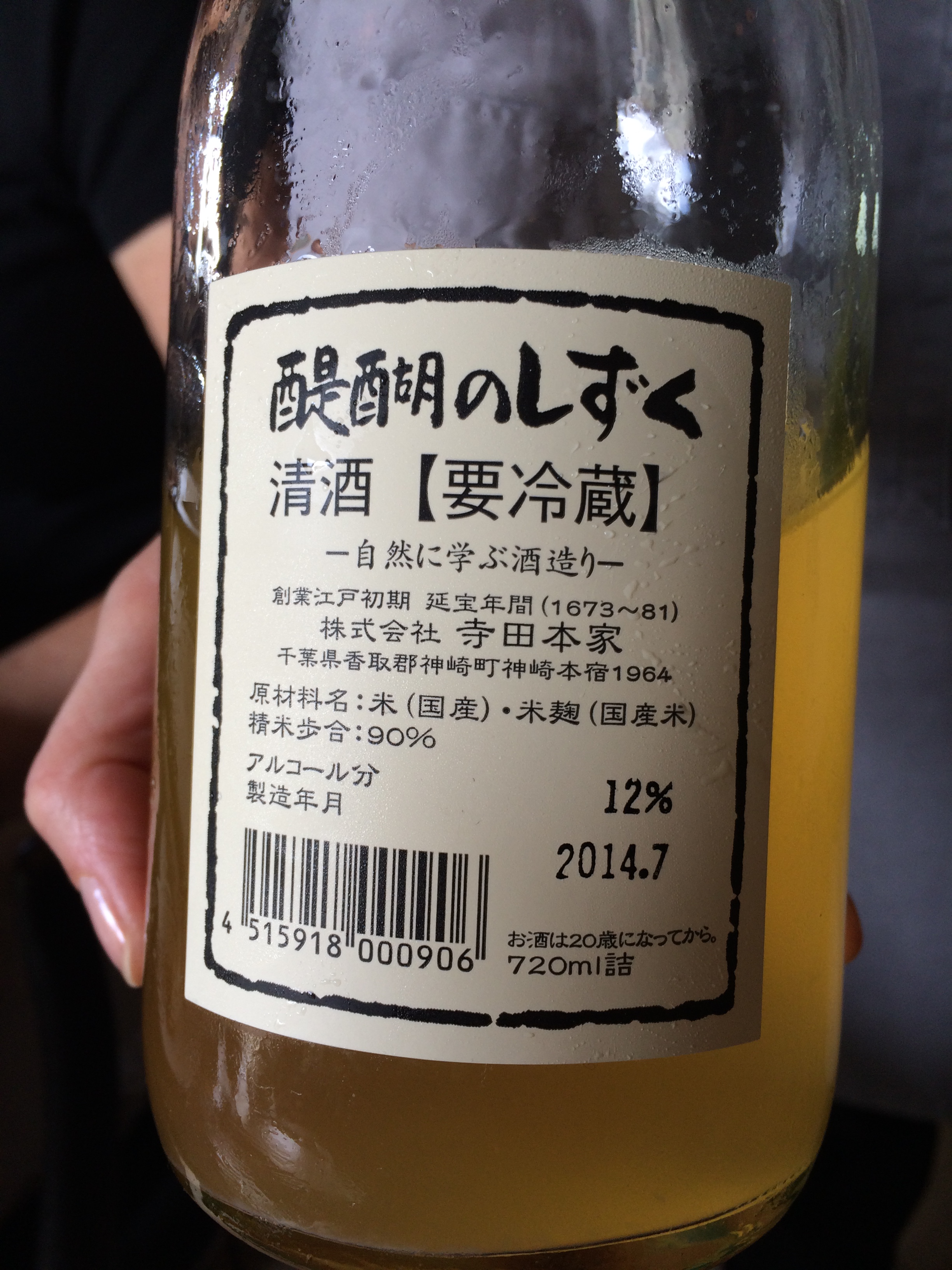
Now, the actual wine pairing begins! With Sake! A 2014 Daigo No Shizuku Terada Honke (LINK), to be exact, which would take us through the next three courses. Full-bodied with a soft and approachable taste; hints of citrus and a long finish.

2015-07-22 12.31.02
Sweet Peas and Sliced Kelp.
2015-07-22 12.31.08
Sweet Peas and Sliced Kelp – Close Up.

The first course of the pairing was sweet peas with sliced kelp. There was a cheese under the kelp – like a ricotta but not a ricotta; and nasturtiums in with the peas (we will see more nasturtiums), all in a sauce. Very tasty with a mixture of textures and flavors. The sake went well with this.

2015-07-22 12.45.43
Flower Tart.

One of the most picturesque dishes, the flower tart. Various petals over a vegetable spread and placed on something like a cracker. We ate it like a small slice of pizza. The sake was less successful here, as it was far more tart than the “tart,” so to speak. This experience reminded me of my childhood, sampling most of the flora in the neighborhood. This dish prompted a nice discussion of all of the things that we ate as children that were not from the home larder. A delicious and fun dish.

2015-07-22 12.49.37
New Danish Potato and Lavage.
2015-07-22 12.51.56
New Danish Potato and Lavage – Opened.

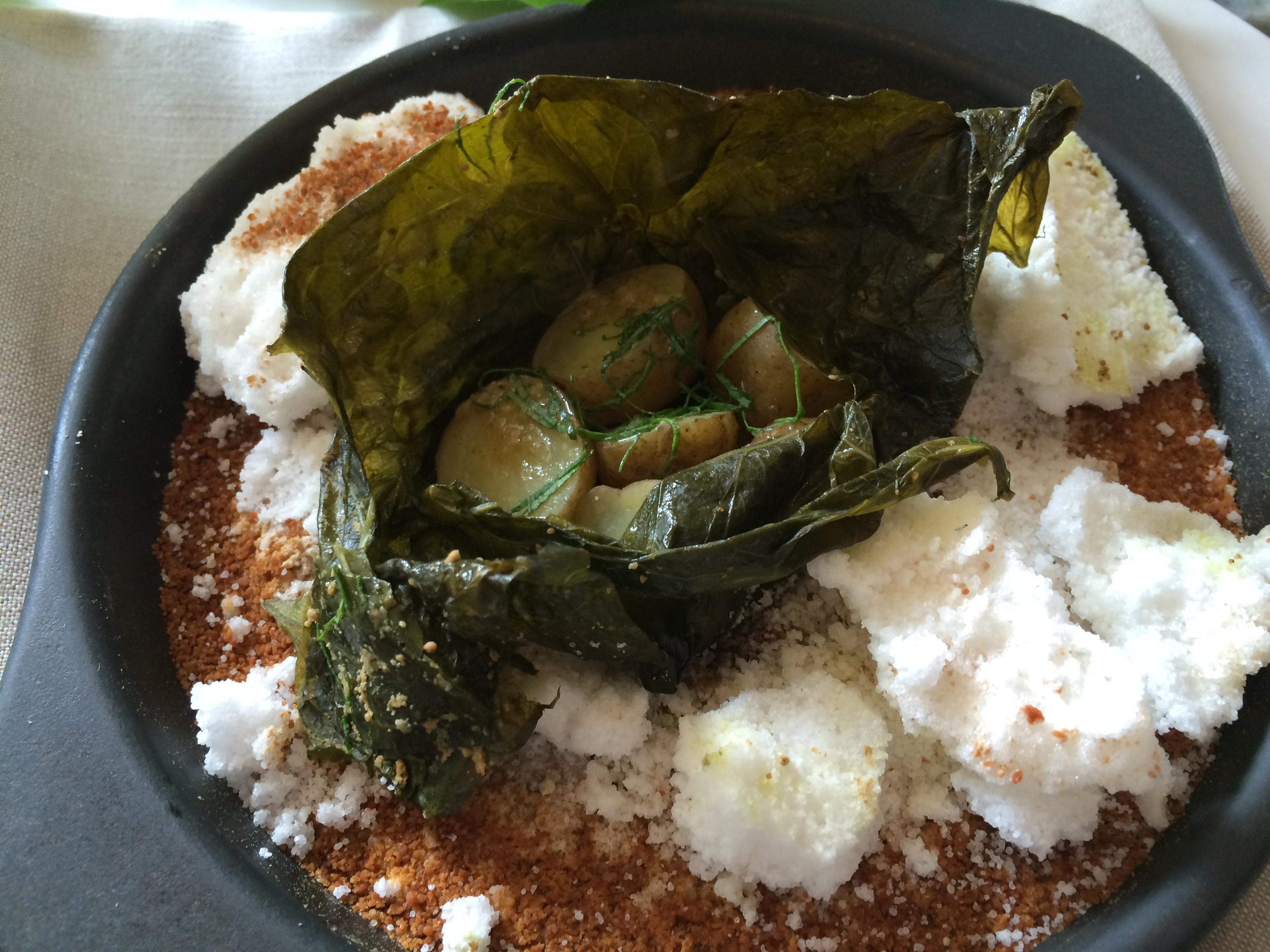
Next came new Danish potatoes wrapped in a lavage leaf, residing on a bed of two kinds of salt (it was recommended that we not eat the salt). This dish was intriguing. The potatoes, once revealed by opening the leaf, were to be eaten with a sharpened Elm twig (very Paleo). They were warm, soft, and, when touched to the salt, delicious! The leaf was also edible, but had absorbed too much salt to be enjoyable. The sake added a fullness to the experience and was a good pairing for this dish, and it completed its duty with this serving.

2015-07-22 13.00.03
Sweet Shrimps Wrapped in Nasturtium Leaves.
2015-07-22 13.00.51
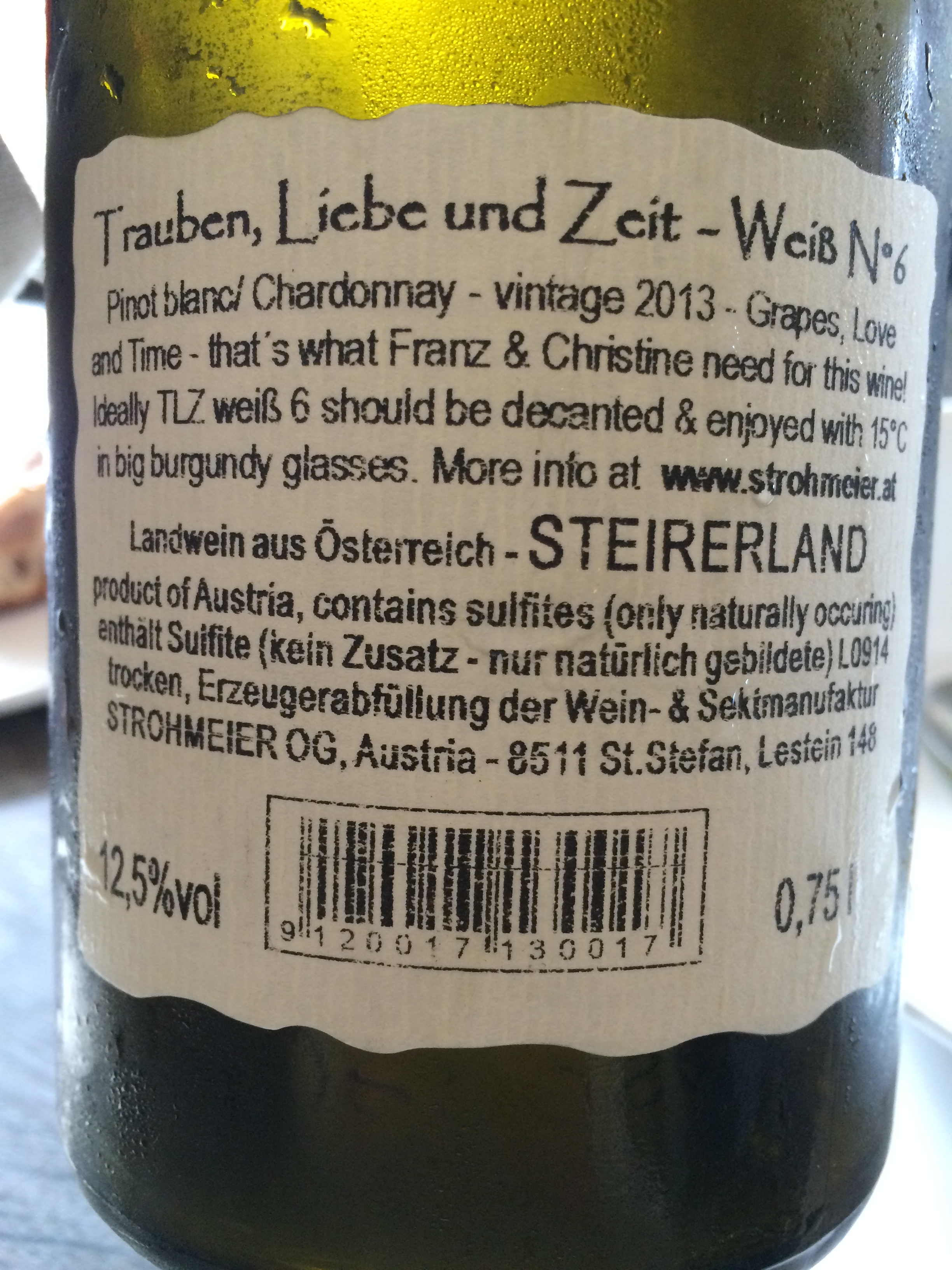
2013 Strohmeier Weiss #6 – Tromen Liebe and Zeit, 50/50 Chardonnay and Pinot Blanc. Austria.

2015-07-22 13.07.46

The next course was sweet shrimps wrapped in nasturtium leaves with a seafood broth. Very tasty – the shrimp and the leaves were a good mix of textures and flavor. The next wine was 2013 Strohmeier Weiss #6 – Tromen Liebe and Zeit, 50/50 Chardonnay and Pinot Blanc from Austria (LINK). This is really a nice white wine. I have loved the whites (weiss) of Austria since visiting there in 2009. I am a particular fan of Grüner Veltliner, the wonderful white grape so popular there and now being grown in California. But I digress – the Strohmeier has the nice acidity that one expects from Austrian whites, plus, the Chardonnay gives it a fuller mouth feel. It was a great accompaniment to the shrimps in nasturtium. Of course, this could be my appreciation for a more familiar wine after the sake.

2015-07-22 13.11.05
Cabbage and Roses.
2015-07-22 13.11.48
Cabbage and Roses Uncovered.

Next came cabbage and roses; dried and candied cabbage leafs sandwiched around samphire (sea asparagus) and rose petals. The leaves were crunchy and the middle was soft and creamy. Eaten with your hands. The 2013 Strohmeier Weiss #6 accompanied this dish very well, giving a smoothness to the experience.

So that is the first half of the Noma dinner, nine courses with nine more to go; and five more wines (by the way, no red wines)! Those will be depicted and described in the next installment, Part 3.

Photos and text, Copyright 2015 by Jim Lockard

WESTERN SONOMA – A TASTE OF THE POSSIBILITIES

The other day, I was joined by Sonic Nourishment (LINK) musicians Erika Luckett and Lisa Ferraro for a day in western Sonoma for some wine tastings and lunch. It was a perfect day weatherwise, and we began with a drive out to Iron Horse Vineyards (LINK) near Sebastopol.

Known for their sparkling and white wines, Iron Horse consists of just over 100 acres of vineyards. We opted for two tastings, with Lisa getting the sparkling wines and me getting the white wines (Erika was our designated driver). The sparklers were all well-crafted (with the exception of one that turned out to be a bad bottle – when we pointed it out to the tasting room personnel, another one was opened, which was fine). I am not a huge sparkling wine fan, but I do appreciate the bubbly from time to time, and these were all very drinkable to me. Lisa said that she was overall less impressed than on a prior visit to Iron Horse.

The whites, all Chardonnays, were equally well-crafted, especially the 2012 Rued Clone Chardonnay which was especially well-crafted with a nose of white fruit – pears and apples – with a hint of caramel. Very nice. We did not taste any of their Pinot Noirs, saving our strength for the long day ahead.

One note – the tasting notes pages at Iron Horse said nothing about the wines, only naming some suggested food pairings. Since there was no food available, I did not find this very helpful. On the other hand, the tasting room staff was very helpful and paid attention to everyone.

Next, we headed into Healdsburg (LINK) for lunch and to hit a couple of tasting rooms there.

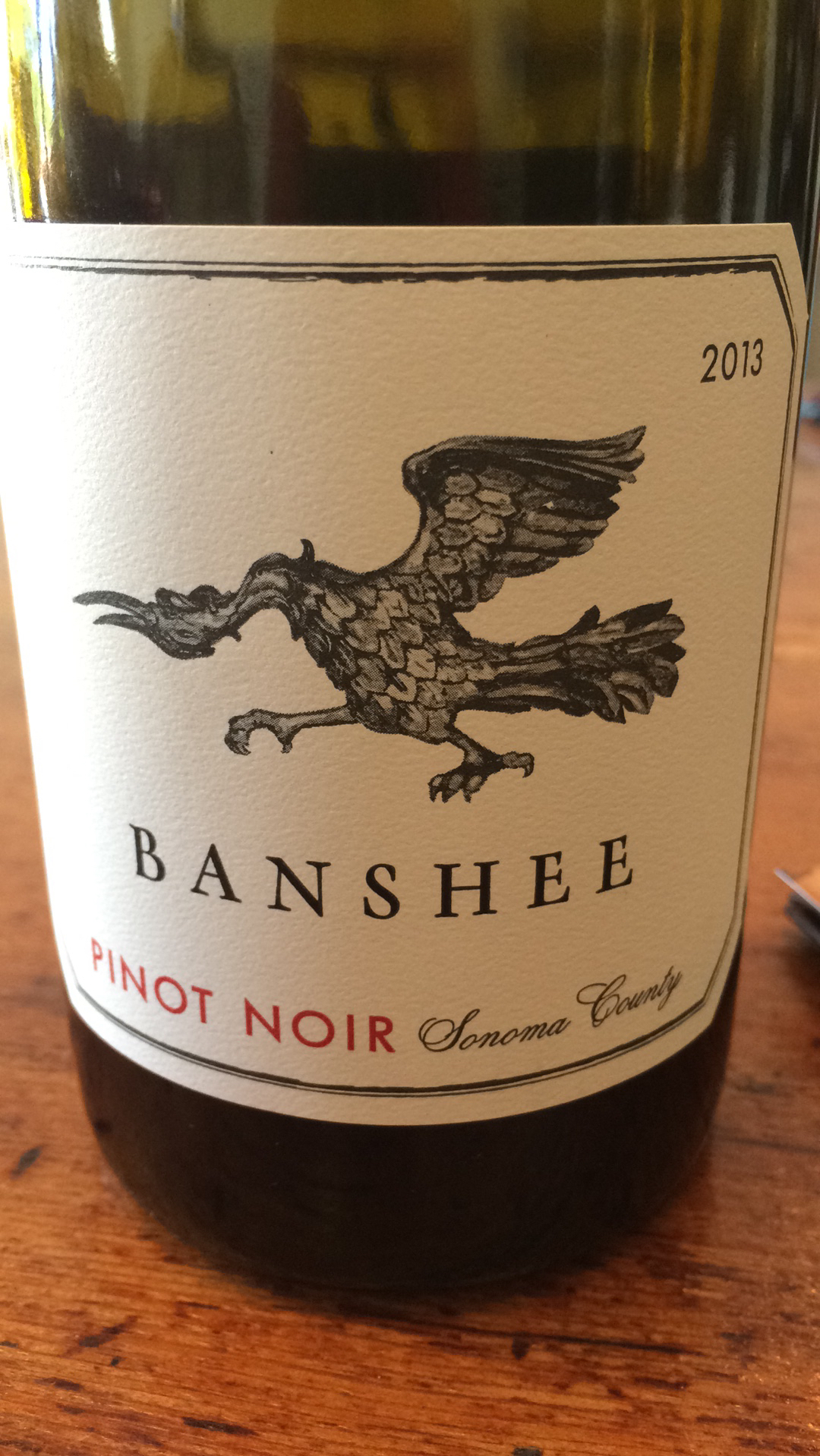
After a healthy lunch at the Oakville Grocery, we headed over to Banshee Wines (LINK), for some Chardonnay, Sauvignon Blanc, Pinot Noir, a Cabernet and a red blend. Banshee sources fruit from a number of Sonoma coastal and inland vineyards. They produce wines that are more Californian than Burgundian in style, which is not surprising. Lisa and I each did their basic tasting (there is also a reserve tasting), of three Chardonnays and two Pinot Noirs. They were all well-crafted and very good (think somewhere between oaky and stainless steel for the Chardonnays; the reds were very nice with one exception – The 2013 Mordecai Red Blend, made up of 9 varietals, had such an off-putting nose (think swampy) that neither Lisa nor I could get to the tasting. We asked the tasting room staff if this was a bad bottle, and were told that it was fine. We dumped that one.

Otherwise, the Banshee Wines that we tasted were enjoyable. Like many smaller producers in the area, their price points are a bit high for the average buyer – but if you like the wines, you will buy them.

2015-06-18 14.52.20

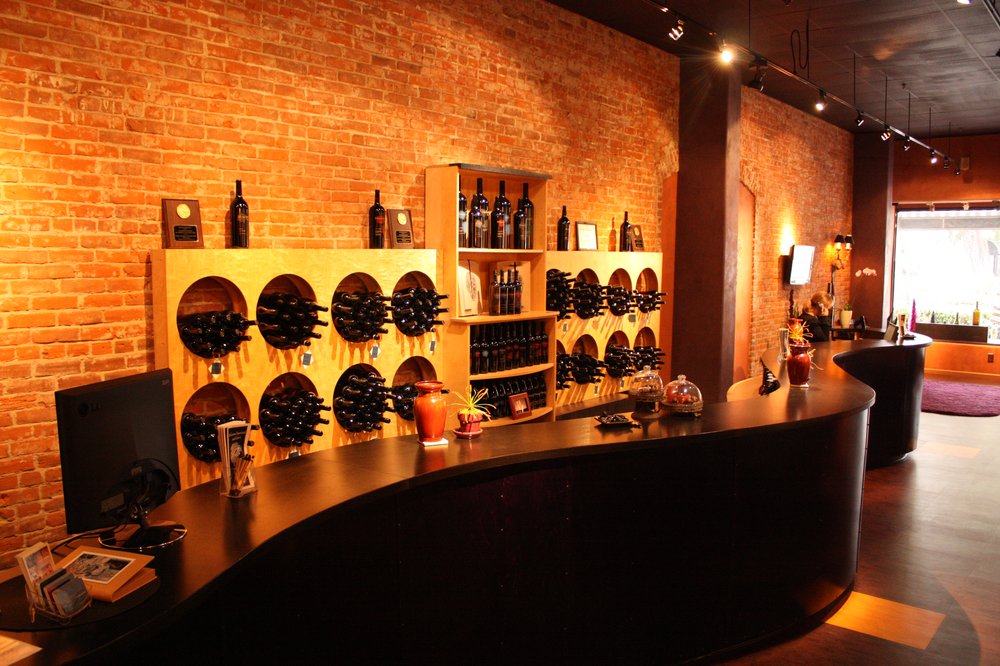
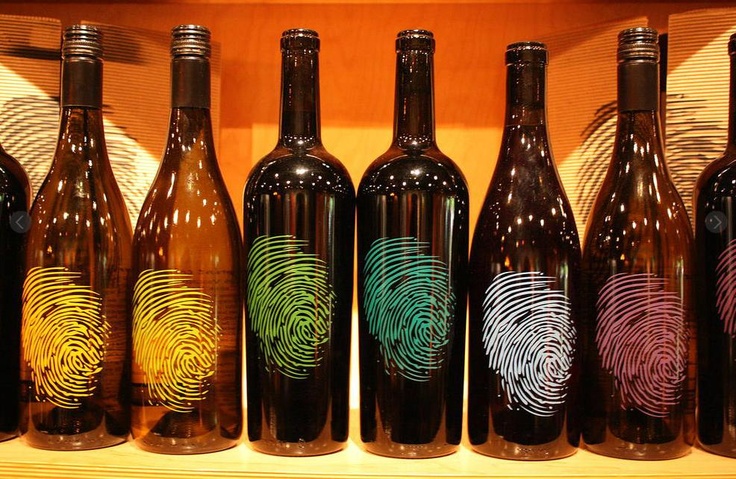
Our final stop of the day (we needed to beat the traffic back to the East Bay), was Thumbprint Cellars (LINK), whose tasting room is just off the square in Healdsburg. I had some of their wines a couple of years back, when they were regularly featured on the Wines Till Sold Out (www.WTSO.com) site, and liked them very much. When I mentioned that to the tasting room staff, I was told that those were special blends made just for WTSO at the time.

We started with their 2013 Arousal white blend of Sauvignon Blanc and Viognier, a floral nose, very rich mouth feel, and smooth finish on this one. We also tasted the 2011 Climax red blend, a mix of 44% Syrah, 26% Merlot,
20% Zinfandel, 7% Cabernet Franc, 3% Viogner
. This one is very smooth and complex (as you might imagine), but well-balanced. Very nice. I brought a bottle of this one home; so did Lisa. The 2011 Sonoma County Cabernet Sauvignon was everything you would want in a Sonoma Cab – rich, spicy, bold, and lots of dark fruit, but with an elegance that is so often missing in “big” wines.

Wine - thumbprint-cellars-wine-tasting-room
Thumbprint Cellars Tasting Room

Wine - Thumbprint - Sonoma

So that was our day in Western Sonoma. Like all such tasting outings, we had a great time and missed a lot of wineries. But that gives us something to go back for.

WINE ENJOYMENT SHOULD BE ACCESSIBLE AND ENJOYABLE, OR WHAT’S THE POINT?

There is a false notion that permeates wine culture at almost every level. That notion is that there is a level of knowledge that is attainable that will enable a person to know about every wine that exists. Now I know that most wine experts (a word that is past its expiration date IMHO) will say that this is not so, but it is conveyed in wine media of all kinds and by many individuals. My wine Twitter feed includes a number of people who purport to have a very deep knowledge of a very wide variety of wines. I have my doubts.

The reason that this is a false notion is that the sheer numbers relating to wine have grown so large and are so widely distributed around the globe. The California Wine Institute (LINK) has figures on its site for world wine production through 2012 – it shows 25,721,000 liters of wine produced world-wide (LINK). WineSearcher.com (LINK) shows about 3,600 wine regions in the world. There are probably around 100,000 wine producers in the world (this number is a bit difficult to nail down). The number of labels that you find in a decent wine store grows each year, with mega-stores like Total Wine and Spirits carrying upwards of 9,000 wines.

How is anyone going to know about all of these wines?

Wine Angst

For someone who is new to wine appreciation, or even for seasoned collectors, it can seem impossible. Most end up narrowing down their focus to a few regions or varietals, or even a single one. I have a friend who only drinks Kendall Jackson Chardonnay for example. Most collectors focus narrowly, some are more expansive, seeking out a wide variety of wines from various locations, vintages, and varietals. Those who focus will likely have a more in-depth knowledge of the particular area or areas of their attention. Those who explore more widely will have a more superficial knowledge of a variety of wines, regions, and varietals.

2014-09-11 12.57.26

Unless you are in the wine business, you will not have time to taste and understand the thousands of wines that are out there, or even the hundreds on the shelves on your local wine retailer’s shelves. And even if you are  in the wine business, it is doubtful that you will need to know about every region, varietal or producer. The idea that one needs to have so much knowledge can drive people away from the enjoyment of wine, and that serves no one.

My recommendation is to find your own way into and through the many types, styles, and iterations of wine. You may just have a glass or two a week of whatever is being served, or you may be an avid collector of all things from the Piedmont in Italy or Napa Valley in California, it does not matter. There are ways for you to access information about your own desires and preferences.

I tend to be an explorer. Even though I drink wine every day, blog about wine, and will be doing wine-related tours in the near future, I do not spend hours and hours pouring through information about wine. I tend to be an explorer – trying all kinds of wines from various regions – but I also have my preferences and I spend more time exploring those in greater depth as time and my wallet allow. Writers like Eric Asimov of the NYTimes work for me, because he explores a variety of wines from different places. I also enjoy Kermit Lynch, the amazing wine purveyor in Berkeley, whose newsletter (LINK)  is very informative and focuses mostly on French and Italian wines.

But you will find your own sources. I try to keep my blog as general as possible, but since I travel a lot, I write about the wines and the wine culture where I travel, so there may be some posts that do not interest everyone.

the world of wine should not be an impenetrable maze of secret or obscure or overwhelming information. It should be accessible, enjoyable, and allow each wine enthusiast to savor the experiences that he or she discovers. Whether that is a focus on First Growth Bordeaux or on trying to sample each of those 3,600 wine regions in the world, it should be an enjoyable experience, or what’s the point?

I would love to see some comments on this post – what do you think? What is your approach to wine?

IMG_0373

CLOS PEPE ESTATE WINES WILL BE MADE NO MORE

In an announcement to his mailing list and via his website, Wes Hagen, Vineyard Manager and Winemaker at Clos Pepe Estates in the Santa Rita Hills AVA, announced that the vineyard and operations have been leased to Hall/Walt Wines of Saint Helena, CA. (LINK TO WEB PAGE)

The 2014 Vintage will be the last for Clos Pepe Estate Wines and for their secondary label, Axis Mundi. Wes Hagen and his wife will move from the vineyard property and he will be looking for other opportunities in the Central Coast of California.

I have been a particular fan of Wes Hagen, his wines, his wine making, and his personality and depth of knowledge about all things wine. He is as much a philosopher as a wine maker. He has been a pioneer in the Burgundian style so prevalent in the Santa Rita Hills, and a leader in establishing the AVA designation there.

Clos Pepe Estate Wines will be missed.

2014-03-15 17.28.41
Jim Lockard and Wes Hagen at a Clos Pepe Estates Wine Tasting Event in Newbury Park, CA in 2014.

IN CATALONIA – A WINE REGION FULL OF LIFE

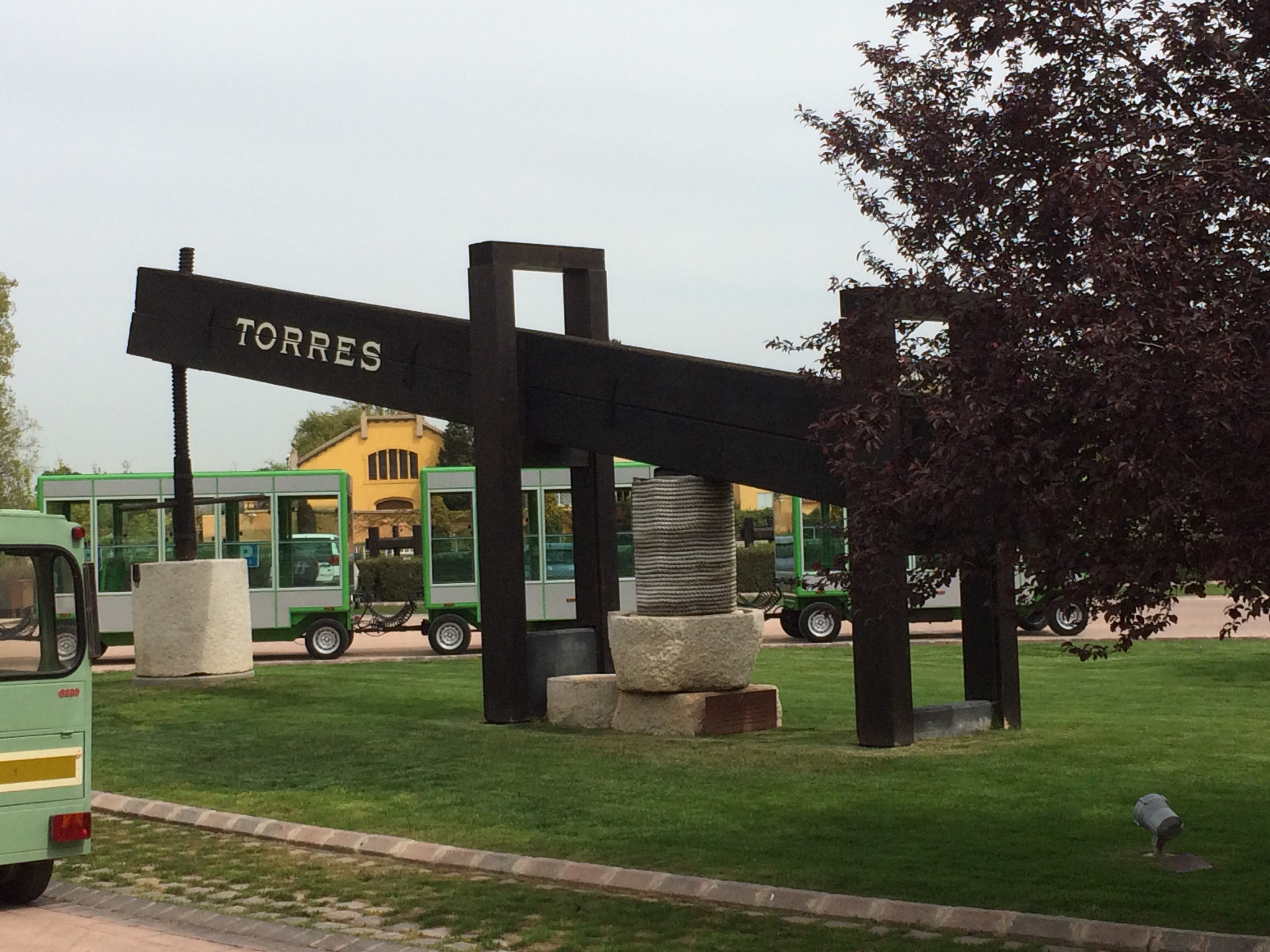
Dorianne and I are in Sitges, Spain this week, which is a beach town south of Barcelona. Just east and slightly inland from Barcelona is the Penedès DO Wine Region, home to a variety of wines, including Cavas, the sparkling wines of Spain. More about cavas in later posts. This concerns our visit to Bodegas Torres (LINK), in Villafranca del Penedès, one of the largest wine makers in Spain.

penedes map catala
The Penedès DO Wine Region

Bodegas Torres is truly a huge operation with a storied history and wine production all over the world (LINK). The Penedès Winery is a state of the art facility producing wine and brandy and is located next to the family home. It is roughly on the level of a Mondavi or a Gallo-sized operation, to give you an idea. The wine tour (which we were given alone with a guide, Archie, a young man from England) includes a tram and Universal Theme Park-like effects, which were inspired, we learned, by a family visit to Universal Studios in Los Angeles. So this is not your boutique winery.

2015-04-15 12.34.47 2015-04-15 12.34.58 2015-04-15 12.35.47 2015-04-15 12.36.32

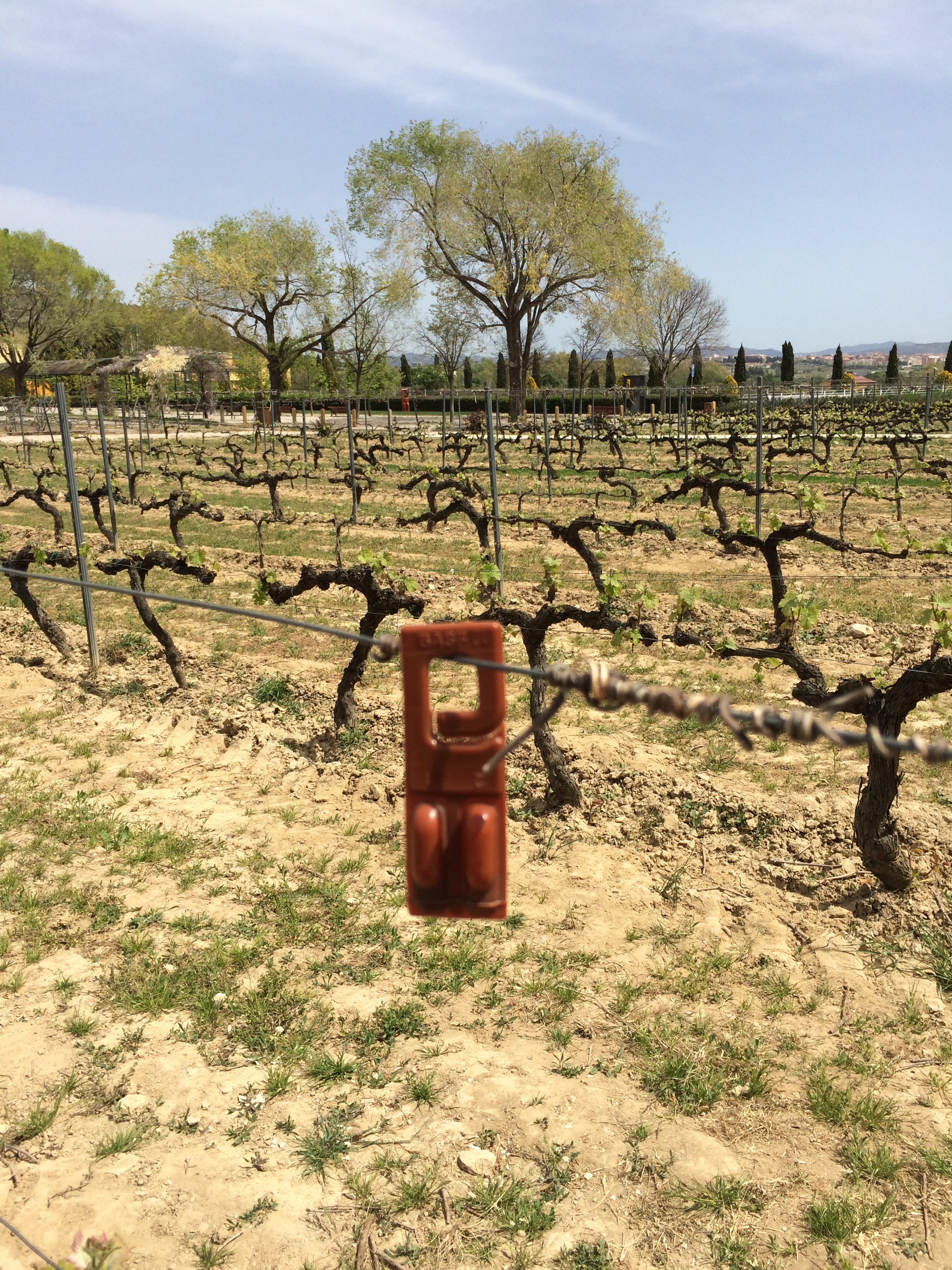
That being said, the company is taking strong steps at environmental sustainability (LINK), including recycling, energy and land conservation, increased organic and biodynamic farming practices, and the like. The tour highlights many of these practices, which the company obviously sees as a good way to market their wines. I agree with them.

2015-04-15 12.36.06
Reservoir used to clean equipment – water is recycled through the artificial wetlands.
2015-04-15 13.38.42
Sand dome over a reserve cellar to provide insulation
2015-04-15 13.55.57
Pheremone capsule to keep flies from laying eggs in the grapes

2015-04-15 13.40.17

The winery facility in Penedès processes millions of bottles of wine annually. It has the look and feel of a place that has the resources to create whatever the owners want – the buildings are nicely appointed, the vineyards well tended, the equipment is in excellent condition, plus there are very nice touches for the customer at every turn. There are about a dozen wines and several brandies produced here. Our tasting after the tour was limited to five wines from three regions in Spain. Archie our guide, has been with the company for about a year and is working toward wine certifications in England. His plan is to work in the wine industry. He showed a great deal of knowledge about the entire process, and he was able to answer most of our questions. The tour would be an excellent introduction for someone new to wine production, and we learned a thing or two as well.

2015-04-15 13.43.33
Barrel Storage Cellar
2015-04-15 13.51.32
Bottle Aging Facility
2015-04-15 13.54.35
Our guide, Archie, describing pruning techniques.

2015-04-15 13.54.18

As to the tasting – the wines we tried – two whites (blancos) and four reds (tintos), were all well-crafted and balanced wines. We tasted across several of the labels of the winery – (there are dozens). The blancos, were a 2013 Jean Leon Chardonnay from Penedès DO, and a 2013 Torres Fransola Sauvignon Blanc. The Chardonnay was 50% oak barrel aged and 50% stainless steel. It was similar to the increasingly popular style of Chardonnay from California, which is less buttery and powerful. The wine was refined and nice on the nose and in the mouth. Very good. The Sauvignon Blanc was more in the French style – smooth and elegant. The wine did not jump out at you with citrus or grassy notes like New Zealand Sauvignon Blancs; rather it seduced you a bit – this wine would be amazing with shellfish, we both agreed.

The four tintos were also all well-structured and balanced wines. They included a 2012 Torres Altos Ibericos Crianza Rioja, a Tempranillo with good character. Moderate tanins and acid make this wine good for drinking alone or with food, such as barbecue or some wonderful Iberico Jamon. The second tinto, a 2012 Torres Celeste Crianza from  Ribera del Duero DO, a Tinto Fino (the name for Tempranillo in that region). This wine was more fruity and had lower tanin – but was clearly well-crafted. Very nice. Next, we moved on to the two higher-end wines in the tasting. A 2012 Torres Salmos a blend of Cariñena (60%) Garnacha Tinta (20%) and Syrah (20%) grapes from the Priorat DO. I have really enjoyed just about every Priorat wine that I have tasted, and this one was no different. A very dark, rich color, fruity and spicy on the nose, and bold fruit-forward in the mouth, very thick (but not unpleasantly so) mouthfeel and a long, silky finish. I really love this wine. Finally, we go to the 2010 Mas la Plana Cabernet Sauvignon from the Penedès DO. This wine brings a greater complexity with some mushroom on the nose and hints of minerality just behind the fruit. Good tanins and acidity balance on the tongue and the finish is smooth and elegant. I liked this just a tiny bit less than the Salmos. The latter two wines should age beautifully. You can research more details at the Torres links above. This may not be the winery visit and tour for everyone – it is a very large facility and run like one. But it does give good insights into the Spanish Wine Industry. There are a number of smaller wineries in the region as well.
2015-04-15 13.59.44
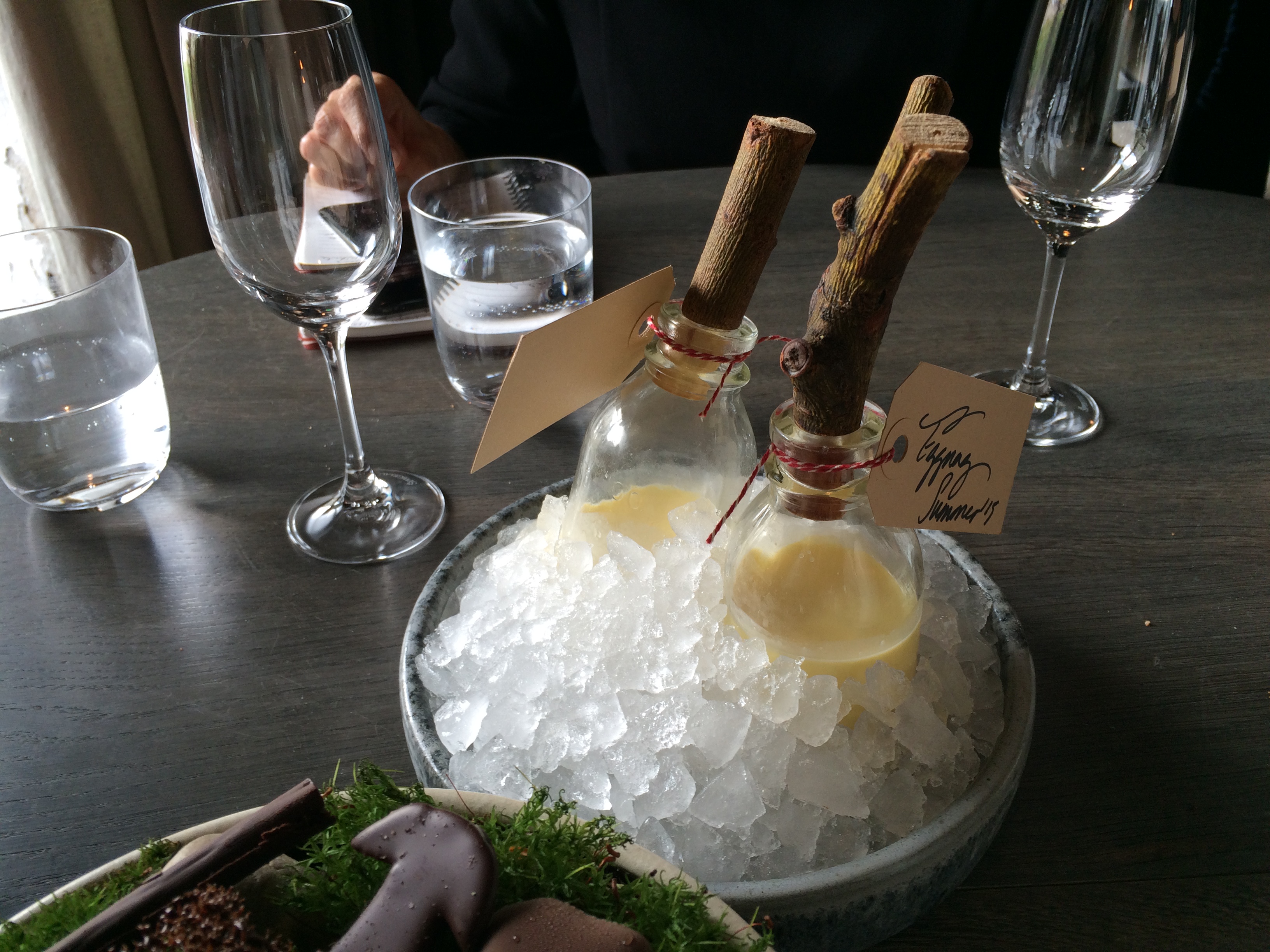
The Tasting Room at Torres
2015-04-15 14.01.31
The Blancos (whites)
2015-04-15 14.17.16
The Tintos (reds)
2015-04-15 14.46.03
Dorianne, Jim and Archie after the tasting.

MORE SANTA RITA HILLS – TYLER AND LAFOND

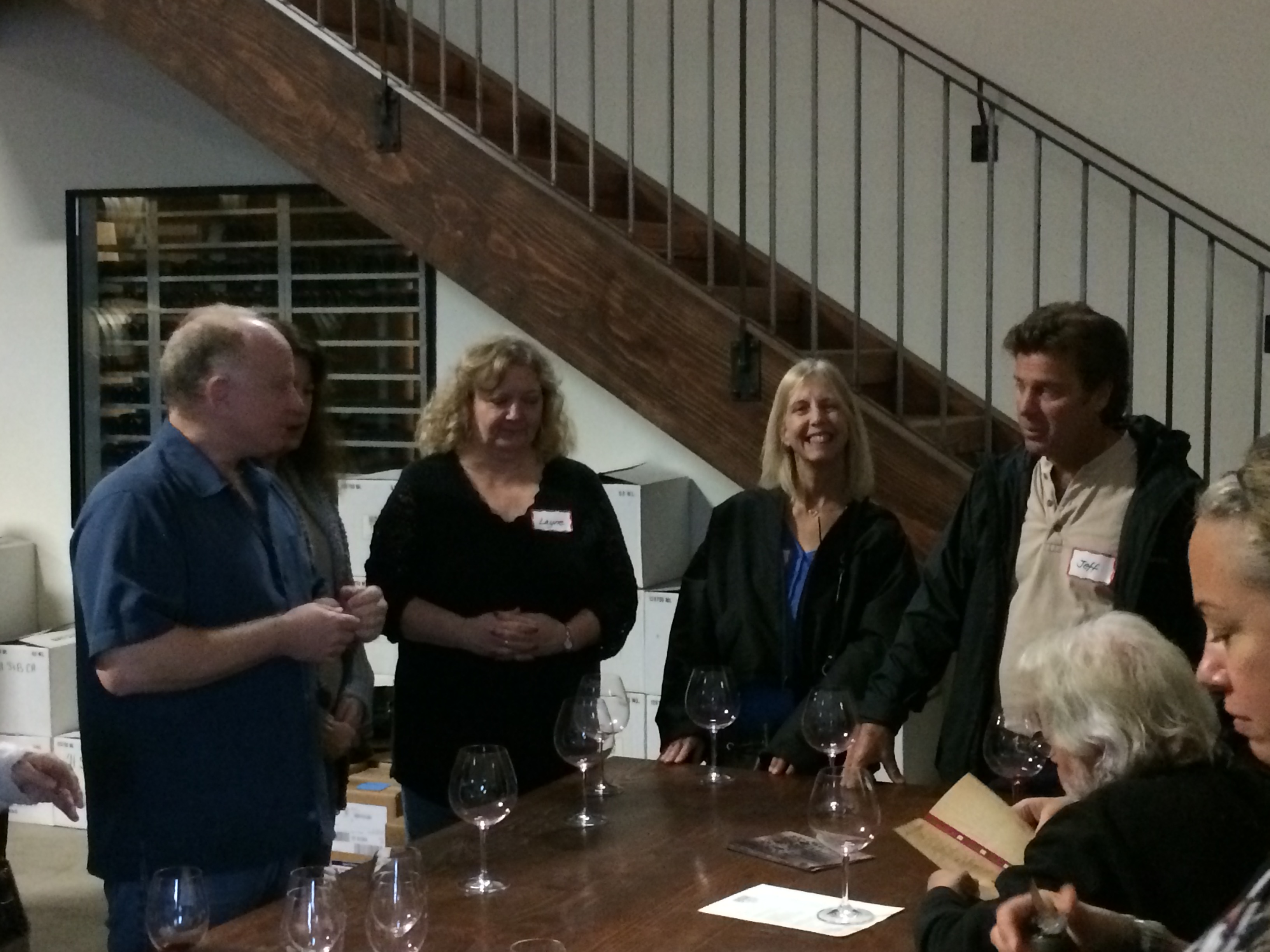
Two more stops on last Saturday’s group wine tour to the Santa Rita Hills AVA (LINK) – Tyler Winery (LINK) and LaFond Winery & Vineyards (LINK – lots of photos).

This was my first visit to Tyler Winery in Lompoc, CA. Located in a stand-alone building, it is not in Lompoc’s famous “Wine Ghetto.” This statement from their website (LINK) speaks volumes about this winery: “We currently produce 12 different bottlings each year from 22 parcels within 7 different vineyard sites. Total production is approximately 2500 cases annually.”

2015-02-07 11.08.18 2015-02-07 11.08.28

Tyler produces only Chardonnays and Pinot Noirs. They source from a number of vineyards in the Santa Rita Hills and Santa Maria Valley AVA’s (LINK). We tasted Chardonnays from the Bien Nacido Vineyard (LINK), a storied vineyard in Santa Maria, and from the Sanford and Benedict Vineyard (LINK) in the Santa Rita Hills. Both were beautifully crafted wines with hits of oak – kind of a middle ground between the oak-bombs of older California and the unoaked newer styles that are becoming so prevalent.

2015-02-07 11.08.41 2015-02-07 11.09.49

We also tasted two Pinot Noirs from the same two vineyards, These wines were a nice balance of fruit, spice, and minerality. The Bien Nacido wine had a bit more body, but the winemaker’s style showed in both wines – restrained and likely to age very well.

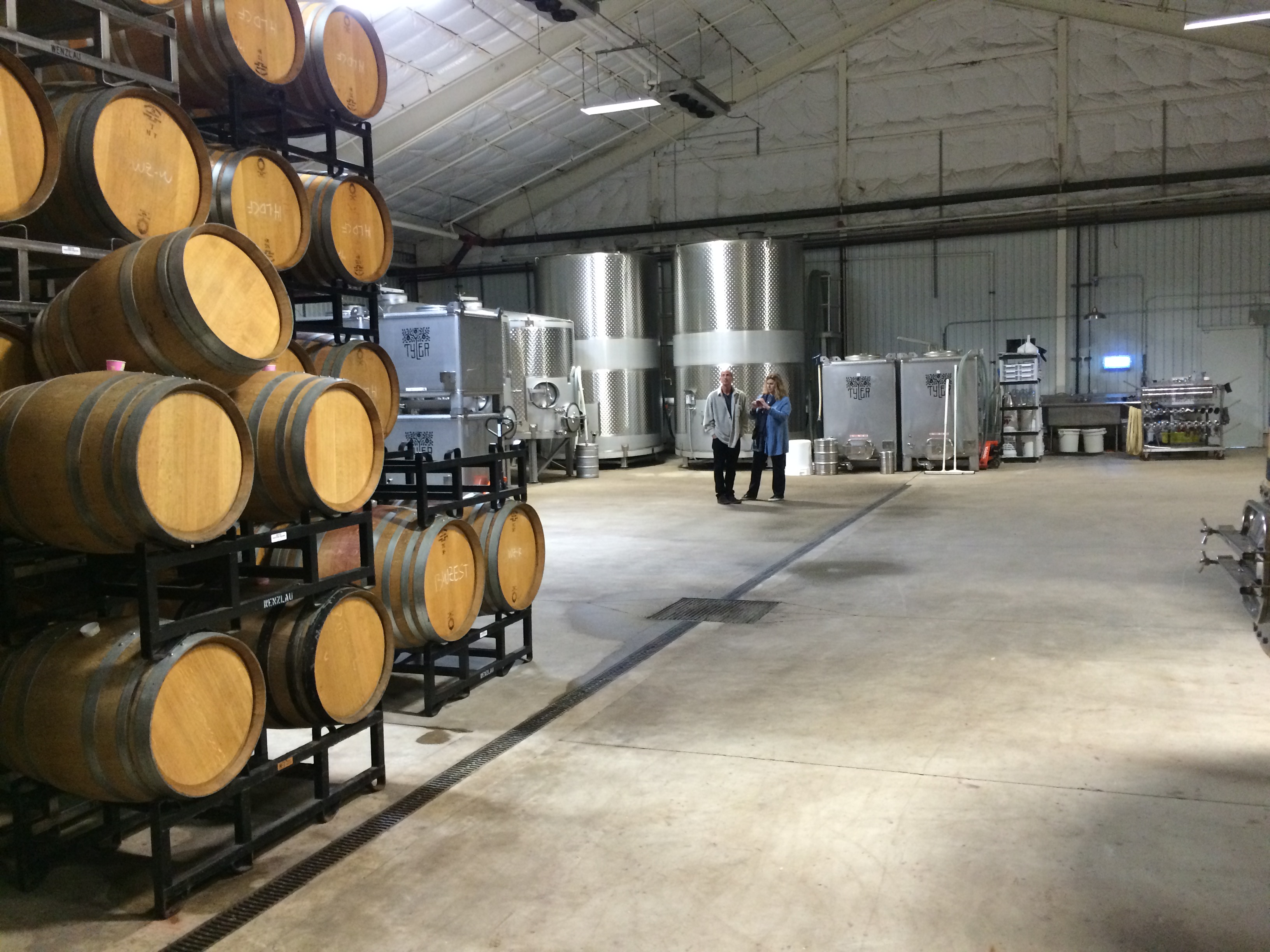
The winery itself is very eye-appealing, a working winery with stacks of barrels adjoining the small tasting area. Tyler is a small producer, and the focus is obviously on the craft of wine making. I was very impressed with these wines.

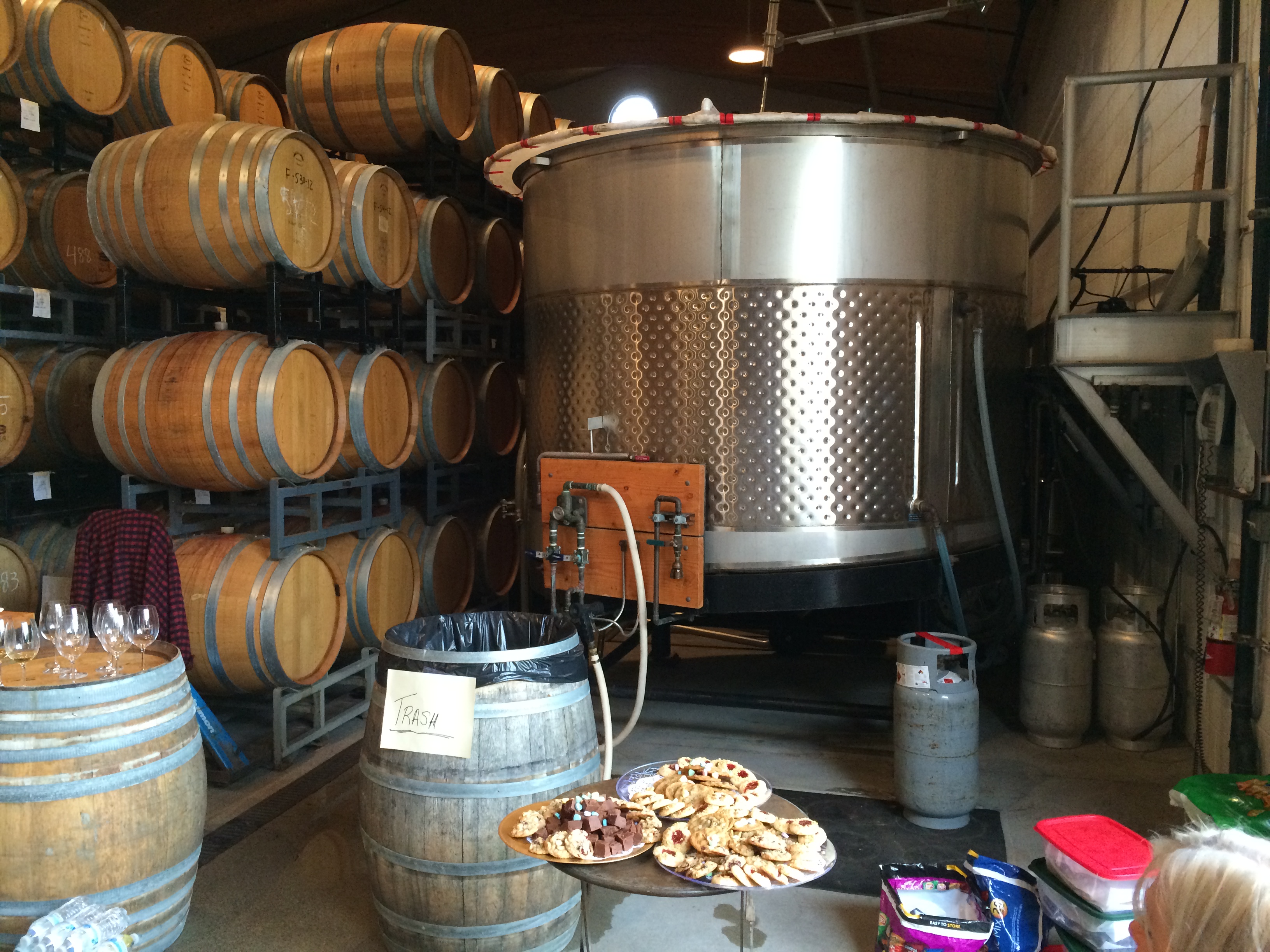
Our next stop was LaFond Winery and Vineyards on Santa Rosa Road in Buellton, CA. The plan was to have lunch in the meadow outside the beautiful tasting room and adjacent winery – but it was raining, so tables were set up in the barrel room. Not bad.

2015-02-07 12.47.01 2015-02-07 12.47.23

Our subset of the larger group purchased a 2010 Lafond Vineyard Pinot Noir Martin Ray Clone ($50.00) and a 2012 SRH Santa Rita Hills Syrah ($27.00) to go with our boxed lunches. Both wines impressed. The Pinot was spice and well-balanced with a smooth finish; the Syrah was also fruity, but balanced with minerality and a heavier mouth feel.

2015-02-07 11.27.00 2015-02-07 12.46.55 2015-02-07 12.47.13

After lunch we tasted a selection of LaFond’s current releases, Riesling, Chardonnay, Syrah, Pinot Noir – I must say that I was impressed. I first visited this winery in 2006, and found the wines generally promising but uneven. This time, everything was beautifully crafted, even elegant.

This is emblematic of the evolution of the Santa Rita Hills as a prime wine region in California. Good news all around for wine lovers!