Some of my favorite wines come from the Piedmont.
Check this out:
Piedmont Region of Italy (link)
As a wine lover, you will want to visit Cellar Masters, a feature of several ships in the Celebrity fleet. This nicely appointed wine bar features comfortable furnishings to sit and sip, a wine bar, and an Enomatic Wine Dispensing System that stores and pours with the use of a card.
We had experienced a Cellar Masters on the Celebrity Equinox a couple of years ago, and were eager to see what the experience on the Solstice would be. Our host is Csbas (Sha-vas) from Hungary, a very formal and knowledgeable young man who has had a passion for wine since he was 14. We stopped in to introduce ourselves and were very impressed with Csbas’ knowledge of wine and wine regions around the world. Celebrity has a very good training program for its international wine staff. The staff ranges from the wine stewards in the dining room, to the Cellar Master host, to the overall Ship’s Wine Master who reports to the Food and Beverage Chief Officer. As with most of the cruise line positions, there is a lot of competition to get promoted, and wine knowledge combined with the provision of excellent service, is the path to the top.
We visited Csbas often during the cruise.

On our first full day at sea, there was an Around the World Wine Tasting event at Cellar Masters. There were six wine stations, three representing the Old World – France, Germany, and Spain; and three featuring the New World – California, Australia/New Zealand, and Argentina. There were a total of 12 wines, six reds and six whites, all of which are available by the bottle on the Solstice. These wines were what I would call, price-accessible to just about everyone, meaning that they were not premium wines. A wine steward staffed each position. There was a table with fruits, cheeses, breads and crackers for palate maintenance. The tasting cost $20 per person, and was attended by about 60 people.

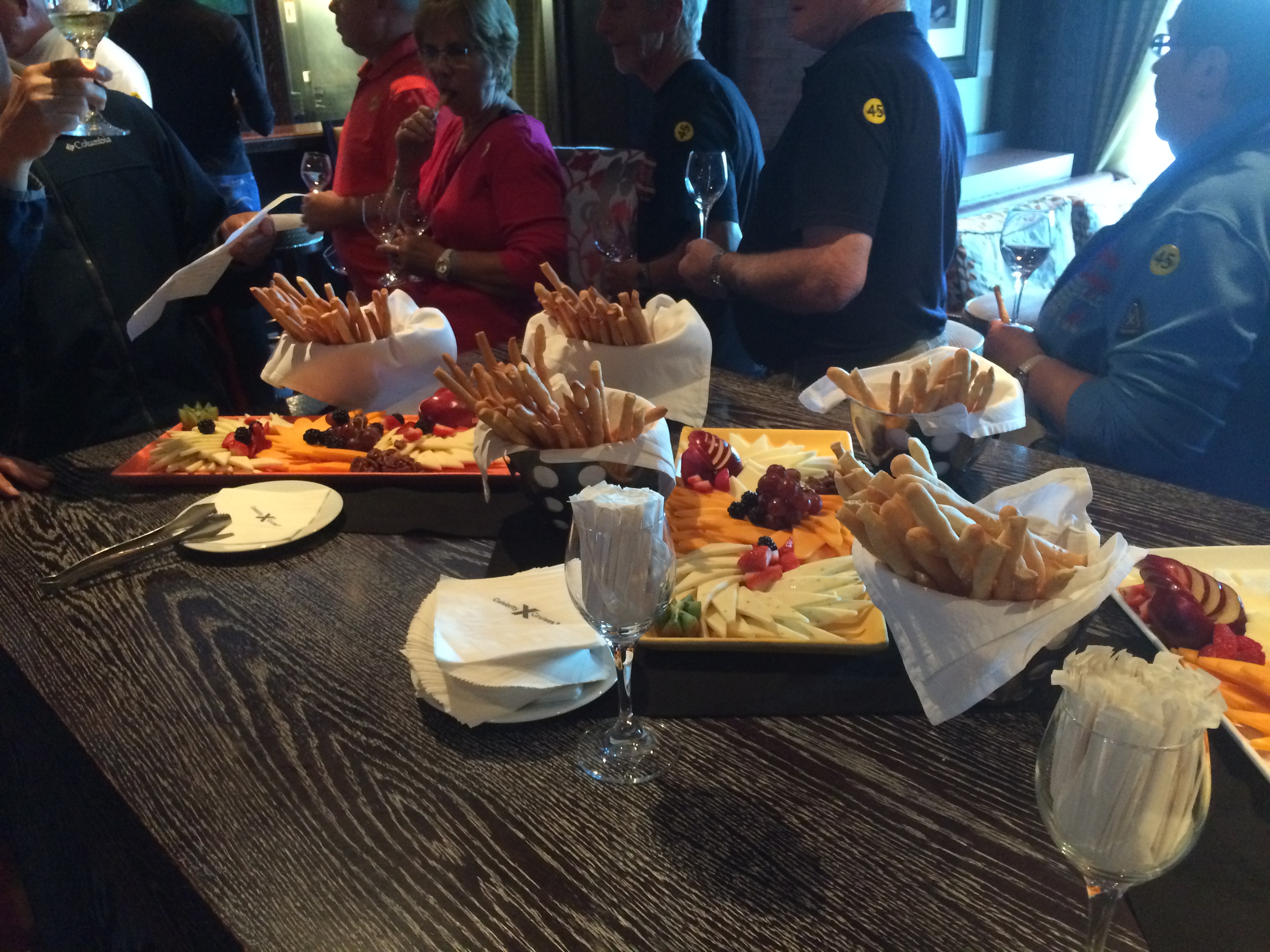
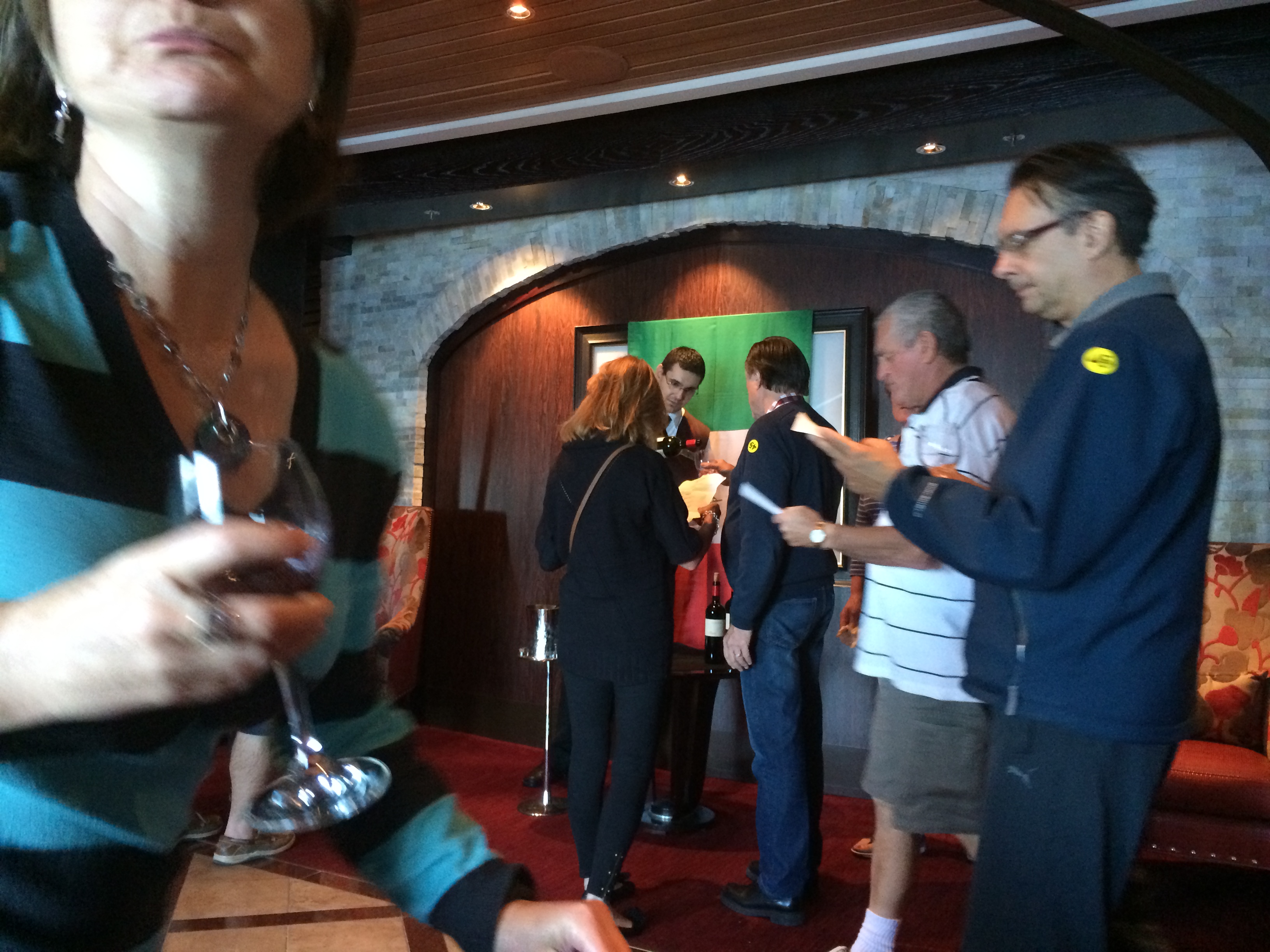
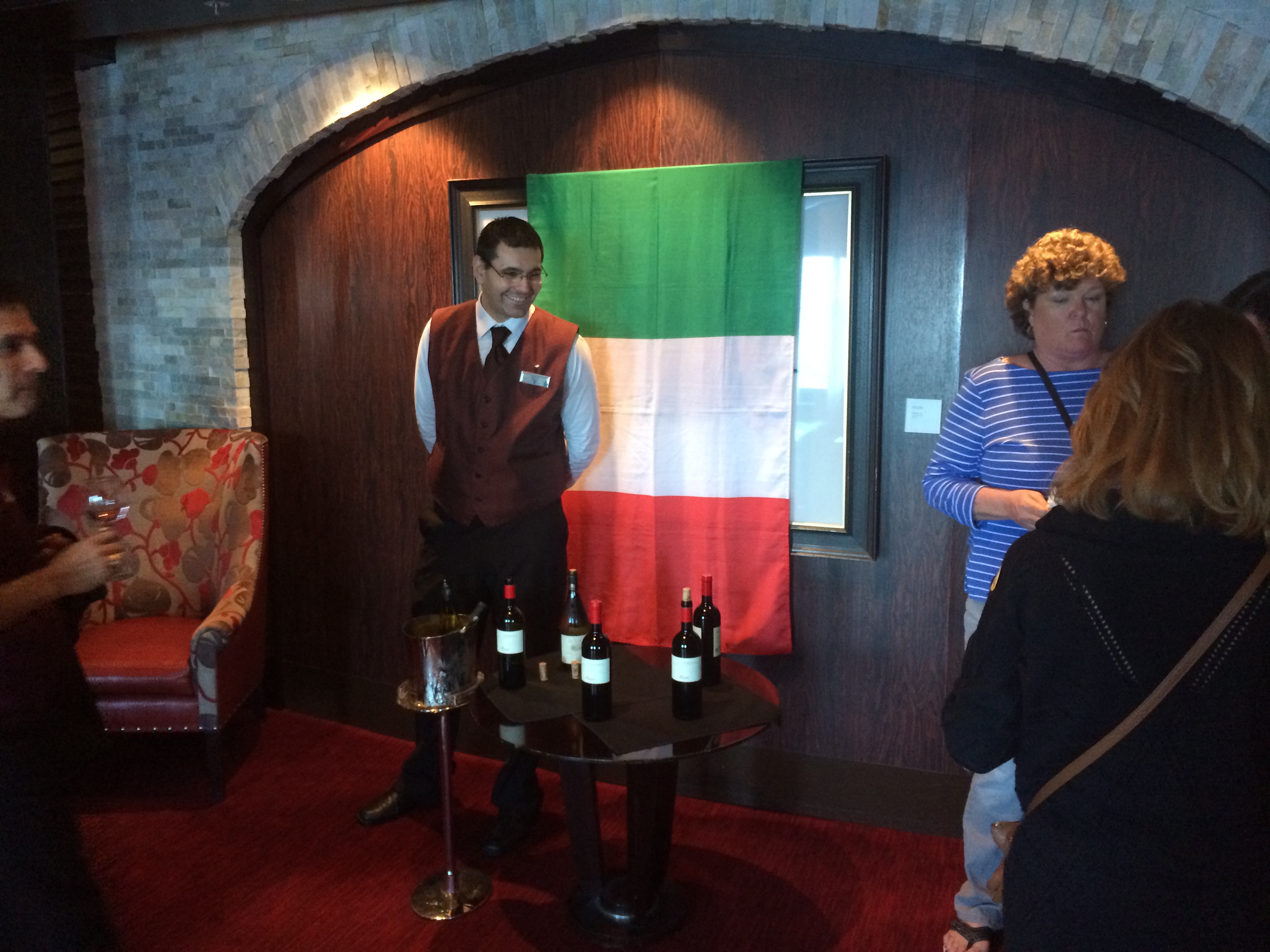
We had a very good time, between tasting wines from labels that, for the most part, we had never had. Speaking with the very knowledgeable wine stewards, and connecting with some of the others at the event.
In the next post, I will describe a higher-end tasting of a flight of four French wines that Dorianne and I enjoyed at Cellar Masters.
This will be the first of several posts about my experiences with wine and other beverages on a cruise to Alaska

We booked an Alaskan Cruise this September. Dorianne and I are leading a group of twenty – something that we do just about every year; sometimes on land, sometimes at sea. Our 11 night cruise on the Celebrity Solstice departed from Seattle and will end in Vancouver, after exploring Alaska and British Columbia ports of call.
We chose Celebrity for a number of reasons. We like their ships (Solstice class especially), and they always do a good job with food and beverages. Celebrity is owned by Royal Caribbean Cruise Lines, and is more upscale than that line.
I will be blogging about the wine experience aboard a ship like this, which is positioned between the basic level lines like Carnival and Royal Caribbean, and the upscale lines like Crystal and Seabourne.
Celebrity has a wine list of over 60 pages to cover its many dining rooms, buffet areas, cocktail lounges and bars. There are a total of 35 to 40 wines served by the glass, the selection varying by location on the ship. Bottled wines are available across a wide spectrum in the main dining room and some of the specialty restaurants; and a more limited selection is available at the other bars throughout the ship. The bars range from upscale lounges with live music to a disco to pool bars to Cellar Masters, which specializes in wine. There are lots of options and very little waiting at any of the bars – the Solstice is brilliantly designed to minimize waits for food and beverages, as well as for just about all activities on board the ship.

The first thing to realize is that your wine experience will depend on some of the decisions that you make before you sail. Celebrity offers beverage packages in two basic categories – general packages that include all kinds of beverages; and specialized packages that give access to a narrow range of beverages. You can also opt for a pay-as-you-go process, paying separately for each drink or bottle that you order. There are plusses and minuses to these options, of course.
We generally opt for the premium general beverage package. This includes all non-alcoholic beverages, including specialty coffee drinks, premium bottled water, etc., and beer, wine and cocktails up to $13 per glass. The premium package costs $56 per day and must be purchased for the entire cruise. The package gives a 20% discount on bottles of wine. There is also a classic package for $10 less per day that limits you to beverages under $9 per glass. The packages do not cover cabin mini-bar or room service beverages.
There is also a wine-only package that gives you a certain number of bottles in one of three price categories for a discount of about 10% off of the regular bottle price. Celebrity’s markups are like restaurant markups – 2 to 2 ½ times the retail price of the wine.
With the premium package, you are better off ordering wines by the glass up to the price point of $13 per glass, which covers about 90% of the wines by the glass menu on the ship. There are a few places, such as the specialty restaurants, where you pay a premium to dine, and Cellar Masters, a wine bar, that have a higher number of upscale wines by the glass on their wine lists. BUT, when you order a wine at, say, $18 per glass and you have the premium package, you pay the full $18 for that glass – you get no credit for the first $13, according to Celebrity policy. However, we did speak to a person who said that she had ordered more expensive glasses on this cruise and was only charged for the difference. I will blog separately about the specialty restaurants and Cellar Masters – some very nice wine experiences are to be had there.
If you are a wine by the bottle person, you will likely do better with a specialty wine package and perhaps a general package that does not include alcoholic beverages, or a classic general package to allow you to get beer and some cocktails. There are well over a dozen bars on this ship, some with amazing cocktail preparations that may draw you away from a wine-only policy. Plus, you are on vacation – so have fun!
We are in Seattle, getting ready to lead a group on an Alaska and British Columbia cruise on the Celebrity Solstice, where I will be blogging about the wine experience aboard ship. Today, we visited Pike Place Market, the legendary Seattle landmark. If you go through the amazing Delaurenti gourmet market, just past the newsstand, you will find a staircase to a wonderful little wine shop.


The selection is relatively small, with the exception of wines of the Northwest, as you might expect. But even the selection of European wines is just large enough and well-chosen enough to give you a sense of real choices. There are great wines in most categories and they have been pre-selected by the owners. There really aren’t any wines here that you would not want to drink. There is also a large selection of great wines in half-bottles to use for a picnic with some of the delicacies downstairs in the gourmet market. And lots of bubbly choices, too.

If you are in Seattle, this is a real gem, along with Pike & Western Wines, at the north end of the market complex, another regional gem.
Another article based on research showing the overall benefits of drinking wine.
Here is a salient quote: “The weight of the evidence shows moderate drinking is better than abstaining and heavy drinking is worse than abstaining – however the moderate amounts can be higher than the guidelines say,” Dr Poikolainen reportedly told The Mail.
What are your thoughts on this?

Tonight for dinner, we had a 2008 Sangiovese from the Conejo Valley Wine Co-op. This wine was made before Dorianne and I joined. We were gifted two bottles by our winemaker, Richard Clark, after a former member turned some wine back to the co-op.
From Wikipedia: Sangiovese (san-jo-veh-zeh[1] [sandʒoˈveːze]) is a red Italian wine grape variety that derives its name from the Latin sanguis Jovis, “the blood of Jove“.[2] Though it is the grape of most of central Italy from Romagna down to Lazio, Campania and Sicily, outside Italy it is most famous as the only component of Brunello di Montalcino andRosso di Montalcino and the main component of the blend Chianti, Carmignano, Vino Nobile di Montepulciano andMorellino di Scansano, although it can also be used to make varietal wines such as Sangiovese di Romagna and the modern “Super Tuscan” wines like Tignanello.[3]
Sangiovese was already well known by the 16th century. Recent DNA profiling by José Vouillamoz of the Istituto Agrario di San Michele all’Adige suggests that Sangiovese’s ancestors are Ciliegiolo and Calabrese Montenuovo. The former is well known as an ancient variety in Tuscany, the latter is an almost-extinct relic from the Calabria, the toe of Italy.[4] At least fourteen Sangiovese clones exist, of which Brunello is one of the best regarded. An attempt to classify the clones into Sangiovese grosso (including Brunello) and Sangiovese piccolo families has gained little evidential support.[5]
The wine was simply amazing – elegant, with a nose of fruit and spice, smooth in the mouth and clearly a wonderful wine. Kudos to Dennis Weiher, our former winemaker for this one!
For more info on our wine co-op, go to this link.
My friend, Ellen Daly, has started Wine Loves Company, a wine blog – check it out
Last night, Dorianne and I got together with Richard Clark and Mary Stec to participate in the New York Times Wine School. The Wine School is a monthly look at different varietals written by Eric Asimov, the Times wine writer. The purpose is to take a deeper look at various varietals and to actually drink the wine, rather than just taste it. Richard, as I have mentioned in other posts, is the winemaker for the Conejo Valley Wine Co-op that Dorianne and I belong to.

We have done the previous Wine School varietals, usually two at a time, with Richard and Mary. We decided to do the Zinfandel, from July, on its own. Appetizers were gathered (baguette, prosciutto, goat and cheddar cheeses, smoked fish, and marinated peppers), and the main course – an AMAZING chicken mole with black beans and rice, was prepared by Mary (she and Richard used to import mole from Oaxaca in Mexico, so she knows her stuff).
Anyway, this is really about the wine. The Wine School always recommends three choices for the varietal of the month – wines that are likely easier to find in New York than in California in most instances. For the Zinfandel Wine School, Asimov recommended three wines: a Dashe Dry Creek Valley Zinfandel 2012 $21, Turley California Zinfandel Juvenile 2012 $30 and Ridge Dry Creek Valley Lytton Springs 2011 $35. Well, we didn’t have any of those, so we used two wines and had a back-up standing by.

Our wines were a 2009 Grgich Hills $34, a 2009 Caymus $45, and a 2011 Moss-Roxx Ancient Vines $20, the latter remaining unopened.
Zinfandel has been in California since the early 1800’s and originally came from Croatia, where it is called tribidrag. I understand that it is also the same grape as primitivo in Italy, although there is some controversy about that.
Zinfandel, like all varietals, can show up in a variety of ways, influenced by everything that wine is influenced by – climate, weather, soils, sun and temperature, viticulture, wine making practices, ageing, etc. However, in general, the wine falls somewhere between Cabernet Sauvignon and Pinot Noir on the heavy to light red wine continuum. I find that Zin and Syrah can be very similar in tone and texture. It is normally great with meats and grilled foods. There are also some very interesting non-traditional Zinfandel blends showing up in places like Paso Robles.
The Grgich Hills and the Caymus were very different wines. The alcohol content was equivalent – 15.3% and 15.2% respectively, but the style was very different. The Grgich Hills was soft and elegant and the Caymus was big, bold, and heavy – definitely a Robert Parker kind of wine.
Fortunately, we opened the Grgich Hills first to have with the appetizers. It was a perfect complement to the prosciutto and cheeses and the other items. Elegantly balanced, the wine had spice notes, pepper, and fruit present. Delicious.
The Caymus was something else. Heavier, almost syrupy on the tongue, it was a fruit bomb. Fortunately, that was what the chicken mole required – something to stand up to the richness of the sauce and the greasy chicken. Richard preferred the Caymus to the Grgich Hills, I took the opposite position – although both are very good wines.

The alcohol level of these wines made opening the Moss-Roxx unadvisable. It is resting back on the shelf as I write, waiting for another day.
Zinfandel has its lovers and its detractors. I am generally a fan, although I don’t actually drink that much of it. Our co-op made a pretty good Zin in 2010 and our just-bottled 2012 vintage includes a Zin-Merlot blend that should be interesting.
Let me know what your favorite Zinfandels are and what your best food pairing experiences have been in the comments section.
As noted in my Philosophy of Wine entry, I drink wine almost every day with dinner. Dorianne and I drink 3 or 4 reds to every white or rosé, except in summer, when that ratio tends to be reversed.
I put reds into three basic categories – everyday, special dinner, and very special occasion. Everyday wines would run about $20 and under, special dinner from $20 to $50, and very special occasion from $50 and up. A bottle with a great story or one that is hard to obtain may put it up a category or two even though the price point is lower.
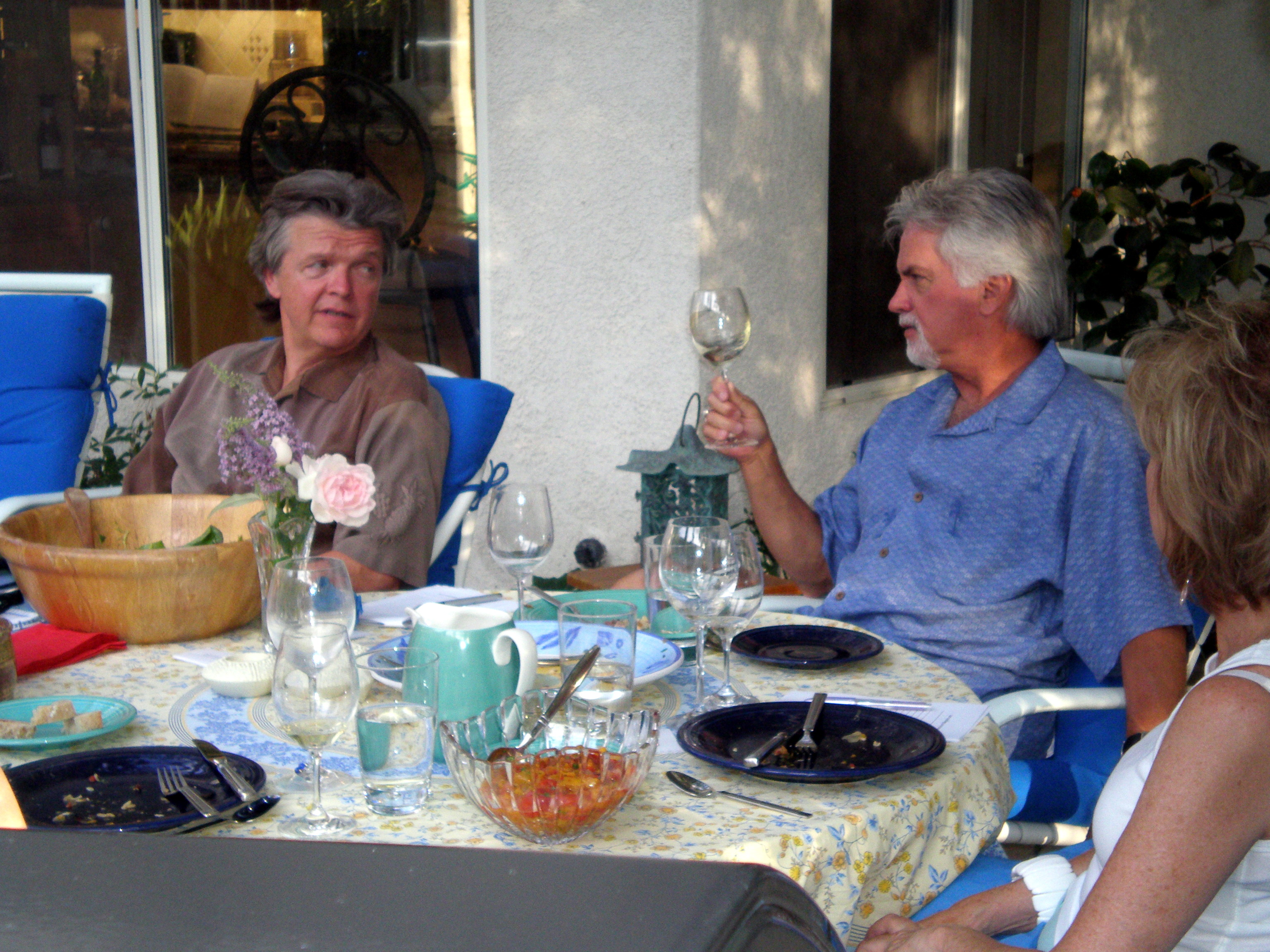
Everyday wines are the mainstay of our consumption. These are generally wines that we buy from local retailers or online at sites like WTSO.com. Occasionally, they come from a winery. We also have our wine co-op wines that fall into the everyday category. We get about 8 cases from our co-op share each year, 6 of red and 2 of white. I will not include the co-op wines in these reviews, because you cannot obtain them. We had a 2010 Petit Syrah/Cabernet Sauvignon on Monday night from the co-op.
So how do you choose your favorite everyday wines? I would begin with trial and error then move out from there based on a certain level of awareness that develops as to what to look for – certain varietals, wine makers, and price points. The trial and error comes first – you sample some wines. This can happen by purchasing at a retailer, or you can be a bit more creative.
When you are invited to a party, if they have lower priced wines, try some. See if you find any that you like and note the brand and varietal. In a restaurant, especially some chain restaurants, they will have inexpensive wines (at a markup no doubt) that you can try. Many wines under $15 is that they will stay very constant from year to year, so you are less likely to be surprised by a new vintage.
I like a variety of wines, so when I look for everyday wines, I am looking at a broad spectrum of wines, both domestic and international. You may be a Merlot or a Cabernet Sauvignon drinker, which narrows the field quite a bit. I like some variety and some signs of craftsmanship, even in my everyday wines. If you look around, you can find wines under $15, and definitely under $20 that have this quality. Here, you will find some variation from vintage to vintage, but that adds to the variety!
So let me start with two red wines that have, for me, been very reliable over time. They are under $15, both are imported, and each has a bit more to offer than the standard-brand or bulk wine product. The vintage will be whatever is currently available – it is unlikely that wine merchants are holding these for aging.
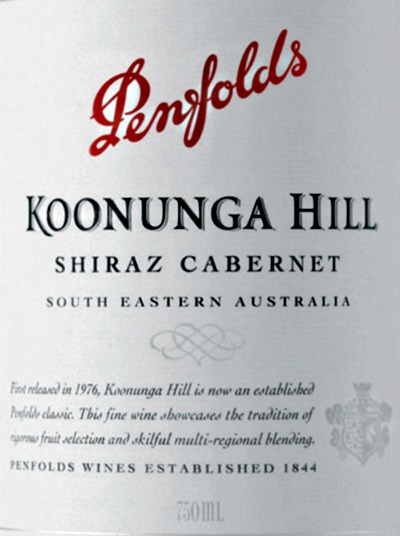
Penfolds Koonunga Hill Shiraz/Cabernet: I began drinking this wine in 2003. Penfolds is the flagship wine brand of Australia, makers of the legendary Penfolds Grange (which is near the very top of my bucket list) Shiraz wine. The Koonunga Hill label is second from the bottom in the Penfolds hierarchy – above the very pedestrian Rawson’s Retreat label. I have tried the Koonunga Hill Shiraz and the Cabernet as separate varietals, and find that the blending of these two grapes creates the most satisfying experience. The 2011 vintage is the most likely on to be on your retailer’s shelf. It is a 62% Shiraz 38% Cabernet blend (this will vary from year to year) and is 13.5% alcohol, which I prefer to the heavier levels of alcohol in may California everyday wines, which are usually just hot and not very well balanced. The Koonunga Hill Shiraz Cabernet is great with red meat and will hold up to BBQ sauces and spiced foods as well. The wine will age for 8 to 10 years, but this wine is not made to age, so drink it right from the shelf.
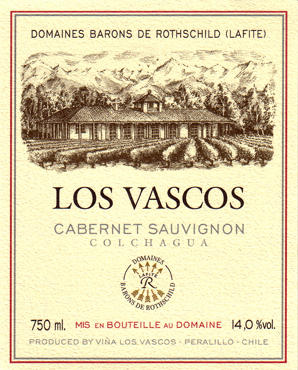
Los Vascos Cabernet Sauvignon: I came across Los Vascos when I was living in South Florida and it came with a great story. A friend was the supervising flight attendant on a private Boeing 727 belonging to the CEO of a South American subsidy of a large US corporation. The CEO was really into wine – he would send my friend on the plane to Paris to load on first growth Bordeaux’s and Burgundies – you get the idea. At the time, the Los Vascos (from Chile) was retailing for about $7. My friend gave her boss a glass on a flight and he really liked it (probably a good thing for her career). He then began to serve it on his plane to his high-roller friends and did not tell them what it was. Pretty much everyone took it for a premium wine.
So what is this wine? Well, it is a large production wine from the Chateau Lafite Rothchild vineyards in Chile. There are a couple of reserve versions of the wine that come in at higher prices – from about $20 up to $65. Today, the basic Los Vascos Cabernet retails for $14 but can usually be had for $10 to $12 or less from a variety of retailers. The website recommends decanting for about an hour before drinking this wine, although I have never done this. You will find notes of ripe fruit, good structure, and hints of a variety of mineral notes – which most of us experience differently. This is a great wine with roasted and grilled meats.
All three of these wines are what I like in an everyday wine. A few others that I imbibe fairly regularly are Bogle Old Vine Zinfandel ($9 to $12); Norton Reserve Malbec, Mendoza, Argentina ($14 to $20); Luigi Pira Dolcetto d’Alba, Piedmont, Italy ($12 to $18); plus many more. You have probably noted that most of the wines listed here are imported. For some reason, producers around the globe seem to be able to get well-crafted wines made and shipped to the US at everyday wine prices. It’s a paradox.
There are lots of decent wines in this price range – ask your wine retailer to guide you to those undiscovered gems in the shop – everyplace has some of these wines. As always, once you find what you like, begin to branch out and explore wines like those.
Clos Pepe, owned by Steven and Kathy Pepe (the Spanish pronunciation, not the French), is a unique winery and vineyard for several reasons. Their wines, primarily Chardonnay and Pinot Noir grown and crafted in the Burgundian tradition, are one. The miniature heritage sheep who keep the undergrowth beneath the vines trimmed and the dogs that herd them are another. Their secondary labels, Axis Mundi, featuring wines crafted from fruit from other Central Coast vineyards are another.
But the main reason that Clos Pepe Estate is such a unique operation is the winemaker, Wes Hagen. Wes is unique among winemakers in a variety of ways – one of which being that he is as much, or more, of a philosopher than anything else. Oh, he crafts amazing wines – some of my absolute favorites – but it is the depth of knowledge about all things wine and wine-related (plus a lot of other stuff) that make being around him so entertaining and enriching.

Visitors to the Estate (by appointment only) are greeted in the vineyard by Wes. Everyone gathers around a vine and he begins his very thorough presentation that includes the geological history of the Santa Rita Hills (a part of California that is separated from the North American tectonic plate and has been rotating at about ¼ inch a year for the past 12 million or so years, so that the valleys here run east and west rather than north and south. This makes for excellent conditions for cool-weather loving grapes like Pinot Noir and Chardonnay); the 6500 year history of wine and viniculture that began with a single vine in Kazakhstan – the ancestor of every wine grape vine on the planet today; the history and philosophy of Clos Pepe in growing their fruit and making their wine; a bit about the sheep and the dogs; Q&A time; THEN up to the owner’s home to taste (and purchase) some wine.
As the videos on the Clos Pepe website show, Wes can tell a story, explain a concept, delve into science, and bring up Joseph Campbell without skipping a beat. He truly loves his work, and he continually studies in a variety of areas to keep his incredible mind occupied and productive.
Clos Pepe wines are beautifully crafted from vines on the 28 acre estate. A number of top California wineries also source fruit from Clos Pepe vineyards. Wes, ever the experimenter, yet aware of tradition, crafts Pinot Noirs in both the lighter, more elegant French tradition, as well as the bigger, bolder California style. They emerge beautifully and age very well.

The Chardonnays are also crafted in the French style primarily, with a nod to what California consumers are looking for as well. Wes is given to grand descriptions of his wines (that prove to be very accurate). Here, is a description of the Chardonnays from the website:
The Chardonnays are naturally lean, mineral-laden and racy, but with more winemaking influence can exhibit richness and roundness: new oak, malolactic treatment, extended barrel aging. When young, the wines have austere structure and bright apple fruit with hints of tropical fruit and peach. Clos Pepe Chardonnay is crafted for both early enjoyment as well as cellaring for a decade or more. As the wines age they gain a hazelnut and mineral complexity, quite similar to Premier Cru Chablis and White Burgundy from great vintages. Try young Clos Pepe Chardonnays with oysters, fried chicken or barbecue. Older vintages can be enjoyed with sand dabs in a lemon cream sauce, firm cheeses, cream-based soups, or any kind of delicate seafood preparation. Clos Pepe Chardonnay seems to like 3-5 years from vintage date to fully integrate, and can last up to 10-12 years for those that appreciate full maturity and a bit of oxidative aromas and flavor.
Dorianne and I have Pinot Noirs from Clos Pepe in our cellar going back to 2007, and Chardonnays from 2010 on (hard to keep the Chardonnays on the shelf). We pull them out mostly for special dinners or to share with good friends. With every bottle, I think of Wes Hagen, the depth of knowledge that he carries into his winemaking, and those sheep. Beautiful wines and beautiful memories.
 Jim Lockard On Wine