In an article called Wine Tasting is Junk Science, David Derbyshire goes over the science of wine tasting. The results are not very good for those who rate wines. Follow the link above for the full and very informative article.

In an article called Wine Tasting is Junk Science, David Derbyshire goes over the science of wine tasting. The results are not very good for those who rate wines. Follow the link above for the full and very informative article.
As a wine lover, you will want to visit Cellar Masters, a feature of several ships in the Celebrity fleet. This nicely appointed wine bar features comfortable furnishings to sit and sip, a wine bar, and an Enomatic Wine Dispensing System that stores and pours with the use of a card.
We had experienced a Cellar Masters on the Celebrity Equinox a couple of years ago, and were eager to see what the experience on the Solstice would be. Our host is Csbas (Sha-vas) from Hungary, a very formal and knowledgeable young man who has had a passion for wine since he was 14. We stopped in to introduce ourselves and were very impressed with Csbas’ knowledge of wine and wine regions around the world. Celebrity has a very good training program for its international wine staff. The staff ranges from the wine stewards in the dining room, to the Cellar Master host, to the overall Ship’s Wine Master who reports to the Food and Beverage Chief Officer. As with most of the cruise line positions, there is a lot of competition to get promoted, and wine knowledge combined with the provision of excellent service, is the path to the top.
We visited Csbas often during the cruise.

On our first full day at sea, there was an Around the World Wine Tasting event at Cellar Masters. There were six wine stations, three representing the Old World – France, Germany, and Spain; and three featuring the New World – California, Australia/New Zealand, and Argentina. There were a total of 12 wines, six reds and six whites, all of which are available by the bottle on the Solstice. These wines were what I would call, price-accessible to just about everyone, meaning that they were not premium wines. A wine steward staffed each position. There was a table with fruits, cheeses, breads and crackers for palate maintenance. The tasting cost $20 per person, and was attended by about 60 people.

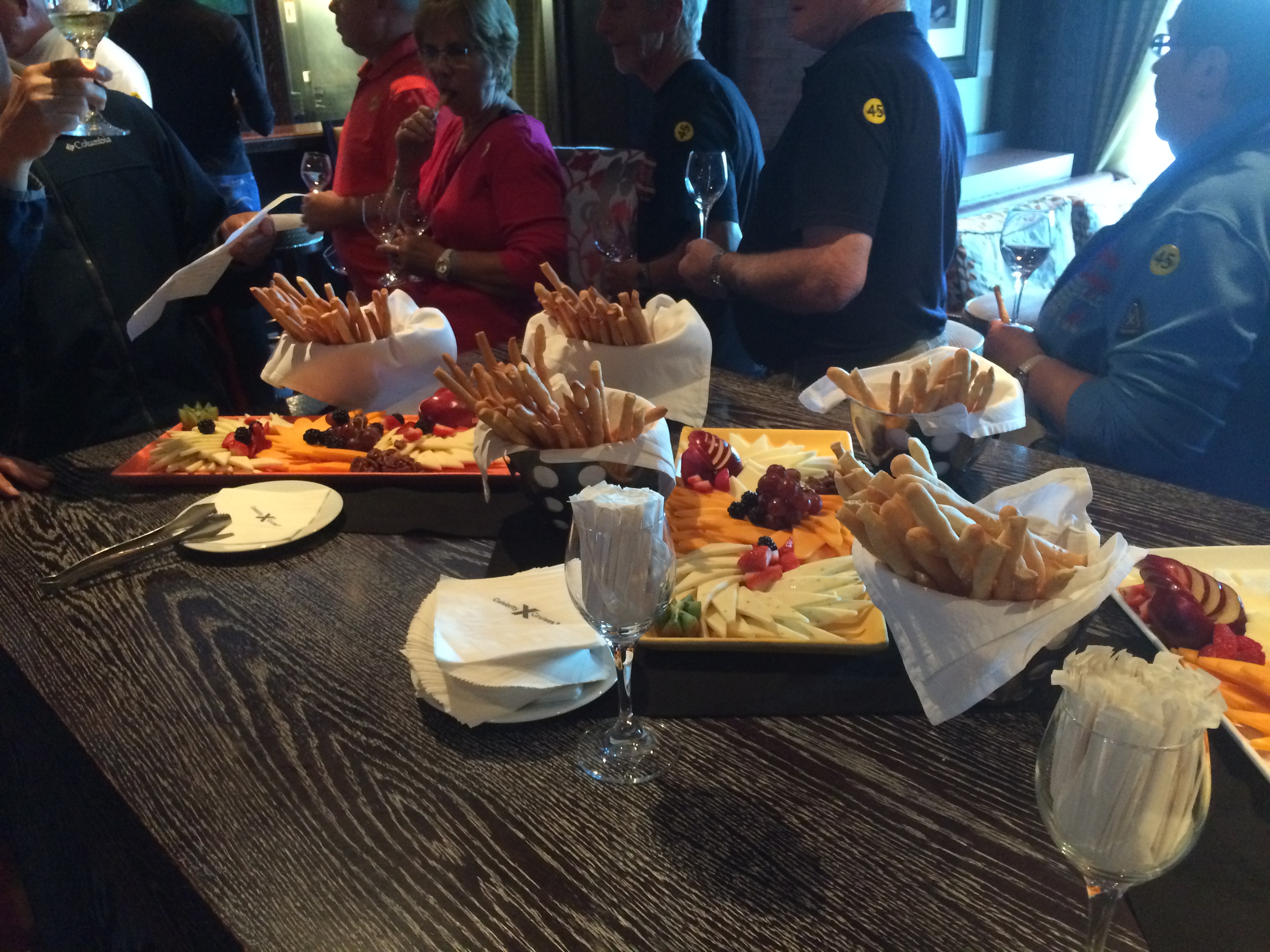
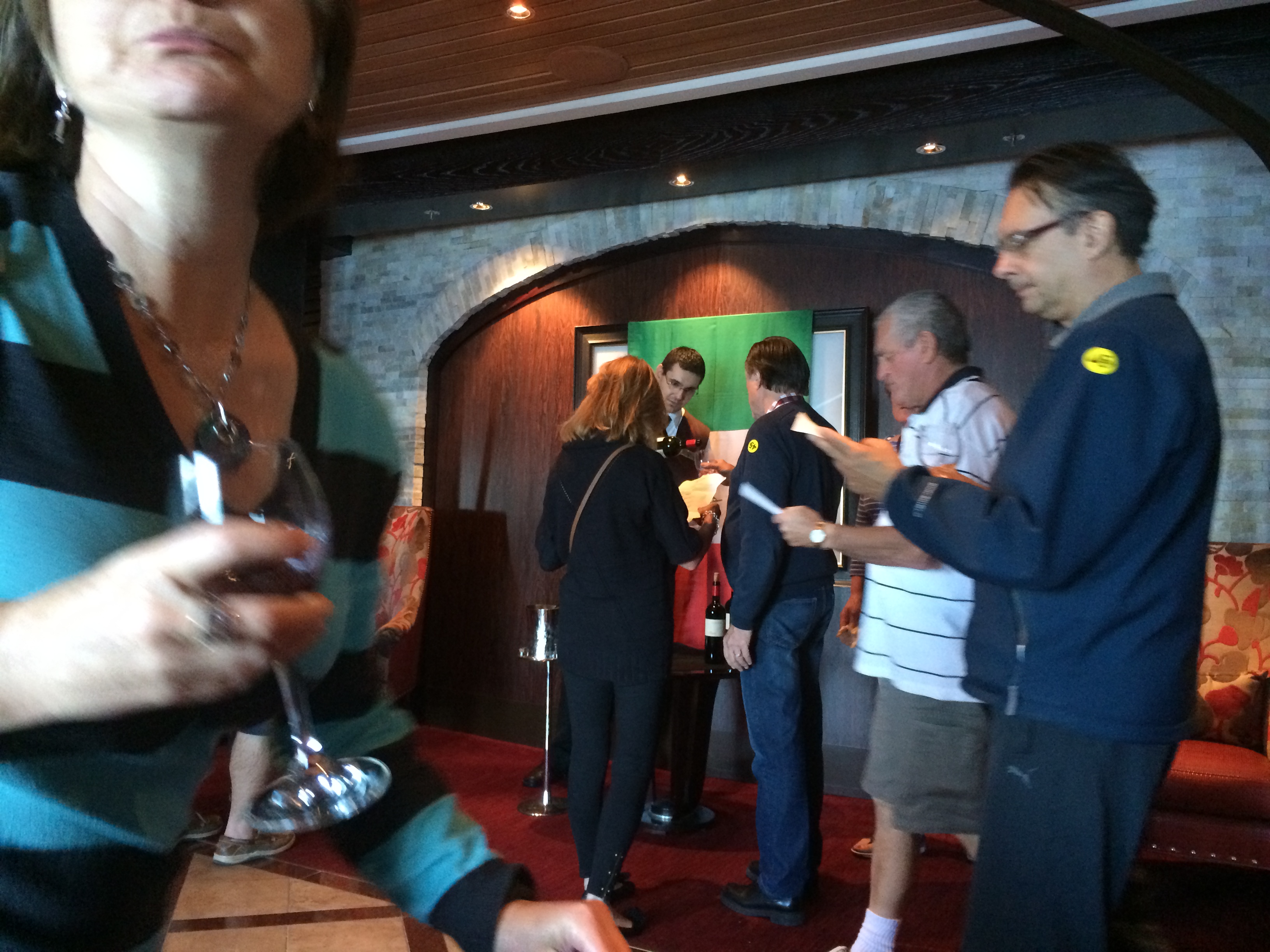
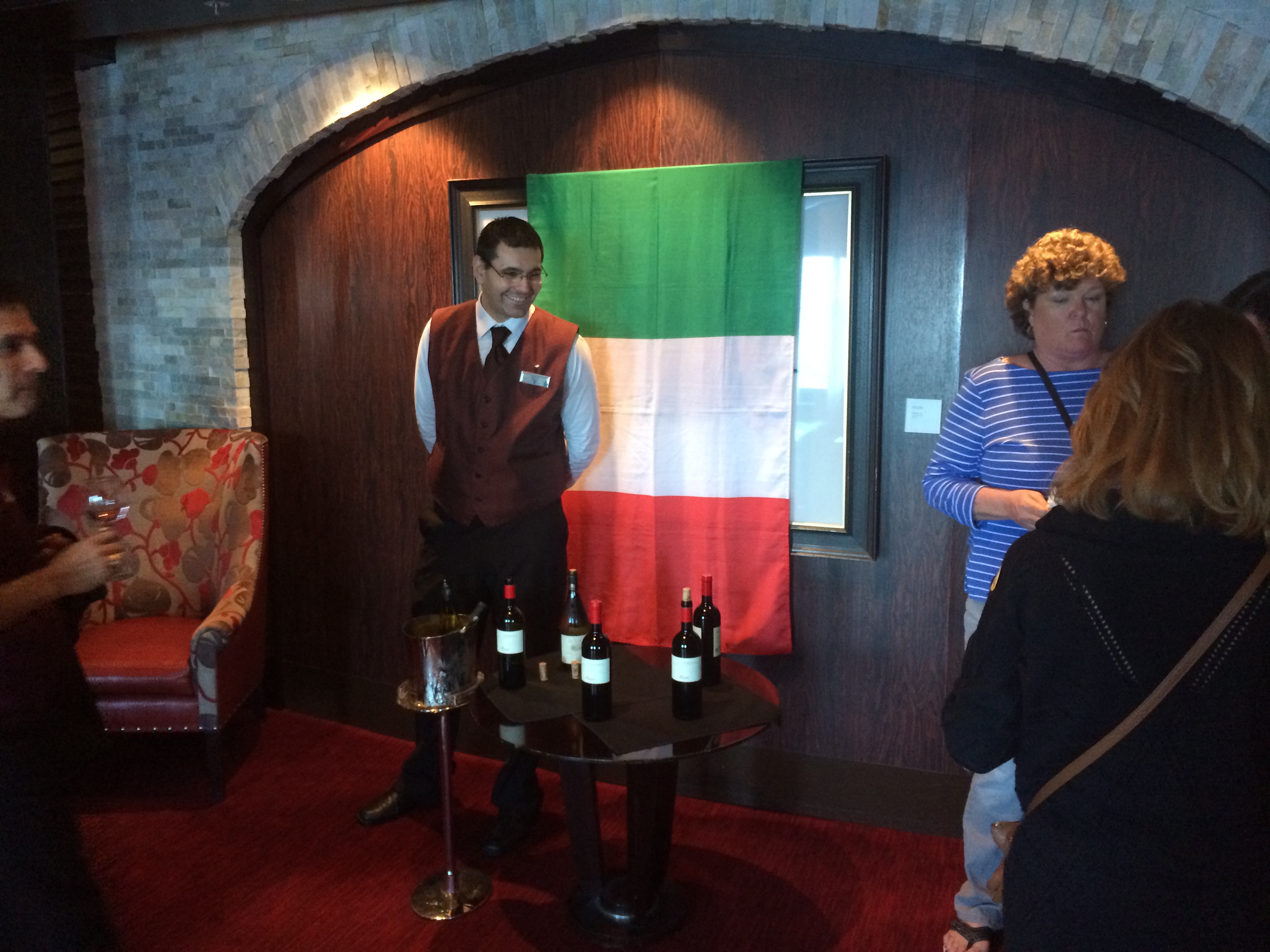
We had a very good time, between tasting wines from labels that, for the most part, we had never had. Speaking with the very knowledgeable wine stewards, and connecting with some of the others at the event.
In the next post, I will describe a higher-end tasting of a flight of four French wines that Dorianne and I enjoyed at Cellar Masters.
Last night, Dorianne and I got together with Richard Clark and Mary Stec to participate in the New York Times Wine School. The Wine School is a monthly look at different varietals written by Eric Asimov, the Times wine writer. The purpose is to take a deeper look at various varietals and to actually drink the wine, rather than just taste it. Richard, as I have mentioned in other posts, is the winemaker for the Conejo Valley Wine Co-op that Dorianne and I belong to.

We have done the previous Wine School varietals, usually two at a time, with Richard and Mary. We decided to do the Zinfandel, from July, on its own. Appetizers were gathered (baguette, prosciutto, goat and cheddar cheeses, smoked fish, and marinated peppers), and the main course – an AMAZING chicken mole with black beans and rice, was prepared by Mary (she and Richard used to import mole from Oaxaca in Mexico, so she knows her stuff).
Anyway, this is really about the wine. The Wine School always recommends three choices for the varietal of the month – wines that are likely easier to find in New York than in California in most instances. For the Zinfandel Wine School, Asimov recommended three wines: a Dashe Dry Creek Valley Zinfandel 2012 $21, Turley California Zinfandel Juvenile 2012 $30 and Ridge Dry Creek Valley Lytton Springs 2011 $35. Well, we didn’t have any of those, so we used two wines and had a back-up standing by.

Our wines were a 2009 Grgich Hills $34, a 2009 Caymus $45, and a 2011 Moss-Roxx Ancient Vines $20, the latter remaining unopened.
Zinfandel has been in California since the early 1800’s and originally came from Croatia, where it is called tribidrag. I understand that it is also the same grape as primitivo in Italy, although there is some controversy about that.
Zinfandel, like all varietals, can show up in a variety of ways, influenced by everything that wine is influenced by – climate, weather, soils, sun and temperature, viticulture, wine making practices, ageing, etc. However, in general, the wine falls somewhere between Cabernet Sauvignon and Pinot Noir on the heavy to light red wine continuum. I find that Zin and Syrah can be very similar in tone and texture. It is normally great with meats and grilled foods. There are also some very interesting non-traditional Zinfandel blends showing up in places like Paso Robles.
The Grgich Hills and the Caymus were very different wines. The alcohol content was equivalent – 15.3% and 15.2% respectively, but the style was very different. The Grgich Hills was soft and elegant and the Caymus was big, bold, and heavy – definitely a Robert Parker kind of wine.
Fortunately, we opened the Grgich Hills first to have with the appetizers. It was a perfect complement to the prosciutto and cheeses and the other items. Elegantly balanced, the wine had spice notes, pepper, and fruit present. Delicious.
The Caymus was something else. Heavier, almost syrupy on the tongue, it was a fruit bomb. Fortunately, that was what the chicken mole required – something to stand up to the richness of the sauce and the greasy chicken. Richard preferred the Caymus to the Grgich Hills, I took the opposite position – although both are very good wines.

The alcohol level of these wines made opening the Moss-Roxx unadvisable. It is resting back on the shelf as I write, waiting for another day.
Zinfandel has its lovers and its detractors. I am generally a fan, although I don’t actually drink that much of it. Our co-op made a pretty good Zin in 2010 and our just-bottled 2012 vintage includes a Zin-Merlot blend that should be interesting.
Let me know what your favorite Zinfandels are and what your best food pairing experiences have been in the comments section.
Last night we were scheduled to meet friends for a tasting at a new tasting room in Thousand Oaks, CA, the next town over from us. They said meet at Alma Sol, but I made it Aldabella – another brand new tasting room just opened in the area. Thus began the comedy of errors.
Dorianne was judging cakes and a life cooking contest at the Ventura County Fair and was going to be a bit late getting home to make our 5:00 pm appointment. I texted our friends and let them know. They texted back that the wife in that couple was stuck in traffic and would be a bit late, too.

Dorianne arrived and we shifted cars and headed for Altabella, located on Via Colinos opposite the Four Seasons Hotel in Westlake Village. Altabella Winery Tasting Room has a beautiful tasting room adjacent to a medium-sized warehouse winery. We settled in on a plush sofa and waited for our friends. We received a text that our friends’ GPS was acting up and they would be a bit later. So we sat. One of the owners noticed that we were just sitting their and ordered us glasses of their Syrah. The wine was nicely-crafted, acidic, and smoky. I liked it more than Dorianne did.
Then, a phone call. “Hi, we are here, where are you?” the voice at the other end of the phone asked. “We are right here – Altabella Wine Tasting Room.” “No, came the response, Alma Sol.” So, we said our goodbyes and headed over to Alma Sol Winery Tasting Room, arriving about ten minutes later. There are two winery-operated tasting rooms in the area and we each went to a different one. End of comedy of errors.
We were greeted at Alma Sol by our friends, of course, and by John and Lisa Shaw, the owner-operators of Alma Sol. And then it all came back.
We had met John and Lisa at the 2013 Garagiste Festival in Paso Robles, a gathering of small producers. We recalled speaking to them, enjoying their wines, and, yes, hearing that they were going to open a tasting room in Thousand Oaks. Our friends used to work with John and Lisa at Sage Publications. So, old home week.
John was heading out to pour at a charity event, so he poured our first glass, a 2013 Sauvignon Blanc, chatted for a bit, and headed out. Lisa stayed with us beyond their scheduled closing time of 6:00 pm, and poured and poured and poured.
Alma Sol is 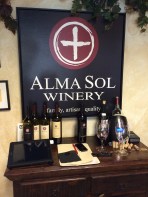 their operation from top to bottom. Their Cabernet Sauvignon grapes are sourced at Lisa’s family vineyard in Paso Robles and their other varietals from a number of nearby vineyards. All of their wines are very well-crafted – you can tell the winemaker’s touch, but the essence of the fruit and the terroir are present. They are a small production winery – almost everything is well under 100 cases of production – but produce a good variety of wines within that structure.
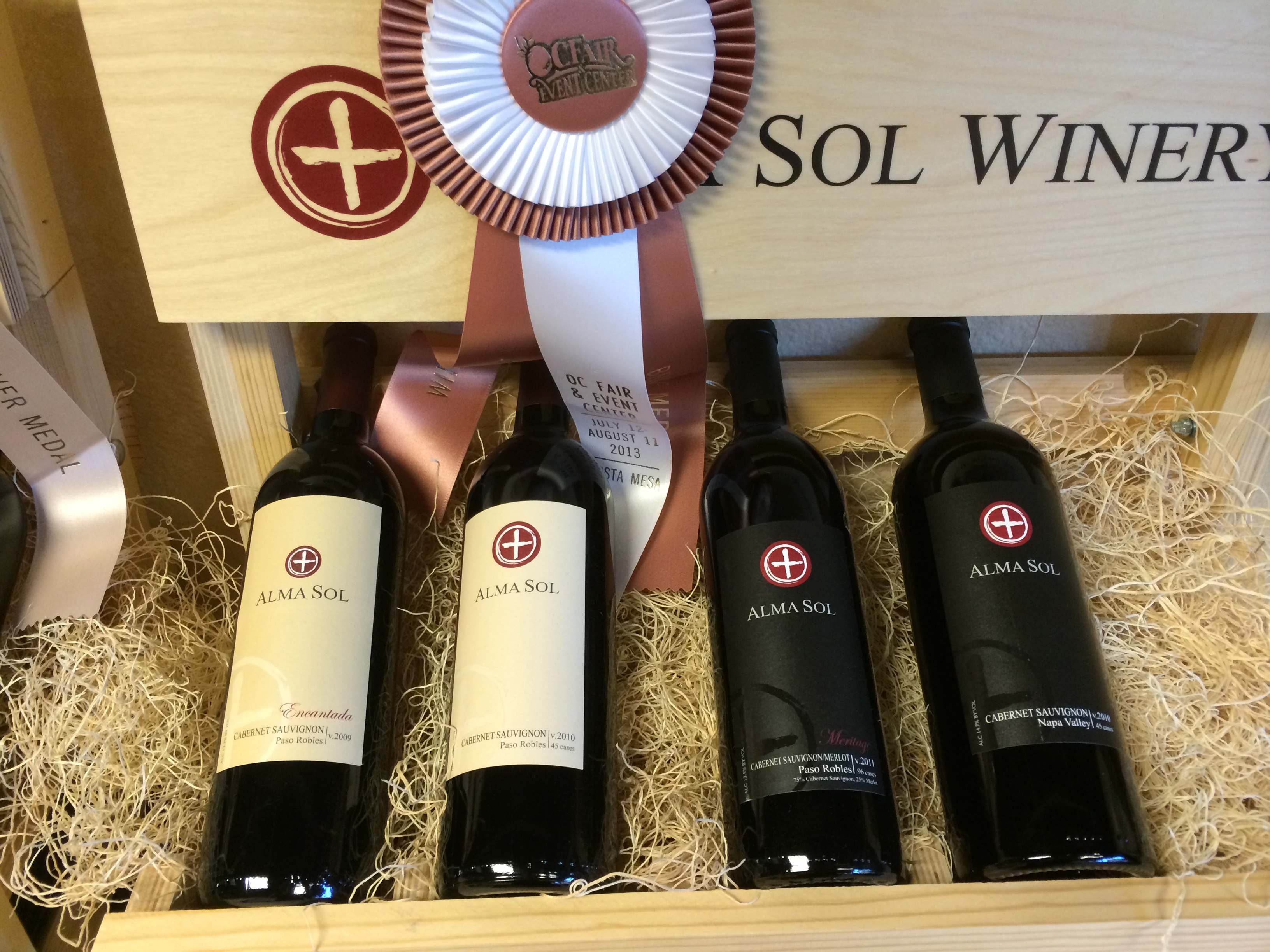
Their 2011 Cuevas Vineyard Cabernet Sauvignon (Curevas is Lisa’s family name) received 92 points from Wine Enthusiast and won Gold in the 2014 San Francisco Chronicle Wine Competition. It was our favorite – very smooth with berry fruit on the nose and subtle lavender and leather notes as well. The wine has a nice mouth-feel and spicy after n
otes. It retails for $32 – a bargain.
We will be visiting their tasting room, which they share with another small producer, Sunland Wines, whose wines we will taste in a future visit. They are located at 1321 E. Thousand Oaks Blvd, Suite A-108, Thousand Oaks, CA 91362.
 Jim Lockard On Wine