Tag Archives: wine education

EXPENSIVE WINE/CHEAP WINE – THE CONTROVERSY GOES ON

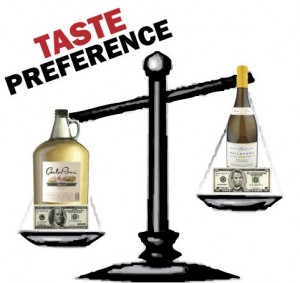
@EricAsimov on Twitter tipped me off about this article (LINK) by Sarah Miller on the Kitchenette Blog about the VOX video (see below) that has been circulating on the internet recently. The video says that Expensive Wine is for Suckers and features a tasting panel by a few folks at VOX of three Cabernet Sauvignons from different price points. They all liked the cheap one, ergo, expensive wines are for suckers.

Sarah Miller’s hilarious blog post in response (CAUTION: ADULT LANGUAGE!!!) takes VOX and the host of others who blithely support their findings to task in a very significant and entertaining way. It’s a long read, but, IMHO, worth it. First, here is the video:

https://youtube.com/watch?v=mVKuCbjFfIYframeborder%3D0allowfullscreen

And here is my take.

I agree with MIller in the basic premise of her post – that there is no definitive line that says what wine is good and what wine is bad; that less expensive wines from large producers tend to be altered with additives to create something other than what the  and grapes and terroir might have created on their own; and that the way we appreciate wine changes with greater knowledge and experience.

Since wine enjoyment is so subjective, each individual will find that his or her experience differs from others’, including many or all of the “experts” in the wine media. This is not unusual, as pointed out in the article – the masses often desire the simplest types of foods, drinks, music and movies. Thus the more expensive wines, those that represent higher quality fruit and true wine making craftsmanship, will tend to be appreciated by smaller numbers of people – more complexity = fewer adherents.

Here is a quote from the article: “Back to the whole cheap wine versus expensive wine thing. Cheap wine is awful. It used to taste like vinegar, and now, more often than not, it tastes like pancake syrup. It is made quickly and with little care. The grapes in it are often too ripe or not ripe enough. Good wine tastes like violets and flowers and fruit and spices and being blown away by it is an experience you are not required to have—but you should believe that it exists, because it does. Yes, of course, there are good wine values and bad ones. There is no one in the wine industry with a brain who thinks that every single bottle of $40 wine is universally better than every single bottle of $18 wine, or that every single person will like a $40 bottle better than a $8 one. As Schneider (a sommelier quoted in the article) pointed out, we aren’t robots.”

The philosopher Ken Wilber writes about the concept of span versus depth: the greater the span of something, the less depth and vice versa. A fast food restaurant will sell many more meals in a day than a fine dining restaurant; an action film with lots of explosions and little if any plot will out draw a character-driven film based on fine literature. Why should wine appreciation be any different?

If you like cheap wine, drink cheap wine. If you like expensive wine, drink that. But I suggest that you not let price, or ratings points, or labels, or other external factors be anything more than suggestions for you. If you are new to wine, find out what you like and drink that. Perhaps you will want to explore other types of wine over time; perhaps you will want to learn more about wines and wine making and that will influence what you drink.

My only caution, as I have stated in other posts, is to watch those really cheap wines produced in large quantities, as they are, more often than not, made with a lot of additives that you do not know about and that may not be good for you. The amount and type of additives tends to change and lessen as the price point of wines goes up, but not in an absolutely predictable fashion. Someday, stricter labeling requirements (LINK TO A GOOD ARTICLE) may help with this issue, but for now, you are pretty much on your own.

WINE ENJOYMENT SHOULD BE ACCESSIBLE AND ENJOYABLE, OR WHAT’S THE POINT?

There is a false notion that permeates wine culture at almost every level. That notion is that there is a level of knowledge that is attainable that will enable a person to know about every wine that exists. Now I know that most wine experts (a word that is past its expiration date IMHO) will say that this is not so, but it is conveyed in wine media of all kinds and by many individuals. My wine Twitter feed includes a number of people who purport to have a very deep knowledge of a very wide variety of wines. I have my doubts.

The reason that this is a false notion is that the sheer numbers relating to wine have grown so large and are so widely distributed around the globe. The California Wine Institute (LINK) has figures on its site for world wine production through 2012 – it shows 25,721,000 liters of wine produced world-wide (LINK). WineSearcher.com (LINK) shows about 3,600 wine regions in the world. There are probably around 100,000 wine producers in the world (this number is a bit difficult to nail down). The number of labels that you find in a decent wine store grows each year, with mega-stores like Total Wine and Spirits carrying upwards of 9,000 wines.

How is anyone going to know about all of these wines?

Wine Angst

For someone who is new to wine appreciation, or even for seasoned collectors, it can seem impossible. Most end up narrowing down their focus to a few regions or varietals, or even a single one. I have a friend who only drinks Kendall Jackson Chardonnay for example. Most collectors focus narrowly, some are more expansive, seeking out a wide variety of wines from various locations, vintages, and varietals. Those who focus will likely have a more in-depth knowledge of the particular area or areas of their attention. Those who explore more widely will have a more superficial knowledge of a variety of wines, regions, and varietals.

2014-09-11 12.57.26

Unless you are in the wine business, you will not have time to taste and understand the thousands of wines that are out there, or even the hundreds on the shelves on your local wine retailer’s shelves. And even if you are  in the wine business, it is doubtful that you will need to know about every region, varietal or producer. The idea that one needs to have so much knowledge can drive people away from the enjoyment of wine, and that serves no one.

My recommendation is to find your own way into and through the many types, styles, and iterations of wine. You may just have a glass or two a week of whatever is being served, or you may be an avid collector of all things from the Piedmont in Italy or Napa Valley in California, it does not matter. There are ways for you to access information about your own desires and preferences.

I tend to be an explorer. Even though I drink wine every day, blog about wine, and will be doing wine-related tours in the near future, I do not spend hours and hours pouring through information about wine. I tend to be an explorer – trying all kinds of wines from various regions – but I also have my preferences and I spend more time exploring those in greater depth as time and my wallet allow. Writers like Eric Asimov of the NYTimes work for me, because he explores a variety of wines from different places. I also enjoy Kermit Lynch, the amazing wine purveyor in Berkeley, whose newsletter (LINK)  is very informative and focuses mostly on French and Italian wines.

But you will find your own sources. I try to keep my blog as general as possible, but since I travel a lot, I write about the wines and the wine culture where I travel, so there may be some posts that do not interest everyone.

the world of wine should not be an impenetrable maze of secret or obscure or overwhelming information. It should be accessible, enjoyable, and allow each wine enthusiast to savor the experiences that he or she discovers. Whether that is a focus on First Growth Bordeaux or on trying to sample each of those 3,600 wine regions in the world, it should be an enjoyable experience, or what’s the point?

I would love to see some comments on this post – what do you think? What is your approach to wine?

IMG_0373

MAKING SENSE OF WINE REGIONS

A very good article from WineFolly.com with infographics on the appellation systems in the United States, France, Italy, and Spain. This is the kind of helpful information that wine buyers need to help decide what to purchase, especially when you are looking at wines with which you are not familiar. There are “click-throughs” to other information as well.

The Spanish Wine Map below is one example from the article (click on it in the article and you go to another excellent article about Spanish Wine).

(LINK TO ARTICLE)

Wine - Spanish Wine Regions Map

DOES SIZE REALLY MATTER? HALF-SIZE CAN BE BETTER! (do we have your attention?)

From The Wine Wanker – the advantages of 1/2 (350ml) bottles of wine. I agree, they can be great to have on hand, and for some people, the 1/2 bottle is the go-to size for everyday drinking. Read the excellent article below.

LINK: Does size really matter? Half size can be better (do we have your attention?).

THE PLEASURES OF WINE – EVERYONE CAN ENJOY IT

As a new year begins, I have been browsing Twitter and some wine blogs and seeing, for the most part, the results of New Years Eve celebrations – pictures of very nice labels, people having fun, even features about opulent wine cellars. Wine is definitely a catalyst for good time and a good lifestyle, isn’t it?

That being said, I have to admit that I am somewhat put off by the displays of opulence. I guess I fall somewhere between those drinking old Chateau Margeaux  and those drinking Yellow Tail. (Full disclosure – I stayed in and did not imbibe last night – a case of food poisoning.) I disparage neither end of the spectrum, for they represent parts of a very wide spectrum of wine enjoyment. Now, I have had both Chateau Margeaux and Yellow Tail, and I hope to have the former again; and I am pretty sure that I will have the latter again. This is more about what wine enjoyment can be and how it is often portrayed in the wine media.

Wine - Bottles Dusty

The emphasis of much of the wine media, including the Twitterverse, is that true wine enjoyment only happens at the high end – by those with better palates, more money, and greater access than most of us will ever enjoy. I know that this is true of many aspects of life – cars, houses, etc. – but with wine, it is, I think, a bit more universal. This deprives many of the true enjoyment that a more modest degree of the three items mentioned above – quality of palate, financial assets, and access to great wines and the places where they are made and consumed – can bring.

I do not wish to disparage the high end of the wine world, but I do want to celebrate the other aspects more than we do. I want to let people, especially young people new to wine, know that a visit to the tasting rooms of Paso Robles or Santa Ynez can be as much or more fun than a visit to the Chateaus of Bordeaux. For one example, you will likely taste wines that are ready to drink in Paso or Santa Ynez, whereas the Bordeauxs that you will taste in Chateaus will mostly be years away from their peak. Also, the people pouring your wines in Paso will be much more accessible and patient with the newcomer than most of the equivalent people in Bordeaux, or in many of the other “premium” places.

I want people new to wine to know that there are many, many AMAZING wines that cost less than $25, and that most of the wines that cost under $50 are really good. That there is a significant drop off in quality to value ratios when you get above $50 per bottle. I want them to know that pairing a wine with a pizza can bring as much pleasure as pairing one with caviar; that screw caps are a better sealing device than corks for wines not meant to age for a long time (and even that is debatable).

Personally, I want everyone who is interested in wine to enjoy their interest without feeling that they are “missing something” due to some lack of knowledge or money or access. I realize that this is probably an impossible desire, but that doesn’t mean that I won’t pursue it. I want this blog and my wine-related activities to speak to people who love wines in all kinds of ways.

During 2015, I will be traveling to Europe and to South America and will blog about wine experiences at all levels. I will be starting to offer wine travel experiences, first in France – Bordeaux and Paris – in two formats – for those who know wine well and for those who want to learn about wine. Later, tours to Burgundy and Lyon and possibly to other world locations will be initiated. The idea is to enjoy travel and to experience the joy of a wine related lifestyle at whatever level works for you.

Wine - expensive-and-inexpensive

Wine is for anyone who wants to enjoy it and we need to keep a broad perspective for the industry, and it’s customers, to thrive. I look forward to exploring more of the world of wine and to sharing it with as many people as want to partake of its many great experiences.

FROM THE SUBLIME TO THE, WELL, NOT-SO-SUBLIME

THE SUBLIME:

Two nights ago, at another dinner with our friends Richard Clark and Mary Stec at their home, Richard pulled out two amazing bottles of wine – a 1992 Joseph Phelps Insignia and a 2007 Aubert Ritchie Vineyard Chardonnay.

2014-11-23 18.37.27

Wine - Aubert 2007

Two AMAZING WINES!!!  The Insignia was rich, lush, fruity – it seemed young, rather than 22 years old. After sitting in the glass for about 15 minutes, it opened beautifully and rewarded our short wait with a beautiful wine experience. A couple of years ago, Dorianne and I went to an 11 year vertical tasting of Insignia, from 1995 through 2005. This wine would have fit right in, naturally.

The Aubert on the other hand, was perfect as soon as it was opened. There is a significant sense of sweetness, which I described as caramel, on the nose, with undertones of spice and fruit. This wine had a viscous mouth feel, not unlike the Insignia in this regard, and had a very nice finish. This was my first experience with this wine and winery. It ain’t cheap, but it offers a very special experience.

THE NOT-SO-SUBLIME:

Yesterday, we stopped at Trader Joe’s to get some groceries. I decided to get some wines for Thanksgiving (see earlier post – Link). The display of Nouveau Beaujolais was right there, so why not? I picked up a bottle of 2014 Georges Deboeuf to have with dinner last night.

It was probably aWine - beaujolais-nouveau-2014 mistake to have this wine the night after enjoying the superb Joseph Phelps Insignia and the Aubert Chardonnay. That said, the Beaujolais Nouveau is sort of like soda pop without the fizz. I actually found it to be more palatable than Dorianne did. I had the wine with some chevre and sourdough bread, then with a bowl of homemade chicken soup.

I found it more enjoyable as I drank it, although the first couple of sips were difficult (I think I was still in the thrall of the previous evening’s wines.)

So, we have done our bit for the Beaujolais Nouveau craze in 2014. Time to move on.

Oh, I bought two bottles.

Well – looks like an addition to the Thanksgiving table!

A BOTTLE OF WINE A DAY IS NOT BAD FOR YOU? NEW RESEARCH.

Another article based on research showing the overall benefits of drinking wine.

Here is a salient quote: “The weight of the evidence shows moderate drinking is better than abstaining and heavy drinking is worse than abstaining – however the moderate amounts can be higher than the guidelines say,” Dr Poikolainen reportedly told The Mail.

What are your thoughts on this?

Wine Improves with Age

THE NEW YORK TIMES WINE SCHOOL – ZINFANDEL

Last night, Dorianne and I got together with Richard Clark and Mary Stec to participate in the New York Times Wine School. The Wine School is a monthly look at different varietals written by Eric Asimov, the Times wine writer. The purpose is to take a deeper look at various varietals and to actually drink the wine, rather than just taste it. Richard, as I have mentioned in other posts, is the winemaker for the Conejo Valley Wine Co-op that Dorianne and I belong to.

2014-09-05 18.59.42
NYTimes Wine School on Zinfandel

We have done the previous Wine School varietals, usually two at a time, with Richard and Mary. We decided to do the Zinfandel, from July, on its own. Appetizers were gathered (baguette, prosciutto, goat and cheddar cheeses, smoked fish, and marinated peppers), and the main course – an AMAZING chicken mole with black beans and rice, was prepared by Mary (she and Richard used to import mole from Oaxaca in Mexico, so she knows her stuff).

Anyway, this is really about the wine. The Wine School always recommends three choices for the varietal of the month – wines that are likely easier to find in New York than in California in most instances. For the Zinfandel Wine School, Asimov recommended three wines: a Dashe Dry Creek Valley Zinfandel 2012 $21, Turley California Zinfandel Juvenile 2012 $30 and Ridge Dry Creek Valley Lytton Springs 2011 $35. Well, we didn’t have any of those, so we used two wines and had a back-up standing by.

2014-09-05 18.59.35
Our Three Wine Choices – the NYTimes Wine School on the iPad.

Our wines were a 2009 Grgich Hills $34, a 2009 Caymus $45, and a 2011 Moss-Roxx Ancient Vines $20, the latter remaining unopened.

Zinfandel has been in California since the early 1800’s and originally came from Croatia, where it is called tribidrag. I understand that it is also the same grape as primitivo in Italy, although there is some controversy about that.

Zinfandel, like all varietals, can show up in a variety of ways, influenced by everything that wine is influenced by – climate, weather, soils, sun and temperature, viticulture, wine making practices, ageing, etc. However, in general, the wine falls somewhere between Cabernet Sauvignon and Pinot Noir on the heavy to light red wine continuum. I find that Zin and Syrah can be very similar in tone and texture. It is normally great with meats and grilled foods. There are also some very interesting non-traditional Zinfandel blends showing up in places like Paso Robles.

The Grgich Hills and the Caymus were very different wines. The alcohol content was equivalent – 15.3% and 15.2% respectively, but the style was very different. The Grgich Hills was soft and elegant and the Caymus was big, bold, and heavy – definitely a Robert Parker kind of wine.

Fortunately, we opened the Grgich Hills first to have with the appetizers. It was a perfect complement to the prosciutto and cheeses and the other items. Elegantly balanced, the wine had spice notes, pepper, and fruit present. Delicious.

The Caymus was something else. Heavier, almost syrupy on the tongue, it was a fruit bomb. Fortunately, that was what the chicken mole required – something to stand up to the richness of the sauce and the greasy chicken. Richard preferred the Caymus to the Grgich Hills, I took the opposite position – although both are very good wines.

2014-09-05 19.52.51
The wines and the Chicken Mole made by Mary Stec.

The alcohol level of these wines made opening the Moss-Roxx unadvisable. It is resting back on the shelf as I write, waiting for another day.

Zinfandel has its lovers and its detractors. I am generally a fan, although I don’t actually drink that much of it. Our co-op made a pretty good Zin in 2010 and our just-bottled 2012 vintage includes a Zin-Merlot blend that should be interesting.

Let me know what your favorite Zinfandels are and what your best food pairing experiences have been in the comments section.