Dorianne and I are spending a month in Oaxaca, Mexico. We knew coming in that this culinary capital, known for molè sauces, chocolate, and coffee was not wine country. The drinks here are mescal and cerveza. Indeed, we have had some wonderful meals, both in the city and out in the pueblos, where indigenous people make amazing foods. But wine – not so much.
There is a large supermercado near our Colonial Reforma AirBnB.com house that has a wine section featuring a few South American and Mexican wines, plus a smattering of French, Italian, and Spanish bottles – all at the lower end of the spectrum. The U.S. is represented here by Gallo. You don’t really find fine wines here, but some decent bottles are available if you know where to look. Better restaurants feature Mexican wines, but the local cuisine, driven by spicy molès, salsas, etc., does not pair well with wine for the most part. Beer (cerveza) is just fine for most cocina oaxaqueña meals.
And, I was, truth be told, growing a bit weary of the local cuisine after two weeks of nothing but . . .
That is why we were so happy to discover Ristorante Italiano Epicuro(no website, LINK to FB page), an oasis of fine Italian dining with a small, but welcome list of Italian wines – a regular list and an artisanal list with a total of about 30 wines. Stepping in off of Calle Guerrointo number 319 one is transported, if not to Italy, to a sophisticated setting that could be in any major city. The decor consists of light green walls, very high ceilings, with a portion that has a retractable roof for this climate, scenes of things Italian on the walls, and nicely appointed tables. There are not a lot of restaurants in Oaxaca that are not oaxaqueña, so there are really few guidelines for how to handle the mix of cultures in terms of food and decor. Ristorante Italiano Epicuro goes purely Italian on the food and a more general upscale look on the decor.
Our good friends Richard Clark and Mary Stec were in town visiting for a few days. They used to own a gourmet chocolate business and sourced their chocolate and molès from Oaxaca. It was their last night with us in Oaxaca, so we went for dinner early – before 7:00 pm, so the place was nearly empty.
Our waiter, Juan Carlos, a veteran of the high-end Los Angeles restaurant scene (Valentino and others), greeted us warmly and masterfully guided us through the evening. Chef Valter Epifania is from Genoa, and knows his way around the kitchen. He came to our table near the end of the meal. We also met Eder, the owner, who came to Mexico from Italy six years ago and opened the restaurant a year later.
We ordered two bottles of wine from the smaller “artisanal wine list.” All were under 600 pesos, or about $35 U.S. at the current exchange rate of 16.8 pesos to the dollar. The most expensive bottle on either list was an Italian Cabernet Sauvignon on the main wine list for 820 pesos, or about $48 U.S.
Our first bottle was a 2010 Il Gargaiolo Chianti, 85% Sangiovese & 15% Merlot. It was very dry and tight at first, but it opened up after a while. I would say that the Merlot added a richness to the Sangiovese. A decent, but not a great wine.
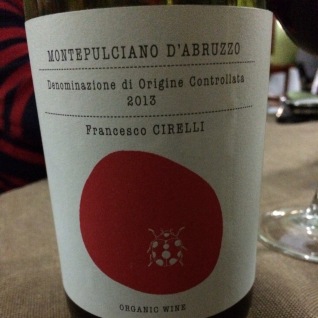
Next we opted for a 2013 Francesco Cirelli Montepulciano d’Abruzzo, and organic wine. Aged in stainless steel, the wine had a sense of terroir and a decent balance of dark fruit, with leather and chocolate overtones. Dorianne was the only one of us who preferred the Chianti to this wine.
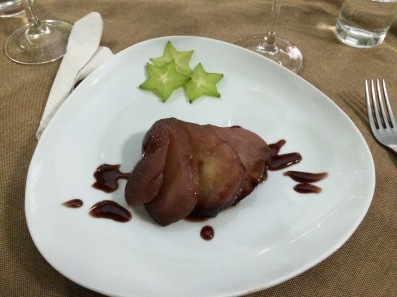
The menu is purely Italian, with first courses, pastas, and secondi (not the terms on the menu). A complimentary eggplant appetizer (deliciously rich) is provided. We also received a sampling of their ice cream dessert after not ordering dessert. When Dorianne could not eat that due to allergies, a pear poached in red wine was substituted by the chef for her. Very nice!
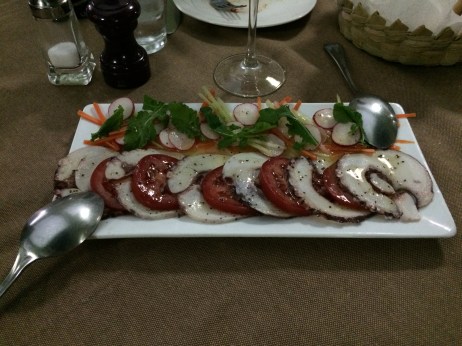
We shared a pulpo carpaccioappetizer that was delicious and reminiscent of the pulpo in Spain. The octopus for this dish was sourced in the Gulf of Mexico we were told.
Pulpo Carpaccio – Delicious!
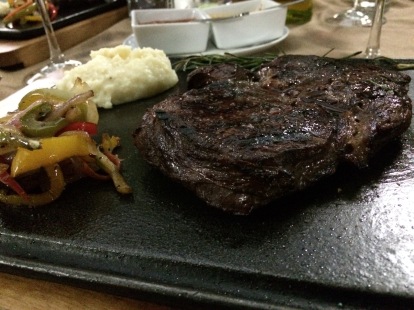
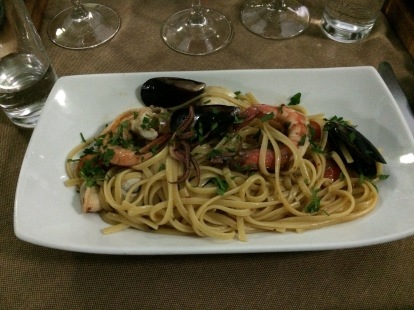
Then, Dorianne opted for a seafood pasta for her main dish. Mary and I ordered the rib-eye steak made with Ecuadorian beef; Richard had the special of the evening – rack of lamb.
Ecuadorian Beef Rib-Eye SteakSeafood PastaPear Poached in Red Wine
All of the main courses were excellently prepared and delicious. We remarked that this quality of Italian dining in the US would command a much greater price. The bill, with tip, was just over 2440 pesos, or under $150 U.S. for four of us, including two bottles of wine!
Richard and Mary have left, leaving Dorianne and I to return to this Italian Oasis a few times in our two remaining weeks in Oaxaca.
Last Saturday, we took a mini tour of the Cotswolds region, a beautiful rural area of southwestern England dotted with picturesque towns. We spent a week in one of those towns, Fairford, which is very friendly and beautiful.
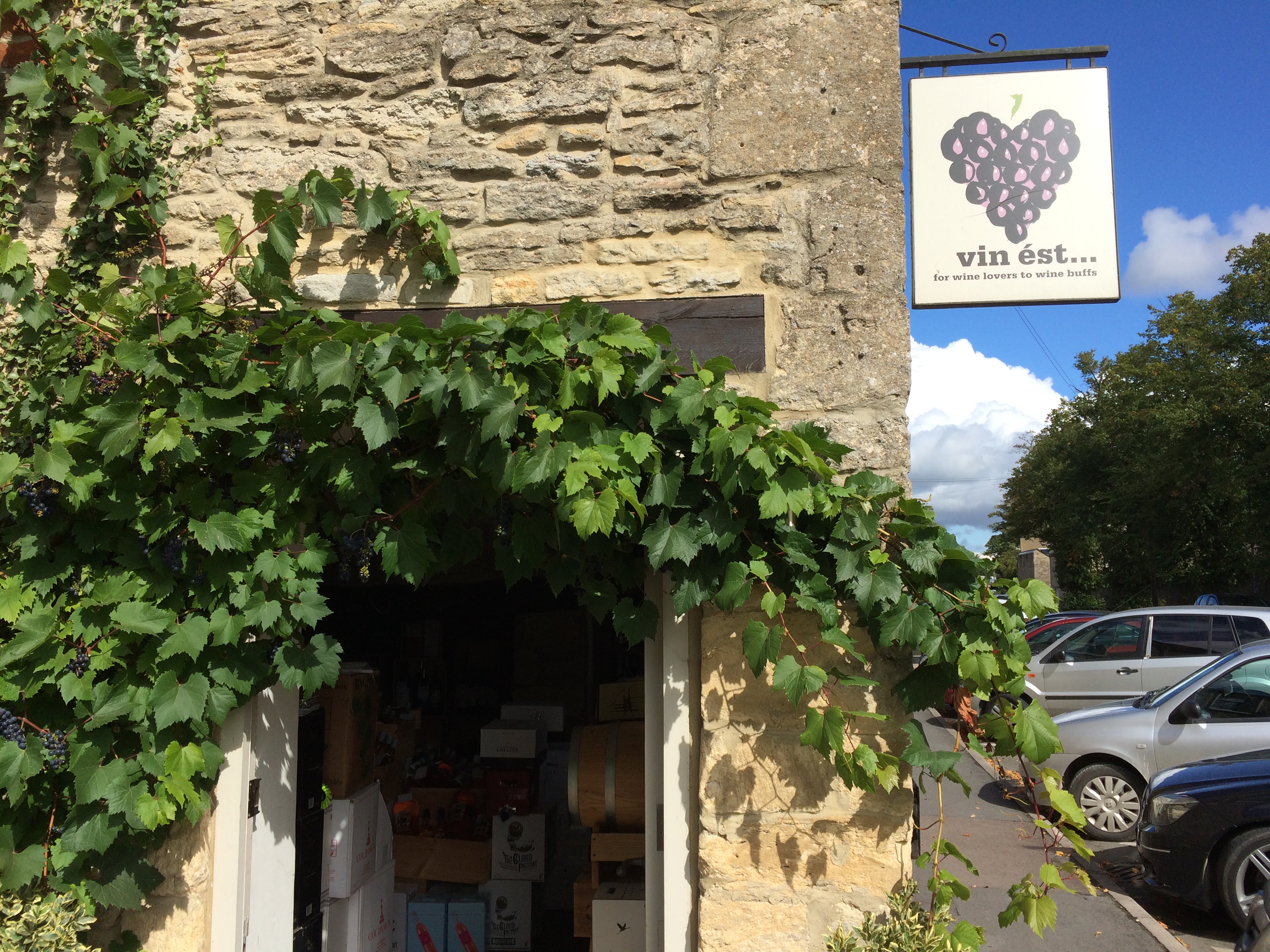
On Saturday, our friends, Charlie and Avril, who live in Broughton Poggs, picked us up and took us out for the day. The first stop was in Lechlade, a town between Fairford and Broughton Poggs. While Dorianne and Charlie went to the store, I spied a little wine shop called Vin Est . . .; I told them to stop on their way back and pick me up.
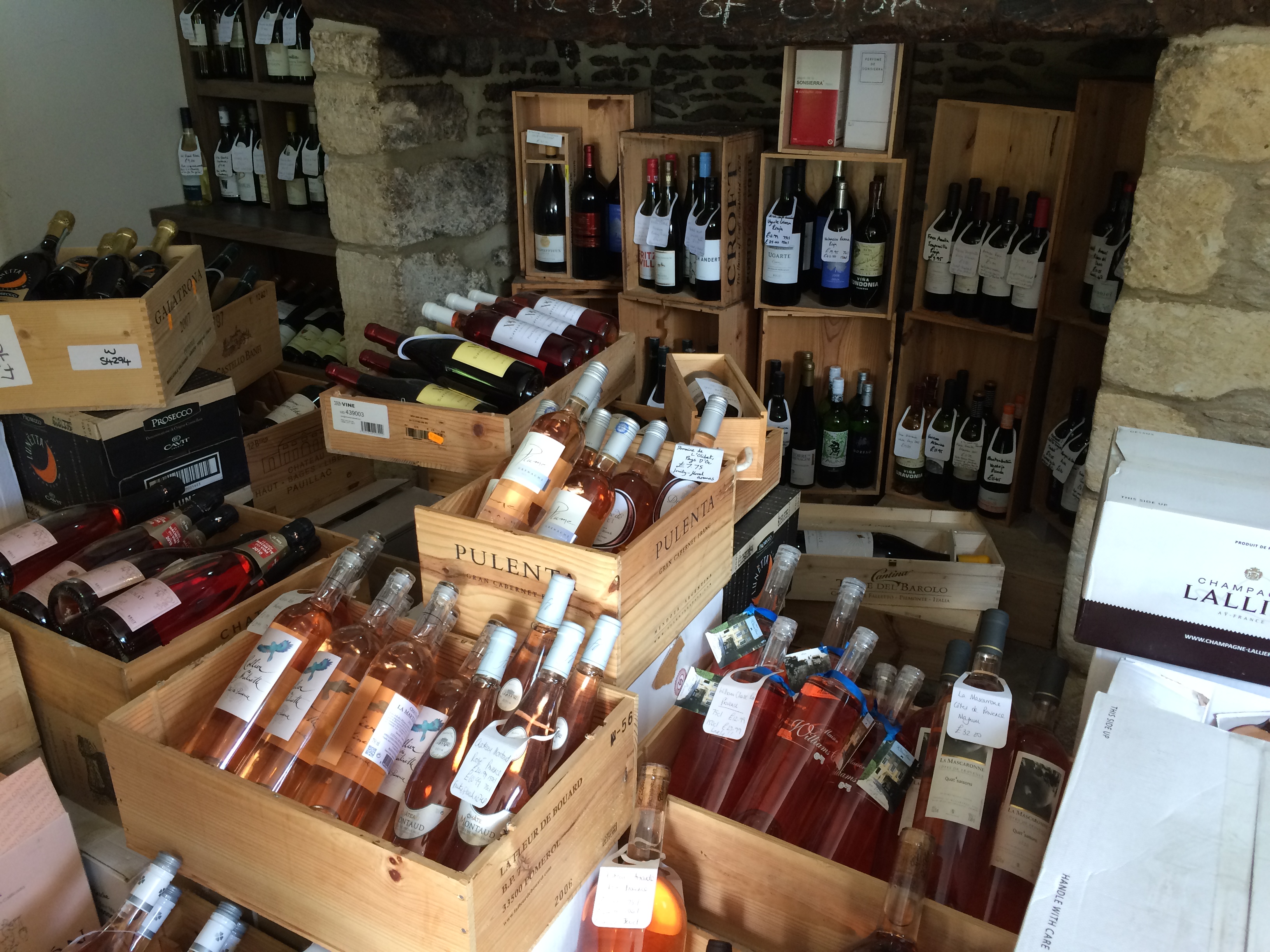
The Vin Est . . . shop (LINK) is very small, a front room stocked with wines on shelves, in bins, on tables, and three casks for those who want to bring their own container. In the back are a couple of more rooms, one empty on this visit – about to become a beer room and to be used for tastings, and a smaller room where the premium wines are kept. They also distribute wines to a number of restaurants and pubs in the area.
Some of the Good Stuff.Fill Your Own Bottle.Nice Wine Shop in Lechlade.The Main Shop Floor
I spoke with Rachel Jenkins, who owns the place with her husband Mike. They moved out from London to this idyllic spot and noticed a hole where a premium wine shop should be. The shop is inviting and intimate, and the Jenkins’ know their wine. If you are in the area sometime, this is the go-to wine shop once you get away from Oxford. I bought a nice bottle of Pouilly Gris that is sitting comfortably in the fridge now.
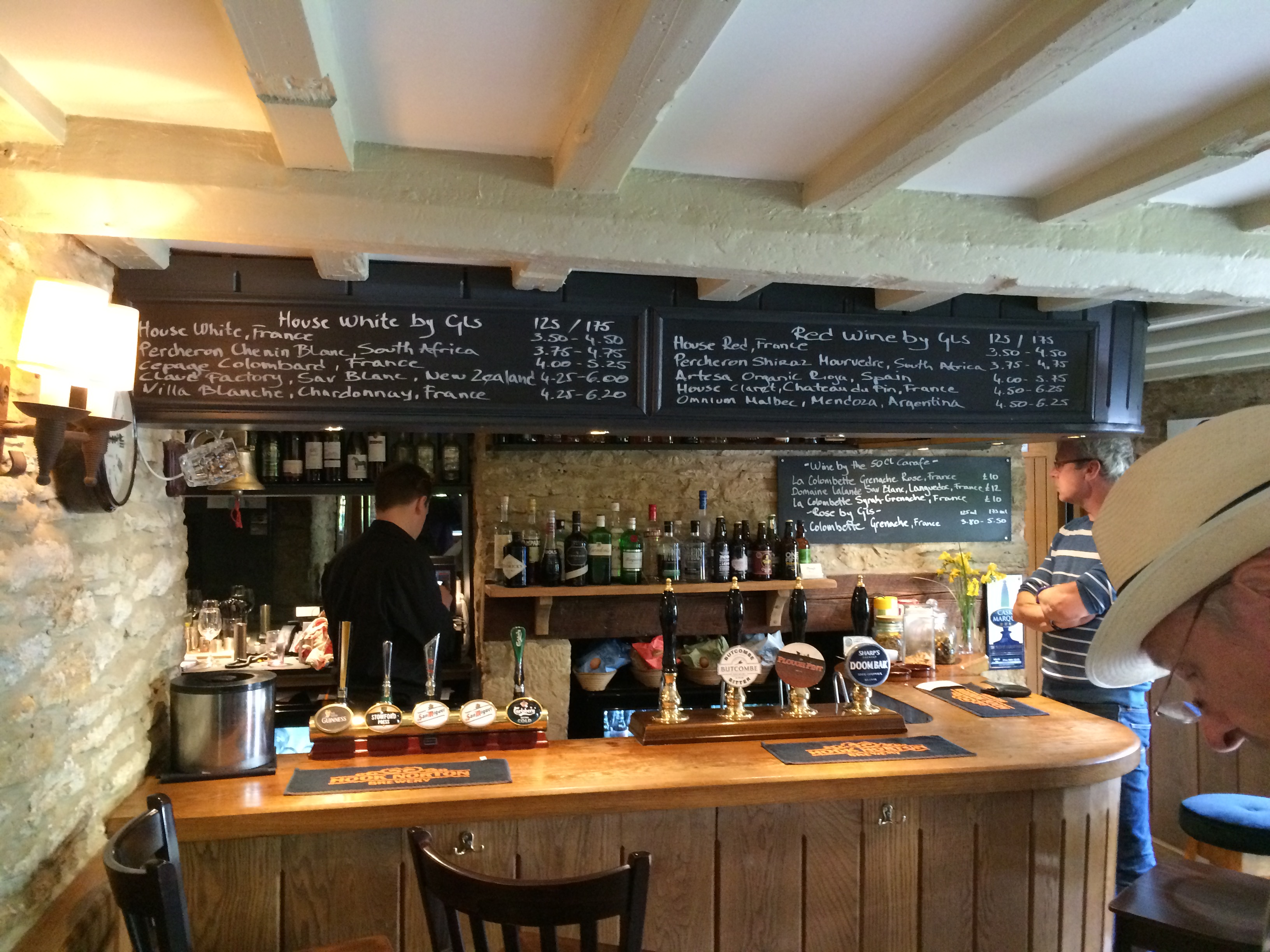
Back in the car to Charlie and Avril’s beautiful home in Broughton Poggs. A cup of tea or coffee and some conversation, then we are off to The Plough Inn(LINK) in Kelmscott for a hearty lunch. Sauvignon Blanc for Dorianne, grapefruit soda for Avril, and the local Buttcombe Bitters for Charlie and me. Great food in a really nice spot – and you can book a room if you like.
The Plough Inn Barroom.Some Wine Choices at the Plough Inn
Then a walk down the lane to Kelmscott Manor (LINK), the former home of the great arts and crafts movement’s William Morris and his family.
After a tour of the stately home and grounds, we headed back to Broughton Poggs, where we examined a very old stone barn that Charlie and Avril are reconditioning into a home. A remarkable transformation is done with these old buildings, keeping the historic charm while remaking them with all the current conveniences.
Then to their home, which is in a converted 15th Century mill, with about an acre plus of gardens on the property – truly a remarkable place. We toured the gardens with a nice glass of Crémant(my fault in not noting the maker) from near Macon in France.
Glasses of Crémant for our Garden tour.Jim, Avril, Dorianne and Charlie. Well into a Very Good Day.
Then more tea and conversation before heading out to dinner at The Five Alls (LINK), a pub about 50 meters from Charlie and Avril’s home. The same management as The Plough Inn, it is a nicely appointed pub with a barroom and several dining rooms. We were seated in short order and I perused the menu and the wine list. The list is interesting, mostly French, of course, but with a number of New World wines from South Africa, New Zealand, Chile, and Argentina. And, the wines are sourced thought our friends at Vin Est . . ., mentioned earlier. The only U.S. wine is a (cringe) White Zinfandel. But, we’re in England after all.
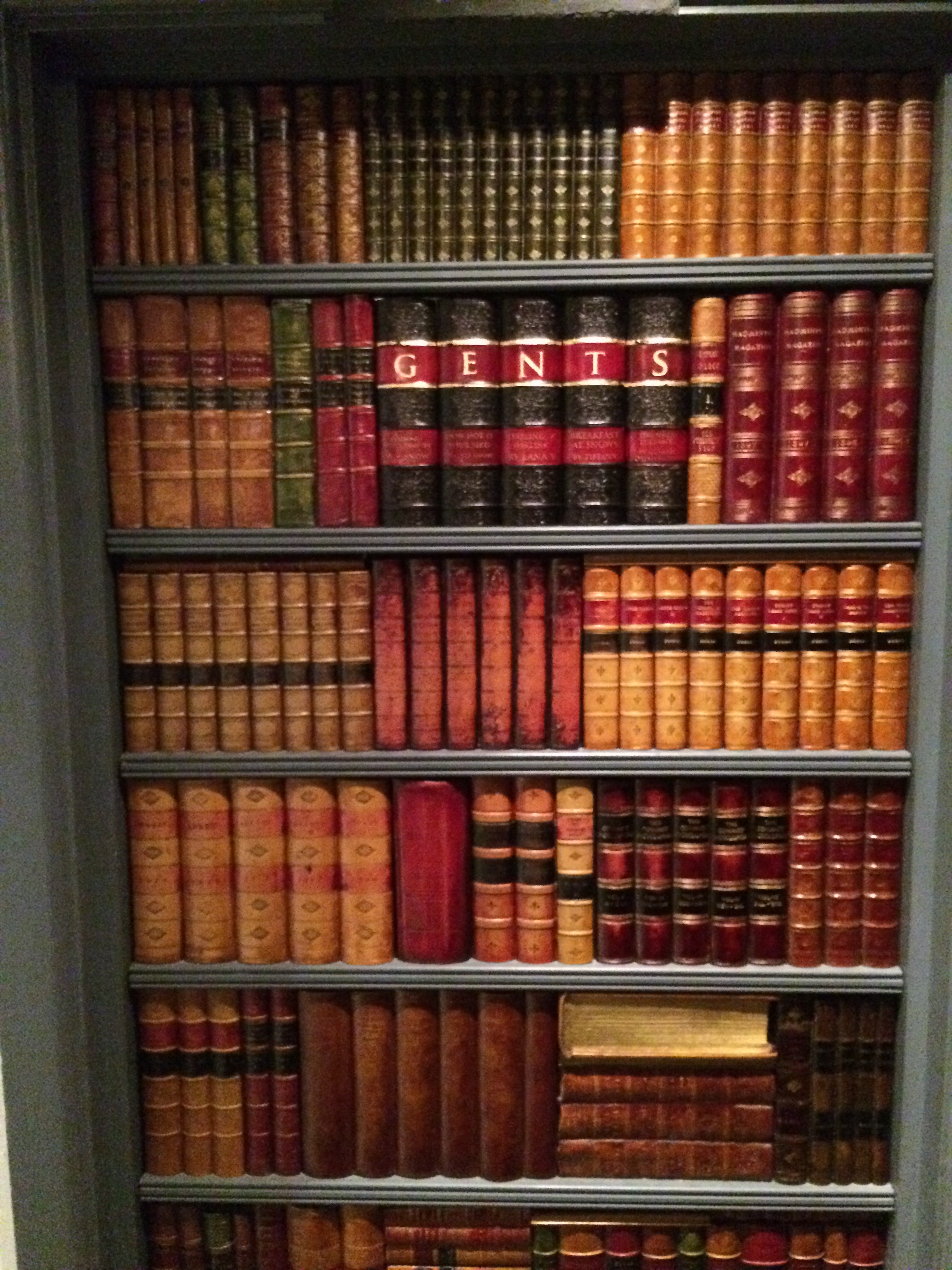
Door to the Gents Room at The Five Alls.
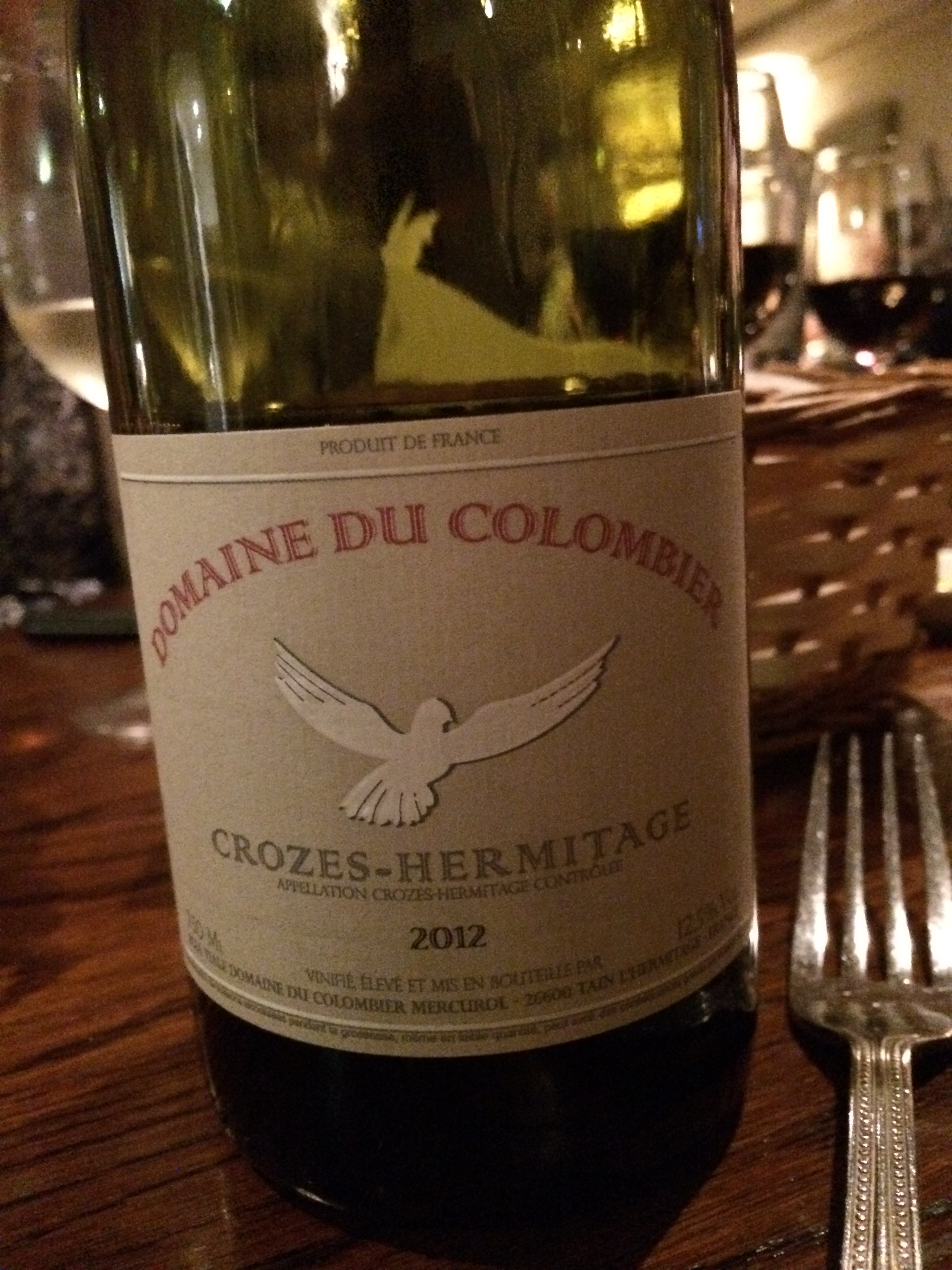
Charlie asked me to select the wines, so I chose a 2014 Picpoul de Pinet from Racine (LINK)in the Languedoc, France. Charlie cringed a bit at my choice, noting that the Picpouls had been pushed in England as an alternative to Pinot Grigio and that he found most of them lacking in any complexity. So we would see. At the same time, I also ordered a 2012 Crozes-Hermitage from Domaine du Colombier (LINK), to go with the venison that we had all chosen for our main course. This rich Syrah with a peppery, dark fruit, favor and good structure proved a success with the venison. I had asked that the second wine be decanted when I ordered it, however, this did not happen, so it took some time to open up nicely.
But back to the Picpoul de Pinet. When it arrived, I was wondering if Charlie would be right, and we would be getting a vin ordinaire with little to no character. Right off the bat, it had a strong minerality on the nose, with hints of pear, citrus and lemongrass – similar, except for the heavy minerality to a New Zealand Sauvingnon Blanc. The taste was strongly earthy with hints of floral notes, pear, and a saltiness around the edges. It opened up a bit more after about ten minutes in the glass – it smoothed out and the complexity showed through. Charlie approved.
This is a beautiful region, becoming more gentrified by the minute due to its proximity to London, but retaining much of its charm – and getting some very good restaurants in the bargain. We have thus far not had an English wine – we plan to do that next week in London, but we have stuck pretty much with the French, with a couple of forays into South America and New Zealand at the supermarket. I would love to hear comments about your wine experiences in the U.K., and any recommendations for London would be appreciated as well.
This past Saturday, Dorianne and I returned to Châteauneuf-du-Pape (LINK) for lunch and a tasting at a wine cave – a retail wine store. It was a beautiful day, and we drove through the lovely Provençal countryside, with its vineyards, orchards, scenic homes and farms, and lush vegetation. Our friendly GPS took us along about 5 kilometers of single-lane road through vineyard after vineyard before we entered the town of Châteauneuf-du-Pape, the most storied Appellation (LINK) of this part of France.
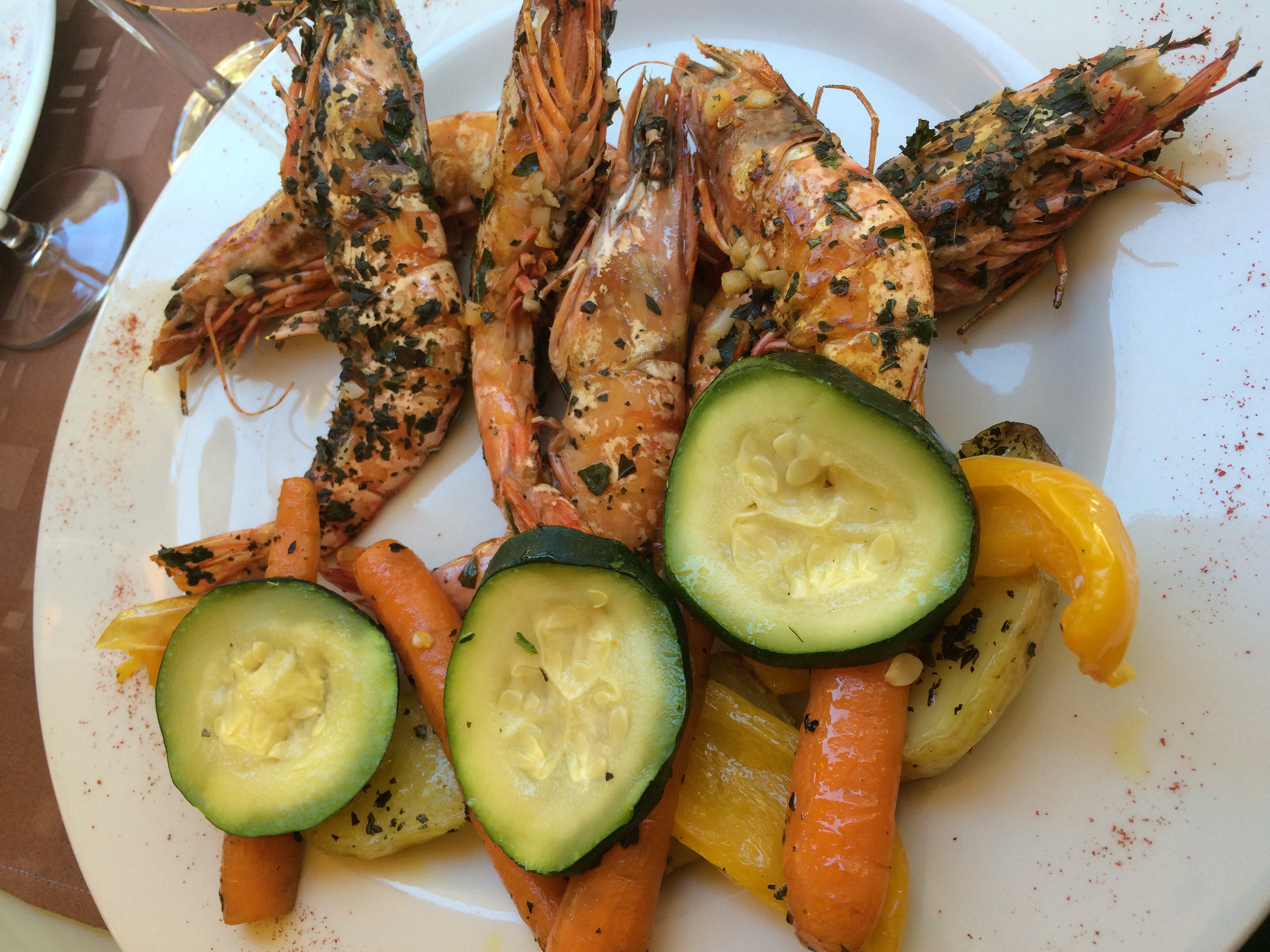
Lunch was at Restaurant Le Pistou (LINK) on a little side street off of the main town square. We sat outside and expected a light lunch, but the servings were very large – gambas salad for Dorianne, and grand gambas with salad and vegetables for me. As you can see, the plates were sizeable. We washed this down with the house white – a Châteauneuf-du-Pape. Before this trip, I did not know that whites were made here – but they are, compromising about 6% of the total production. The whites of Châteauneuf-du-Pape stand alongside the storied reds as excellent wines.
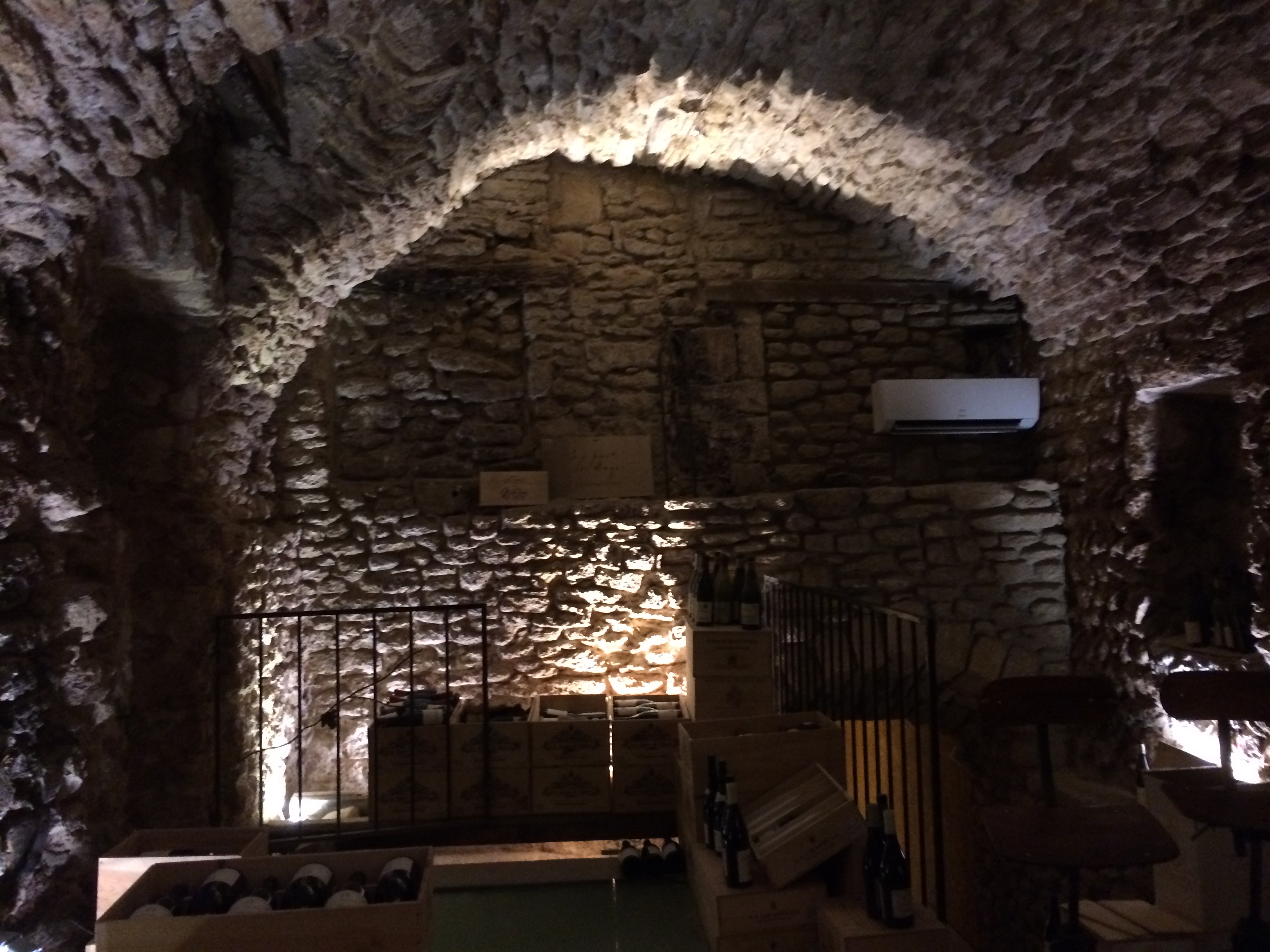
Le Caves Saint Charles (LINK) was highly recommended in Tripadvisor.com (LINK), which we used as a means of sorting through the dozens and dozens of caves du vin in the town of Châteauneuf-du-Pape. We wanted to ensure that we were tasting really good wines. After deciding, we made an appointment via email to meet the owner, Guy Brèmond, for 3:30 pm. We were a bit late, having had some trouble locating the cave – our GPS being little help – and in finding a place to park. When we arrived at the cave, which is at the top of the highest hill in town, only overlooked by the nearby ruins of the original Château of Châteauneuf-du-Pape, it was locked up. We knocked on the door to no avail. We called the number, and did connect. It turned out that Guy was later than we were, having been stuck in traffic in Marseilles earlier. After a few minutes, we were in the temperature controlled cave, which is under the home of the owner.
The actual cave structure of Le Caves Saint Charles dates from the 13th Century. There is another section underneath that dates from the 12th Century that is going to be renovated in the coming year. The cave in use has four rooms carved out of the rock with stone walls and vaulted ceilings – a lobby area, the tasting area, a small storage area and an area converted into a modern kitchen. There are bottles of wine in wooden boxes from the 45 producers that Guy represents throughout the cave rooms. We started in the tasting area.
Guy Brèmond is a Master Sommelier and a very personable and outgoing man. Once we established that Dorianne and I knew something about wine, although not that much about Châteauneuf-du-Pape, we were off and tasting. He spoke in depth about the philosophy and history of the appellation, and about the way the wines are made and the misconceptions that many have about Châteauneuf-du-Pape. We tasted 8 wines, two whites and six reds. The reds were made in three different styles, or methods.
The 90 minutes or so that we were at Le Caves Saint Charles with Guy Brèmond went by quickly. I kept having the feeling that this was a really special experience, and it was. The depth of his knowledge of wine in general and Châteauneuf-du-Pape wines specifically, combined with his enthusiasm, was a bit hypnotic. I will share now that we did purchase a mixed case of wine at the end of our visit to have shipped to California; but we were intending to do that when we arrived, if the wines were good. Guy is a very good businessman, but there was no pressure to purchase beyond what may naturally arise when you are in a fabulous environment, tasting exceptional wines, with an enthusiastic and knowledgeable host.
Now to the wines – to be tasted in huge stemmed glasses, by the way:
We began with two whites. As I said, I was surprised to find whites here, as I have never seen them in the U.S., nor read about them. We had tried a Mont-RedonChâteauneuf-du-Pape white shortly after arriving here in Provence and found it delicious.
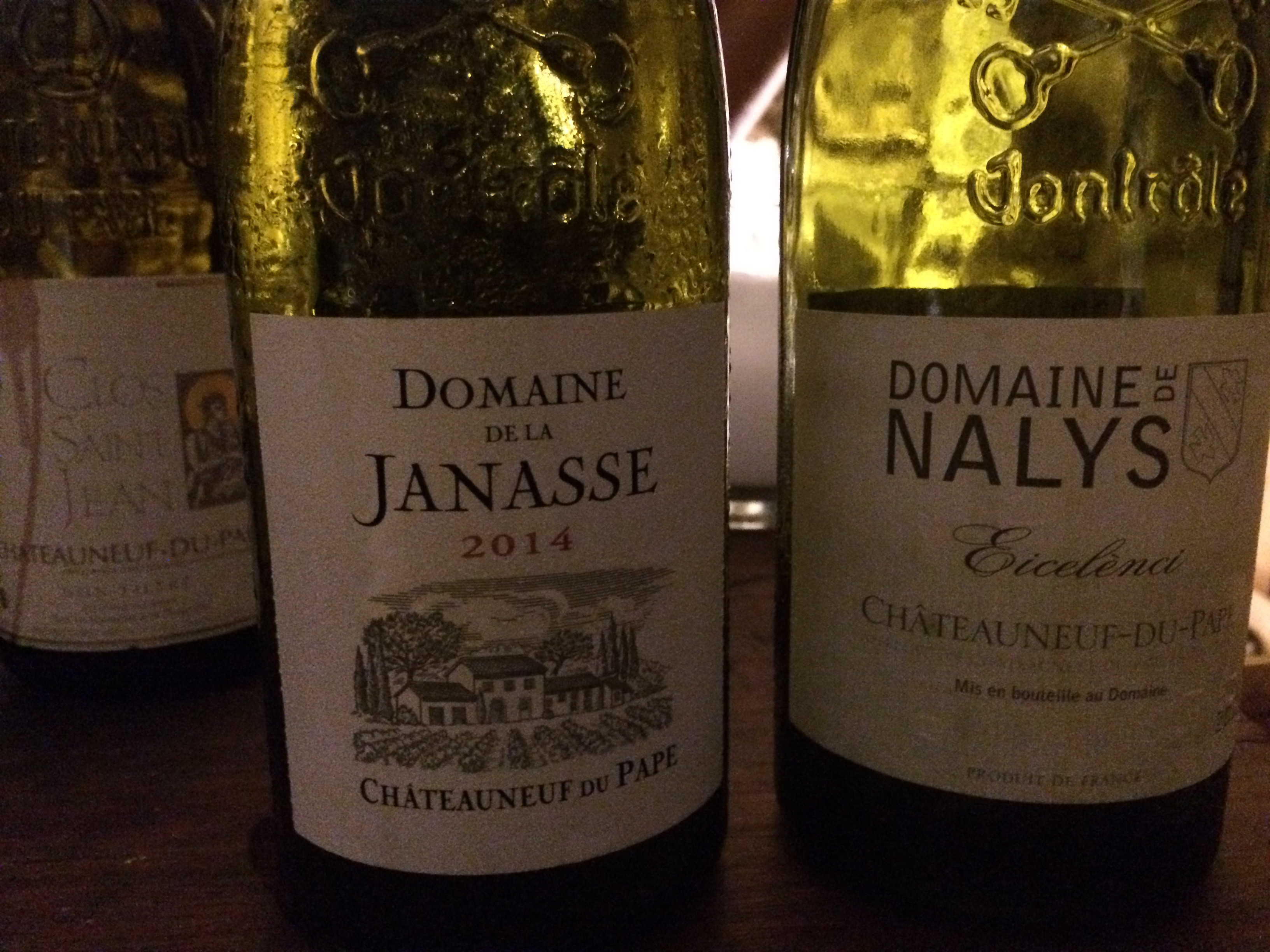
The Châteauneuf-du-Pape Whites.
First, we tasted a 2012 Domaine de Nalys Blanc (LINK)(LINK), a blend of 40-56% Grenache blanc, 14-34% Clairette, 13-27% Bourboulenc, 3-10% Roussanne, 1-5% Picardan, 1-3% Picpoul. The white wines of Châteauneuf-du-Pape are, like the reds, complex. This wine gives you a lot to experience on the nose, in the mouth, and through the finish. There is green fruit, minerality (always), some floral notes on the nose; apple, pear, and hints of earth and anise on the tongue; with a smooth lingering finish that returns to the mineral notes from the bouquet. This wine would be exceptional with lighter cheeses and seafood – oysters and shellfish in particular. We bought 3 bottles at 31€ and change.
Next, we went to the 2013 Domaine de la Janasse Châteauneuf-du-Pape Blanc (LINK)(LINK), a blend of 40% Grenache Banc, 40% Clairette, and 20% Rousanne. This is a beautiful wine from one of the most highly regarded producers in Châteauneuf-du-Pape. A wine that is very drinkable now, but should age well. The nose is peach and floral, but with that ever-present minerality; mouthfeel is rich and viscous with hints of vanilla; long, smooth finish. We bought 3 of these, too, at 34€ and change. (That’s half a case so far.) I think that we will continue to explore the whites of Châteauneuf-du-Pape; in fact, I am certain of it.
As we move to the reds, I should point out of few things (this will be a rather long post). As we taste, there is a lot of conversation going on. Dorianne is full of questions. I ask a few myself. Guy Brèmond is expounding on each wine, each producer, their philosophy, their practices, the market, his business, and more. It is quite lively and very interesting.
There are a number of misconceptions that are very common when it comes to Châteauneuf-du-Pape wines:
Many people do not know about the white wines, as their small production limits their distribution.
Many believe that all Châteauneuf-du-Pape reds come from thirteen varietals. There are, depending upon who you speak to, anywhere from 14 to 18 varietals in the appellation. Some do not count the white varietals other than Granache Blanc. Others count only some of them. So there are, essentially 13 varietals of red, but some of the white varietals may be blended into the red wines. The appellation currently allows 18 varietals under a Châteauneuf-du-Pape label.
Many believe that all Chateauneuf-Du-Pape reds must be blends. This is not true. For example, you can have a 100% Granache, which we have tasted (not at the Cave). Most reds are a blend of three to five varietals. The basis for almost all Châteauneuf-du-Pape reds is the classic GSM Blend – Granache, Syrah, and Mourvedre.
Why so many varietals in a small appellation? Guy says that it was because when the appellation was developed and the rules created in 1923 (amended in 1936 and 2009), all of the varietals under cultivation at the time were included. This “democratic” move forestalled the inevitable infighting that might have jeopardized the pact.
Châteauneuf-du-Pape is part of the Côtes du Rhône, or the Rhône Valley Area. It has 3161 hectares, or 7811 acres under cultivation. Total production is 2,686,841 gallons, or about 21,000 cases per year. 94% is red and about 6% is white. (LINK)
So on to the reds. We tasted six, from three different philosophies of making Châteauneuf-du-Pape red wines, as described by The Wine Cellar Insider website (LINK):
The Traditional, Modern & Neoclassical styles – “Much of the difference between traditional and modern, is the ripeness of the grapes, effective yields, amount of stems used and most importantly, the percentage of new oak barrels used in aging the wine. Producers making wines in a more traditional style do not use oak, preferring to age the wine in older, neutral, massive barrels, cement lined vats or foudres that are widely used in the region. They do not destem the grapes. In other words, they follow the traditional practices of the region. There are numerous high quality traditional Châteauneuf-du-Pape wines made all over the appellation today” (LINK). So the use of smaller oak barrels designed to impart its characteristics onto the wine is a hallmark of the Modern Method. The Neoclassical Method is a hybrid of the other two, some oak barrels are used, but only for a portion of the harvest.
Our first two red wines are from the Modern Method:
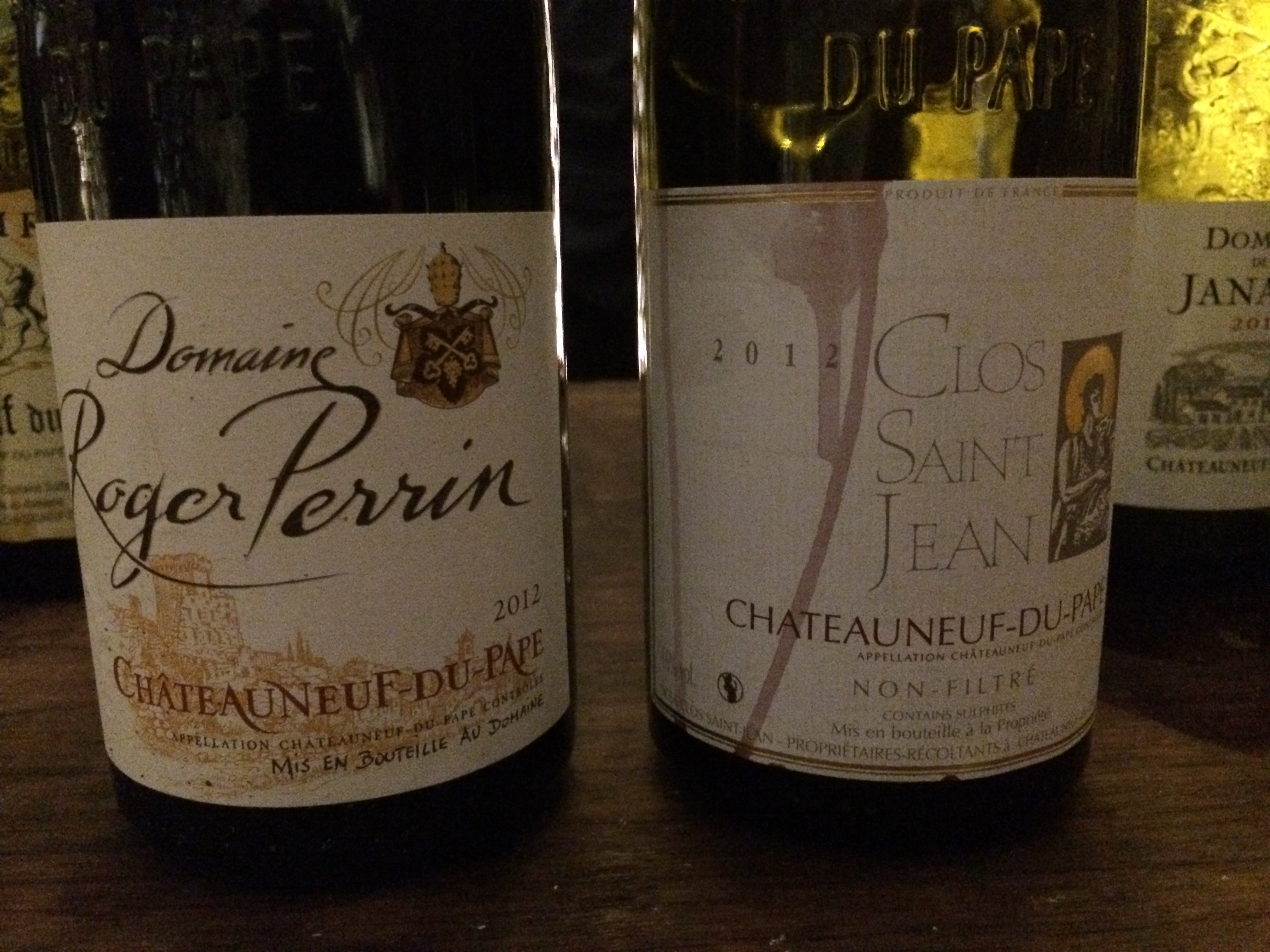
The Châteauneuf-du-Pape Modern Method Reds.
First, a 2012 Clos Saint Jean “Vieilles Vignes” Châteauneuf-du-Pape (LINK), a blend of 85% Grenache with the remainder a mix of Mourvedre and Syrah (Guy says that Syrah is used only for “cosmetic purposes” – to provide a richer color). This is a big wine, full-bodied, with deep red fruit and minerality on the nose and the palate. A wine that will age well, I think. If this is typical of the Modern Method, it is very much like a California or New World wine – bold, high alcohol, fruit forward. In my research, I noticed that Robert Parker generally gave higher marks to Modern Method wines.
The next Modern Method wine is a 2012 Domaine Roger Perrin Chateauneuf-du-Pape(LINK) the website lists an average blend of 70-75% Grenache, 15-20% Syrah, 10-15% Mourvedre, 2-5% Cinsault or Clairette and 1-2% Counoise or Vaccarese. Another big, fruit-forward wine. Dark red fruit, a bit of mushroom on the nose, minerality throughout. Very similar to the Clos Saint Jean, but with a bit more finesse.
The next three wines are from the Traditional Method:
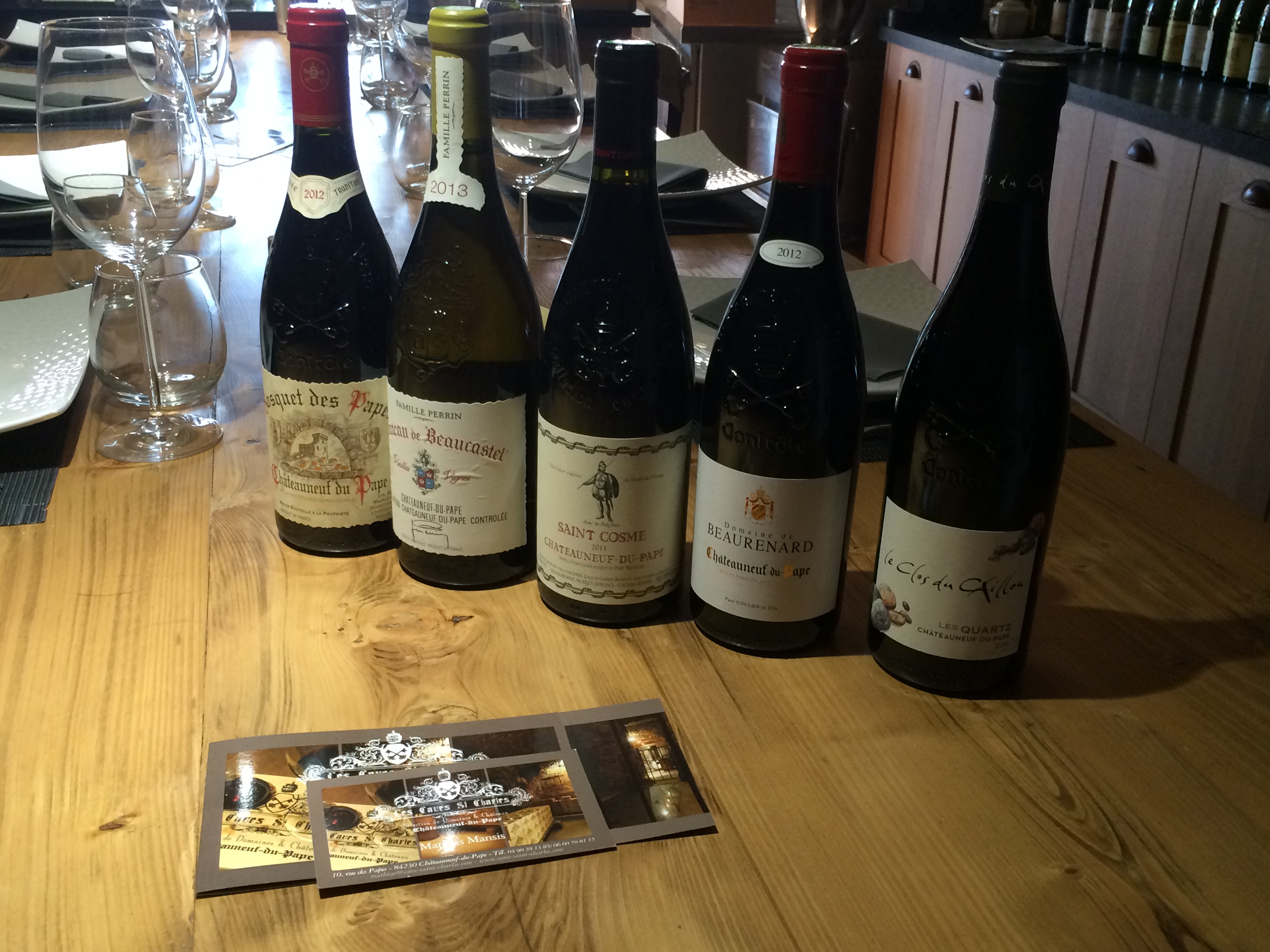
The Châteauneuf-du-Pape Neoclassical Method wine (Left) and the three Traditional Method Reds.
First, a 2010 Domaine du Pegau Châteauneuf-du-Pape Cuvee Reservee (LINK), a blend of 80% Grenache, 6% Syrah, 4% Mourvedre and 10% other varietals. This is an amazing wine – you can immediately see the difference between this method and the Modern Method – something that would carry through with the rest of the wines tasted. It is more mineral than fruit, more elegant than bold, with a beautifully balanced structure of tannins. This is my style of wine. But we did not buy this one.
Next, a 2010 Château Fortia Châteauneuf-du-Pape Tradition (LINK), a blend of 65% Grenache, 20% Syrah and 15% Mourvedre. Aged in foudres (concrete tanks). This wine is pretty much everything that the Domaine du Pegau is, but it takes it to a higher level, but is very much its own wine. You get some barnyard on the nose, which begins to dissipate after a few minutes, but remains. I did not find it off-putting, but some may. There is ripe fruit in there, but it is subdued in a minerality – dirt, terroir – that permeates the wine. On the palate it is very nicely structured and balanced and the fruit began to come through. This is a wine that will age well and one that would benefit from decanting. We bought 3 of this one at 35€.
Next, a 2010 Beaurenard domain Cuvee Boisrenard Chateauneuf-du-Pape (LINK), a Grenache blend but the winery does not release specifics as far as I can tell – only that up to 13 varietals may be included in the wine. Parker 91, Wine Spectator 97 points. A long, smooth finish. The initial tasting bottle had been opened too long, Guy opened a new bottle and got us clean glasses. This one, too, could benefit from decanting a while. We probably would have bought some of this wine, too, but a case was our limit, and we couldn’t pass up the next wine.
Finally, a wine in the Neoclassical Method – meaning a mixture of traditional and modern. A Château Jas de Bressy Châteauneuf-du-Pape (LINK)(LINK), a blend of 80% Grenache; 15% Syrah and 5% Mourvèdre. This wine has lots of mushroom on the nose and a nice peppery sense as well. Fruit is secondary to the minerality on the palate, plus a sense of chocolate. The tannins were there to ensure a relatively long life for this wine. A very nice wine. We added three of these at 36€ and change to round out our case purchase.
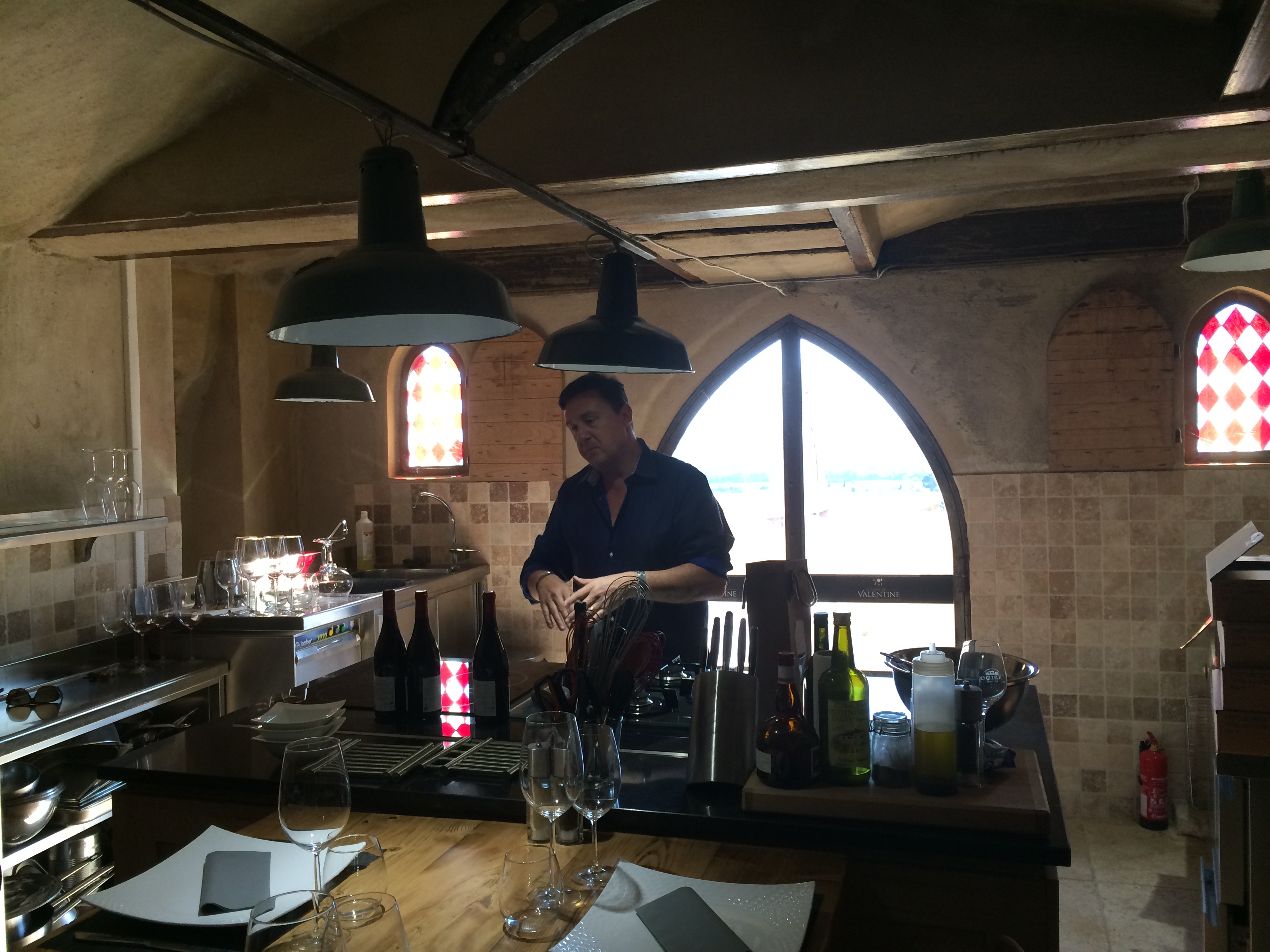
After our tasting, we had a quick tour of the rest of Les Caves Saint Charles with Guy Brèmond. There is another small storage room in the cave and a modern kitchen also where gourmet dinners are prepared to pair with these amazing wines. Guy also takes his act on the road, bringing dinners to private homes in the U.S. with a Michelin-Star chef. You can find out more about this at his website (LINK). This experience has been the wine highlight of our six weeks in France. I am very grateful to have discovered so much about the joys of Provence, and the wines of this amazing region.
Guy in the kitchen. Behind him is a terrace with an amazing view.Some of the Cave wines in the kitchen.A Cave Storage RoomEvery Chef needs some Wine for Cooking – and for the Cook!
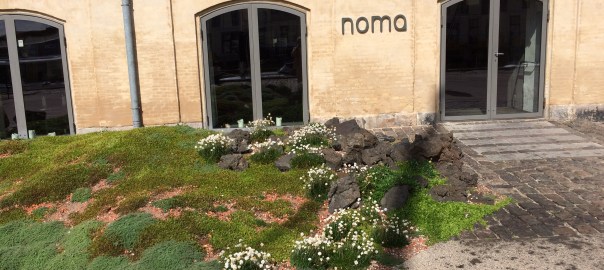
Noma, the Copenhagen restaurant that has been voted “The Best Restaurant in the World” (LINK) over and over, was the site of a recent visit by Dorianne, two friends, and me recently. Here are the links to the first three installments of the series: (LINK TO PART 1)(LINK TO PART 2)(LINK TO PART 3).
This post, the final installment in the series, covers the post-meal tour of the facilities at Noma (LINK)and contains some commentary.
After our meal (see parts 2 & 3 of this series), it was good to stand up. We had been sitting for about two and one-half hours in a very intensive activity – eating new things, drinking new wines, talking about the meal and doing our own internal processing without stopping. When I stood up, I realized two things – I had been sitting quite a while and I had a lot to drink. Wine with 20 courses . . . you do the math.
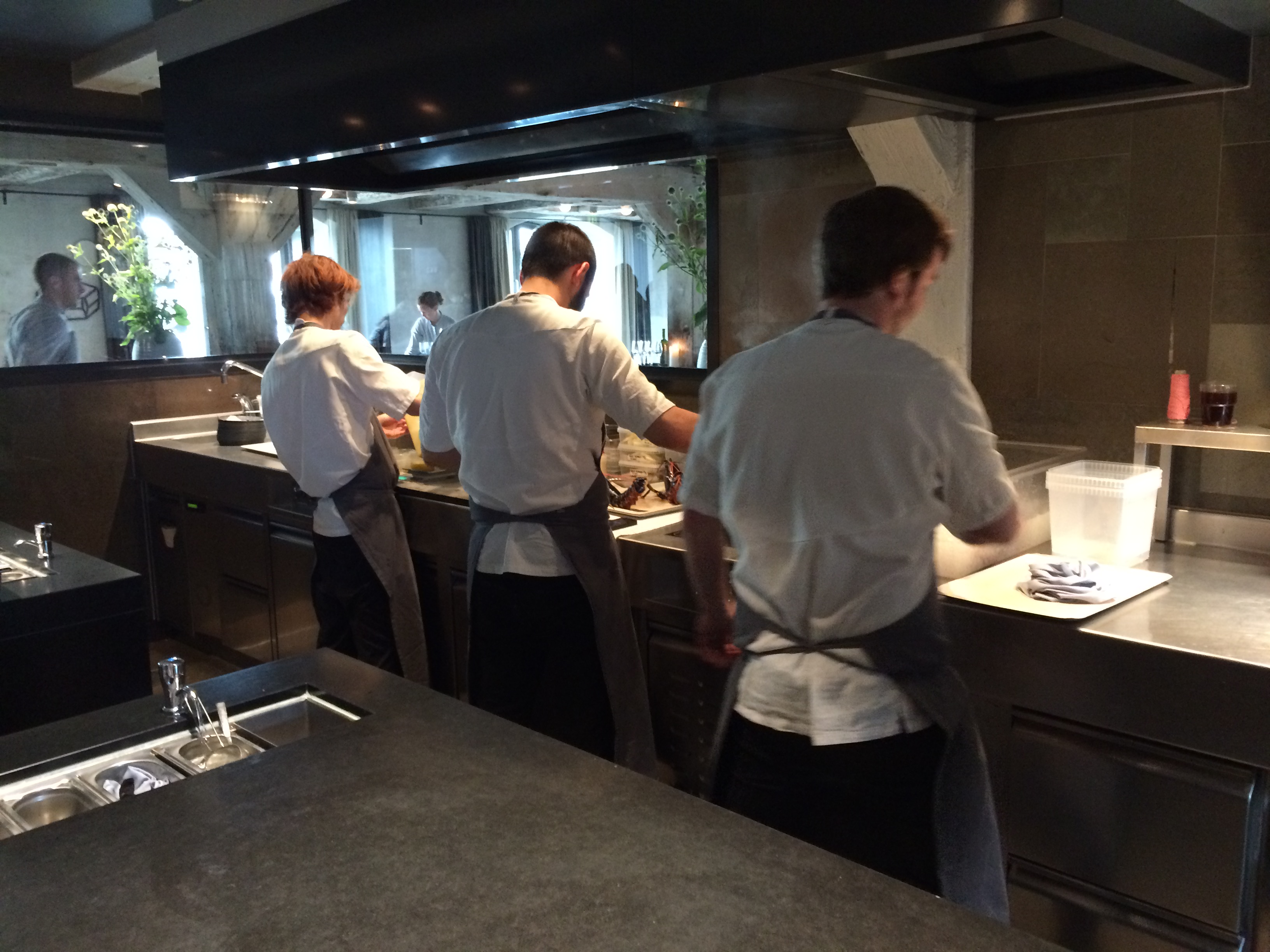
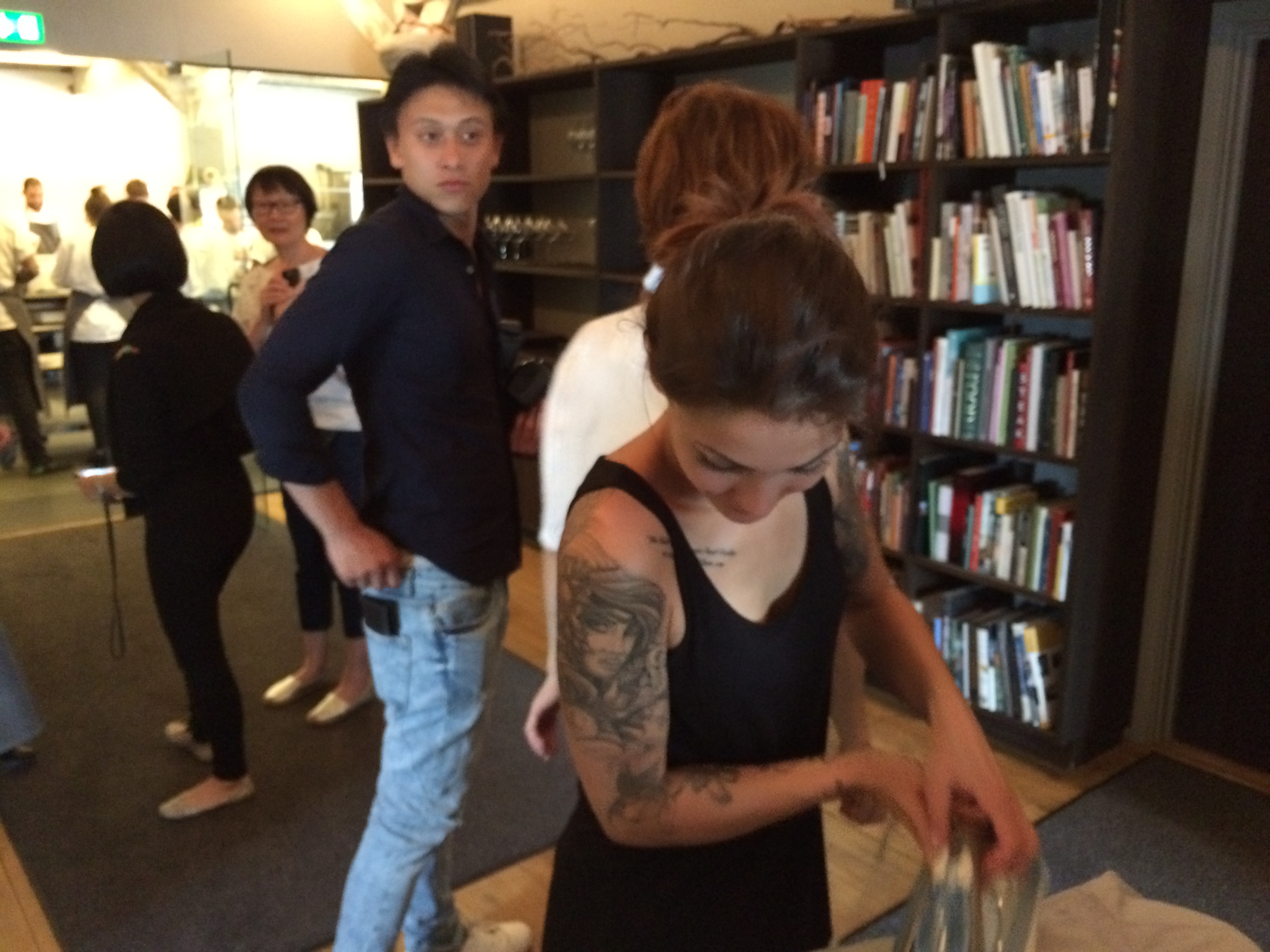
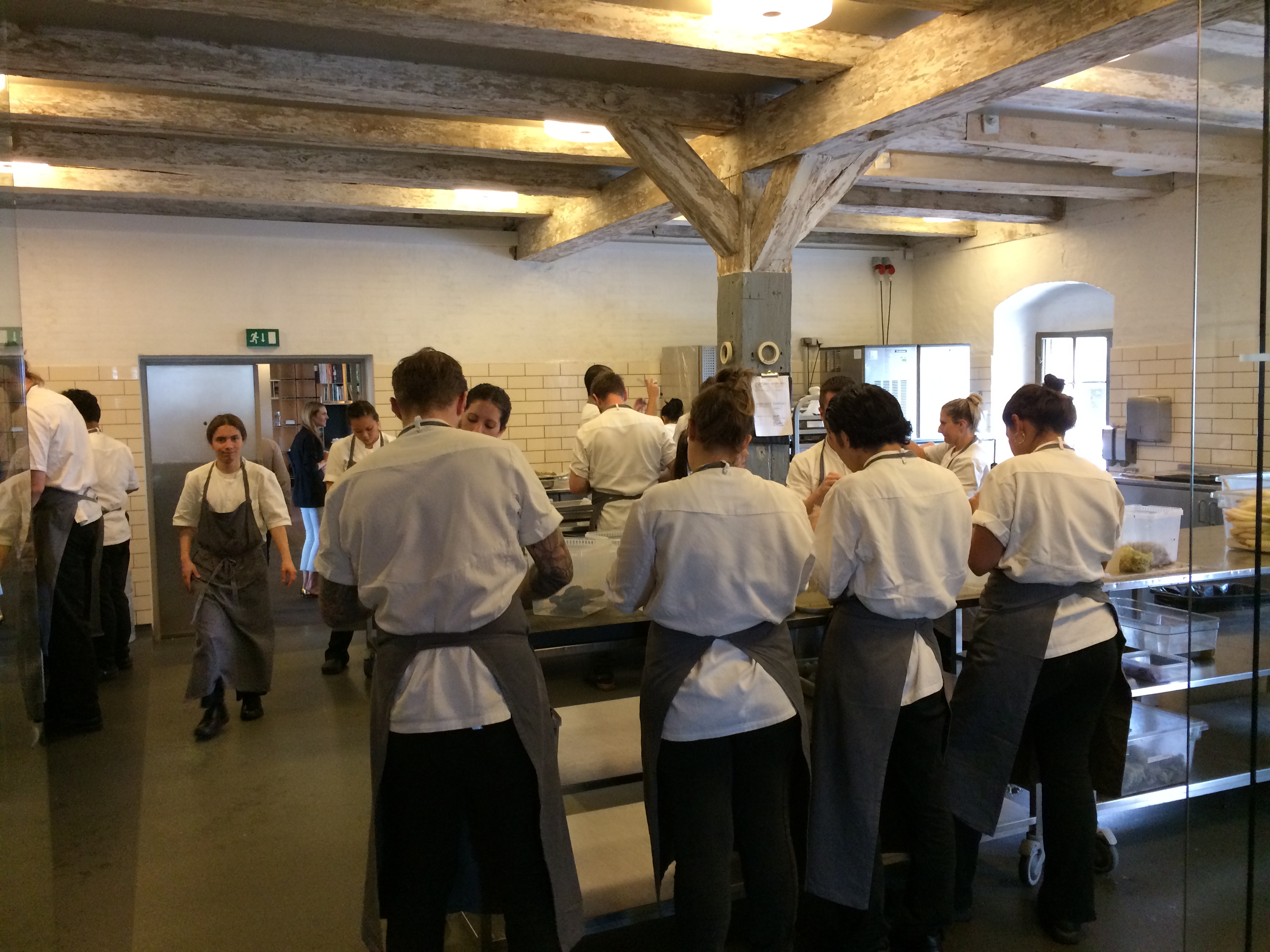
So I went to the restroom and then joined our party in the preparation kitchen, which is adjacent to and visible from the dining room. The tour, being guided by a young woman who is a chef at Noma (she said that she started as an intern a few years back. She is in her early 20’s, and YES, she knows – or says she knows – what an advantage that is for her). I did not get this young woman’s name, but I am sure that I will be seeing her face in a future foodie magazine as a star chef someplace.
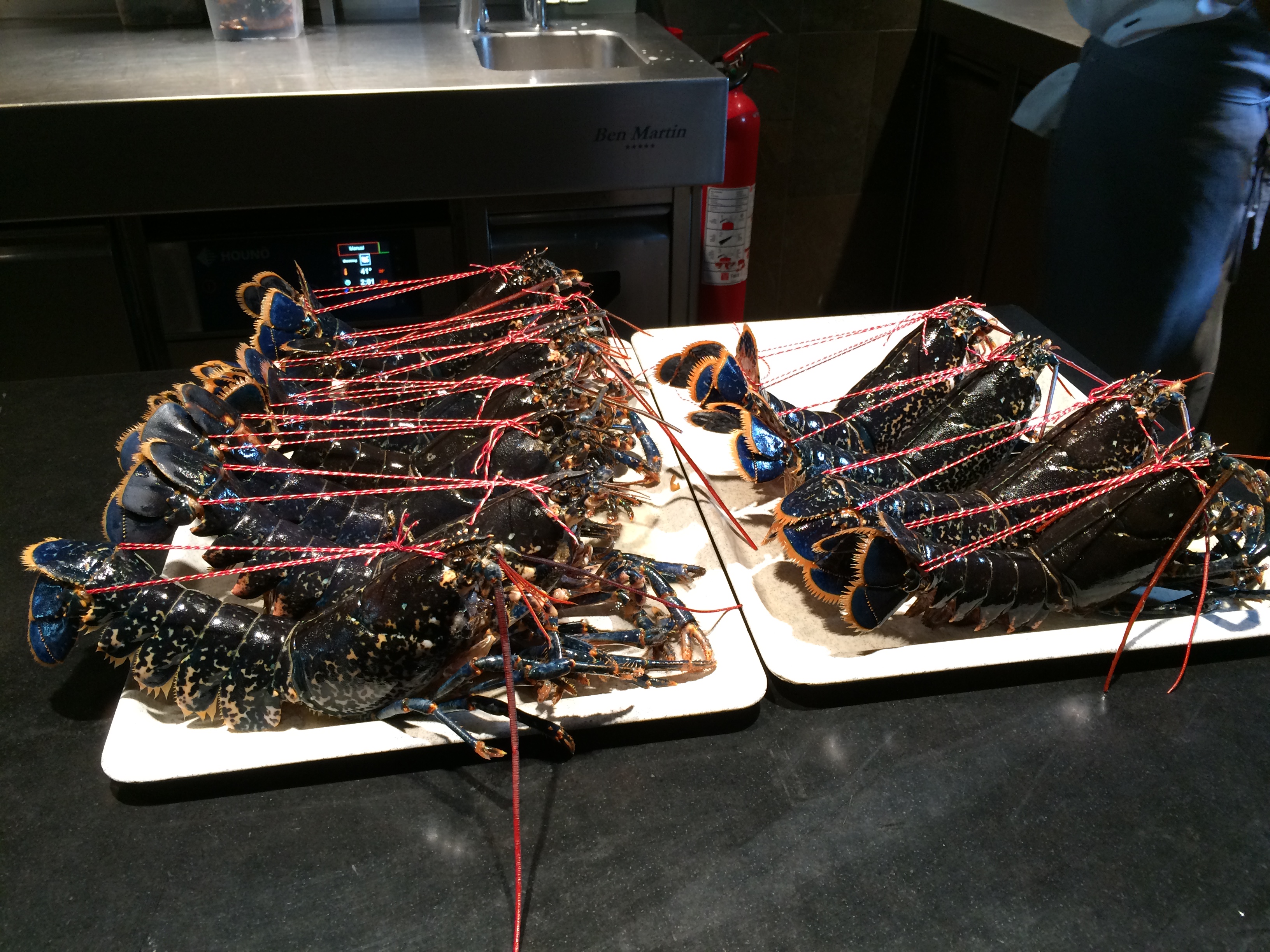
Assembling the Forest Flavors and Chocolate Desserts.North Sea Lobsters all in a Row.Presentation Kitchen Activity.Getting the Egg Liqueur Ready.
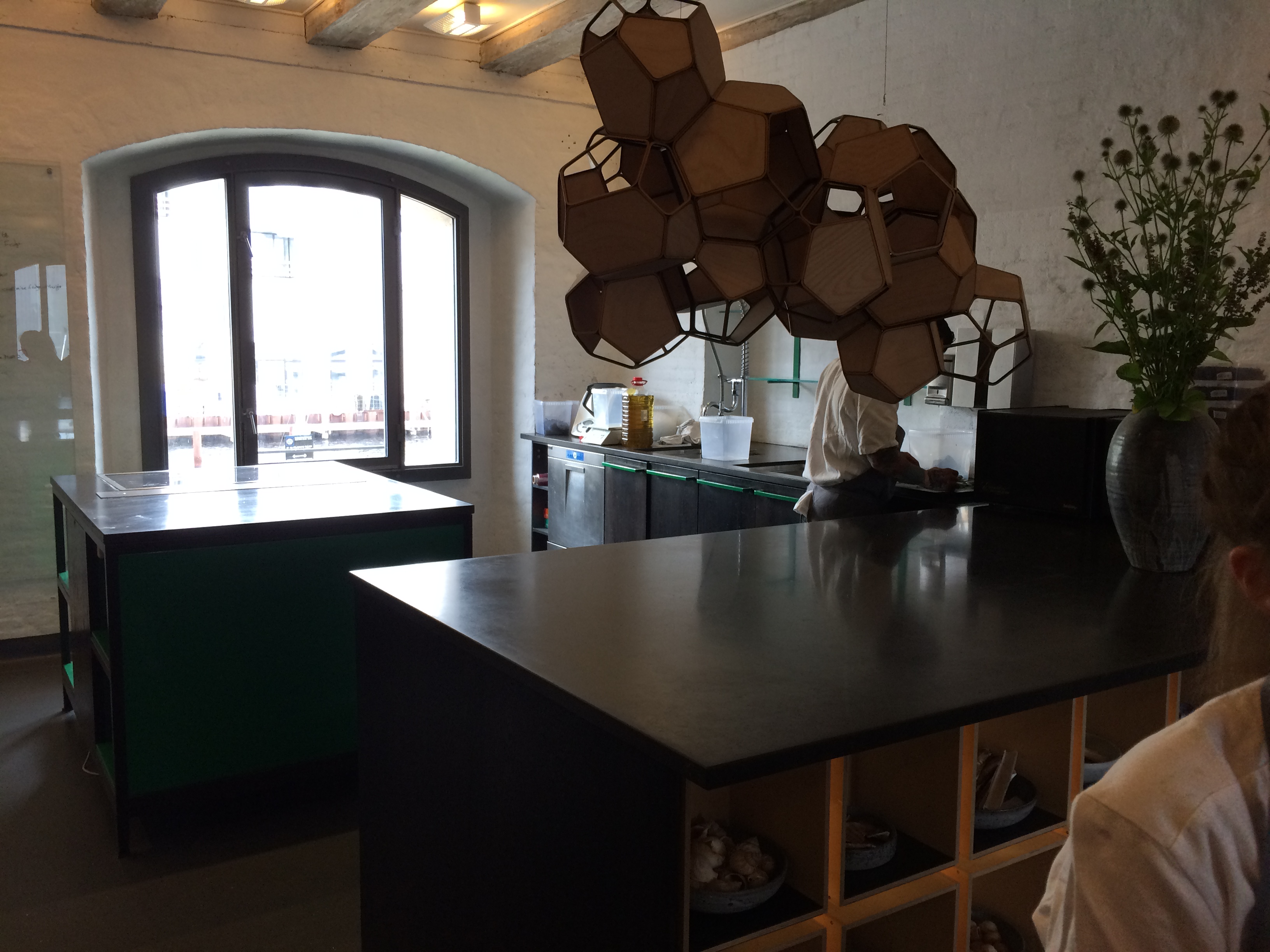
This first kitchen is where things are prepared to be served at the table and where some of the cooking is done.
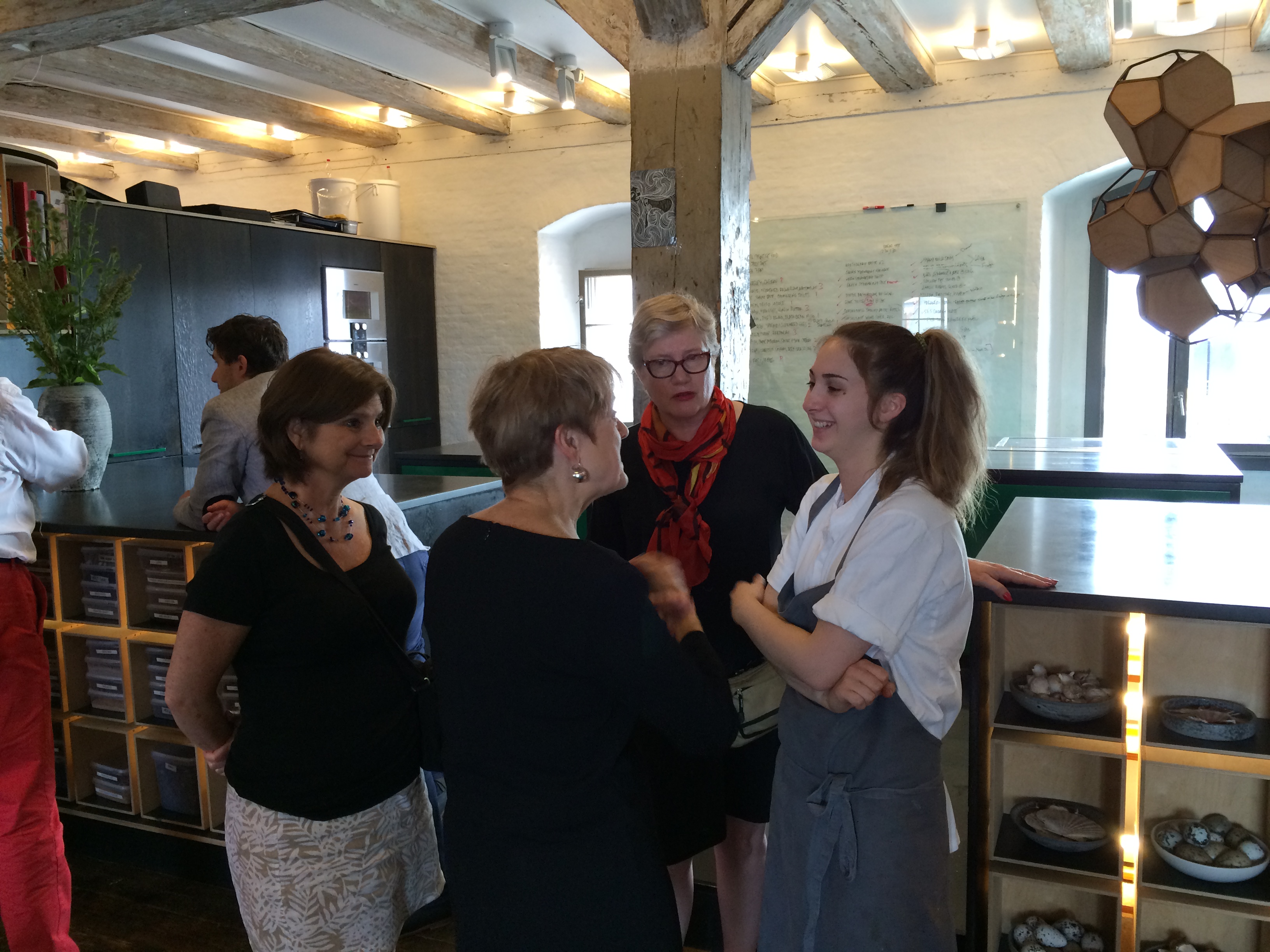
Our Young Chef Tour Guide Showing us Around.
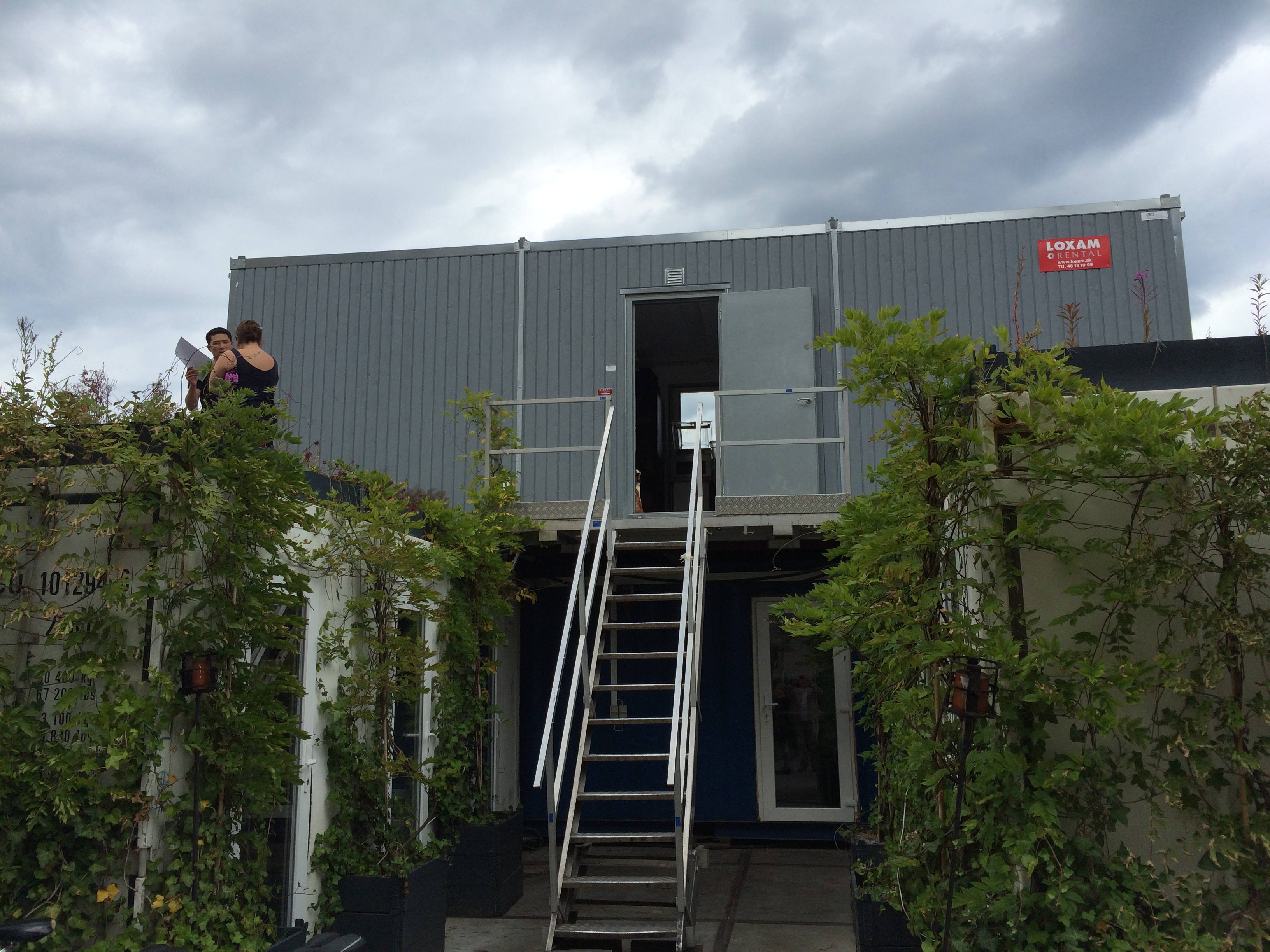
Then we went out back of the restaurant to the Laboratory.
That’s right. The LABORATORY.
The Laboratory Facility.Various Plants, Molds, etc., Being Tested for Various Qualities. All Very Mysterious.Testing How Certain Berries Age.
Here they try things out – there are all kinds of experiments going on to test various ingredients and what happens to them over time in various marinades, and under various conditions, etc. A very interesting part of the operation.
Upstairs, a private dining room that seats up to twenty. You can rent the room for a lot of money (like thousands of Euros) and then PAY FULL PRICE for your Noma meal!
The Private Dining Room on the Second Floor.
The Book Shelves of Noma.
Action in the hallway: Ironing uniforms.
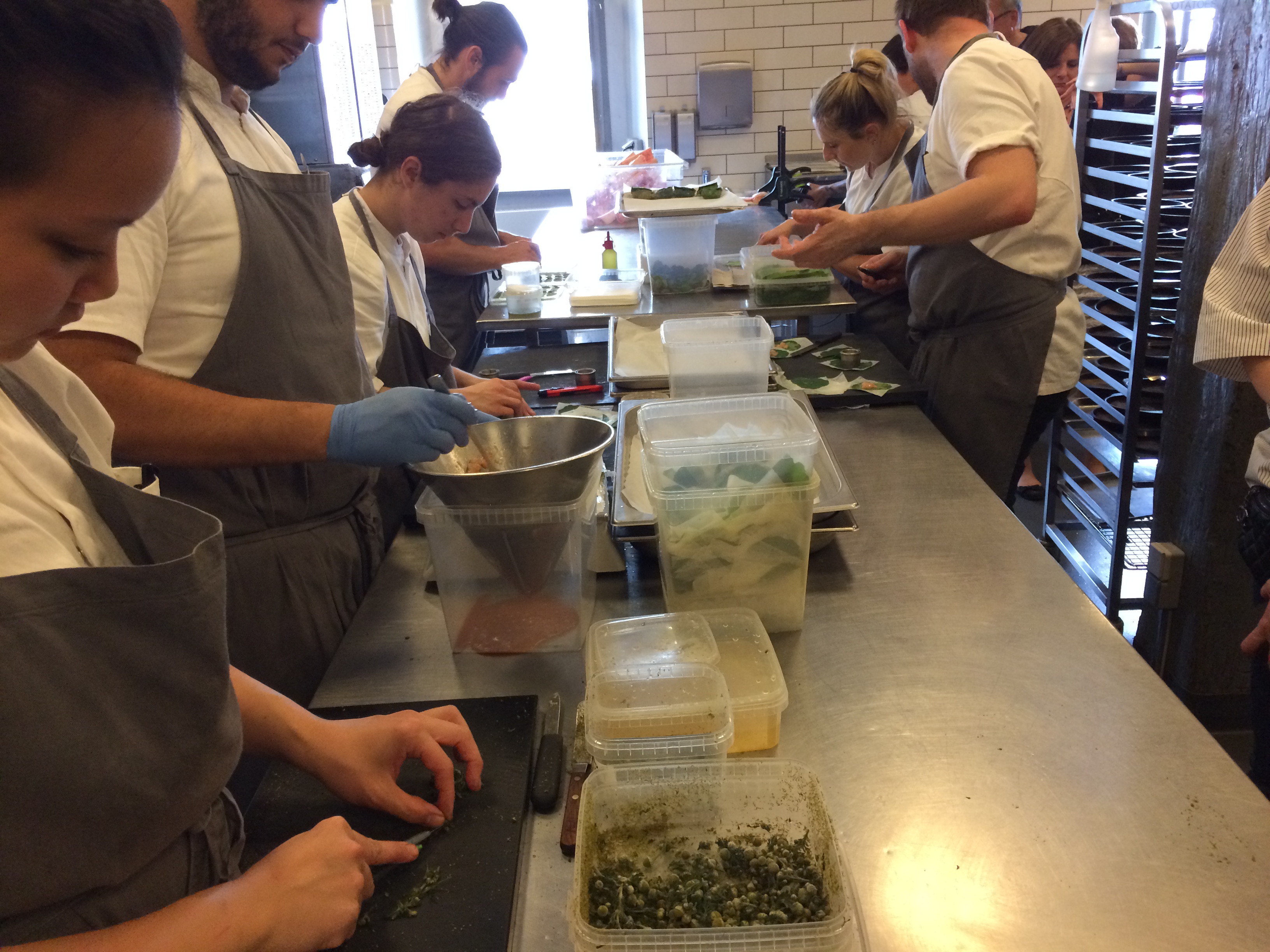
The Prep Kitchen – where the action is.
Cutting Frozen Bones for the Bone Marrow Dish.
Reindeer Moss.The Prep Kitchen Staff – Keep in Mind that Noma Seats 45 or so.
The Staff Room – where cooking, exploring recipe ideas, relaxing, changing clothes, etc. happens. There is a smaller kitchen, an herb garden, and lots of things stored – mushrooms, etc. Here you really get a sense of the Noma Culture, which is think is the glue that makes Noma what it is – one of the best restaurants in the world. You can see that the people who work here have accepted an ethos that they have had a hand in co-creating. René Redzepi, Owner and Founder and Chef de Cuisine is Daniel Giusti were not on the premises that day. They have brought a powerful culture of creativity, innovation, sustainability and success that seems to permeate the staff in a very good way. To work at Noma is to believe in this ethos, even if your intention is to get some experience and move on. While you are there, you are a true believer. Here is a link a partial list of Noma Alumni(LINK).
The Kitchen in the Staff Room.The Kitchen Garden in the Staff Room.Our Group has Lots of Questions for our Guide.
The lounge – near the entry, where you can have a drink before or after, or, I imagine, in lieu of, dinner.
The Lounge at Noma.The Wine Storage in the Lounge.
So ends our tour of Noma. On to some commentary.
Overall, this wonderful experience. While I did not like everything that I was served (probably not possible), I will say that the experience of the food was overall very enjoyable, both in tasting the dishes and in experiencing the creativity.
We were served 20 courses. My main negative about Noma is that the courses came out too quickly.
We had 20 in that time and it was too much too quickly. This is food that you want to savor – to talk about the amazing combinations of ingredients with your table mates, to take some photos (but of course!), and to taste the wine served and to experience the pairing of food and wine; then to reflect privately for a moment or two and then to share with your fellow diners your impressions and experience.
This takes time. But the next course is here!
I don’t think that this is a minor quibble. I like to savor. I don’t like to feel like they need to move me out to get the next seating in (which was not the case, as the next seating was for dinner). So please, Noma, a bit more time. I am not in a hurry when I am spending this kind of money for this kind of experience. I am sure that all of this has been figured out over time, but for me, it was not optimal in regard to truly enjoying the meal at leisure.
I read the other day of a restaurant opening in Barcelona that will serve 50 courses in two and one-half hours. I doubt I’ll be going there.
The wines at Noma were, let me say, unique (LINK TO LIST AS PDF). I have written about each and posted photos of the labels, but you probably won’t be able to find most of them – maybe one or two. I spoke with Sommelier Yukiyasu Kaneko about his choices. He said that he preferred to use only European wines, and that included a wine from Georgia in the former Soviet Union. He also clearly has a preference for young wines to accompany the fauna heavy Noma menu. All of the wines were whites. I found that the pairings worked well with one or two exceptions, and in those cases the wines were either sour or so very young as to have only rough edges, which I guess was intentional, but I did not agree with those choices.
Note that there is a lounge at Noma, where you can come for a drink or some wine before or after dinner, although you get quite a bit of wine with the paring meals – I recommend a taxi or a designated driver. We walked, and got a bit lost on the way back to our apartment.
How much did it cost? The wine pairing meal was 3100 DKK or about $450 per person. the juice pairing was 2500 DKK or about $367. Expensive, I know. It was Dorianne and my 10th Wedding Anniversary gift to one another, so a very special occasion.
Will I go again? Not sure that I need to, but if the opportunity presents itself – I will strongly consider it. I’d like to see what they do next. Have you been to Noma? Your comments are appreciated.
Noma, the Copenhagen restaurant that has been voted “The Best Restaurant in the World” (LINK) over and over, was the site of a recent visit by Dorianne, two friends, and me recently. Here are the links to the first two installments of the series: (LINK TO PART 1)(LINK TO PART 2).
This post covers the second half of our 18 (actually 20) course meal and wine pairing.
Course #10:
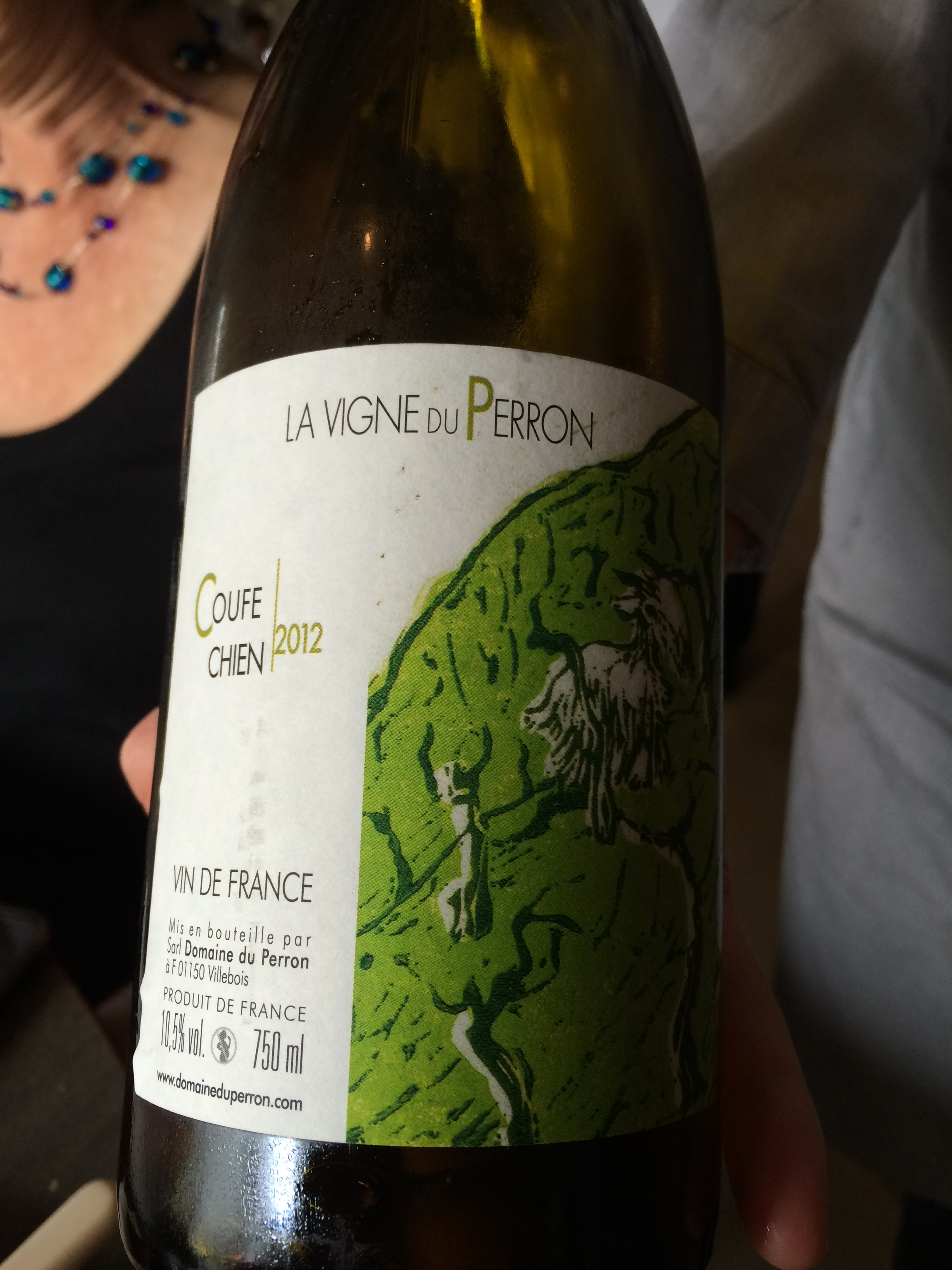
2012 Coufe Chien, Domaine du Perron, Bugey – SavoieMahogany Clam and Grains.Mahogany Clam and Grains.
Our wine for this and the next course is a 2012 Coufe Chien, Domaine du Perron, Bugey – Savoie, Chardonnay (LINK to the 2011)from the Rhone Valley. Young and high in acid with an aromatic nose and hints of citrus, it was a perfect accompaniment to the Mahogany Clam.
The single clam was mounted on a bowl of wet stones (which we were advised not to eat). The uncooked clam meat was sitting in a marinade with a dusting of samfire (LINK) around the top of the shell. The dish was to eaten with a wooden fork. It was delicious – I could have eaten the rest of the dozen, but alas, it was not to be.
Next:
Monkfish Liver on Toast.Monkfish Liver on Toast.
This course, Monkfish liver, cooked then chilled and served very cold on toast, sitting atop a folded napkin. This was a particularly succulent dish, with a great texture and flavor. The Coufe Chien was a beautiful match for this dish. Eaten with fingers.
Next:
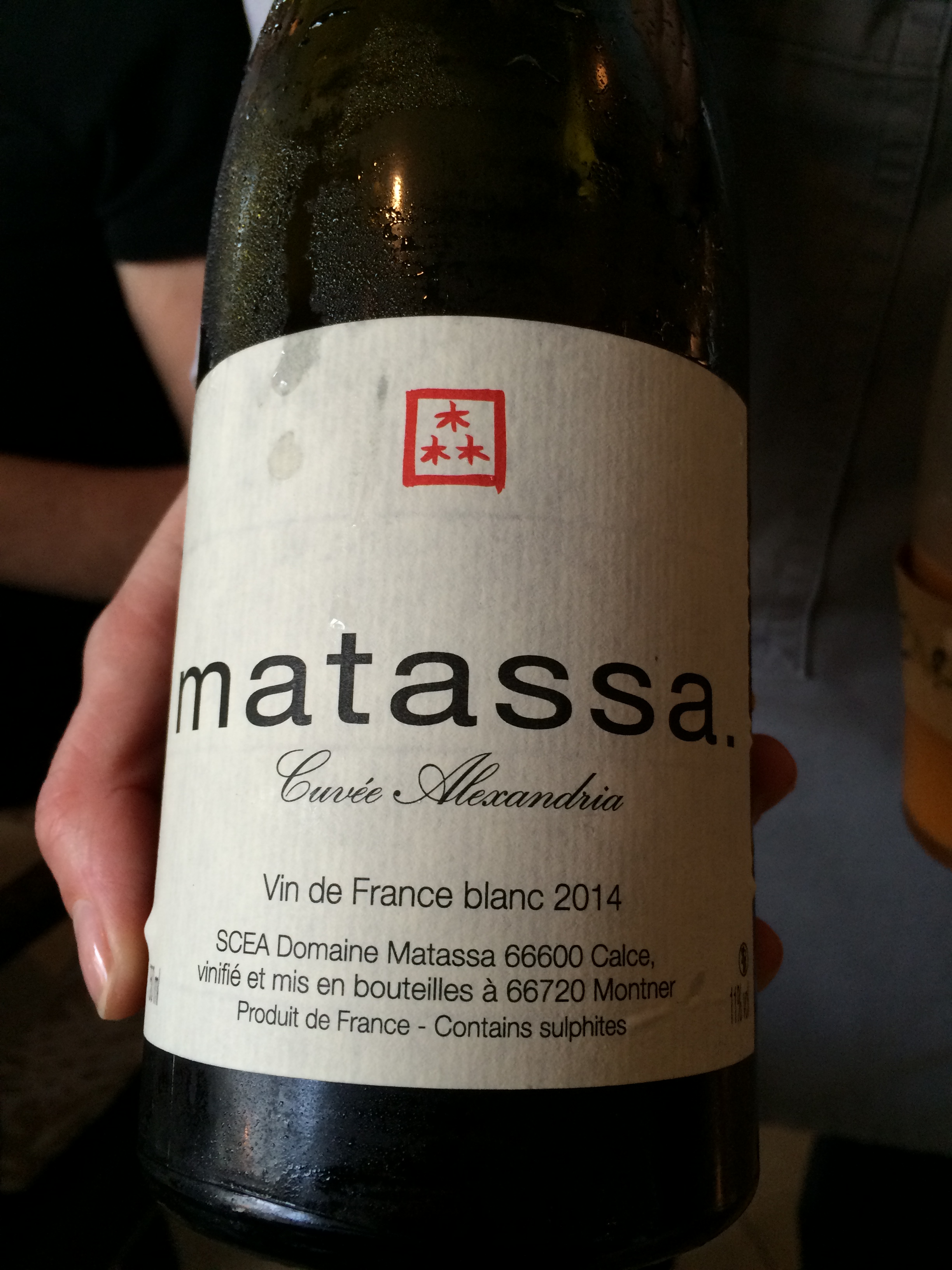
White Asparagus, Goosefoot, and Barley.2014 Cuvée Alexandria, Domaine Matassa, Calce – Cote Catalan
Our next wine, a 2014 Cuvée Alexandria, Domaine Matassa, Calce – Cote Catalan (LINK – click on Cuvée Alexandria), is described as a “raw wine,” made from a grape called Muscat d’Alexandria. You won’t find much about this wine, from the Catalan hills in extreme southwest France, online, and I doubt that you will be finding this wine in your local wine shop. The wine is unfiltered, very young and is very raw. I would describe it as bitter and a bit sour. Not for sipping. It reminded me of the must right after fermentation, while the wine is still in the fermentation vessel.
It was served with only one dish, a white asparagus, goosefoot (LINK), and barley plate, this one eaten with utensils. The asparagus was amazing – tender and delicious, the goosefoot and barley added notes of green sour and some texture. And, I was surprised to see that there was some justification for the wine pairing. The Cuvée Alexandria was a decent match, adding to the sour notes of the dish (you would have to like sour), and extending the flavors through a long finish. Intriguing.
For the next course, a new wine:
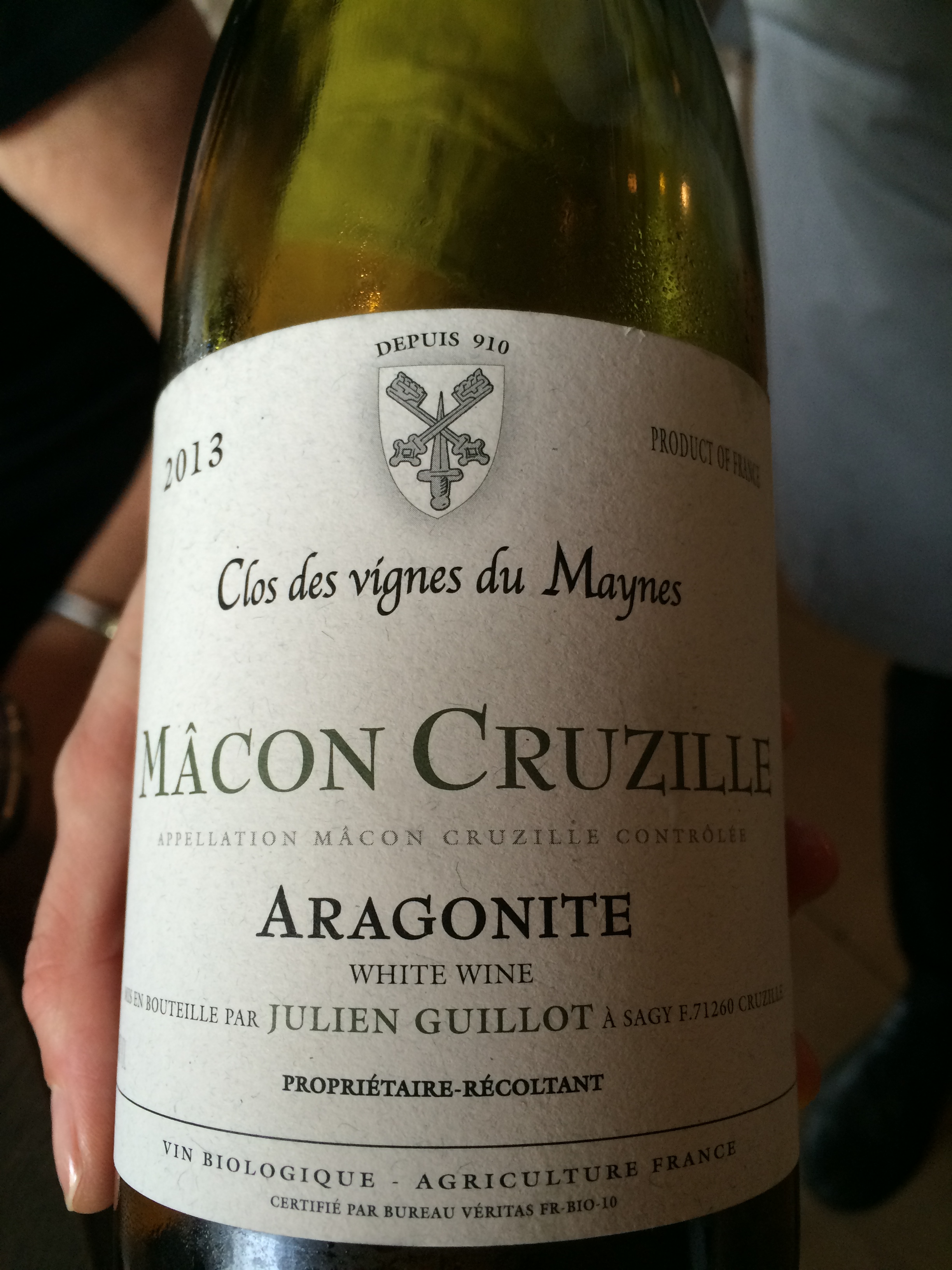
The Glasses Accumulate.2013 “Aragonite” Julien Guillot, Cruzille – MaconVegetable Flower.
The new wine, a 2013 “Aragonite” Julien Guillot, Cruzille – Macon(LINK), a Burgundian Chardonnay, was a return to wine-normalcy for me. Fragrant, well-structured, and clean, the wine drank very well.
The first of two pairings with this wine was called vegetable flower. As you can see, it was nasturtium flowers in a vegetable broth. Delicious and delicate, the wine did not overpower this dish.
Then:
Lobster and Nasturtium.Lobster and Nasturtium.
Lobster and nasturtium was next. A North Sea lobster tail served with nasturtium leaves attached. Paired with the Julien Guillot Chardonnay, it was one of the highlights of the meal.
Now, we enter into a bit more unusual territory:
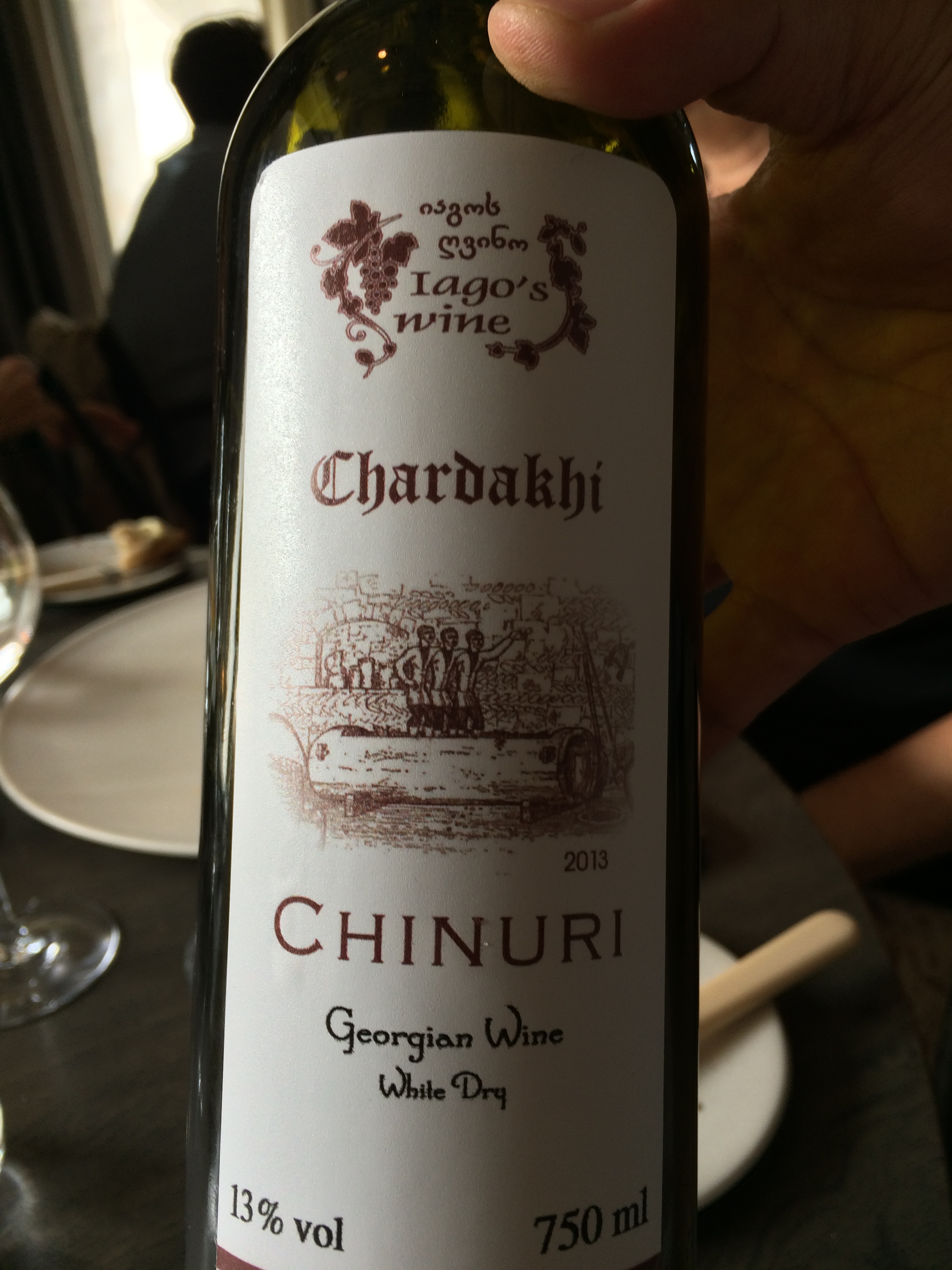
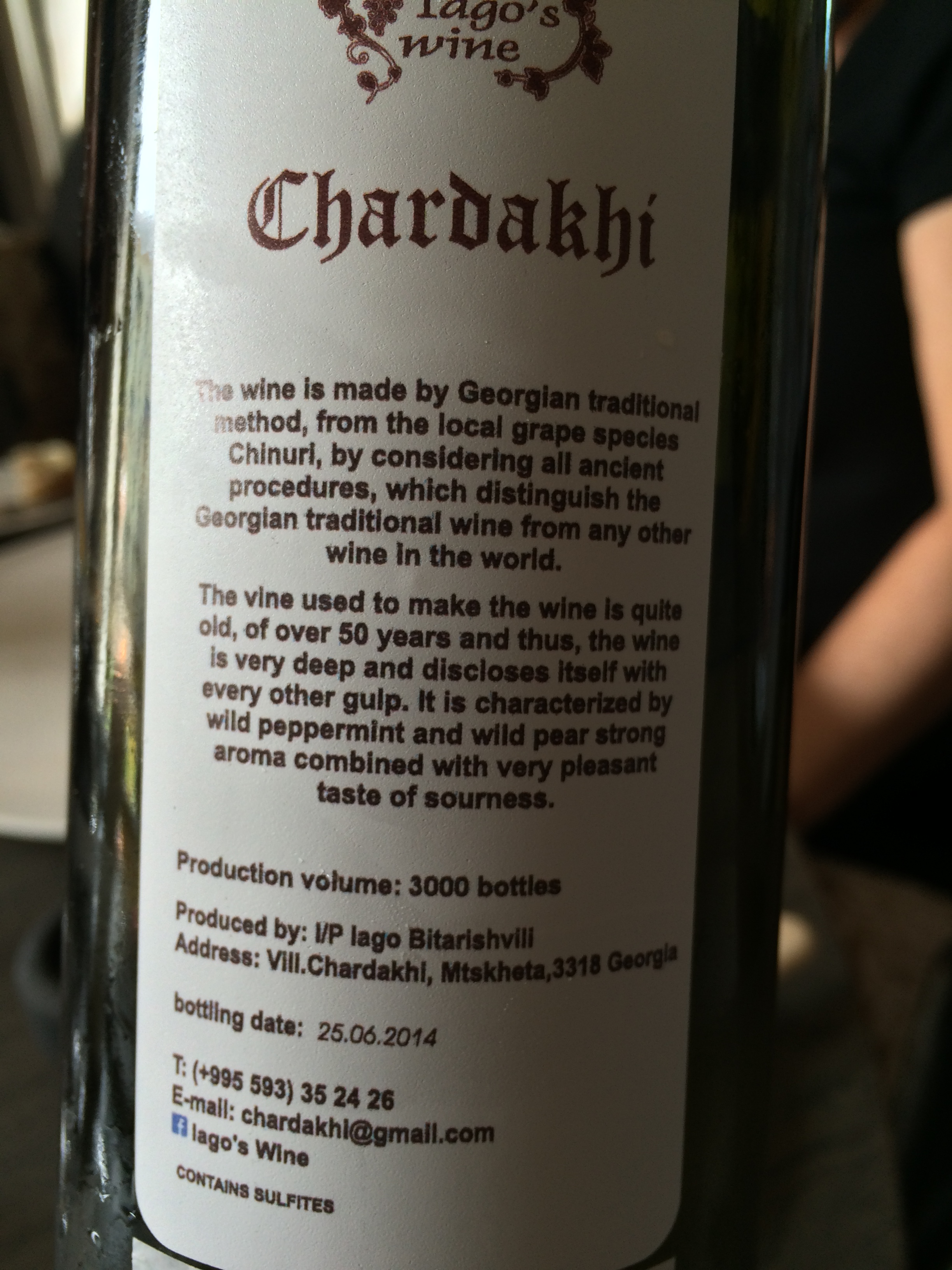
2013 Chinuri, Iago’s Wine, Chardakhi – Georgia.2013 Chinuri, Iago’s Wine, Chardakhi – Georgia. Back Label in English!
The next wine, a 2013 Chinuri, Iago’s Wine, Chardakhi – Georgia(LINK), was most unusual. Unfiltered, young, sour. Even more so than the Cuvée Alexandriamentioned earlier. This wine was almost unpleasant – there was wine in the mix somewhere, it was just hard to find.
The first pairing was a dried fruit “leather” shaped into a leaf with a number of other items on it, including some garlic and grasshopper flour. It had the consistency but not the flavor of licorice and was very good.
Next:
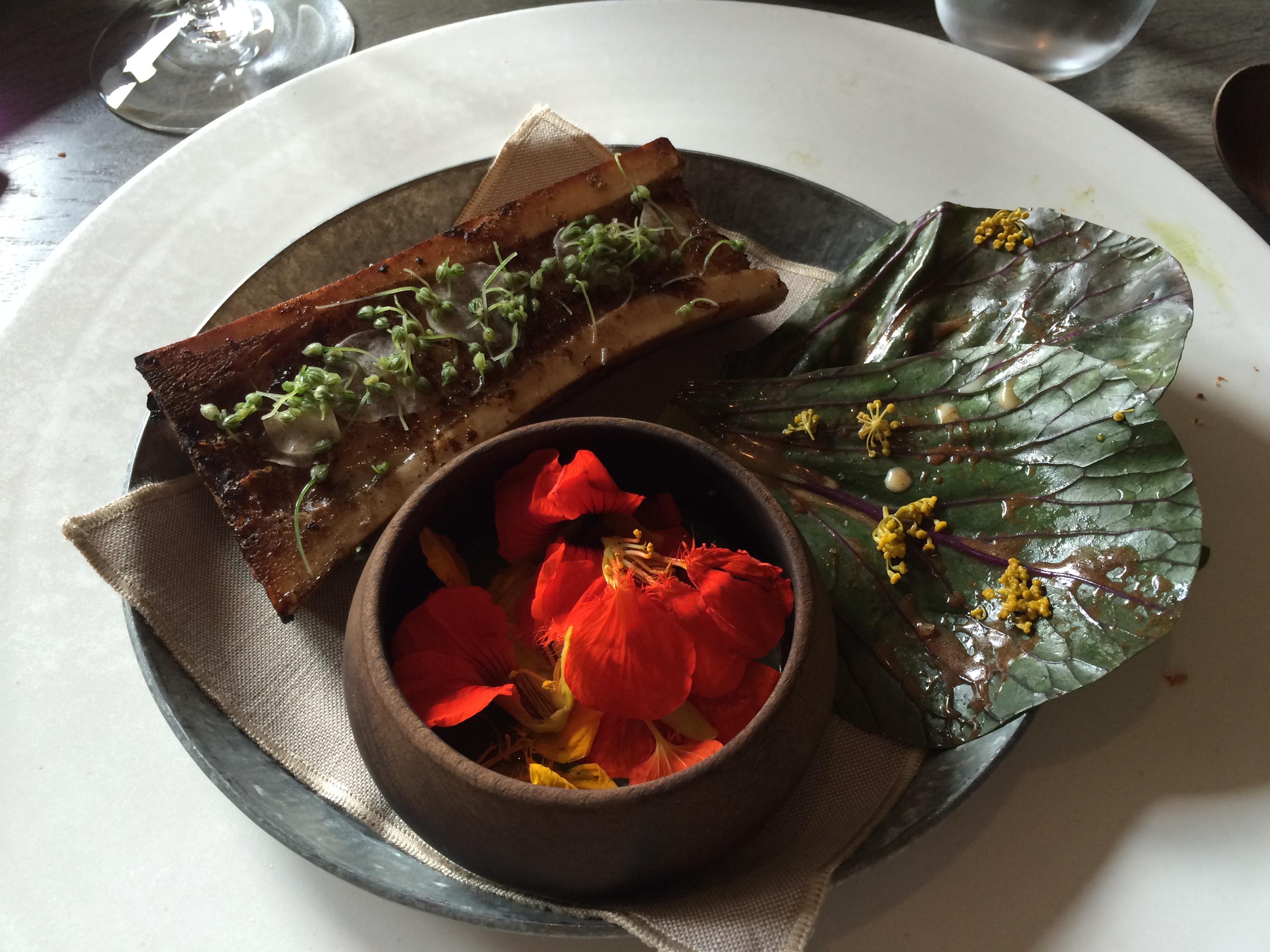
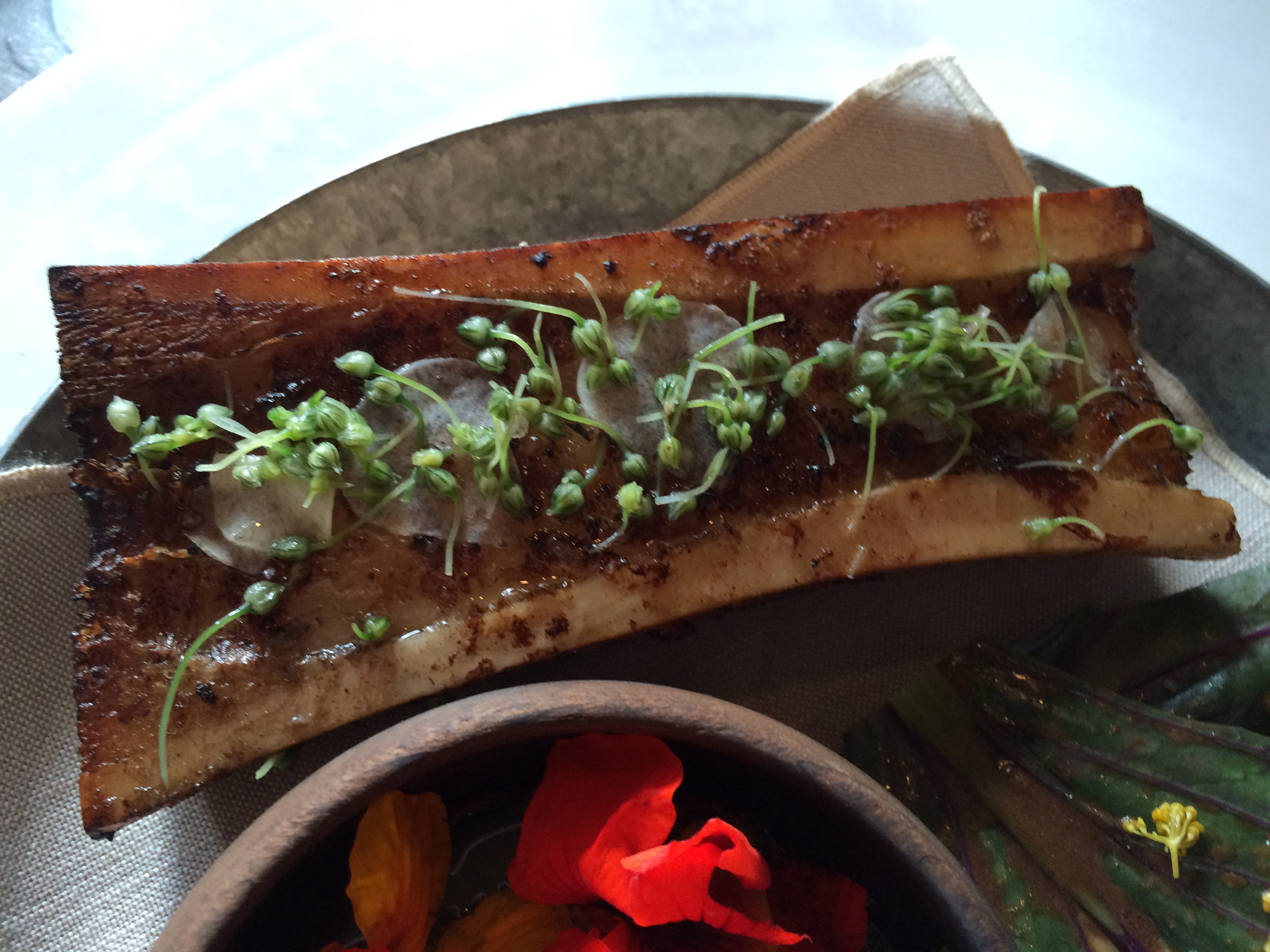
Bone Marrow with Flower Soup and Nasturtium Leaves.Bone Marrow with Flower Soup and Nasturtium Leaves.
Then, a dish not on our printed menu – beef bone marrow with a “soup” of flowers, and nasturtium leaves. This dish was the only one served that might have called for a red wine, but the Chardonnay did it’s job of pairing pretty well.
At this point, we were visited by the Sommelier, Yukiyasu Kaneko of Japan.
Noma Sommelier, Yukiyasu Kaneko of Japan.
He answered our questions (I had a longer chat with him later) and explained his theory of using younger wines to compliment Noma’s unique cuisine.
Next:
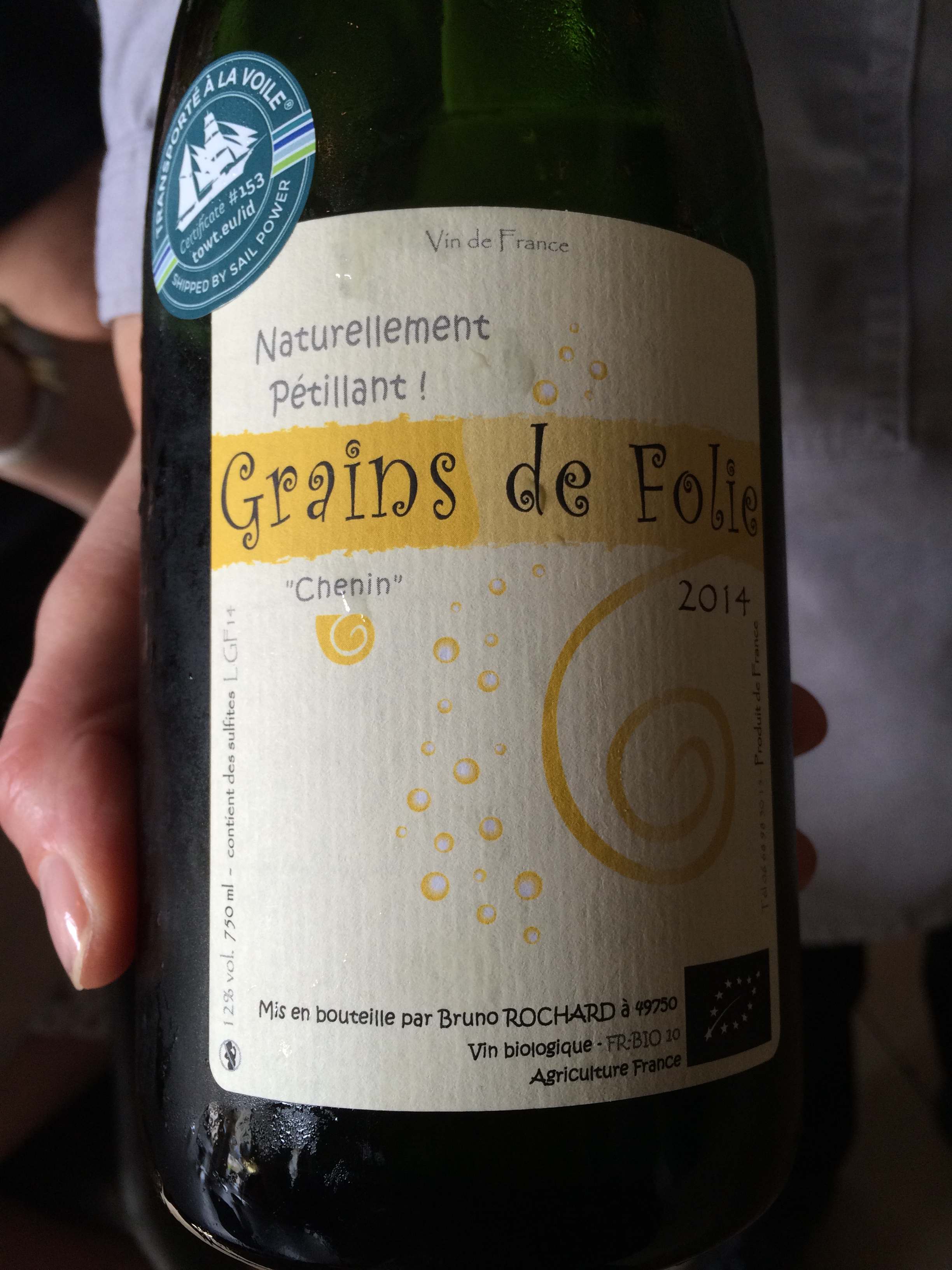
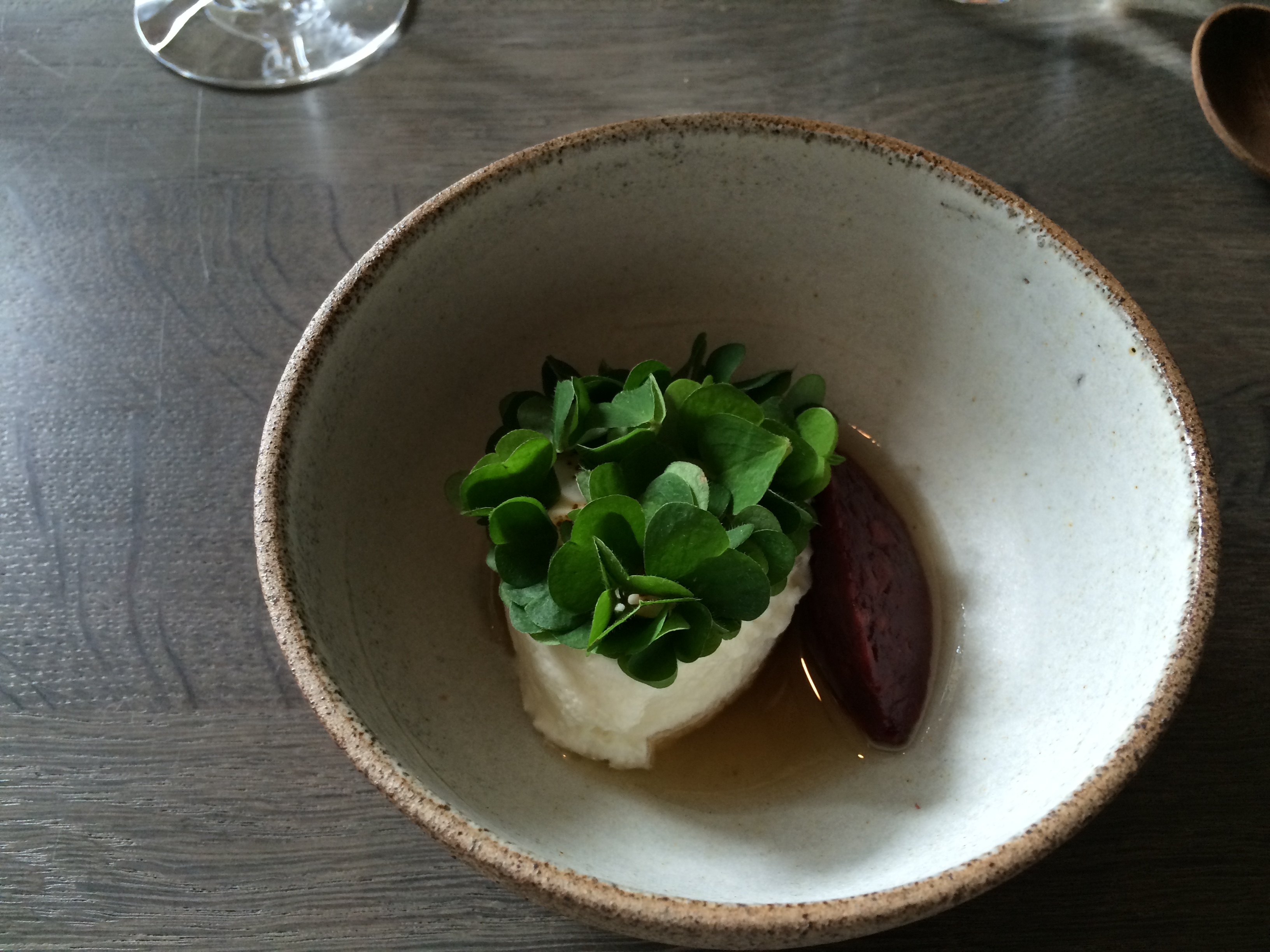
2014 Grains de Folie, Bruno Rochard, Coteaux du Layon – Loire.The Cheese Course – Not Sure of the Ingredients beyond a Creamy Cow’s Cheese.
The next wine, a 2014 Grains de Folie, Bruno Rochard, Coteaux du Layon –Loire Valley, Chenin Blanc (LINK – Related)comes from a region known for sweet wines. This wine, was a bit on the sweet side of dry. It was light, refreshing, and a nice pairing for the cheese course (also not on the written menu). The pairing worked well. The cheese was light and creamy, in a vegetable broth. Very good.
Now, on to Desserts:
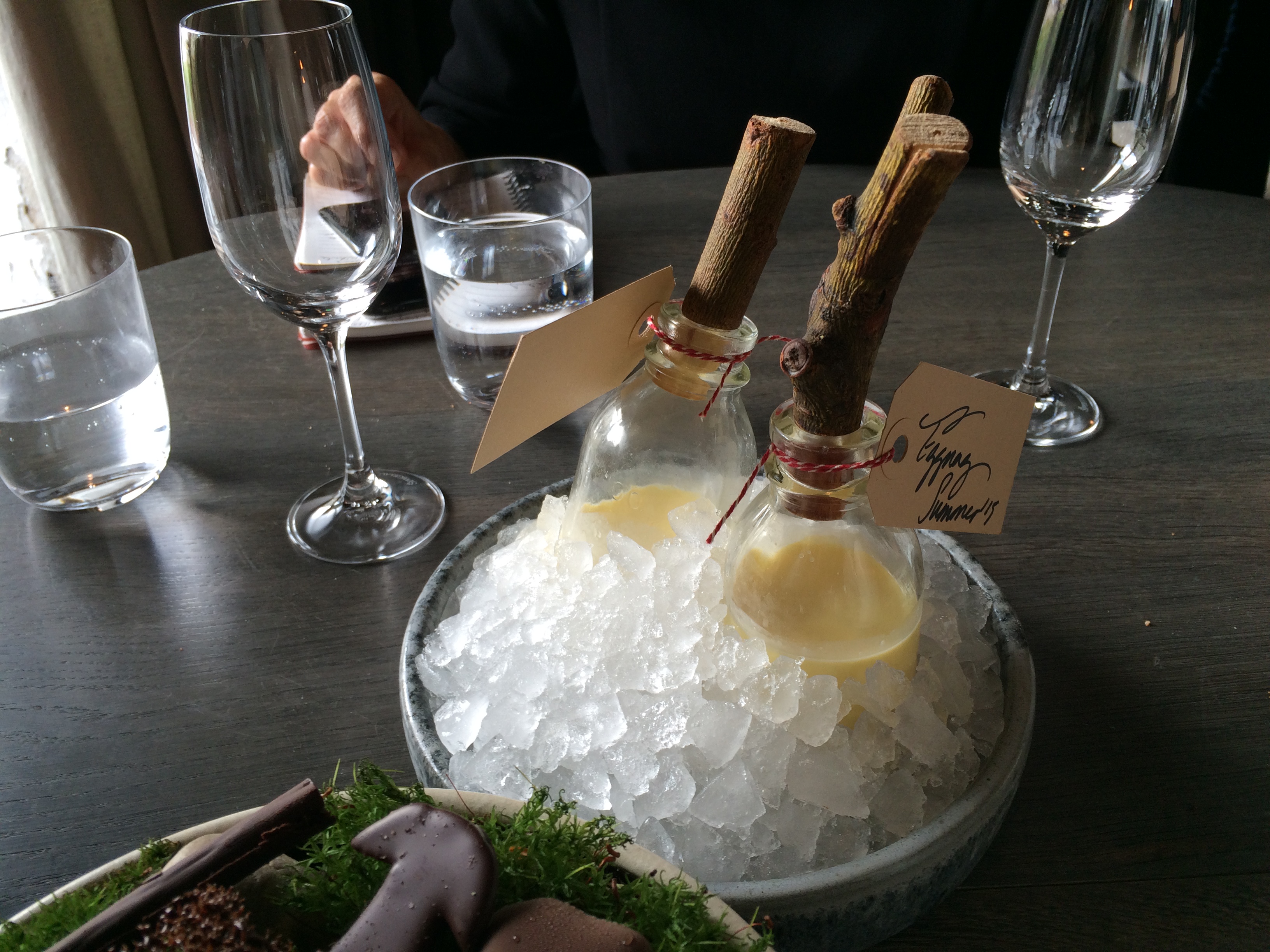
Berries and Greens Soaked in Vinegar for One Year.Forest Flavors – Deep Fried Reindeer Moss Dipped in Chocolate.Creme and Dipping Sauce.Egg Liqueur.Espresso to Finish.
Desserts were a flurry of items, pickled and sweet, with egg liqueur and espresso. The berries and greens soaked in vinegar for one year were very good – each retained much of its original flavor, but the textures were very unusual. The forest greens dipped in chocolate were a combination of tart, sour and sweet – the creme dipping sauce could tip it to the sweet side if you preferred, plus there were some more conventional chocolates on the plate. The egg liqueur was very smooth, much thinner than eggnog, and refreshing.
I should point out that Dorianne has allergies to beef and cow dairy, and the Noma staff made every effort to accommodate her in this regard, substituting ingredients, etc. You let them know 30 days in advance of your reservation about any allergies.
Wow. What a meal! The 18 courses turned out to be 20. We were well-fed, entertained, amazed, and, actually, ready for more. In the next and final installment of this series, I will let you know about the tour that you are offered of the Noma Complex and what you learn about the unique Noma Culture.
The food at Noma changes, sometimes daily. It is based on the seasons, on what has been foraged that morning, on what the chefs are trying to do, and, I am sure, on other factors that I know nothing about. Everything that we had was unique and clearly well thought out. I did not like everything, but I did not hate anything served. There was quite a bit of “sour” taste on the menu, and some on the wine list. There were some dishes that were interesting but not memorable. And there were some that soared. Those experiences were different for each of us at our table for four – Dorianne, me, and friends Ginger and Patricia. Three of us opted for the wine paring, Ginger opted for the juice pairing – a different juice blend comes at the same time that new wines are introduced. She raved about the juices, and we all tasted some and they were very, very good.
The presentations were unique, generally attractive and appealing, and mostly, delicious. There were lots of flowers, some rocks, mushrooms, moss, leaves, dough, lobster, bone marrow, berries, and many things that I had never seen on a plate before.
The restaurant is very nicely appointed, but not flashy at all. Rough-hewn wood, lots of gray colored fabrics and surfaces; you might say that the dining room is understated, as you might expect in Denmark.
The Dining Room with the Wine and Juice Cooler.
The tables are simply set. There is a clear effort to have guests feel welcome and to make the experience as unpretentious as possible. Staff are friendly, direct, and relatively informal. They do what they do very well, are always in motion, but have time for any query or request.
THE MEAL
Turnip and Unripe Strawberry Marinated in Aquavit with chamomile and other berries. Served on Ice.The First Wine – Not on the Menu – A Champagne.The Bread Bowl.
The first three courses are not considered a part of the pairing dinner. We were served a Champagne for all of these courses, a dufour par charles champagne “les instantanes”, which I could not find in an internet search (found the producer, but not this wine). Suffice to say that it was very well made, light and crisp, and you likely will only get it at Noma. The first item served to us was a small bowl of ice topped with turnip and unripe strawberry marinated in Aquavit. There are obviously other things sitting on top of the slice of turnip and the strawberry, berries, flowers and such – there are always other things on the dishes that are not described on the menu, but are described by the server. The server, by the way, will be either one of the wait staff or someone from the kitchen who worked on the dish being served.
This dish, eaten with the fingers, was very tart (Aquavit and unripe things) and the Champagne was a wonderful match, giving a sense of ripeness, but not too much. I was thinking that they know what they are doing. Smiles, oohs and aahs, and photo taking all around the table (I stopped the server to photograph each wine bottle as it was served – they were wonderfully patient). A very good start.
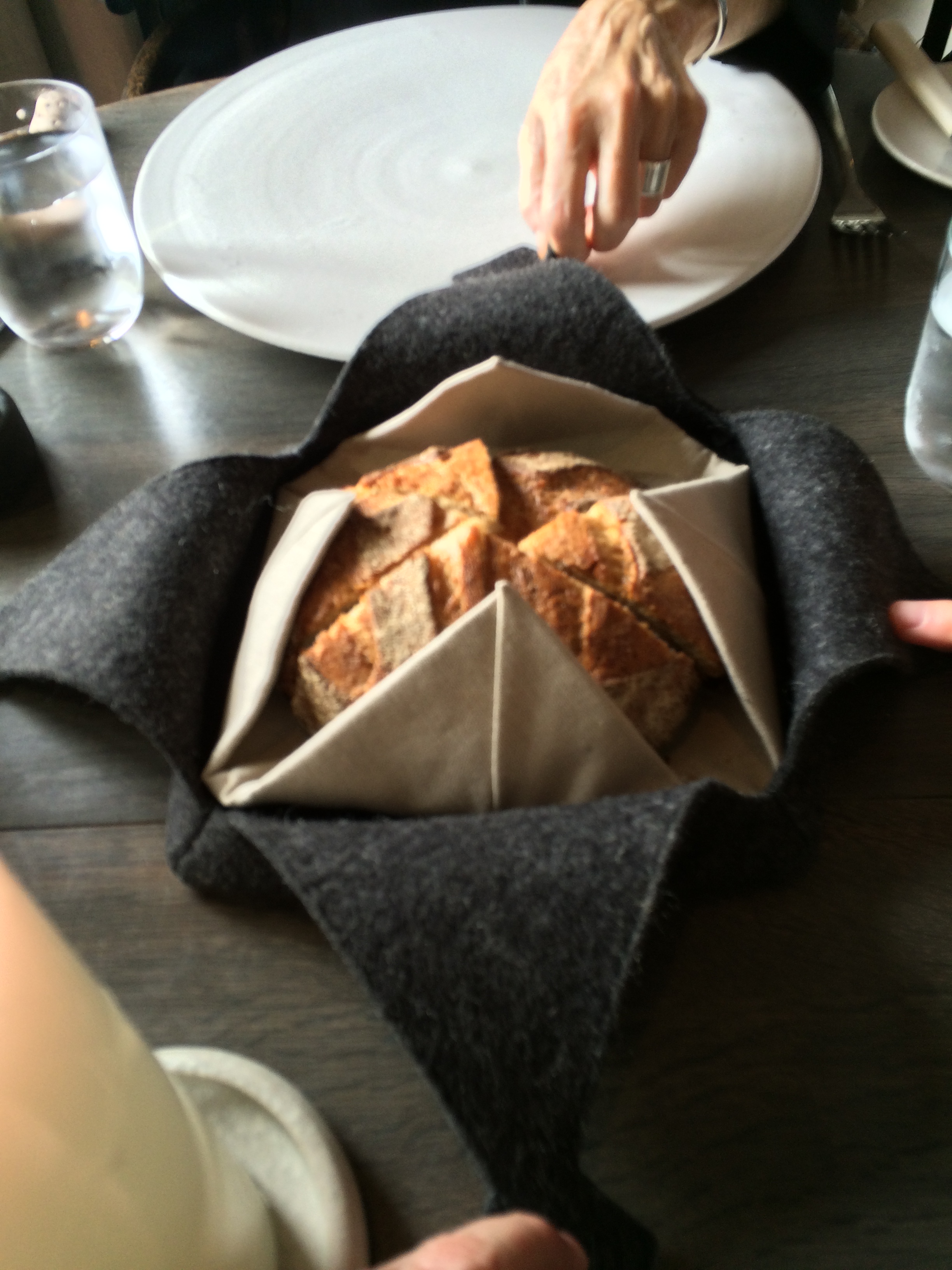
The bread, served in a felt basket, made from native Oland wheat and accompanied by both butter and rapeseed oil was delicious. The basket was refilled at least twice during the meal.
Summer Cabbage Leaves and White Currants.The sauce being added to the Summer Cabbage for Patricia.
Next came summer cabbage with white currants and a white currant broth that was added at the table. This continued the tendency toward sour, unripened flavors. It could be classified as a soup, I suppose. Again, the Champagne was right there to extend and ripen the experience of the food.
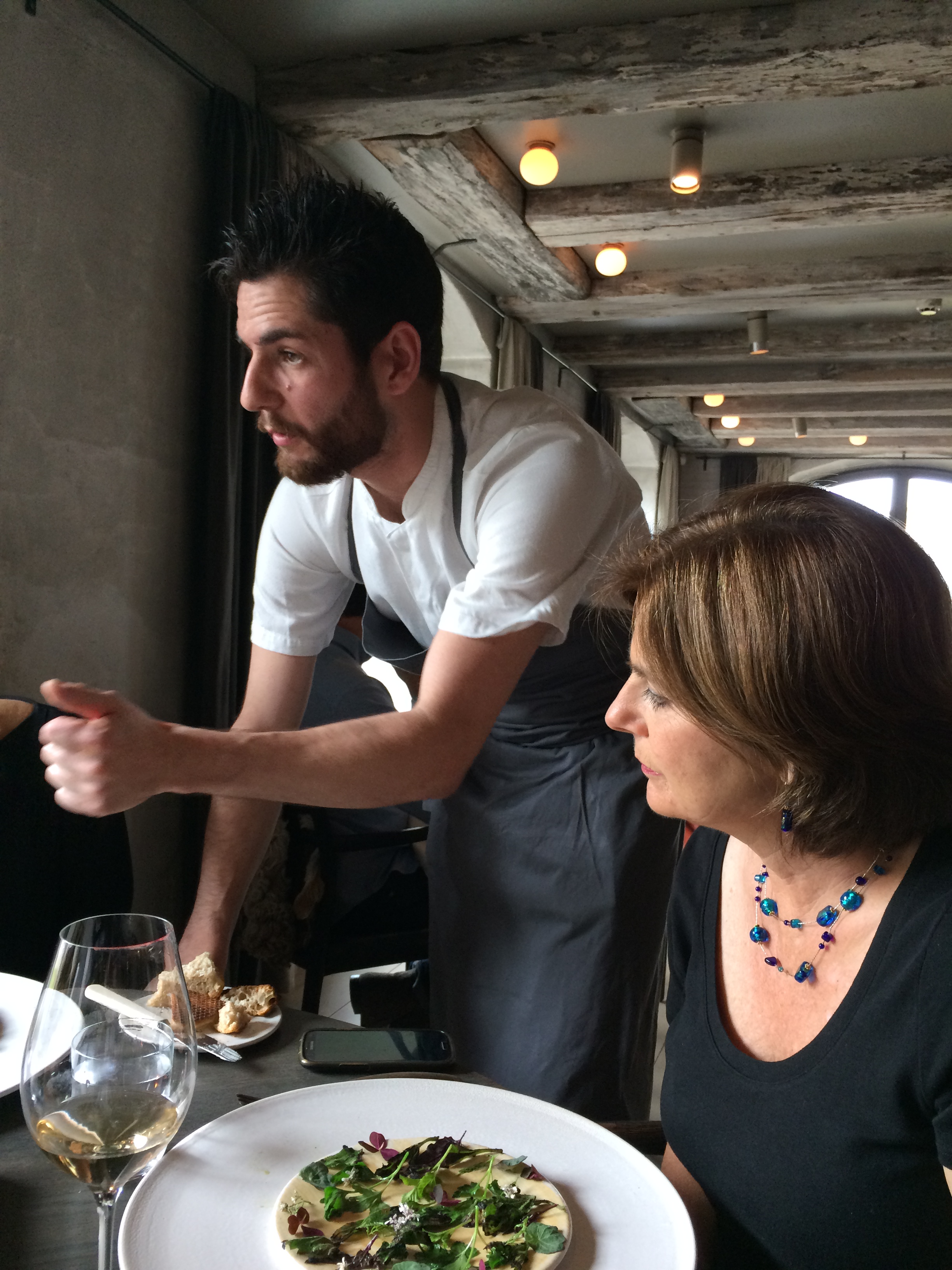
The First Shoots of the Season with Scallop Marinade.Dorianne Looks On as the Dish is Explained.
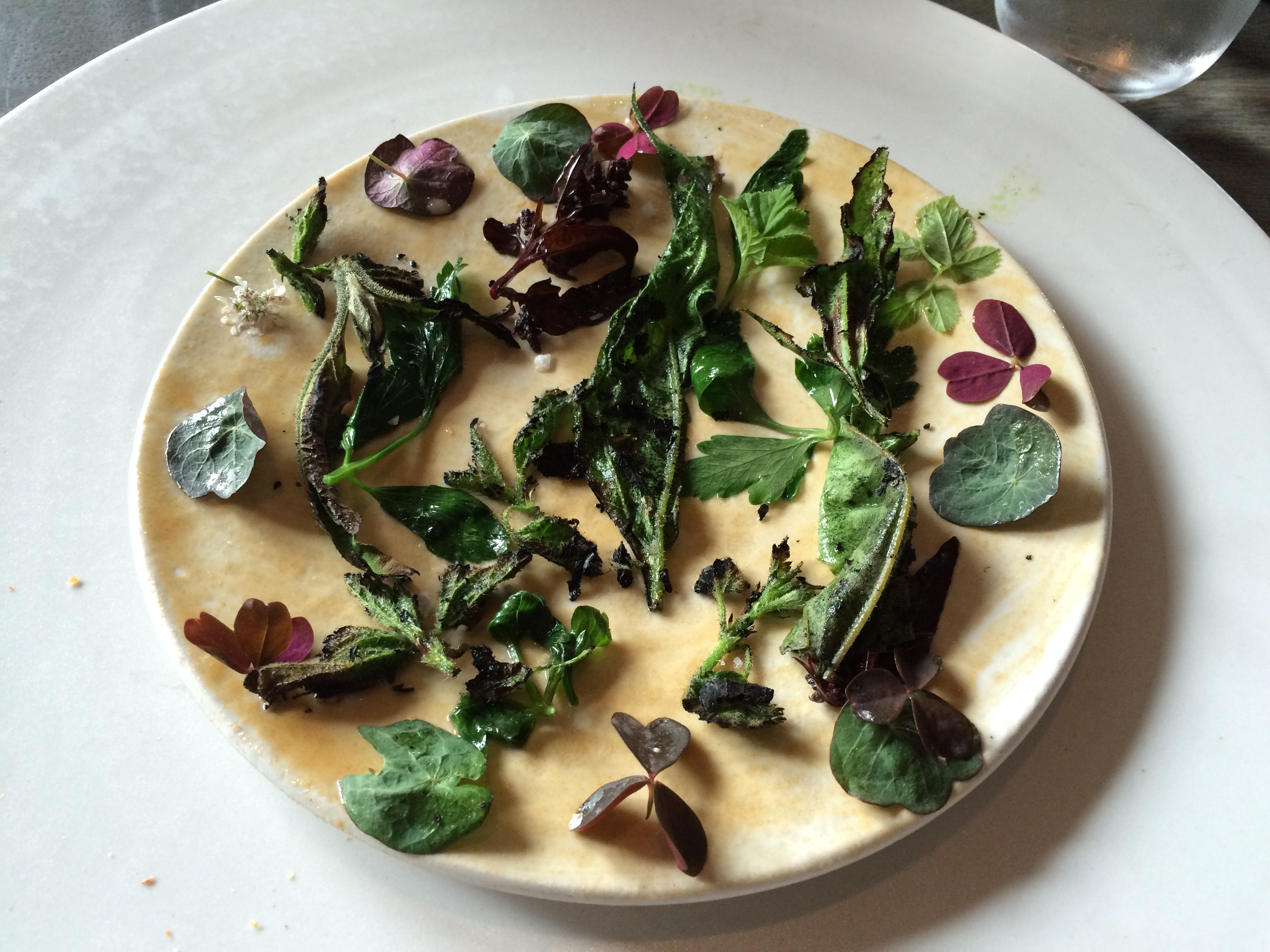
Next, course #3, the first shoots of the season with a scallop marinade, again with the Champagne. The plants were tiny and tender, some of them toasted, and after enjoying the presentation, you mix them all together in the thin layer of marinade and eat them in a few bites with your fingers. The rush of various flavors and the marinade tasting of the sea was delicious. After doing yeoman’s duty, it was time to part with the Champagne. Note: they do refill your glasses as often as you like.
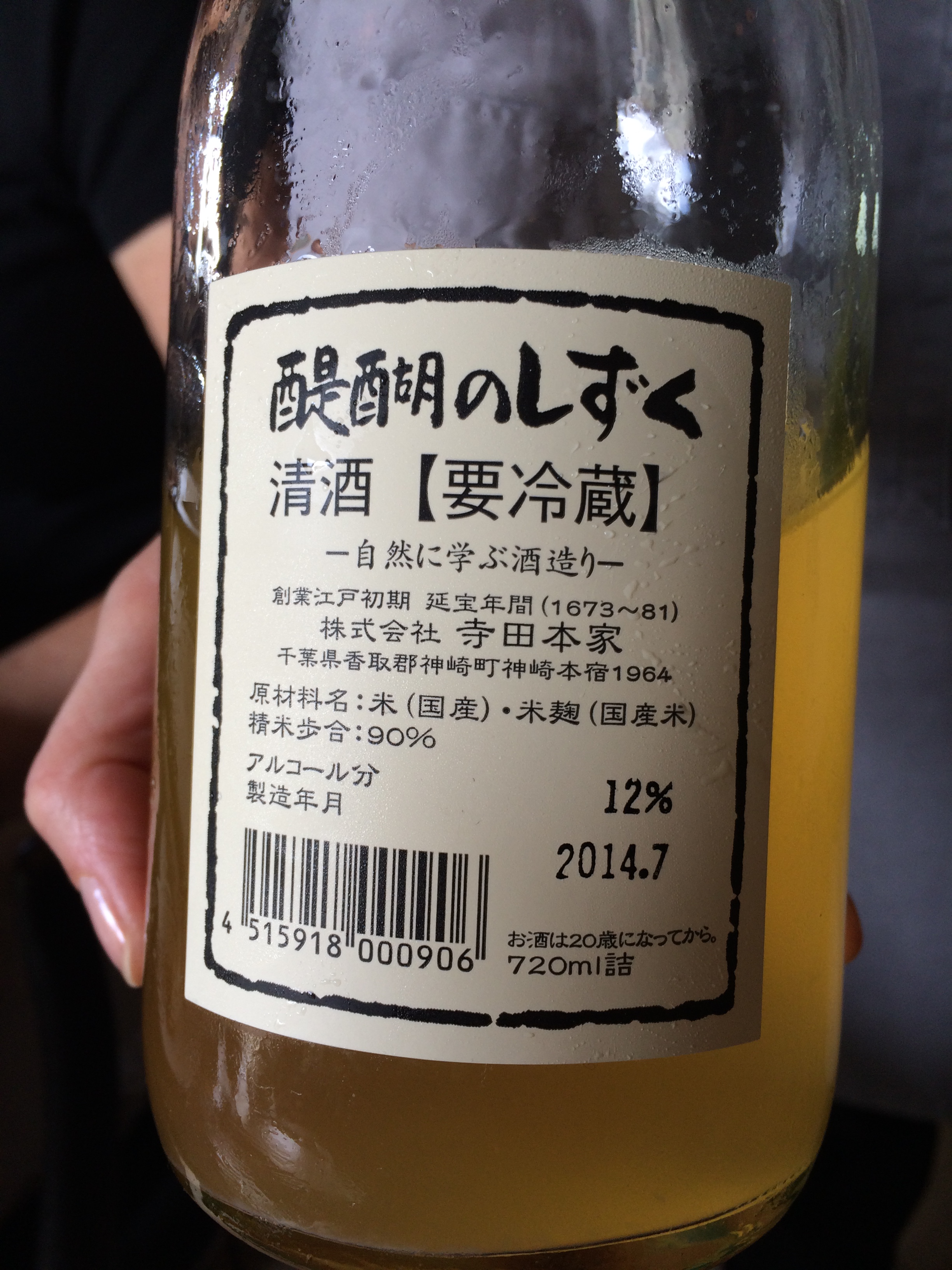
Now, the actual wine pairing begins! With Sake! A 2014 Daigo No Shizuku Terada Honke (LINK), to be exact, which would take us through the next three courses. Full-bodied with a soft and approachable taste; hints of citrus and a long finish.
Sweet Peas and Sliced Kelp.Sweet Peas and Sliced Kelp – Close Up.
The first course of the pairing was sweet peas with sliced kelp. There was a cheese under the kelp – like a ricotta but not a ricotta; and nasturtiums in with the peas (we will see more nasturtiums), all in a sauce. Very tasty with a mixture of textures and flavors. The sake went well with this.
Flower Tart.
One of the most picturesque dishes, the flower tart. Various petals over a vegetable spread and placed on something like a cracker. We ate it like a small slice of pizza. The sake was less successful here, as it was far more tart than the “tart,” so to speak. This experience reminded me of my childhood, sampling most of the flora in the neighborhood. This dish prompted a nice discussion of all of the things that we ate as children that were not from the home larder. A delicious and fun dish.
New Danish Potato and Lavage.New Danish Potato and Lavage – Opened.
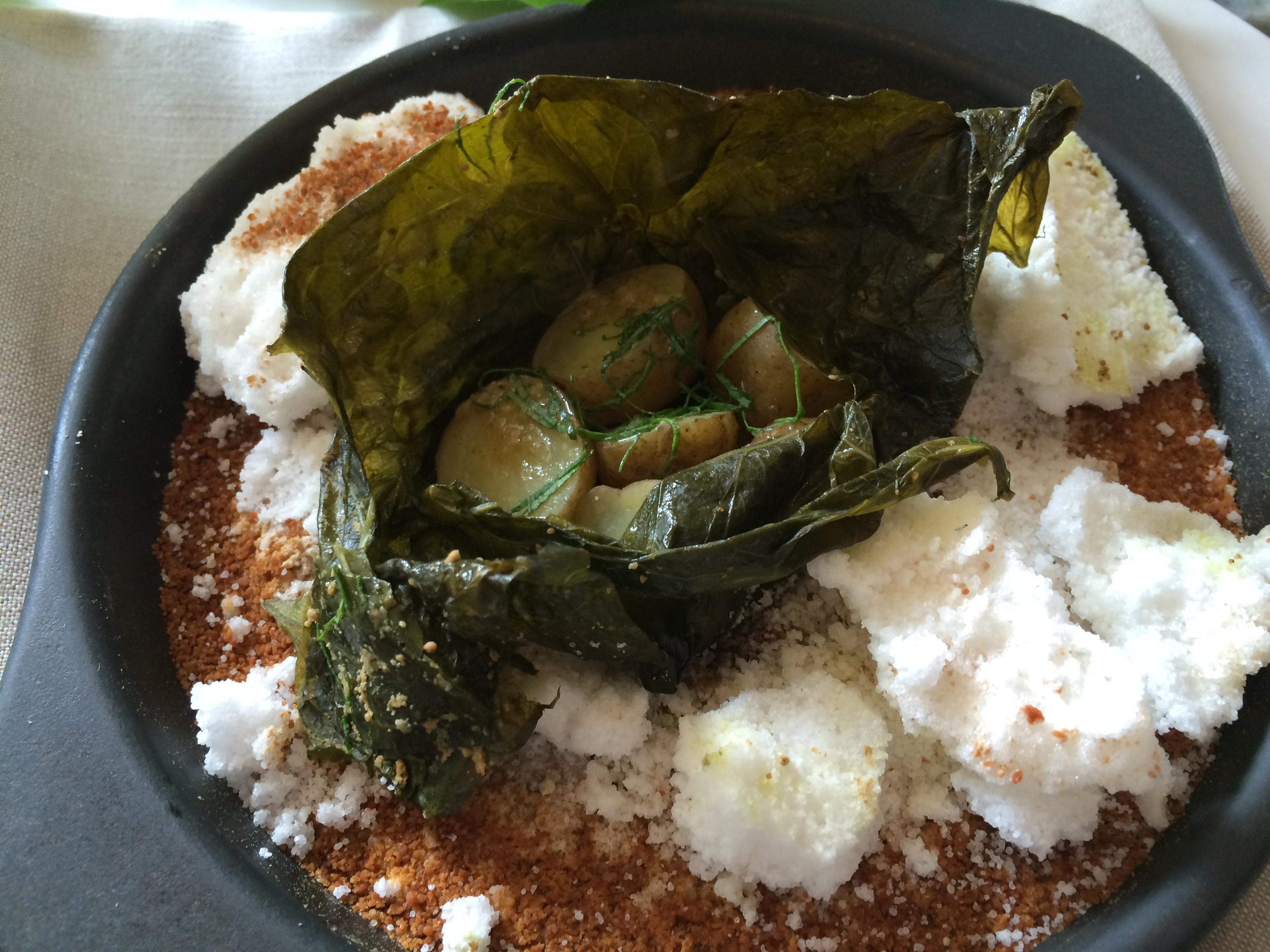
Next came new Danish potatoes wrapped in a lavageleaf, residing on a bed of two kinds of salt (it was recommended that we not eat the salt). This dish was intriguing. The potatoes, once revealed by opening the leaf, were to be eaten with a sharpened Elm twig (very Paleo). They were warm, soft, and, when touched to the salt, delicious! The leaf was also edible, but had absorbed too much salt to be enjoyable. The sake added a fullness to the experience and was a good pairing for this dish, and it completed its duty with this serving.
Sweet Shrimps Wrapped in Nasturtium Leaves.2013 Strohmeier Weiss #6 – Tromen Liebe and Zeit, 50/50 Chardonnay and Pinot Blanc. Austria.
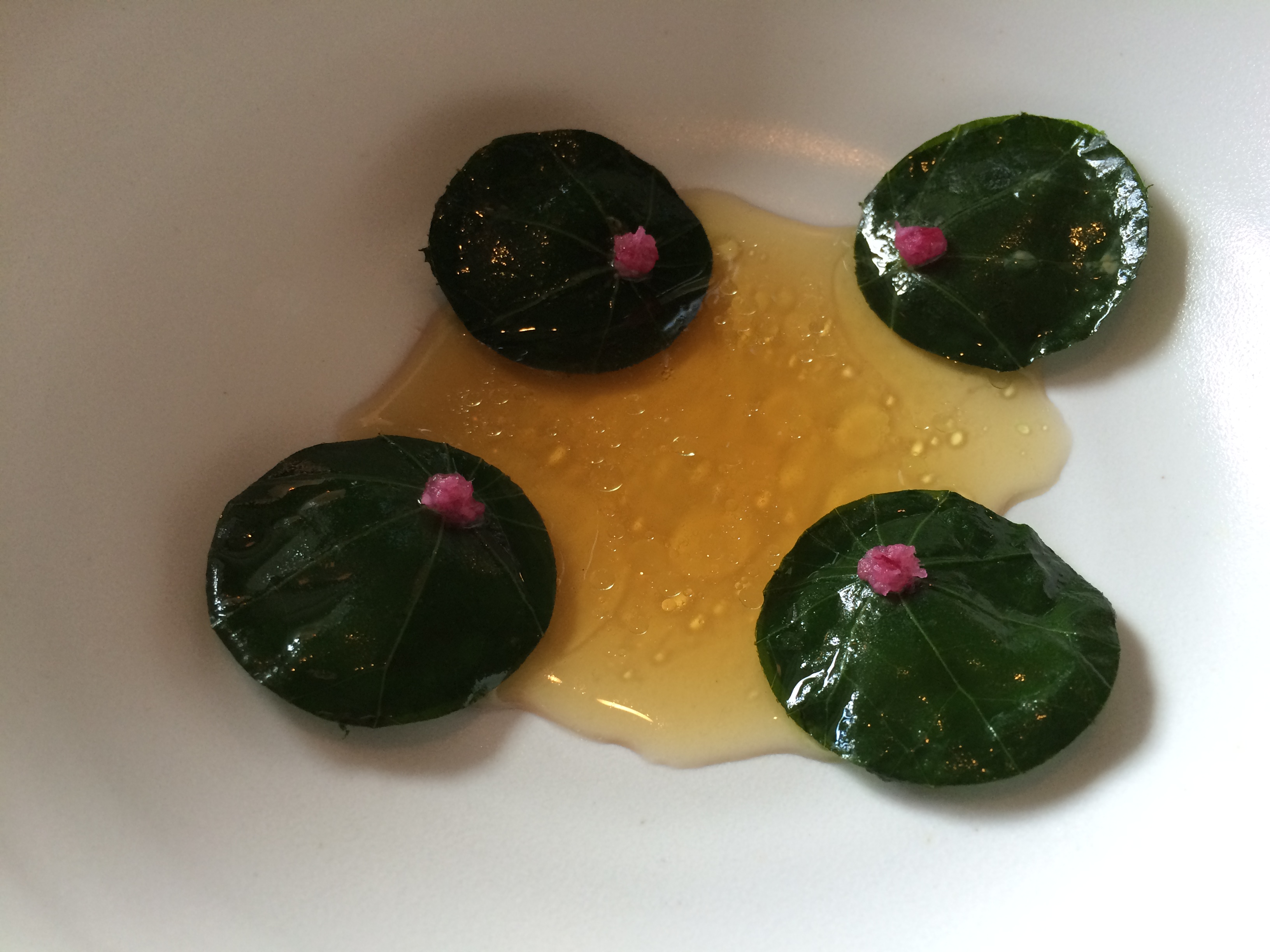
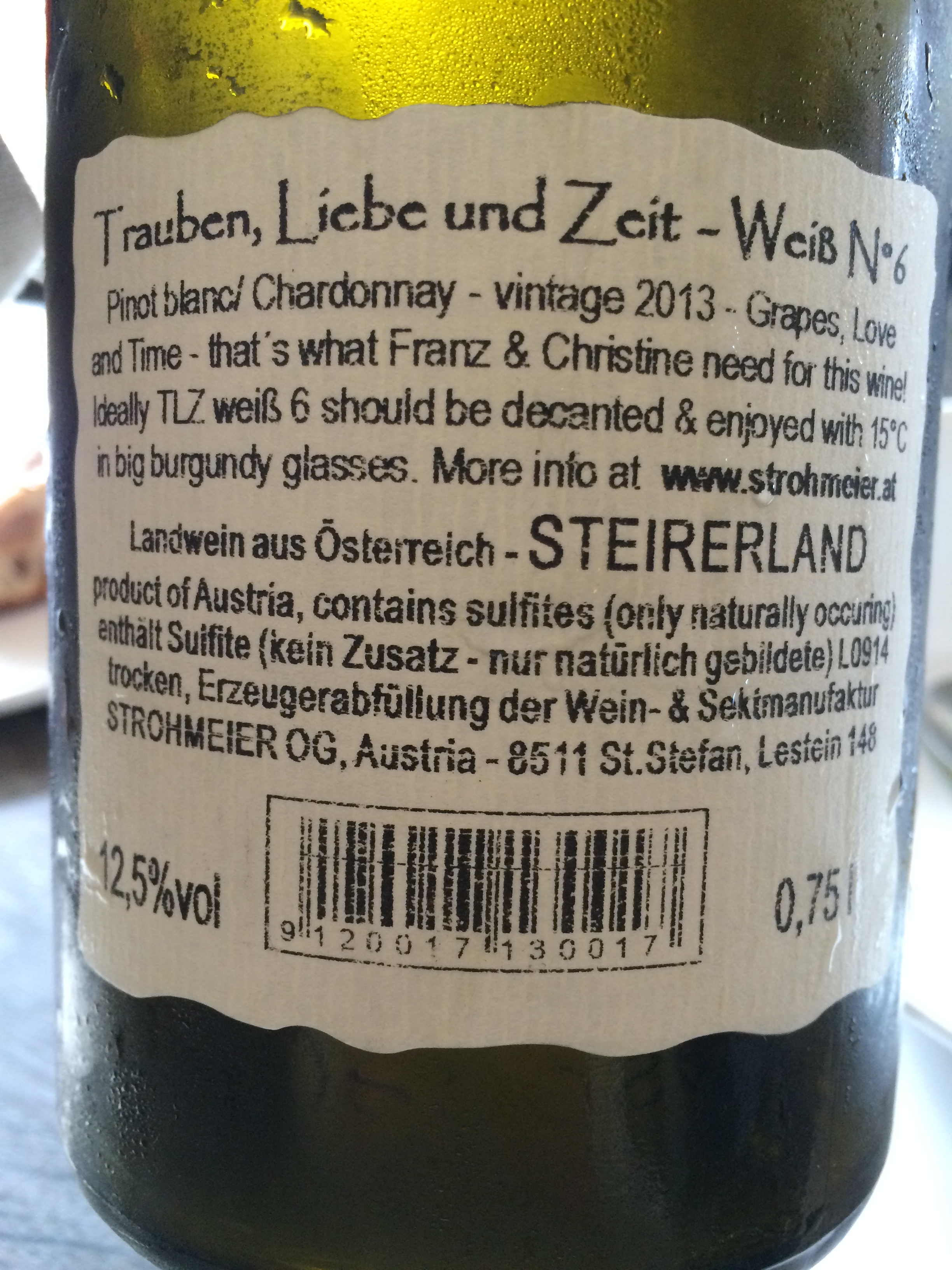
The next course was sweet shrimps wrapped in nasturtium leaves with a seafood broth. Very tasty – the shrimp and the leaves were a good mix of textures and flavor. The next wine was 2013 Strohmeier Weiss #6 – Tromen Liebe and Zeit, 50/50 Chardonnay and Pinot Blanc from Austria (LINK). This is really a nice white wine. I have loved the whites (weiss) of Austria since visiting there in 2009. I am a particular fan of Grüner Veltliner, the wonderful white grape so popular there and now being grown in California. But I digress – the Strohmeier has the nice acidity that one expects from Austrian whites, plus, the Chardonnay gives it a fuller mouth feel. It was a great accompaniment to the shrimps in nasturtium. Of course, this could be my appreciation for a more familiar wine after the sake.
Cabbage and Roses.Cabbage and Roses Uncovered.
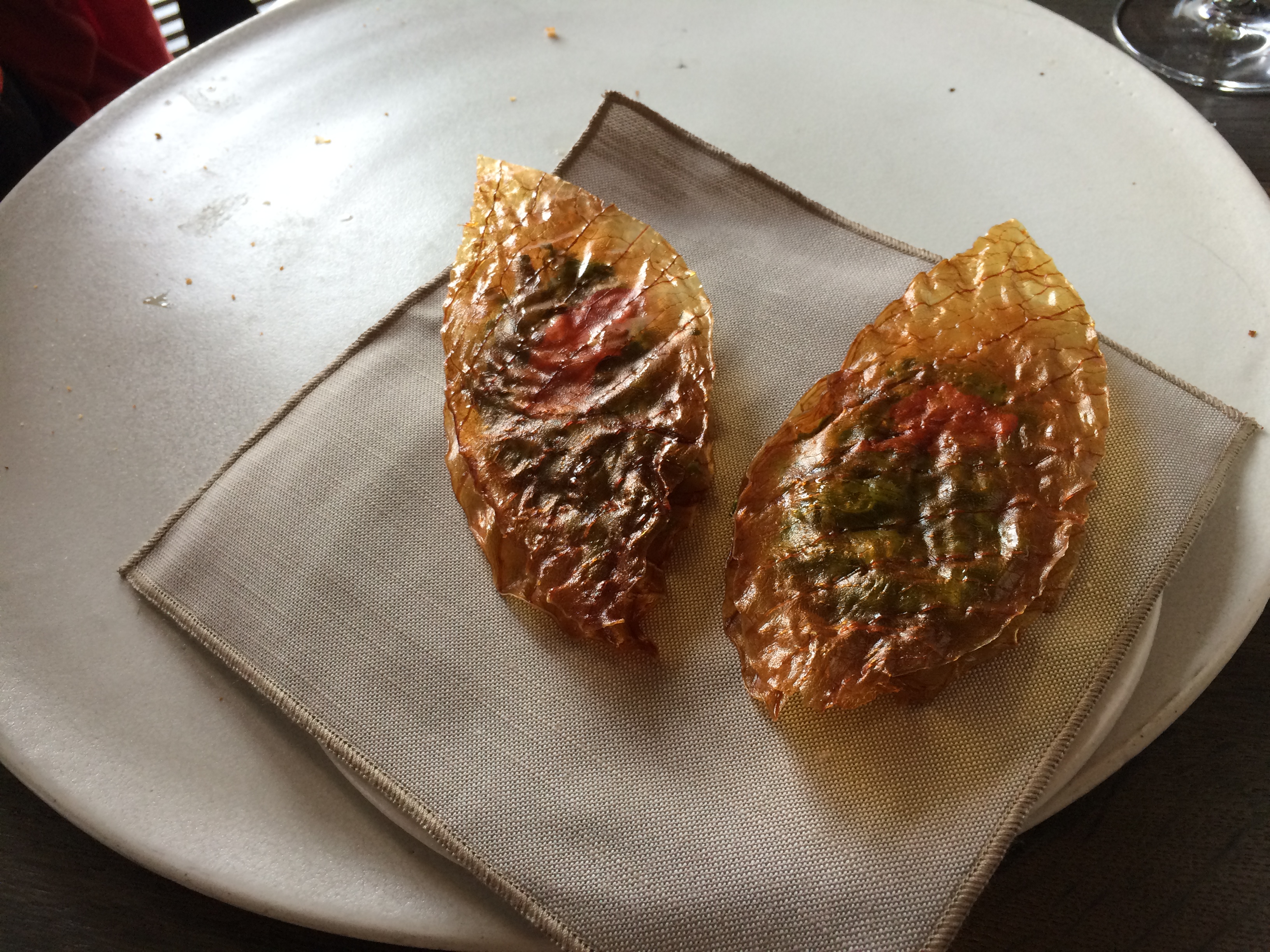
Next came cabbage and roses; dried and candied cabbage leafs sandwiched around samphire (sea asparagus) and rose petals. The leaves were crunchy and the middle was soft and creamy. Eaten with your hands. The 2013 Strohmeier Weiss #6 accompanied this dish very well, giving a smoothness to the experience.
So that is the first half of the Noma dinner, nine courses with nine more to go; and five more wines (by the way, no red wines)! Those will be depicted and described in the next installment, Part 3.
How does one blog about a visit to Copenhagen’sNoma, the “best restaurant in the world”? Do you focus on the food, the changing menu of everyday and very unusual ingredients put together in ways that, well, us regular people never would think to do? Do you focus on the wine, paired with the many courses from some of the most obscure and unusual wineries in Europe (only European wines!). Do you focus on the culture of Noma, which can be observed from the friendly greeting from EVERYONE as you enter, through the service of the exceptional and long meal, and via the tour of the premises that is offered after you finish eating? Do you focus on the price – not crazy expensive these days, but an investment nonetheless?
I will attempt to do a bit of everything in this series of four posts, for my visit to Noma with Dorianne and two friends was, if nothing else, an event. It was more than the food, more than the wine, more than the service, more than the culture, more than the location. It was more in just about every sense of the word. It is over 24 hours after we left and I am still not feeling normal, physically, mentally or emotionally. How does a visit to a restaurant do that to someone?
We began to plan our visit to Noma over six months ago. Imagine a 45 seat restaurant with a staff of 45 or more! With a food lab on the premises! That serves 18 or so courses of totally creative dishes! Much of which is foraged! With wine! We decided to go, but getting there was not without its complications and moments of fear.
I researched several websites that were about Noma or about visits to Noma (LINK)(LINK) (LINK). I looked at Noma’s unassuming website (LINK) to find out how to get reservations. They put a month’s worth up at a time, about 3 months in advance. Since we wanted to come in July around the date of our tenth wedding anniversary, I discovered that we needed to be online on April 6th at 10:00 am Copenhagen time.
We were in Spain at the time. I got online a bit late, about 10:10 am, and was informed that I was number 2499 and that there were 2278 people ahead of me waiting to be served. My waiting time would be about 90 minutes. I did not do the math of about 2 seatings a say of 45 people for 31 days, as some of those ahead of me would not be getting the dates they wanted, etc.
About 70 minutes later, I was in. We had booked an apartment in Copenhagen for July 21-24, so I requested a table for four (another couple was going to join us on the trip) on the 23rd through the website (all automated). The response was that I was booked for lunch. Great! That was comparatively easy.
A few days later as expected, I got an email from Noma requesting a credit card number (they have a policy that charges you if you change your reservation), and saying that they were looking forward to seeing us on APRIL 23RD!!!
NO!
I called Noma to try to get this changed and eventually connected with the reservations director. She told me that I made the reservation for April 23rd via the website. I told her that I thought that only July reservations were available on that day. She told me that there were also cancellations available via the website (you heard that here first!). I told her that we would not be in Copenhagen until July, so was there a way to change the reservation?
She checked and said that July 23rd was fully booked. I asked about July 22nd. She said that there was a spot for lunch for four. I said we would take it. Then I hung up and had a glass of wine.
Then, in May, the couple who was going to go to Copenhagen and to Noma with us, cancelled. This put us in the position of either changing our reservation and paying the fine(!!) or finding someone else to go with us. We were in Barcelona when we go the news. What to do?
The next evening in Barcelona, where we were attending and presenting at the Spirituality and Creativity in Management Congress 2015, at the Esade Graduate School, we went to dinner with some of the other attendees and presenters. There we met Ginger Grant, who just happened to be teaching at a graduate program in Copenhagen in July. Match made in heaven! Ginger agreed to come and bring someone to make a party of four.
The Big Day came. We arrived in Copenhagen in the evening on July 21st, had a quiet dinner on the Nyhavn canal, and turned in at our 5th floor walk-up AirBnB.
Nyhavn Canal area in Copenhagen.
At the appointed hour on July 22nd, we walked the kilometer or so to Noma, met our dining companions outside. A Noma staff member came out and invited us to come in. About 25 staff were gathered inside the front entrance to greet us. It was as international a group as you can imagine, mostly young. We were shown to a table in the rustic, rough-hewn dining room. And the show began.
The meal and (very unusual) wine pairings will be described in the next two posts, followed by the tour of the restaurant, kitchen, the lab, and the staff room in the final installment over the next few days.
Forgive the foodie flavor of this series of posts, but we are in Amsterdam and Copenhagen this week and sampling some truly amazing restaurants, which will include the legendary Noma in Copenhagen in my next post.
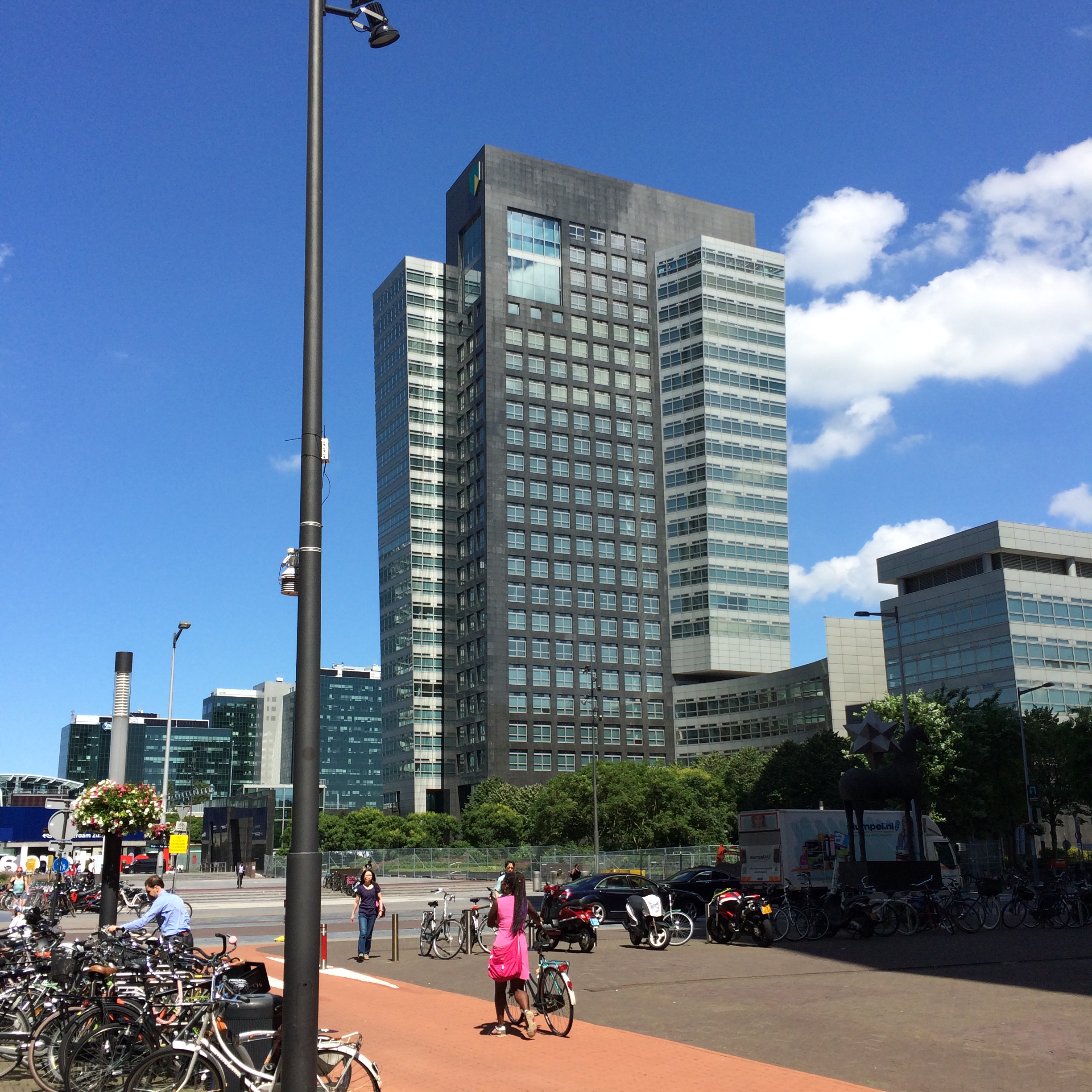
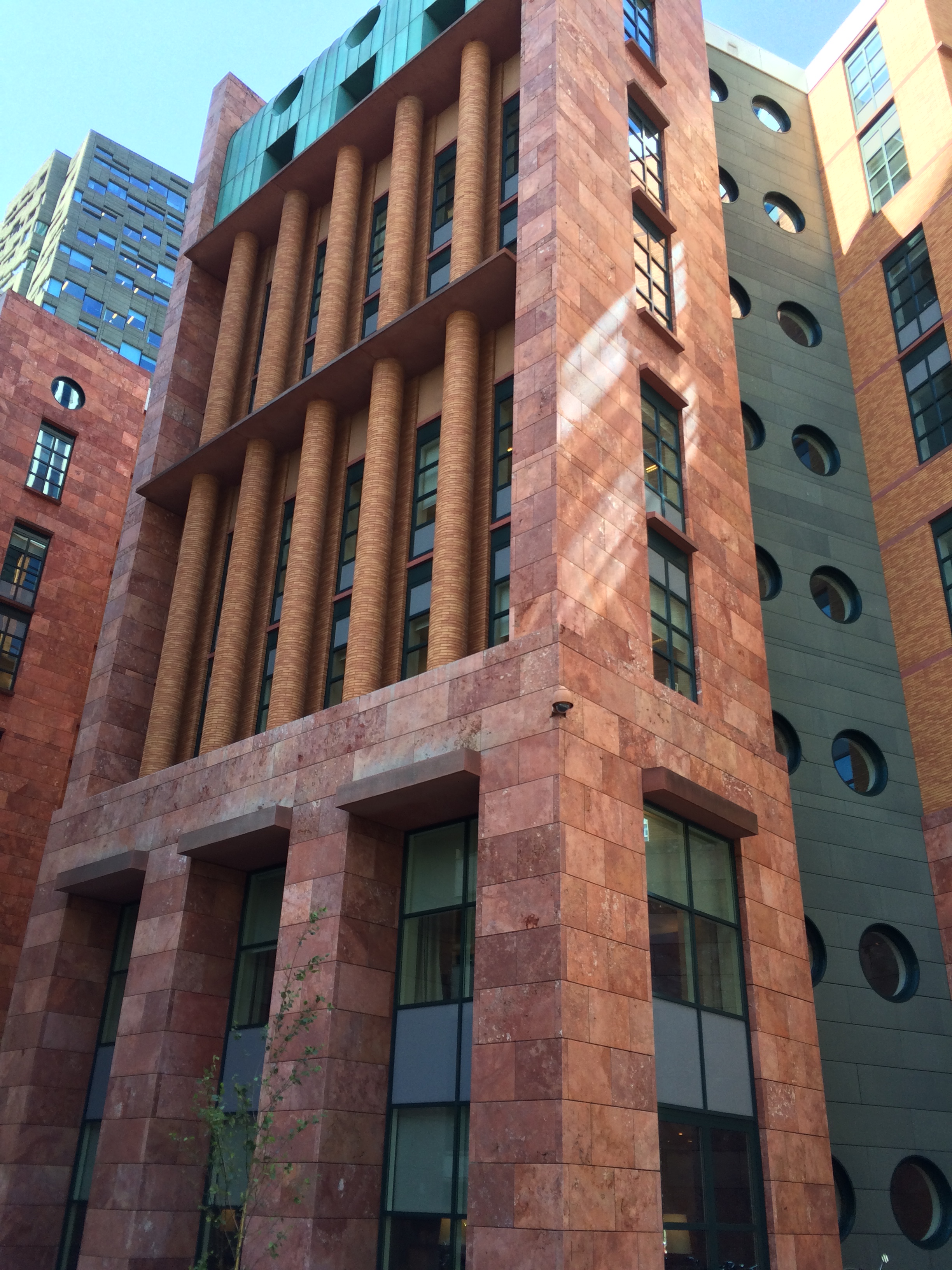
Yesterday, before departing Amsterdam, we strolled down by the Amsterdam Zuid (South) station and a rising complex of very modern buildings, both office and residential towers. Here are a few examples.
Our target was a restaurant that we had read about, BOLENIUS (LINK), that emphasized wine, local ingredients – especially vegetables, an open kitchen, and beautiful design. we were there for lunch before an early evening flight to Copenhagen.
First, let me say that our meal was splendid. Co-owner Xavier Giesen greeted us, told us a bit about the restaurant and their nearby organic garden, and oversaw (and participated in) our service through the meal. BOLENIUS has a mostly prix-fix menu with a variety of choices of complete dinners (up to 99 euros), one two-course lunch that varies day to day (34.50 euros), and a few à la carte items. The separate wine list is on an iPad and is very nicely put together with broad rather than deep range of wines from various areas of Europe.
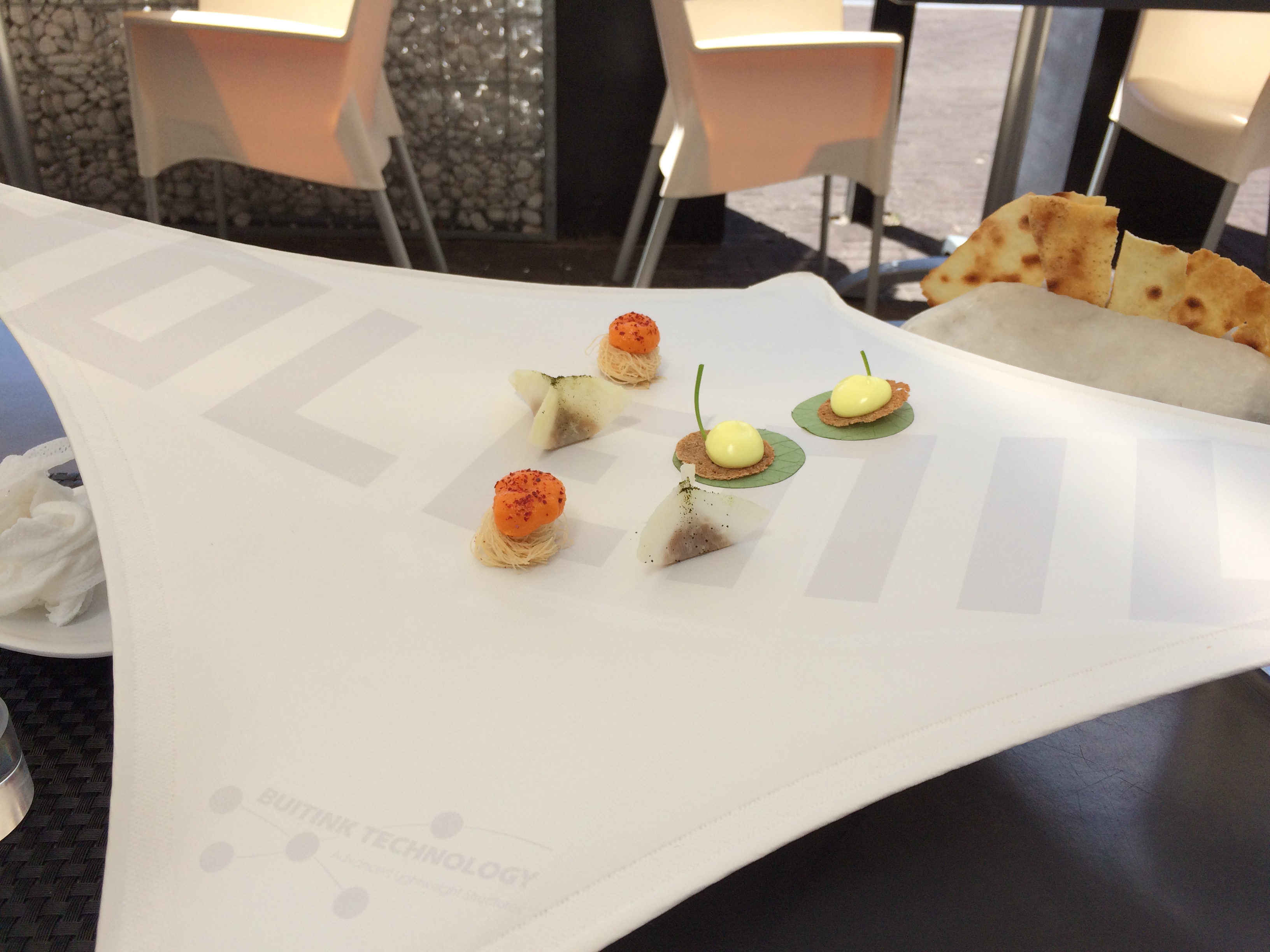
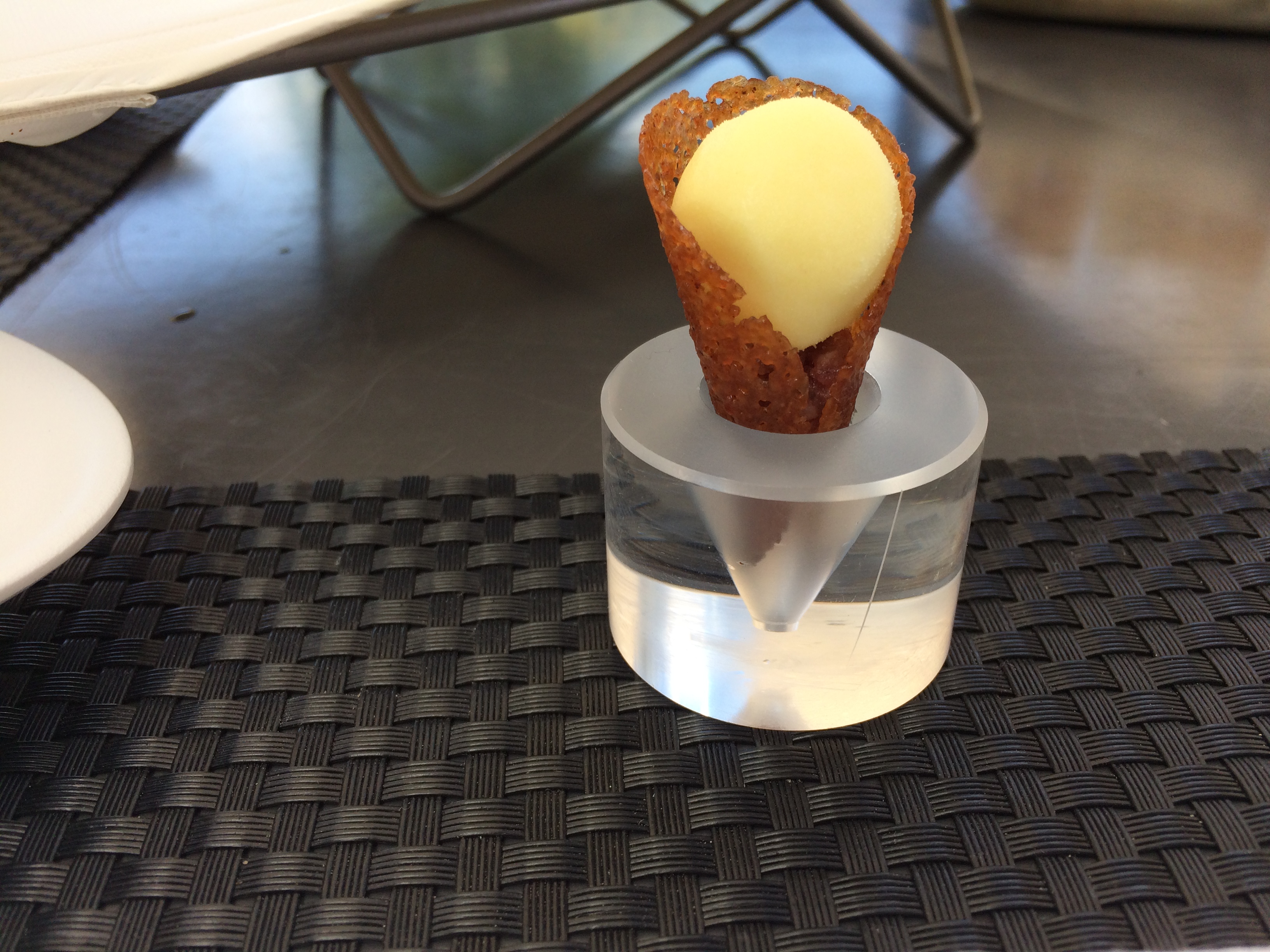
We opted for the two-course lunch menu, which consisted of a first course based upon vegetables from the organic garden near the restaurant and a second course of cod with mashed potatoes and vegetables. But first, a “tray” of complimentary appetizers on a “sail” that matched their outdoor awnings, then an amuse-bouche, a tiny ice cream cone – the ice cream made from sweet Netherlands onions was sitting atop a piece of warm beef sausage in a tiny waffle cone. Odd-sounding, but delicious. Then, a bowl was brought out which contained four small objects. A very small first course, I thought. But no, this was a palate cleanser – a bit of beet sitting atop a small dollop of aioli, two halves of a sliced blueberry, and a baby beet covered with grated hazelnut.
The wine came at this point – we ordered a 2013 Albariño d Fefiñanes from Palacio de Fefiñanes in Rias Baixas, Spain (LINK). The wine was smooth and well balanced, with nice round mouth feel and hints of green fruit. It was a perfect compliment to the meal, and one of the best Albariño’s I have had.
The fish course was beautifully prepared and presented:
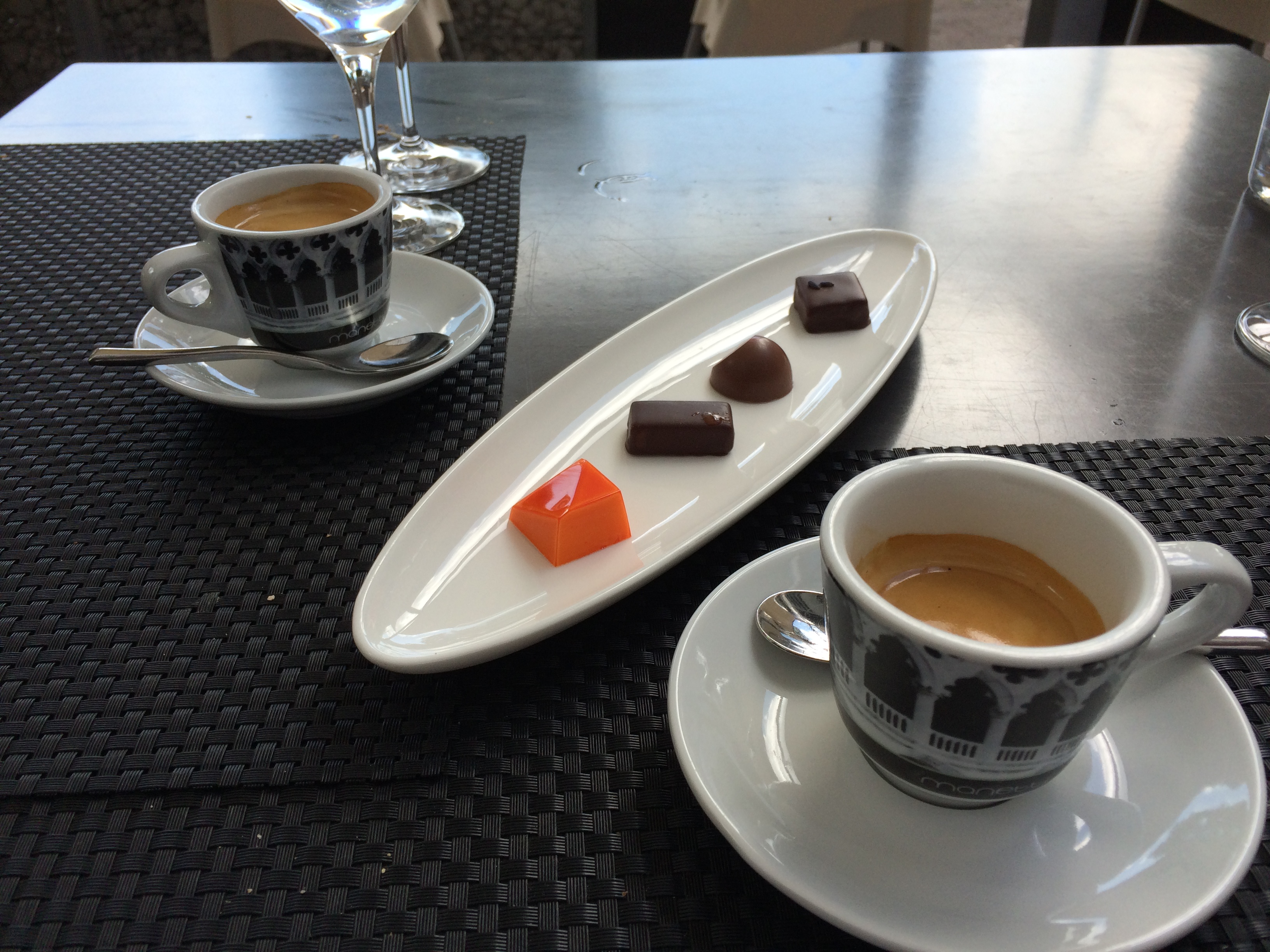
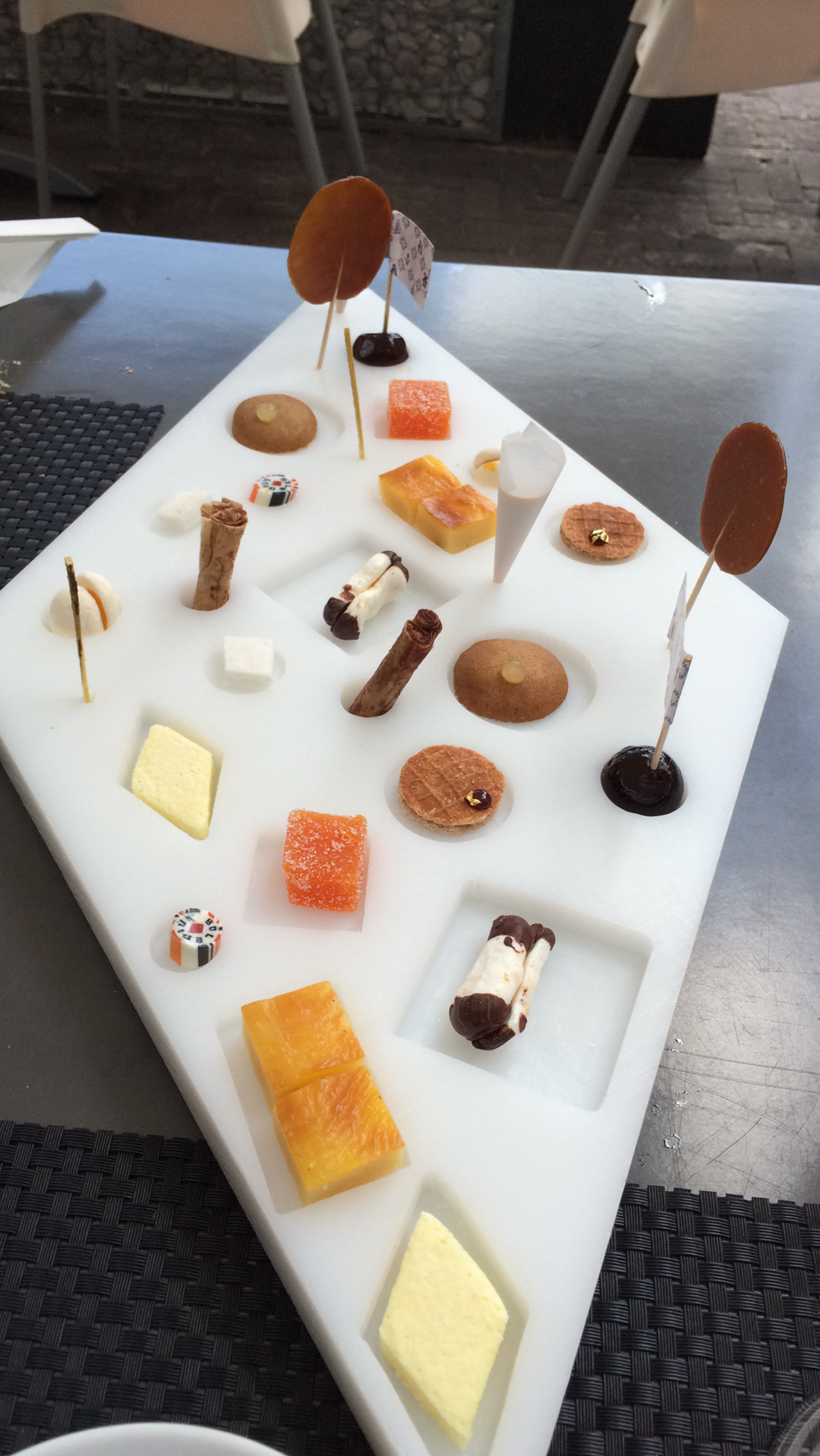
Afterward, espresso, chocolates, and a very special tray of assorted treats for us to enjoy.
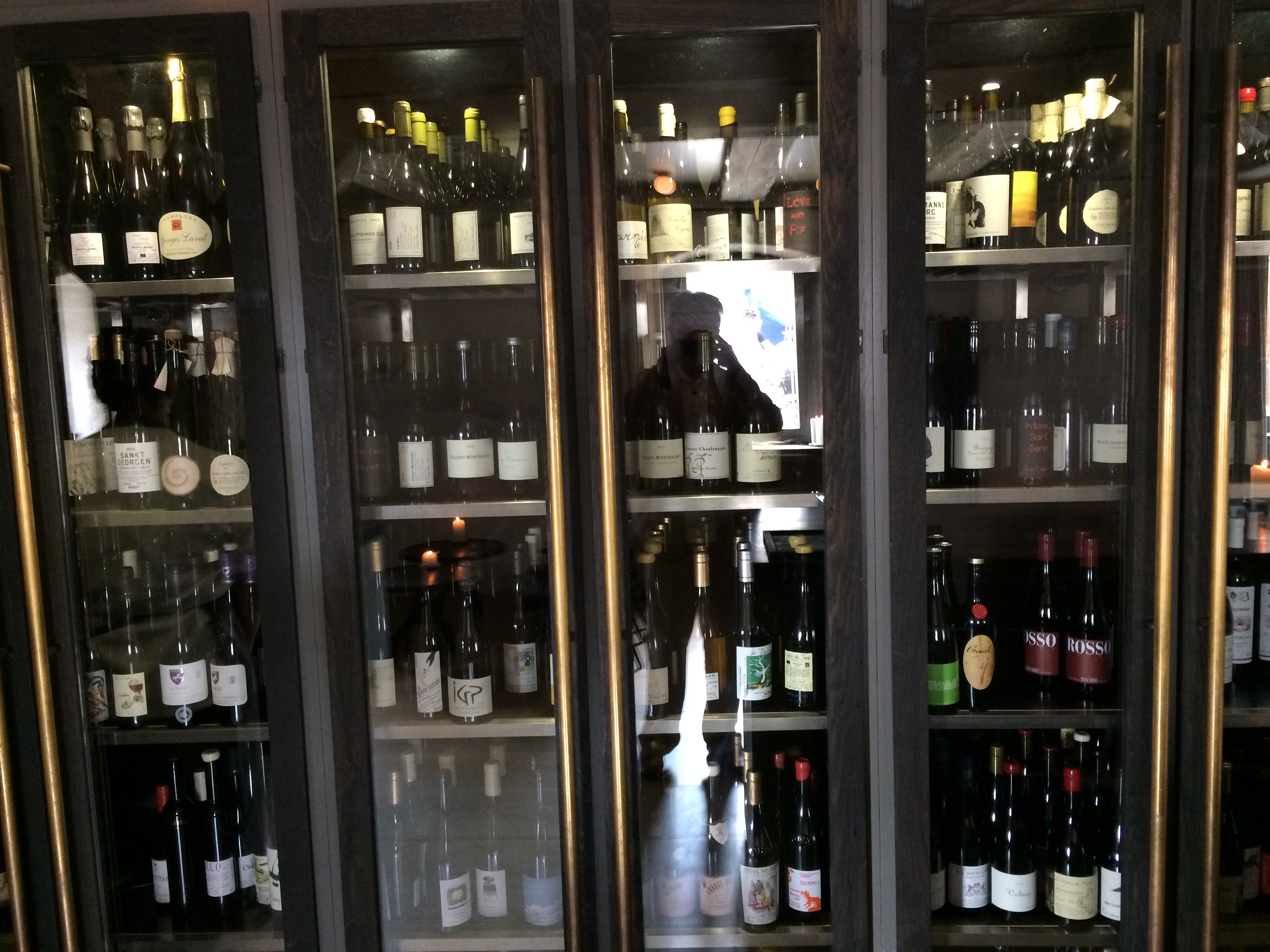
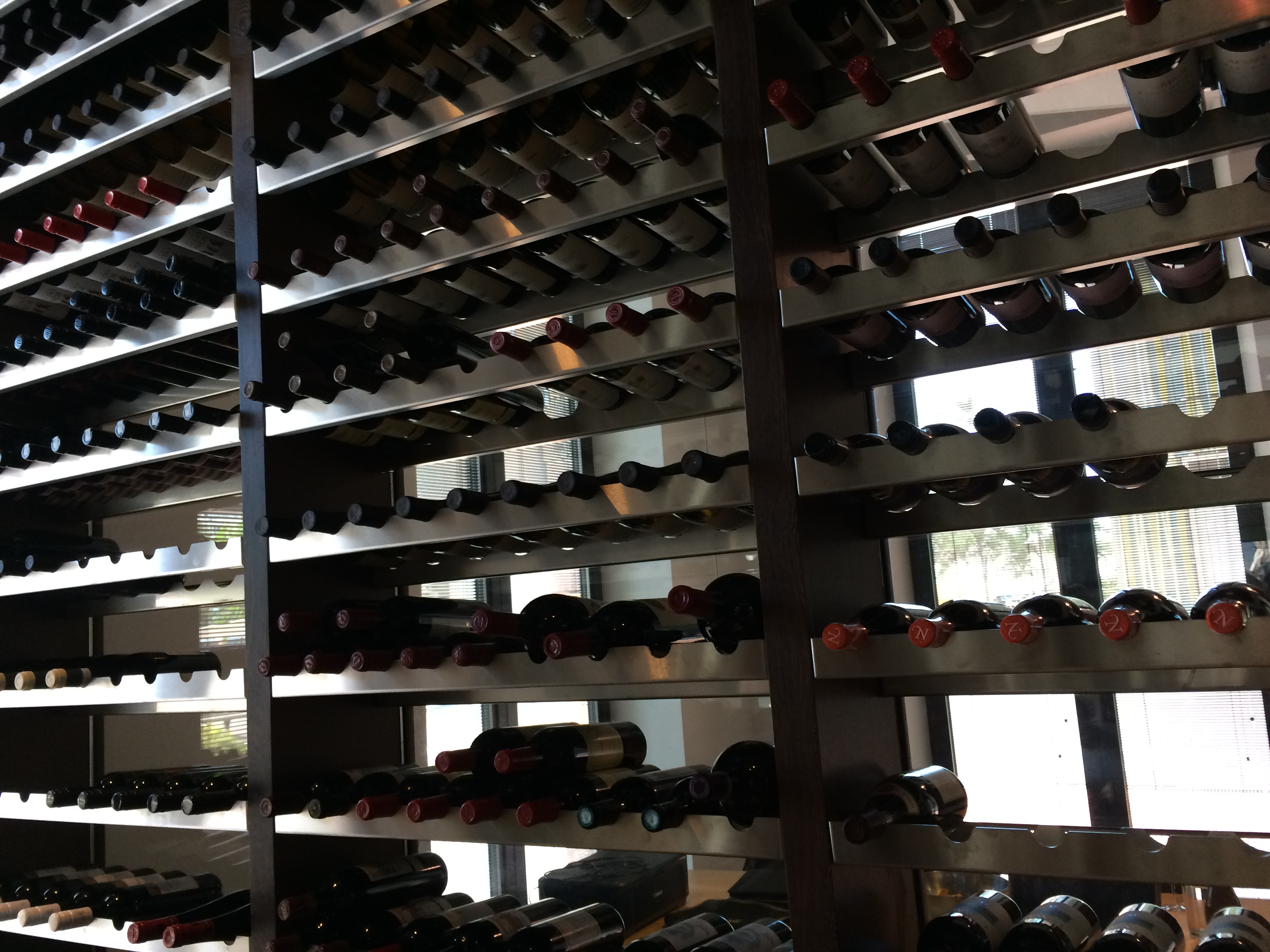
After our meal, Xavier took us to the kitchen and the wine storage area, where we talked about wine, his love of Spain, and his desire to have a wine list that represents the best of Europe. The care, pride, and professionalism of the owners and staffof this excellent restaurant was evident in every aspect of the experience, and Xavier was very generous with his time to share much of it with us. It was truly a very special experience. We will definitely be returning to Amsterdam!
The Open Kitchen.The Wine RoomThe Cheese Table in the Wine RoomThe Wine–By-The-Glass Area
Amsterdam (LINK) is a great city for food and wine. Over the past three days, with one more to go, Dorianne and I have had amazing meals. With so many pleasures and options, wine is not the only thing that they focus on in this international city, of course. There are world class beers and spirits and, of course, marijuana to salve the human need for altered states. But where the wine is the focus, they do it very, very well.
Guts & Glory (LINK) is a very small restaurant (about 40 seats inside, another 16 outside) in Amsterdam near the Rembrantplein (Square). Dorianne and I went for lunch on a Sunday. We walked into a foodie and wine haven.
The plan here is to make an entire menu around one item – fish in summer, pork in winter, beef or fowl in other seasons – and offer up to seven courses based on treatments of that item. It is summer, so we opted for three courses of fish.
I asked our server, Liselore, about the wine list and was directed to Ricardo, the sous chef and wine expert. He reviewed the list with me and suggested pairings. We opted to buy by the glass to get the best pairings with each course.
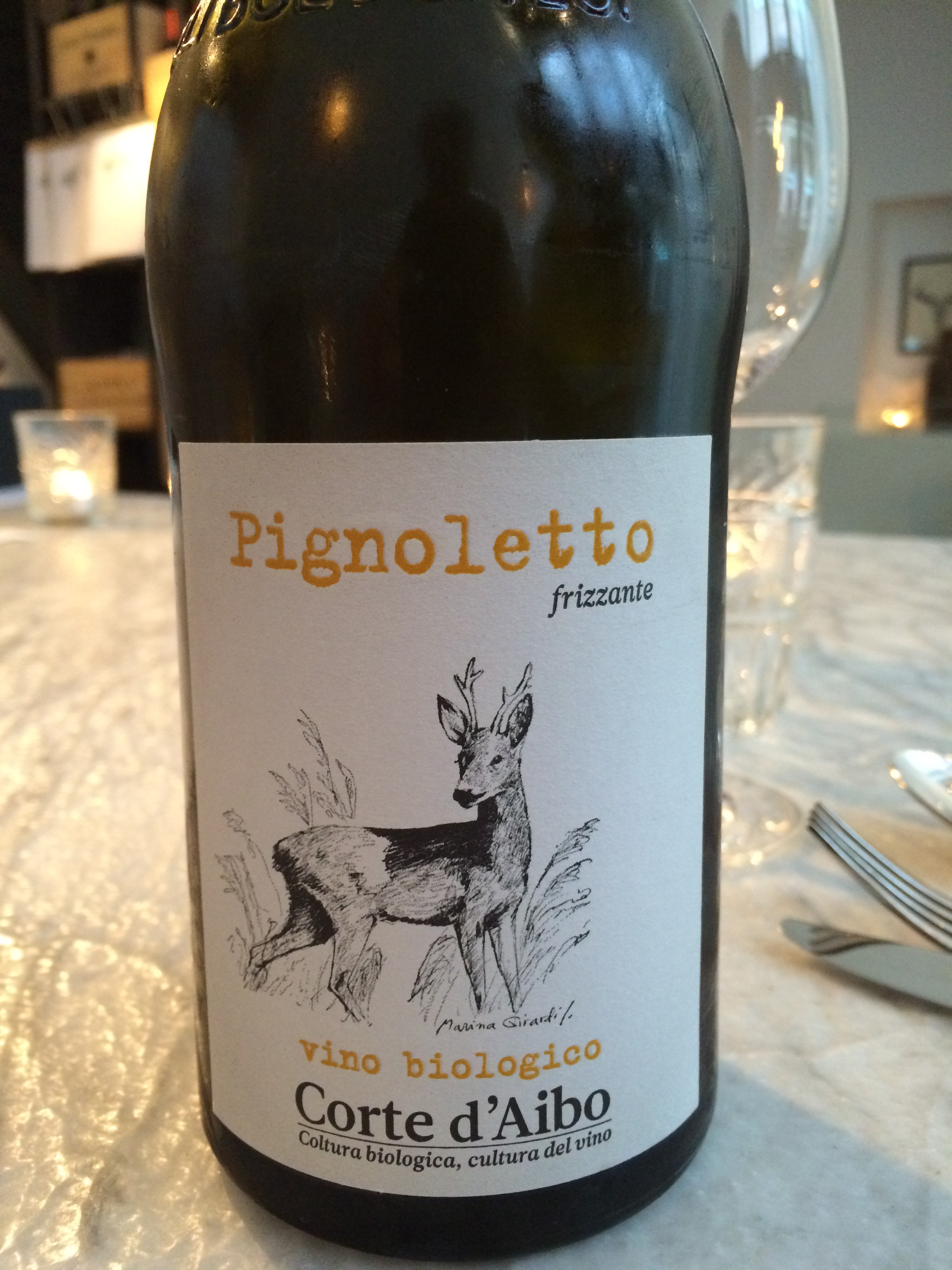
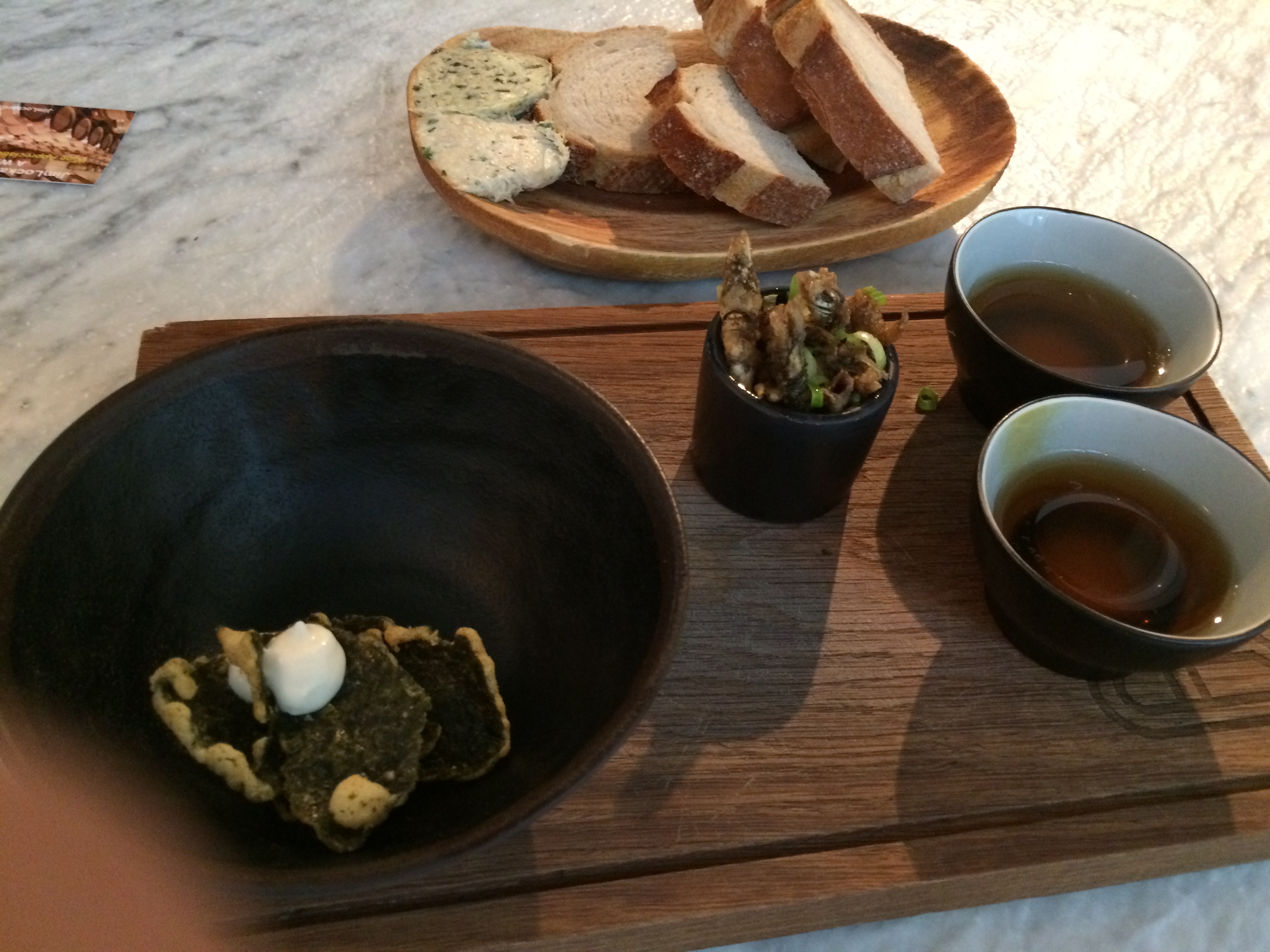
Our first course, after an amuse bouche of seaweed broth, marinated North Sea Shrimp, and deep fried Nori, was a very unusual sea bass ceviche with onions, sweet potato sauce, wheat nuts (deep fried!) avocado paste, and some crispy lime foam (yes). The wine pairing was a sparkling Pignoletto Frizzante Bio DOC `13, Corte d’Aibo (LINK), from Bologna, Italy. The dry sparkler went perfectly with the ceviche.
Pignoletto Frizzante Bio DOC `13, Corte d’AiboAmuse Bouche of DelightsSea Bass Ceviche.
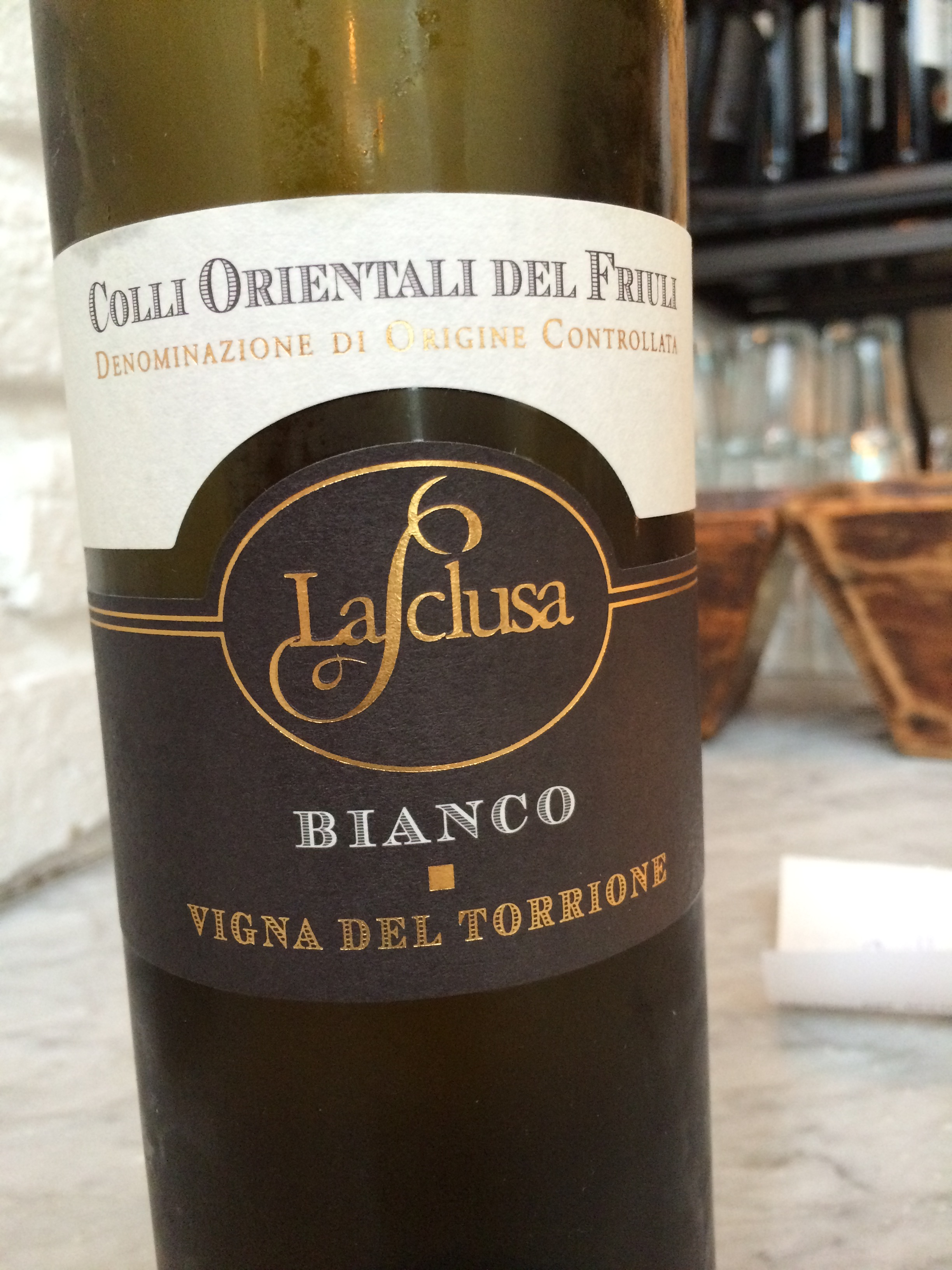
Next, we had skate with Italian Brocollini, onions, anchovies, and other delicacies. The pairing was a Friulano Vigna del Torrione Bianco DOC ‘12 La Sclusa, (LINK), from Friuli, Italy. I had begun to wonder if Ricardo was only recommending Italian wines, but the next course settled that. By the way, the Fruliano was a perfect match for the skate dish, with little acidity, a nice oaky flavor, and more minerality than fruit in the flavor of the wine. It also had a deep golden color. A very unusual white wine.
Friulano Vigna del Torrione Bianco DOC ‘12The Skate Course.
The third course was very different – a cod cake nestled in a steamed beignet with pickled cucumbers, onions, black beans and lime aioli. The pairing with this one was a Villa Wolf Pinot Noir ‘13, Ernst Loosen (LINK), from Pfalz, Germany. The German Pinot Noir, of which we had had several on our cruise up the Rhine River this past week, was one of the best I’ve had, with a bit more body than most German reds, plus a floral sense on the nose. It, once again, paired wonderfully with the cod dish. Nice work, Ricardo!
Villa Wolf Pinot Noir ‘13, Ernst LoosenCod Cake Course
The wine list (LINK) is pretty extensive for such a small place, with wines from the Old and New Worlds. Here is the team – Michael Randag, Guillaume de Beer (Chef/Owner), and Ricardo Russo (Sous Chef/Wine Guy). Not pictured is our server, Liselore Tieshers. A great group!
Michael Randag, Guillaume de Beer (Chef/Owner), and Ricardo Russo (Sous Chef/Wine Guy).
Guts & Glory was a very good preparation for our visit to NOMA in Copenhagen later this week.
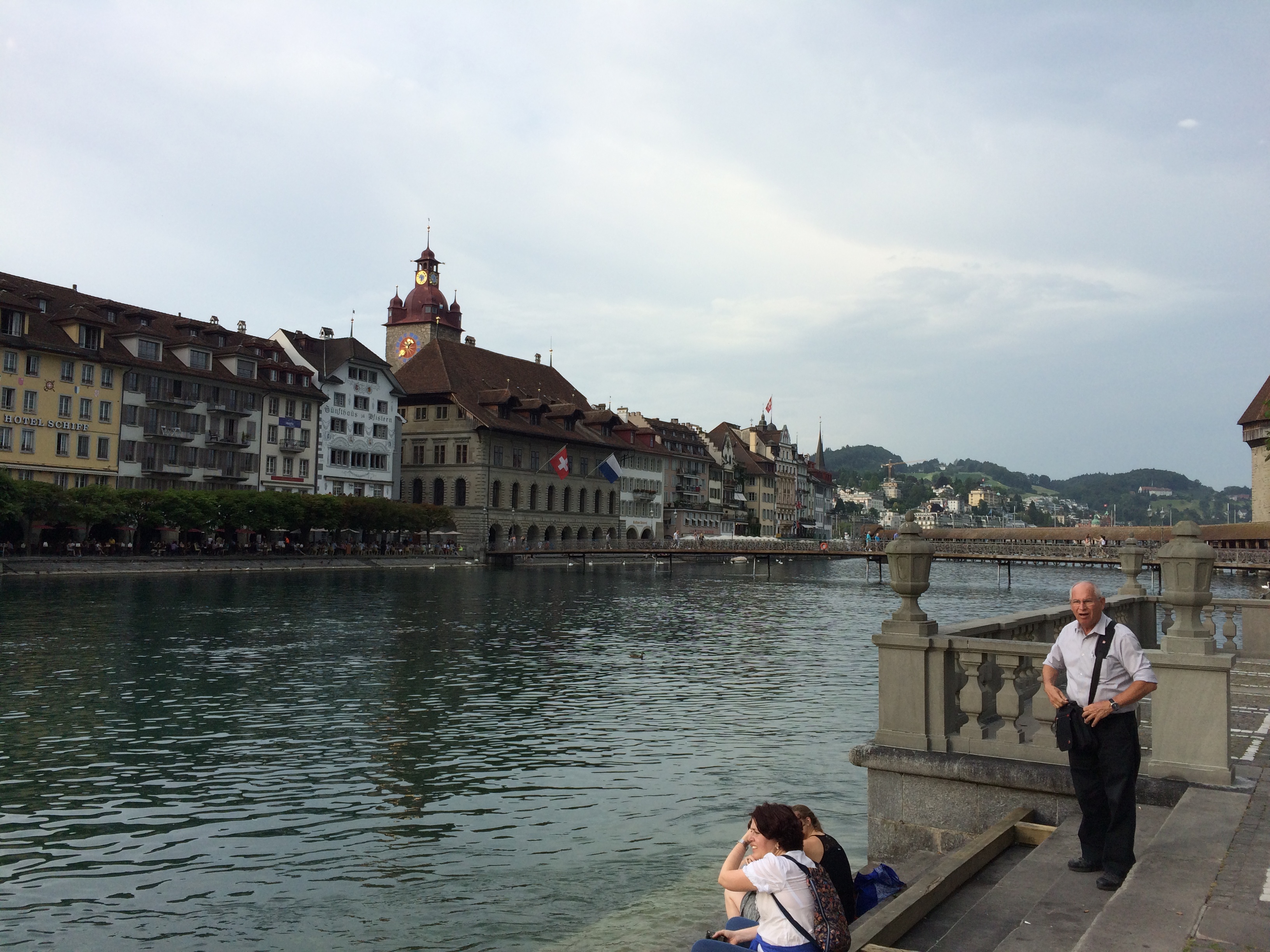
The wine scene is Lucerne, Switzerland (LINK)is varied, diverse, and generally speaking, fairly expensive. We recently spent a few days visiting this postcard-worthy city and visited a number of restaurants and wine shops.
Let’s begin with Opus (LINK), a wine-themed restaurant along the riverfront next to the huge Jesuit Church. We sat outdoors, where there were seats for a couple of hundred guests. The menu is Swiss and Italian with a fairly extensive wine list that is international in scope. We opted for a bottle of Swiss Rosé to go with our dinner selection, the antipasto bar, which had a nice selection of salads, meats, and vegetables. The wines here are priced for on and off-site consumption, and there were some good bargains on the list, like an Amarone for under 30 Swiss Francs (about par with the US dollar when we visited). Opus was very enjoyable and we sent some friends there on ensuing evenings.
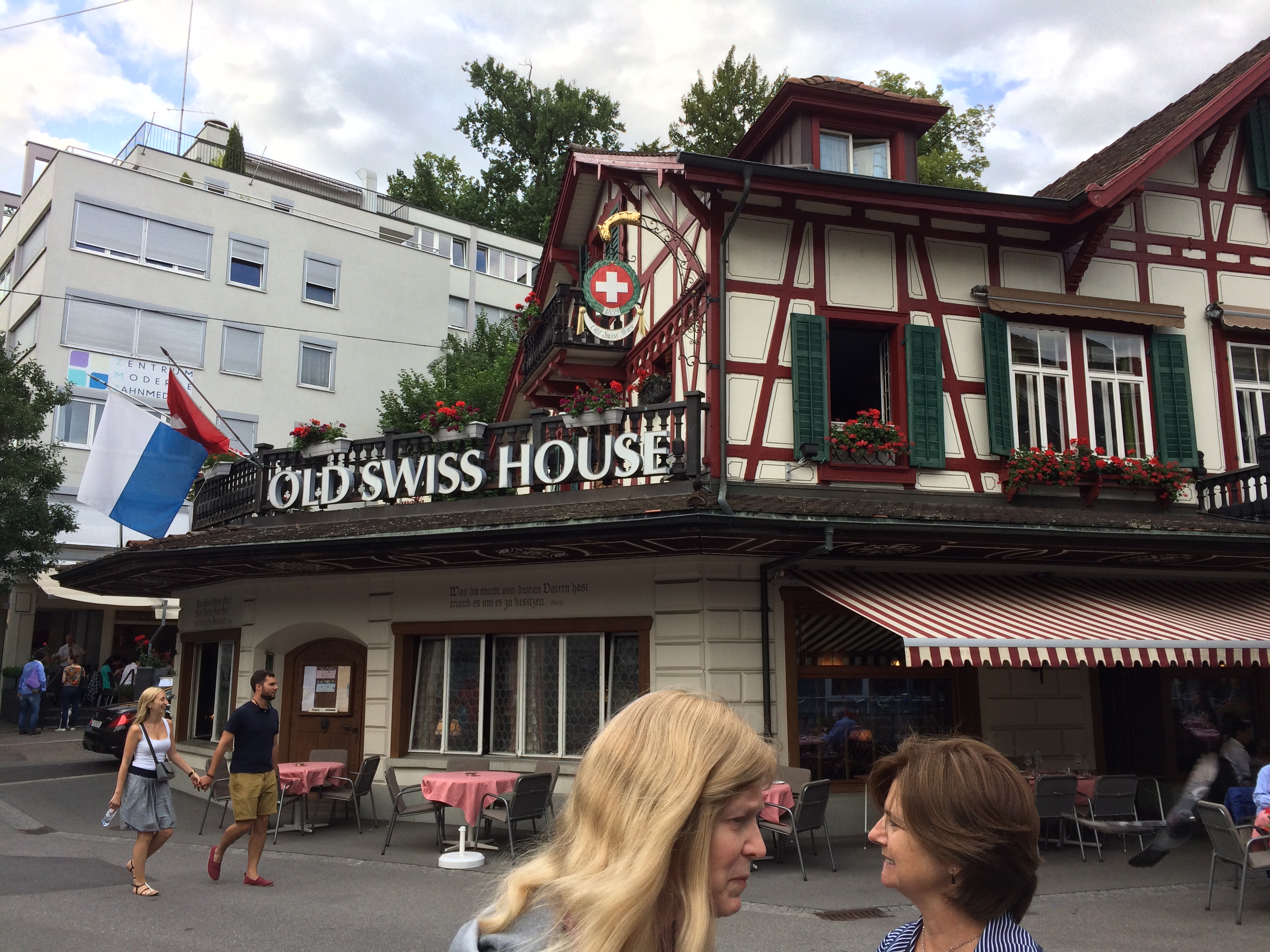
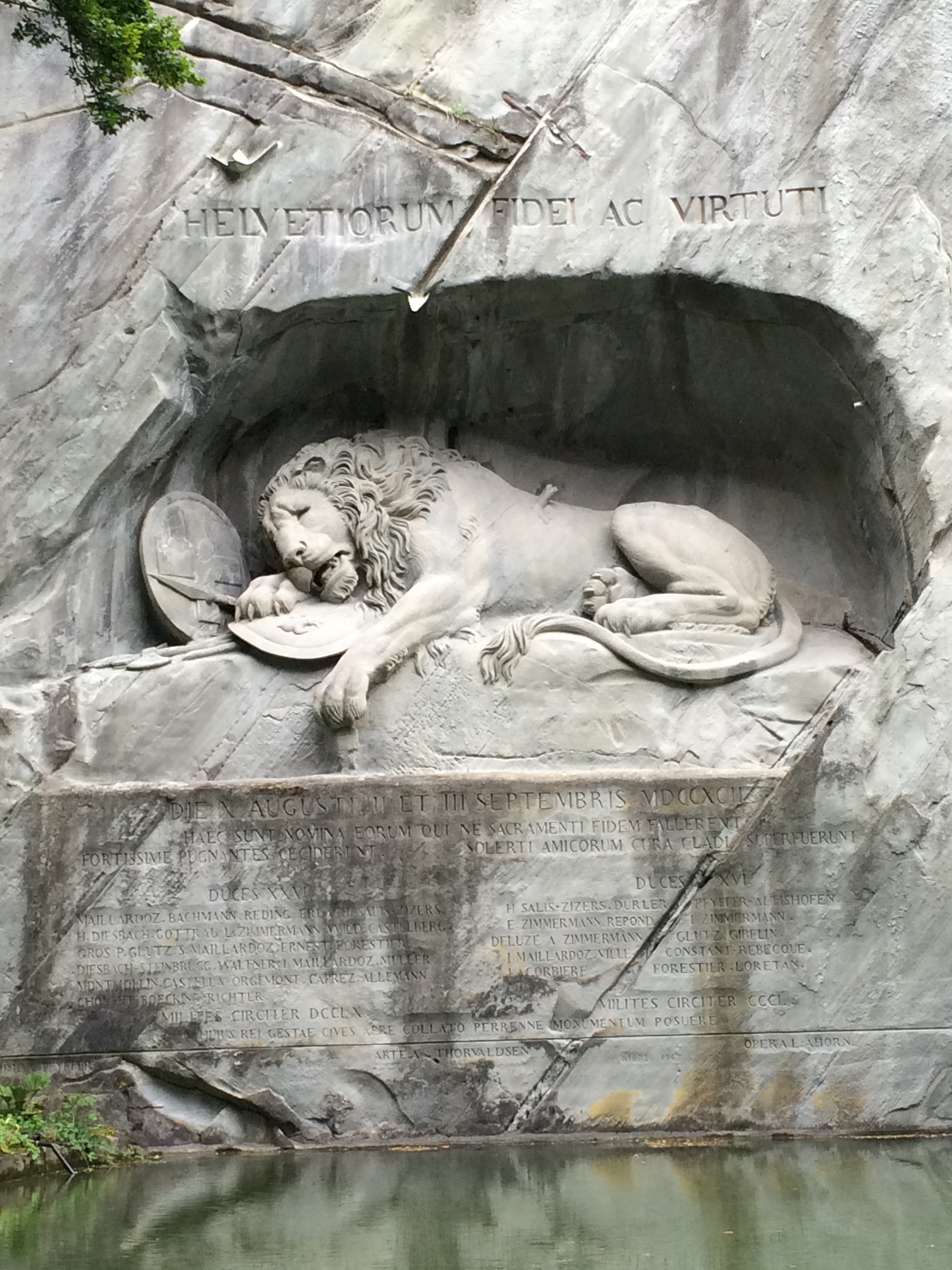
Another end of the spectrum is The Old Swiss House Restaurant (LINK), a revered tourist restaurant near the famous Lion Sculpture in Lucerne (LINK), just a couple of blocks off of the lake. Six of us tried to get a table one evening after visiting the sculpture and were told that they were full and referred to another very nice restaurant. So we made a reservation for the next night on the spot. So don’t go here for dinner without a reservation.
The building is historic and very picturesque, inside and out. The service is formal and competent. Eating here is like going back in time to a more formal era. There is a specials menu and a regular menu. Entrees run 40 to 55 Swiss Francs; appetizers from 14 to 25 Swiss francs – $$$$ level.
The wine list is deep, rich, and amazingly varied (and a bit disorganized). Along with the local wines of Switzerland, they have a wonderful selection of the finest French Burgundies and Bordeauxs (with about 15 Chateau Mouton-Rothchild First Growths on the list), plus some great Italians and even an Australian Penfold’s Grange (1996). These high-end wines are very reasonably priced, mostly at or below what I have seen them at retail, but still hundreds or thousands of Swiss francs per bottle. We opted for a Swiss Chardonnay that complimented my lobster over pasta dish perfectly – light, high in acidity, with notes of pear and grass on the nose, and almost no oak.
Restaurant Lapin (LINK) is a French/Swiss place with excellent service and a warm atmosphere. It is family run (the same family that runs the small hotel of which the restaurant is a part). The wine list is Swiss and French, with some nice selections, but not very adventurous. We opted for an old friend, a 2010La Haute-Smith Burgundy Red Blend (LINK). We visited the chateau in Pessac-Leognan (LINK) in 2013 and enjoyed their wines very much. This one did not disappoint – the Merlot/Cabernet blend was rich, lively, and laced with dark fruit. Very nice.
The Globus Department Store’s basement is a gourmet food and wine market that is simply amazing. The wine department has a very good selection of wines and spirits, with an emphasis on Swiss and Italian wines, but with selections from all over Europe. There were wines for tasting as well, and Dorianne and I tasted nice wines from Portugal and Spain, and bought a bottle of the excellent Spanish tinto from Ribero del Duoro for our upcoming Rhine River cruise.
I am sure that we just scratched the surface of the wine scene in beautiful Lucerne during our three-night visit. As a wine lover, it is a good place to visit.

 hat is why we were so happy to discover Ristorante Italiano Epicuro (no website, LINK to FB page), an oasis of fine Italian dining with a small, but welcome list of Italian wines – a regular list and an artisanal list with a total of about 30 wines. Stepping in off of Calle Guerro into number 319 one is transported, if not to Italy, to a sophisticated setting that could be in any major city. The decor consists of light green walls, very high ceilings, with a portion that has a retractable roof for this climate, scenes of things Italian on the walls, and nicely appointed tables. There are not a lot of restaurants in Oaxaca that are not oaxaqueña, so there are really few guidelines for how to handle the mix of cultures in terms of food and decor. Ristorante Italiano Epicuro goes purely Italian on the food and a more general upscale look on the decor.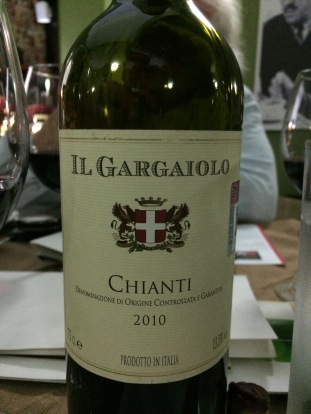
























































 Jim Lockard On Wine