Tag Archives: blog

TWO WINERIES TO VISIT IN SANTA BARBARA COUNTY

Recently, Dorianne and I visited two very impressive wineries in Santa Barbara County with friends. The purpose of the trip was to scout locations for a wine tasting tour to benefit a non-profit organization. We tagged along to be of any possible assistance!

The first winery, Presqu’ile Vineyard & Winery (LINK), is located in the Santa Maria Valley AVA (LINK) near the Bien Nacido vineyard in northern Santa Barbara County. A family run operation set on a beautiful 200 acre  vineyard property and boasting some amazing architecture, Presqu’ile (pronounced press-KEEL; it means penninsula) focuses on Pinot Noir, Chardonnay, and Sauvignon Blanc. The beauty of the tasting room, cave, and winery seem beyond what one finds at a vineyard & winery operation producing only 1600 cases per year.

Matt Sobczak, the Tasting Room Manager, conducted our tasting. The wines that we tasted were very good, even exceptional in the case of the Chardonnays; and the Pinot Noirs were a close second. The Sauvignon Blanc was also very good. The 2013 Steiner Creek Vineyard Chardonnay was particularly good, with a rich mouth feel, ample green fruit on the nose and palate, and a pleasant finish. We bought a bottle to share with some cheese and snacks after the tasting, and several of us bought more to take home.

The 2014 Presqu’ile Vineyard Chardonnay is also beautifully crafted and should please those who love the traditional California-style Chardonnays in a slightly less oaky, more modern form.

Dieter Cronje is the wine maker at Presqu’ile. We did not meet him, but I will laud his talents in crafting Burgundian-style wines with a California influence. Presqu’ile wines can be ordered from their website (LINK) and the winery is worth a visit and not far from other wineries off the 101 Freeway.

Our next stop was Pence Ranch Vineyards & Winery (LINK), along Route 246 West in Buellton, California in the Santa Rita Hills AVA (LINK). As I have noted before (LINK), the Santa Rita Hills AVA is unique in that the mountains and valleys run east to west due to a geological anomaly – the AVA is on land not connected to the North American Tectonic Plate. The Pence Ranch property is relatively narrow and runs north from Route 246 West, just west of the part of Buellton made famous in the film, “Sideways.”

Josh Hamilton was on duty in the small, but nicely appointed tasting room (open only by appointment for now). There is also another area adjacent to the tasting room that can accommodate more visitors. Pence has a relatively small production, under 1500 cases, and is expanding into a second label for restaurants. The Pence labels represent depictions of images of freedom and coins from the founding of the United States.

For our tasting, Josh poured the Pinot Noirs first, then the Syrah, and only then the Chardonnays. The reason for this is that the Pinots are elegant by California standards, as is the Syrah. The two Chardonnays are rich and fuller-bodied, yet still retain a sense of elegance. So, this unconventional tasting pattern – reds first – makes sense at Pence Ranch Winery.

The wines at Pence are exceptionally well-crafted. The Pinots are a bit spicy and peppery, but hold their soft fruit on the nose and in the mouth. They are very well-balanced and will work sipping alone, with light cheeses, or with foods such as salmon or vegetarian dishes.

The Chardonnays, both single-vineyard as are the Pinots, are rich yet very smooth. There is an oakiness present, but it does not dominate. The mouthfeel has a nice viscosity and there are many layers to both wines – great complexity here. All the Pence wines (LINK) are well-crafted. Get your hands on some if you can! We took away several bottles.

I am a huge fan of Santa Rita Hills wines, where the Burgundian style has been carried forward by such local legendary labels as Sanford, Clos Pepe, Ken Browne, LaFond, and others. Pence is establishing itself among those names – they produce Pinot Noirs and Chardonnays that reflect the Santa Rita Hills terroir very well.

I really didn’t find anything to complain about at either winery. The price points are a bit high, but they make sense when you understand the size and the quality of the operations at both vineyard/wineries. Both Presqu’ile and Pence are wineries worth your time if you are in the Santa Barbara County wine regions. And if you can’t visit, you can order their wines to enjoy at home.

As always, your comments are appreciated.


Copyright 2017 – Jim Lockard

A RETURN VISIT TO PASO ROBLES

Earlier this week, Dorianne and I spent a couple of days in the California Central Coast Wine Country with friends. We stayed at the KonTiki Inn, a mid-20th Century gem in Pismo Beach. Don’t try to reserve a room at the KonTiki online – you can’t. They have a website (LINK), but you can’t reserve there or on the other online hotel sites. It’s very retro, very well maintained, very inexpensive, every room has an ocean view, and it’s very comfortable.

On Monday, we drove up to Paso Robles and visited three wineries. The first was Peachy Canyon (LINK) on Paso’s West Side. The tasting room is picturesque – they have been around for a while, since 1988 – and their wines are very drinkable. There is a nice selection of clothing and wine stuff in the tasting room shop. The $10 tasting fee is waived with a two-bottle purchase. Peachy Canyon is known for their Zinfandels, but their whites are also worth a look, as well as their other reds.

Next, we went over to Paso Robles’ East Side, to Sculptera Winery & Sculpture Garden (LINK). This was my first visit to Sculptera, even though I have been to Paso Robles many times. The first thing that you notice about Sculptera, after passing through the vineyards, is the amazing front sculpture garden. Here is a sample of what is there – there is another garden behind the tasting room.

Inside, the tasting room is nicely appointed, with more sculptures, including miniature versions of some of the larger sculptures. At this point, my suspicions were aroused – how often does an impressive winery and tasting room that clearly cost millions of dollars produce mediocre and overpriced wines?

Well, Sculptera is not in that category. The wines were uniformly excellent – so much so, that all three couples – all knowledgeable about wine – ended up joining the wine club. As I write this, two cases of their wines are on the way to our temporary residence, Roam.co (LINK), in Miami. And the tasting room staff was knowledgeable and very good at what they do. Their wines are priced from the low $20’s to $60.

Several of the wines on the tasting list (8 wines) were exceptional, including the first one poured, the newly-released 2015 Viognier, one of those whites that hits your palate and you instantly know that it is exceptional; it has everything you want, a rich bouquet – floral with hints of minerality; a slightly viscous mouthfeel; lots of green fruit and levels of complexity; and a smooth and very pleasing finish. At $26 retail, this wine is a bargain. Other highlights were the 2013 Pinot Noir, which was peppery and earthy, but the fruit held its own (yes, a good Pinot Noir from Paso Robles); the 2014 Primitivo (and the 2013 Primitivo Reserve, which was not on the list, but was poured for us), a big wine that also showed complexity and balance; the 2012 Merlot, also nicely balanced; and the two blends we tried, 2013 Figurine (45% Cabernet Sauvignon, 42% Primitivo, & 13% Merlot), and the 2013 Statuesque (38% Cabernet Sauvignon, 34% Syrah, 28% Petite Syrah). There is also a second label called Héroe Wines, which are also very good as well, and they honor the workers who produced it on the labels, front and back.  So many good wines.

photo-jan-02-4-11-41-pm
The Gang at Sculptera’s Wine Tasting Room

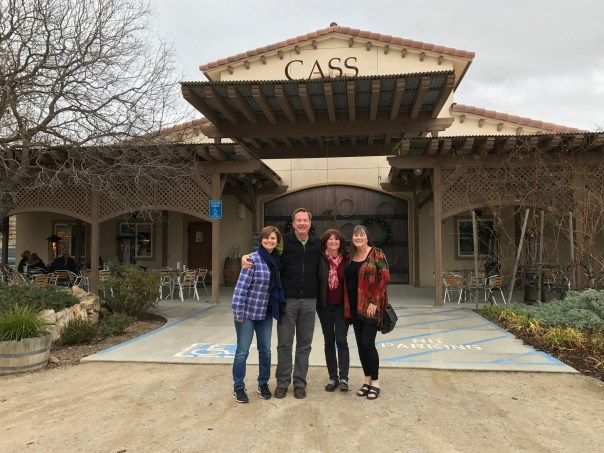
Our final stop was at Cass Winery (LINK), where we had lunch from their excellent kitchen. We did not do a tasting here, but had glasses of wine with lunch. Cass produces very good Rhône-style wines, and their whites – Rousanne & Marsanne and the blend they make with them are superior. It is a great lunch spot with indoor and outdoor seating and a very convivial atmosphere in the tasting room.

photo-jan-02-3-12-16-pm

Paso Robles is one of the most interesting wine regions in California right now. There are some wineries that have been around long enough to develop some great wines, there are some who are very nearly at that point, and there are a lot of very innovative things happening with interesting varietals and new viticulture and wine making techniques. A great place to visit.

The next day, we drove south to the Bien Nacido area and the Santa Rita Hills AVA to visit two very interesting wineries – more about that in the next post.

Copyright 2017 – Jim Lockard

EXPENSIVE WINE IS NOT A RIP OFF

I was going to let 2016 end without a new post, but then I came across and excellent article at VinePair.com (LINK to Article).

The article by Keith Beavers, is entitled “The People Calling Expensive Wine a Rip-Off Are Lying to You.” It is a thoughtful look at a recent trend in the wine media world – the trend of attacking wine experts, the folks who are highly trained in all aspects of wine  and who often recommend expensive wines to their readers. This would include people such as Robert ParkerJanis Robinson, and Eric Asimov.

Here is a sample from the article (I highly recommend that you read the entire article via the link above):

“The pleasure of “taking down” the wine industry is certainly understandable. There’s something devastating about knowing that other people are able to appreciate something that we can’t. It’s especially unsettling to know this about something we imbibe regularly, yet know we are not fully experiencing. There’s something mystical about wine – all those mouthfeels and blueberries and leather. What could be more delicious than to find out that those shamans, those mavens with their alienating knowledge, were nothing but charlatans, snake-oil peddlers whose knowledge was all a hoax?”

Now this blog is, if anything, a voice urging greater appreciation of wine without all the pretense. I have tried to simplify purchasing and enjoying wine, and generally removing the intimidation factor that many feel when confronted with a complex wine, a point system they do not understand, ridiculously mellifluous tasting notes, or a price tag in the hundreds of dollars.

But I have never said not to read the experts. I am self-taught in all things wine (meaning that I have never taken a wine course for certification; I have taken a few seminars) as is Keith Beavers, the author of the VinePair article. Like him, I learned, in part, by reading the experts. Unlike the experts, I am not doing regular tastings of dozens of Bordeaux or Burgundy wines. I have not tasted wines from dozens of other vintages to compare with what I am tasting now (although that is changing over time). So I count on the experts to be guides, although I am not a slave to their guidance.

A good point in the article is the difference between the typical European and American wine consumer:

“Then there’s the fact that there is just so much wine out there. It makes choosing and understanding each bottle that much more difficult. This is especially true here in the United States, because we are not a culture that grew up with wine. Wine in the U.S. is a relatively young culture, and though we want to understand wine, we’re very new at it.

“Compare us to Europe, where drinking wine is such an integral part of the lifestyle,  a part of the attitude. In the rural wine regions of Europe, you don’t go to a wine store and choose a bottle from a selection of 10,000. You live in a specific region that grows one kind of grape best, and the wine that comes from that grape is what you drink, probably every night with dinner. The soil itself determines what wine people drink, and they grow up with a specific varietal like mother’s milk.”

Americans face a huge variety of regions, varietals, wine growing techniques, wine making styles, terroirs, additives, and more when deciding which wines to purchase. The advice of experts is one pathway to take toward greater understanding, but they are never a substitute for trying things yourself and discovering what you like and enjoying yourself along the way.


As to expensive versus inexpensive wines, there are reasons why some wines cost more. And there are reasons why many people prefer cheaper wines, even in taste tests with more expensive wines. Again from the article:

“. . . people with less experience drinking wine tend to enjoy cheaper wines. It’s not because wine is one big hoax. It’s rather because their first experiences with wine were probably with cheaper wines, and cheap wine is manipulated to taste the same every year. There’s no inconsistency, no terroir. It’s homogenized, for a very simple reason: We are a culture that likes sweet things. When you’re drinking a really cheap wine like Yellowtail or Trader Joe’s Two Buck Chuck, you’re drinking a wine that has added sugars and added coloring so it tastes the same every time you buy it. And it’s wine experts who teach us how to move past these wines, and how to enjoy the more expensive stuff.”

In my experience with expensive wines, which is somewhat limited I admit, once you get to about $50 per bottle, you can expect an excellent wine and will often get it. I have drunk and tasted wines that cost $250, $500, even $1000 or more. At those price points, if the wine is old, every bottle is unique, and the more refined your palate (LINK), the greater your experience. There is also a certain mystique in knowing that you are drinking say, a 1982 Chateau Lafitte-Rothschild, which I have had the pleasure of drinking. What is that mystique like? Think of driving a Rolls Royce versus a Nissan – both will get you there, but the experience of the Rolls will be different. In fact, just knowing it’s a Rolls makes a difference.

For me, wine appreciation has been a slow but certain road toward wines that are well-crafted and which have different characteristics from year-to-year. I drink or taste from at least 500 bottles per year (considering that a day of wine tasting can mean 20 or so different wines). Maybe 40% of those are wines I have had before – at least the label is the same, although the vintage may not be. I would say that the average price per bottle of the wines I drink has gone from $10-$12 a dozen years ago to $25-$28 now. Over that time, my tastes have changed, my palate has improved (intentionally), I have read and learned more about wine in general and have experienced a greater variety of wines.

So I recommend that you read Eric Asimov’s Wine Columns in the New York Times (LINK), especially his wine school columns. Get yourself a copy of Janis Robinson’s Oxford Companion to Wine (LINK) or borrow it from the library. Read Hugh Johnson’s A Life Uncorked (LINK) or A Pocket Guide to Wine (LINK). Or, go through the Amazon listings of wine books (LINK) and find something that appeals to you. Read Wine Spectator or Wine Enthusiast Magazines. And, this blog!

If you are a wine lover, or aspire to be, my suggestion would be to enter 2017 with the intention of deepening your knowledge and expanding your experience with wine. Your life will be richer for it.

Copyright 2016 – Jim Lockard