I have never had the opportunity to try the same wine with different seals. Here is an interesting article from Jamie Goode’s Wine Blog. Follow the link below.

LINK: Cork or Screw Cap?
I have never had the opportunity to try the same wine with different seals. Here is an interesting article from Jamie Goode’s Wine Blog. Follow the link below.
LINK: Cork or Screw Cap?
As we plan for the US Thanksgiving next week, the topic of what wines to drink is always a challenge. There are a couple of reasons for this. First, Thanksgiving Dinner tends to last for hours of prep time, appetizers and snacking, football, the dinner itself, then desserts, etc. Eric Asimov of the NYTimes recommends going with wines that have less alcohol, given that you may be imbibing over a longer period of time.
Second, the kinds of foods served in many American homes runs a much wider gamut than on a normal day. I mean, how may other days do you serve sweet potatoes with marshmallows? So there are sweet and savory dishes on the table, plus whatever else has been laid out during the day. In Maryland, where I grew up, there was usually a bushel of fresh oysters in the garage or on the back porch from mid-morning on. By the time you get to the fruit and pumpkin pies, you have eaten a variety of foods.
So here are some ideas for wines – not specific wines, but varietals that will tend to serve you well with the chaos and wide variety of foods that you are likely to be served (or are serving). I also recommend less expensive wines for this day, unless you are having a relatively simple meal. Good wines can get lost in the mix of everything from those sweet potatoes to sauerkraut, to green bean casserole to well, whatever.
You will want red, white, and some bubbly for the day. Bubbly? Well, why not? Sparkling wines can be great for earlier in the day (like with those oysters) and for a toast to begin the main meal. Some of your guests may well prefer to have sparkling wine with dinner as well. I recommend Spanish Cava – very accessible both in terms of price and it’s flexibility to go with a variety of dishes. There are also some great California sparklers if you want to stick to American wines on this most American of holidays. Sparkling wine is great with dessert, as you do not want to add more sweetness to the end of a meal like this one!
As for whites, I think that this is a day for Sauvignon Blanc, Chenin Blanc, Torrontes, and Albarino. All of these are light, low in alcohol, and versatile. There are dozens of Sauvignon Blancs from California, France, and New Zealand that will fit your budget. The New Zealand wines will tend more to citrus notes, while the French produce wines with more floral notes. The Americans can be either – so ask you wine merchant if you have a preference for one style or another. Chenin Blanc is a French gem that is also becoming more and more popular with US growers up and down the west coast. Torrontes is the top white wine of Argentina, light and crisp and affordable. Albarino is a Spanish beauty that translates well with anything from fish to poultry. I think that you will be happy with any of these varietals on your holiday table.
Looking at reds, we want to keep the alcohol on the low side, which makes it tough to purchase most California wines that are in the affordable range (under $25 a bottle). You can find some Pinot Noirs and Merlots that fit the bill, but you may have to do some searching. Actually, I think that your best answers are France and Argentina or Chile. French Beaujolais is an excellent choice. The wines tend to be lighter, lower in alcohol, and there are a number of good wines in this category that are priced right. Malbec from Argentina can range from lighter to heavier; the lighter versions are great for the holiday table, as are some of the Malbecs being produced in California’s Central Coast reason. Chilean Merlot is a great bargain, just watch that alcohol level. I recommend a variety of reds and whites – let your guests explore.
I would figure a bottle per person, plus any other beverages that you will be serving. Of course, you can also have a similar approach for your Christmas Dinner, which in the US is often a repeat of Thanksgiving. If you are having a beef or pork roast, you may still want white and sparkling wines for earlier in the day or with dessert.
Have a wonderful Thanksgiving Holiday and let me know you Holiday wine recommendations.
From Esquire Magazine – Link
“Aldo Sohm, the aptly named wine director of Le Bernardin, was the 2008 winner of the “Best Sommelier in the World” award given by the World Sommelier Association. He is the man. We talked to Aldo to ask for some basic tips for a guy that wants to buy a bottle of wine at the store and doesn’t know anything beyond “it should cost more than $15.” (Which, by the way, is not bad advice as far as it goes.)”
This from Food & Wine Magazine is a good addition to my earlier post on buying wine in restaurants.
Link to Food and Wine Article.
Link to Previous Post on JimLockardOnWine.
Good drinking!
Dorianne and I like to host special wine-related dinners once in a while. The idea is to get some people interested in wine together, to have some good food, to have some interesting wines, and to engage in conversation beyond the ordinary. We have found that the wine can aid and abet this kind of conversation.
Not to talk endlessly about the wine itself – you know what I mean – but to tell a story in which the wine is a character and see where that leads. I will write about a couple of those dinners here.
Your theme is important. One was “Bring the bottle that you have been saving for a special occasion for ten years and the special occasion has never happened; or it did happen and you couldn’t part with the wine.”

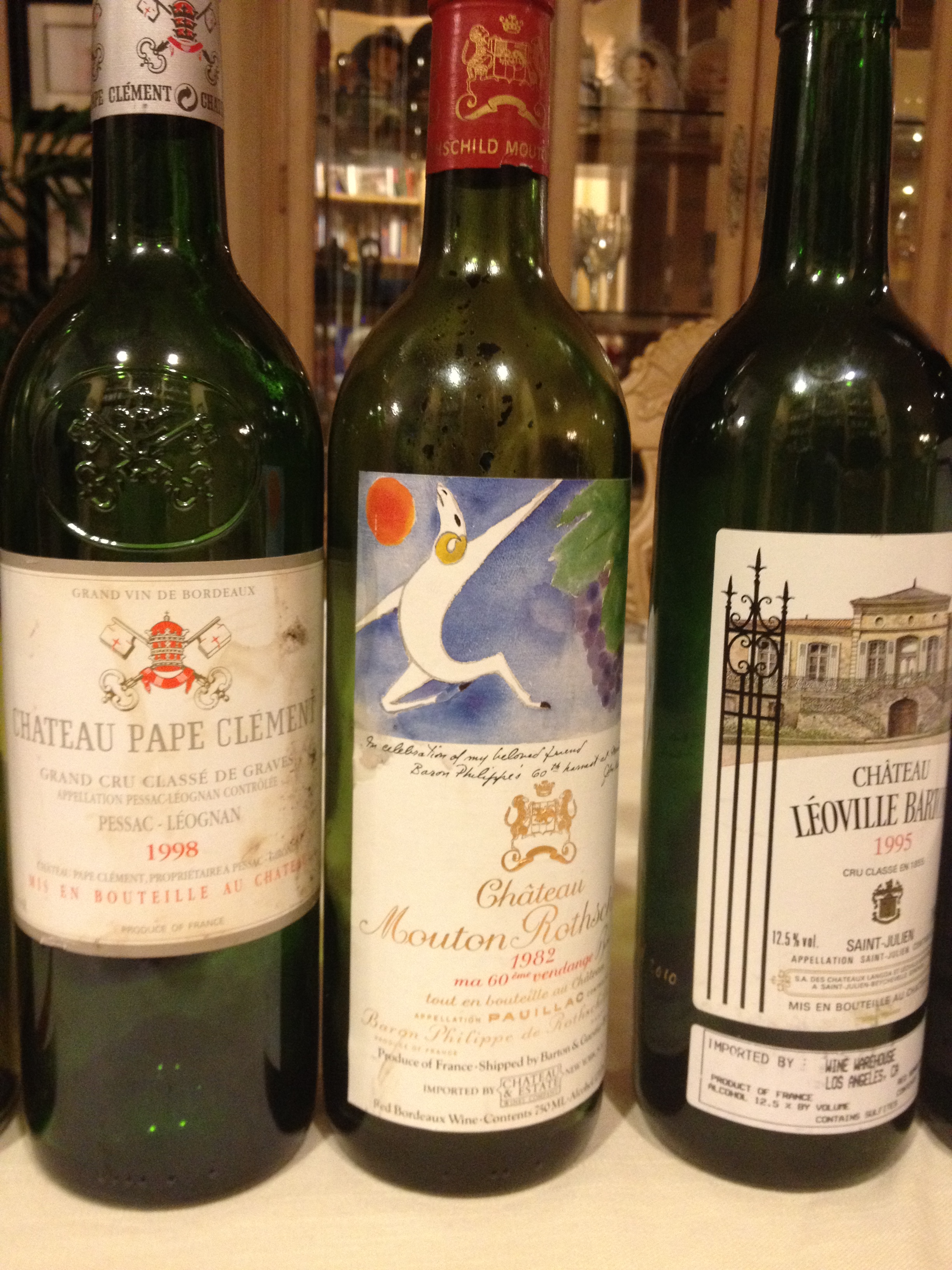
Five couples and one single attended, each bringing their special wine and a dish to go with it. Dorianne and I supplied the main course. Each couple would share how they obtained the wine, and any special story that went along with it. We ended up with nine wines. Oddly enough, only one was a California Wine. The highlight was a 1981 Chateau Mouton Rothschild, and there were fabulous wines from Australia and Italy. We provided a number of decanters for the wines – the evening was memorable on many levels.
A few months ago, we hosted a “Bring a Wine with a Great Story” dinner. Four couples and a single friend brought food and some wonderful wines to share. The dishes ranged from pâté and melon and prosciutto appetizers to Tuscan chicken with side dishes of chickpeas and rabe and a green salad, to home-made peach pie and chocolate cake for dessert (there were two birthdays in the group). The wines ranged from the Chateaux Margeaux Premier Cru to an Il Borro Tuscan red Bordeaux Blend, to a Central Coast Pinot Noir to another Tuscan red just obtained on a trip to Italy. One friend had just flown in from British Columbia and brought two bottles of ice wine – a Merlot and a Riesling.
We have also hosted dinners where you bring your favorite red or white under $25, or bring a specific varietal from a certain appellation. The idea is just to provide a theme that the meal and the experience can be built around.
The joy of such occasions is to share food and wine with people who appreciate both. The stories about the wines inevitably lead to other stories – about family, travel or just about anything. We share the experience and, if the evening is a true success, the wine fades to the background and the connection come to the fore.
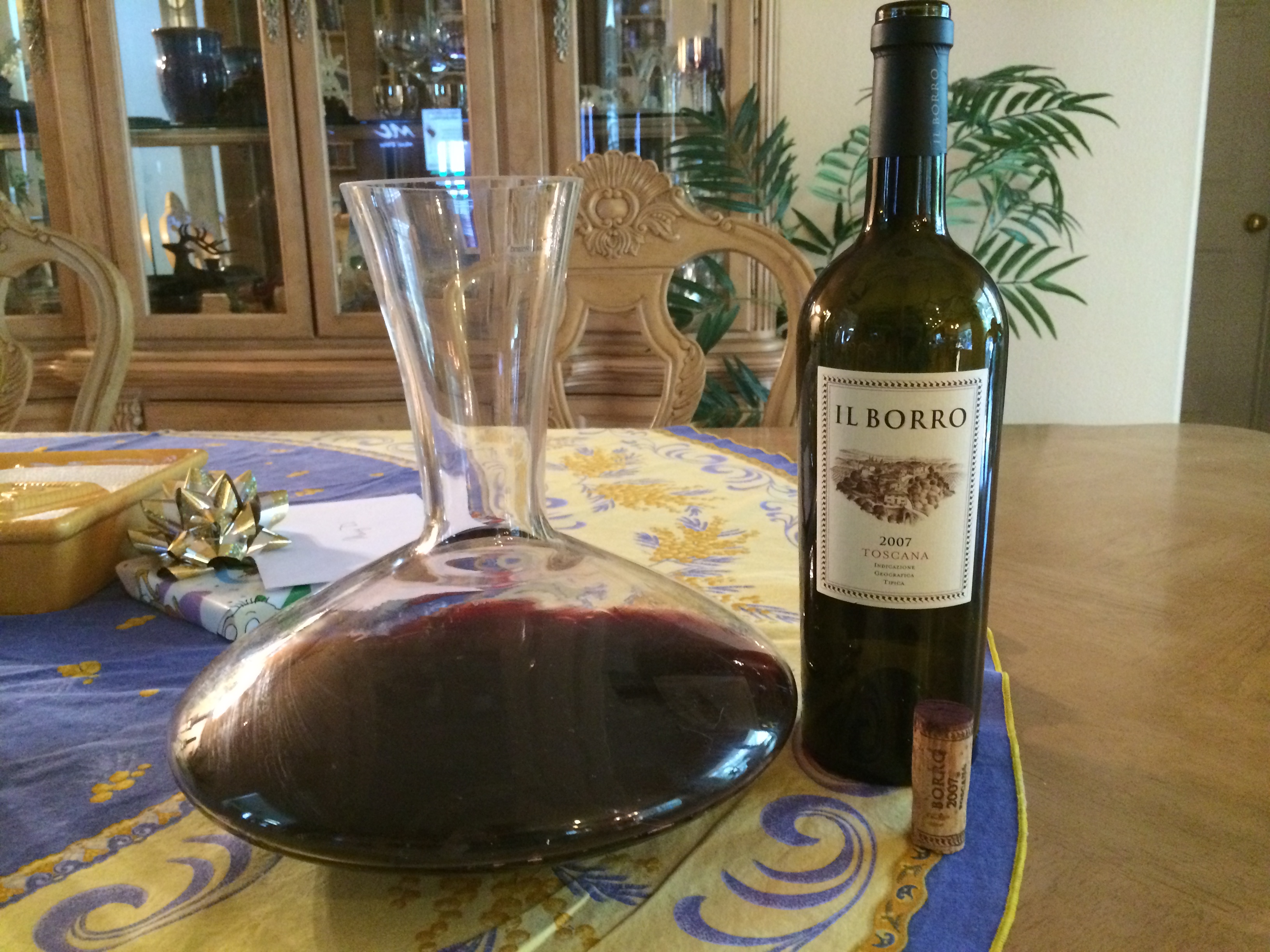

Later, the coffee is shared and the dishes are done, and people depart having experienced a memorable evening that itself becomes the next story.
To plan your own special wine dinners think “Theme – Story – Invitation List – Wines – Food. Make a plan and find creative ways to invite people and to share the idea. If guests bring a dish to share, there is less work for the hosts, and more involvement in the whole experience by everyone. Have fun!
Another article based on research showing the overall benefits of drinking wine.
Here is a salient quote: “The weight of the evidence shows moderate drinking is better than abstaining and heavy drinking is worse than abstaining – however the moderate amounts can be higher than the guidelines say,” Dr Poikolainen reportedly told The Mail.
What are your thoughts on this?

Tonight for dinner, we had a 2008 Sangiovese from the Conejo Valley Wine Co-op. This wine was made before Dorianne and I joined. We were gifted two bottles by our winemaker, Richard Clark, after a former member turned some wine back to the co-op.
From Wikipedia: Sangiovese (san-jo-veh-zeh[1] [sandʒoˈveːze]) is a red Italian wine grape variety that derives its name from the Latin sanguis Jovis, “the blood of Jove“.[2] Though it is the grape of most of central Italy from Romagna down to Lazio, Campania and Sicily, outside Italy it is most famous as the only component of Brunello di Montalcino andRosso di Montalcino and the main component of the blend Chianti, Carmignano, Vino Nobile di Montepulciano andMorellino di Scansano, although it can also be used to make varietal wines such as Sangiovese di Romagna and the modern “Super Tuscan” wines like Tignanello.[3]
Sangiovese was already well known by the 16th century. Recent DNA profiling by José Vouillamoz of the Istituto Agrario di San Michele all’Adige suggests that Sangiovese’s ancestors are Ciliegiolo and Calabrese Montenuovo. The former is well known as an ancient variety in Tuscany, the latter is an almost-extinct relic from the Calabria, the toe of Italy.[4] At least fourteen Sangiovese clones exist, of which Brunello is one of the best regarded. An attempt to classify the clones into Sangiovese grosso (including Brunello) and Sangiovese piccolo families has gained little evidential support.[5]
The wine was simply amazing – elegant, with a nose of fruit and spice, smooth in the mouth and clearly a wonderful wine. Kudos to Dennis Weiher, our former winemaker for this one!
For more info on our wine co-op, go to this link.
Last night, Dorianne and I got together with Richard Clark and Mary Stec to participate in the New York Times Wine School. The Wine School is a monthly look at different varietals written by Eric Asimov, the Times wine writer. The purpose is to take a deeper look at various varietals and to actually drink the wine, rather than just taste it. Richard, as I have mentioned in other posts, is the winemaker for the Conejo Valley Wine Co-op that Dorianne and I belong to.

We have done the previous Wine School varietals, usually two at a time, with Richard and Mary. We decided to do the Zinfandel, from July, on its own. Appetizers were gathered (baguette, prosciutto, goat and cheddar cheeses, smoked fish, and marinated peppers), and the main course – an AMAZING chicken mole with black beans and rice, was prepared by Mary (she and Richard used to import mole from Oaxaca in Mexico, so she knows her stuff).
Anyway, this is really about the wine. The Wine School always recommends three choices for the varietal of the month – wines that are likely easier to find in New York than in California in most instances. For the Zinfandel Wine School, Asimov recommended three wines: a Dashe Dry Creek Valley Zinfandel 2012 $21, Turley California Zinfandel Juvenile 2012 $30 and Ridge Dry Creek Valley Lytton Springs 2011 $35. Well, we didn’t have any of those, so we used two wines and had a back-up standing by.

Our wines were a 2009 Grgich Hills $34, a 2009 Caymus $45, and a 2011 Moss-Roxx Ancient Vines $20, the latter remaining unopened.
Zinfandel has been in California since the early 1800’s and originally came from Croatia, where it is called tribidrag. I understand that it is also the same grape as primitivo in Italy, although there is some controversy about that.
Zinfandel, like all varietals, can show up in a variety of ways, influenced by everything that wine is influenced by – climate, weather, soils, sun and temperature, viticulture, wine making practices, ageing, etc. However, in general, the wine falls somewhere between Cabernet Sauvignon and Pinot Noir on the heavy to light red wine continuum. I find that Zin and Syrah can be very similar in tone and texture. It is normally great with meats and grilled foods. There are also some very interesting non-traditional Zinfandel blends showing up in places like Paso Robles.
The Grgich Hills and the Caymus were very different wines. The alcohol content was equivalent – 15.3% and 15.2% respectively, but the style was very different. The Grgich Hills was soft and elegant and the Caymus was big, bold, and heavy – definitely a Robert Parker kind of wine.
Fortunately, we opened the Grgich Hills first to have with the appetizers. It was a perfect complement to the prosciutto and cheeses and the other items. Elegantly balanced, the wine had spice notes, pepper, and fruit present. Delicious.
The Caymus was something else. Heavier, almost syrupy on the tongue, it was a fruit bomb. Fortunately, that was what the chicken mole required – something to stand up to the richness of the sauce and the greasy chicken. Richard preferred the Caymus to the Grgich Hills, I took the opposite position – although both are very good wines.

The alcohol level of these wines made opening the Moss-Roxx unadvisable. It is resting back on the shelf as I write, waiting for another day.
Zinfandel has its lovers and its detractors. I am generally a fan, although I don’t actually drink that much of it. Our co-op made a pretty good Zin in 2010 and our just-bottled 2012 vintage includes a Zin-Merlot blend that should be interesting.
Let me know what your favorite Zinfandels are and what your best food pairing experiences have been in the comments section.
As noted in my Philosophy of Wine entry, I drink wine almost every day with dinner. Dorianne and I drink 3 or 4 reds to every white or rosé, except in summer, when that ratio tends to be reversed.
I put reds into three basic categories – everyday, special dinner, and very special occasion. Everyday wines would run about $20 and under, special dinner from $20 to $50, and very special occasion from $50 and up. A bottle with a great story or one that is hard to obtain may put it up a category or two even though the price point is lower.
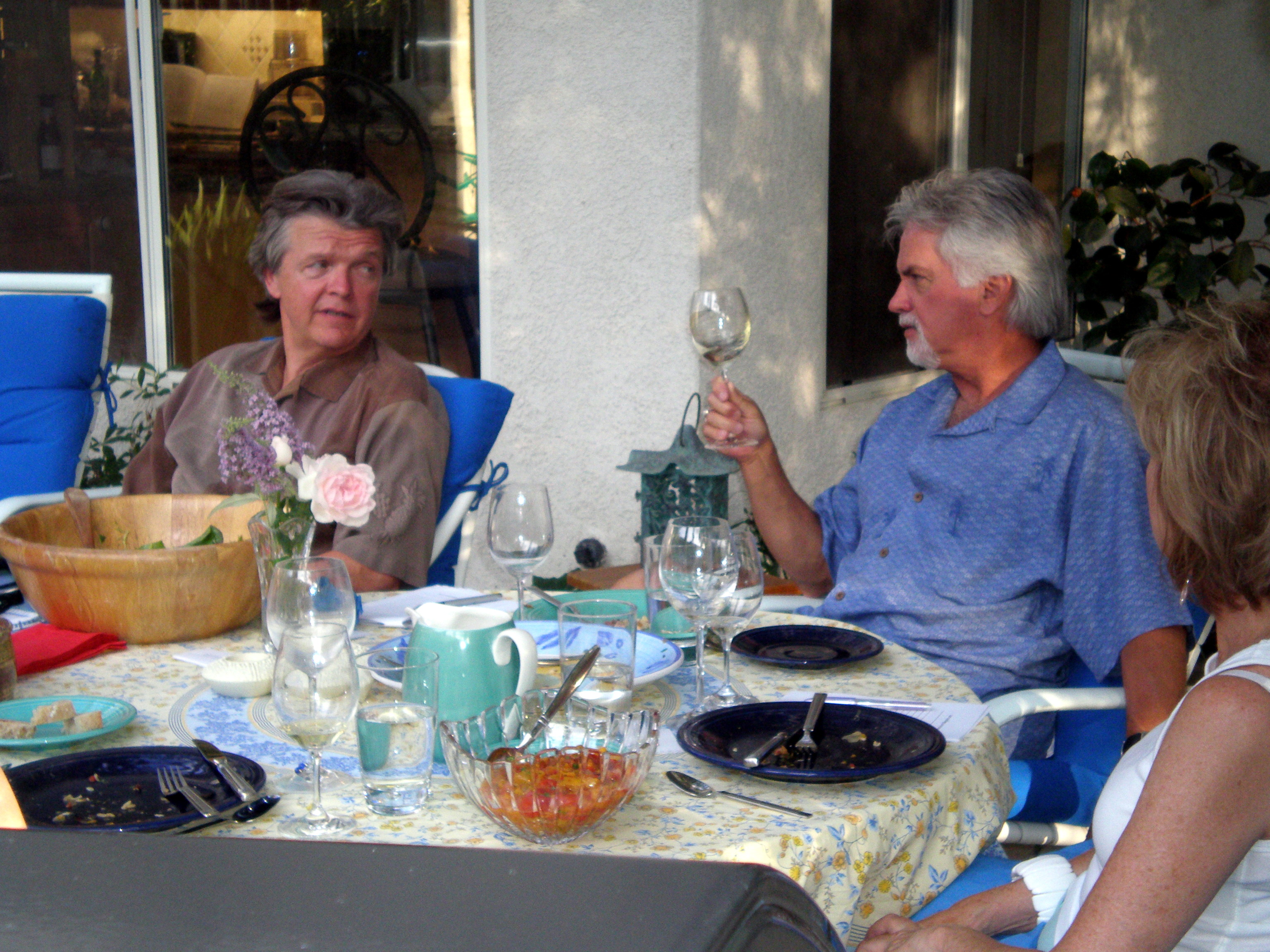
Everyday wines are the mainstay of our consumption. These are generally wines that we buy from local retailers or online at sites like WTSO.com. Occasionally, they come from a winery. We also have our wine co-op wines that fall into the everyday category. We get about 8 cases from our co-op share each year, 6 of red and 2 of white. I will not include the co-op wines in these reviews, because you cannot obtain them. We had a 2010 Petit Syrah/Cabernet Sauvignon on Monday night from the co-op.
So how do you choose your favorite everyday wines? I would begin with trial and error then move out from there based on a certain level of awareness that develops as to what to look for – certain varietals, wine makers, and price points. The trial and error comes first – you sample some wines. This can happen by purchasing at a retailer, or you can be a bit more creative.
When you are invited to a party, if they have lower priced wines, try some. See if you find any that you like and note the brand and varietal. In a restaurant, especially some chain restaurants, they will have inexpensive wines (at a markup no doubt) that you can try. Many wines under $15 is that they will stay very constant from year to year, so you are less likely to be surprised by a new vintage.
I like a variety of wines, so when I look for everyday wines, I am looking at a broad spectrum of wines, both domestic and international. You may be a Merlot or a Cabernet Sauvignon drinker, which narrows the field quite a bit. I like some variety and some signs of craftsmanship, even in my everyday wines. If you look around, you can find wines under $15, and definitely under $20 that have this quality. Here, you will find some variation from vintage to vintage, but that adds to the variety!
So let me start with two red wines that have, for me, been very reliable over time. They are under $15, both are imported, and each has a bit more to offer than the standard-brand or bulk wine product. The vintage will be whatever is currently available – it is unlikely that wine merchants are holding these for aging.
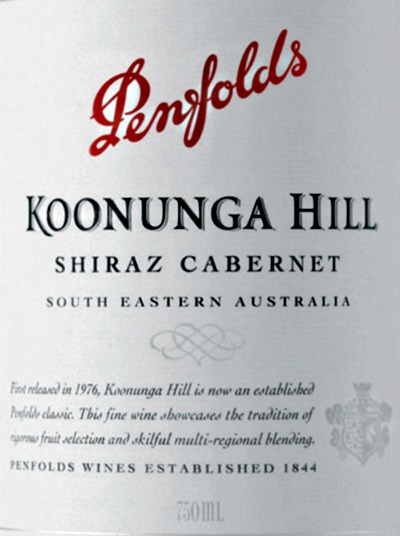
Penfolds Koonunga Hill Shiraz/Cabernet: I began drinking this wine in 2003. Penfolds is the flagship wine brand of Australia, makers of the legendary Penfolds Grange (which is near the very top of my bucket list) Shiraz wine. The Koonunga Hill label is second from the bottom in the Penfolds hierarchy – above the very pedestrian Rawson’s Retreat label. I have tried the Koonunga Hill Shiraz and the Cabernet as separate varietals, and find that the blending of these two grapes creates the most satisfying experience. The 2011 vintage is the most likely on to be on your retailer’s shelf. It is a 62% Shiraz 38% Cabernet blend (this will vary from year to year) and is 13.5% alcohol, which I prefer to the heavier levels of alcohol in may California everyday wines, which are usually just hot and not very well balanced. The Koonunga Hill Shiraz Cabernet is great with red meat and will hold up to BBQ sauces and spiced foods as well. The wine will age for 8 to 10 years, but this wine is not made to age, so drink it right from the shelf.
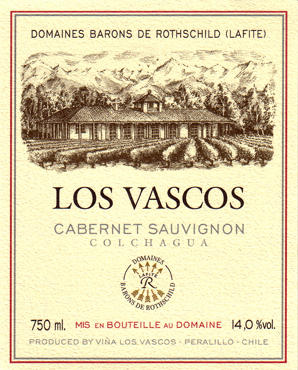
Los Vascos Cabernet Sauvignon: I came across Los Vascos when I was living in South Florida and it came with a great story. A friend was the supervising flight attendant on a private Boeing 727 belonging to the CEO of a South American subsidy of a large US corporation. The CEO was really into wine – he would send my friend on the plane to Paris to load on first growth Bordeaux’s and Burgundies – you get the idea. At the time, the Los Vascos (from Chile) was retailing for about $7. My friend gave her boss a glass on a flight and he really liked it (probably a good thing for her career). He then began to serve it on his plane to his high-roller friends and did not tell them what it was. Pretty much everyone took it for a premium wine.
So what is this wine? Well, it is a large production wine from the Chateau Lafite Rothchild vineyards in Chile. There are a couple of reserve versions of the wine that come in at higher prices – from about $20 up to $65. Today, the basic Los Vascos Cabernet retails for $14 but can usually be had for $10 to $12 or less from a variety of retailers. The website recommends decanting for about an hour before drinking this wine, although I have never done this. You will find notes of ripe fruit, good structure, and hints of a variety of mineral notes – which most of us experience differently. This is a great wine with roasted and grilled meats.
All three of these wines are what I like in an everyday wine. A few others that I imbibe fairly regularly are Bogle Old Vine Zinfandel ($9 to $12); Norton Reserve Malbec, Mendoza, Argentina ($14 to $20); Luigi Pira Dolcetto d’Alba, Piedmont, Italy ($12 to $18); plus many more. You have probably noted that most of the wines listed here are imported. For some reason, producers around the globe seem to be able to get well-crafted wines made and shipped to the US at everyday wine prices. It’s a paradox.
There are lots of decent wines in this price range – ask your wine retailer to guide you to those undiscovered gems in the shop – everyplace has some of these wines. As always, once you find what you like, begin to branch out and explore wines like those.

 Jim Lockard On Wine